
Most Arlington car owners overestimate what their vehicle is actually worth at trade-in. Not by a little either. The gap between what you expect and what a dealer offers often comes down to one thing: visible maintenance habits and the proof to back them up. The good news? Closing that gap doesn’t require expensive upgrades or a brand-new paint job. It takes consistent car care, a little organization, and a few Texas-specific habits that protect your investment from the inside out. This guide walks you through exactly where to focus your effort.
Table of Contents
- Why car care is the secret to higher resale offers
- What maintenance and repairs matter most for resale?
- How service records and documentation shape buyer confidence
- Texas climate tip: protect your car’s finish and interior
- Applying a resale mindset: how to prepare before listing or trade-in
- The overlooked payoff: how proactive car care pays back, even when you aren’t selling
- Take the next step: professional car care for Arlington drivers
- Frequently asked questions
Key Takeaways
| Point | Details |
|---|---|
| Documented maintenance matters | Well-kept service records can boost your car’s resale price by proving care. |
| Fix warning lights early | Address dashboard warnings to avoid costly negotiation deductions. |
| Prioritize routine care | Regular oil changes, fluid checks, and tire/brake inspections ensure higher offers. |
| Cleanliness lifts appeal | A detailed clean and small cosmetic fixes make a big difference at appraisal. |
| Protect against Texas weather | Sun and heat protection in Arlington prevents preventable value loss. |
Why car care is the secret to higher resale offers
Let’s cut straight to it. Buyers and dealers aren’t just looking at what your car is. They’re estimating what it could cost them after the sale. Every unresolved oil leak, flickering warning light, or worn set of brakes tells a story about risk. And risk means a lower offer.
Documented maintenance and repairs reduce uncertainty and can translate into higher trade-in or sale offers. Think of your service history as a character reference for your car. When a dealer or private buyer sees a folder full of receipts, they feel more confident. That confidence has real dollar value attached to it.
On the flip side, deferring repairs can hurt reliability and safety, which puts downward pressure on resale value because buyers discount cars that show evidence of neglect. Even one ignored issue can signal “what else didn’t they fix?”
Here’s a quick look at how consistent care stacks up against deferred maintenance at the point of sale:
| Factor | Well-maintained vehicle | Neglected vehicle |
|---|---|---|
| Service records | Available and organized | Missing or incomplete |
| Warning lights | None present | One or more active |
| Fluid levels | Full and clean | Low or dirty |
| Cosmetic condition | Clean, minor wear | Faded, stained, damaged |
| Likely buyer reaction | Confidence, higher offer | Skepticism, lower offer |
| Estimated offer impact | Higher baseline | Hundreds less |
“A well-documented car with no warning lights and clean fluids almost always closes faster and for more money than a similar vehicle with question marks hanging over it.” Think of your maintenance folder the same way you think about curb appeal when selling a house. First impressions matter enormously.
The practical takeaway here is simple. Before you even consider listing your car or heading to a dealer, follow a solid car maintenance schedule throughout your ownership. Buyers reward consistency. Dealers reward it even more.
Key habits that support a stronger resale position:
- Keep oil changes current and save every receipt
- Address any fluid leaks promptly, no matter how minor they seem
- Fix warning lights before they turn into bigger repairs
- Track tire rotations and brake inspections
- Log any major repair with the shop name, date, and mileage
These habits align directly with how to make your car last longer, which has a direct ripple effect on what it’s worth when you’re ready to move on.
What maintenance and repairs matter most for resale?
Not every repair has equal return on investment. Some fixes make a big difference to buyers. Others don’t move the needle much at all. Knowing which is which saves you time and money before you sell.
The most resale-relevant car care is what you might call “condition proof”: routine services like oil changes, fluid top-offs, and filter replacements, along with safety-critical items like tires and brakes, and cosmetic cleanliness done before any dealer appraisal or buyer inspection.
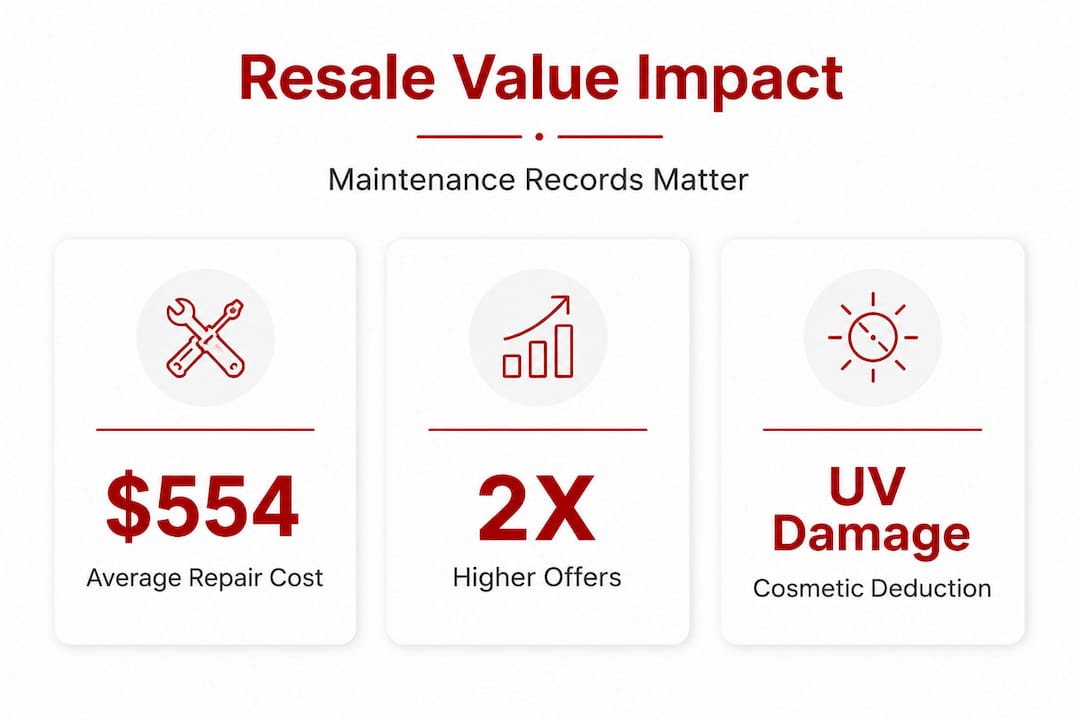
Record check engine repair costs hit new highs in 2025, with the average repair running around $554. That number is basically what a buyer will mentally subtract from your offer the second they see a check engine light glowing on your dashboard. Fix it first, and you keep that money in your pocket.
Here’s how different maintenance categories rank by resale impact:
| Maintenance category | Impact on resale | Typical cost to address |
|---|---|---|
| Oil change and fluids | High (signals consistent care) | $60-$120 |
| Tires (worn or mismatched) | Very high (safety concern) | $400-$800 |
| Brakes (worn pads or rotors) | Very high (safety concern) | $200-$500 |
| Check engine light resolution | High (triggers buyer fear) | $150-$600+ |
| Interior detailing | Medium-high (first impression) | $100-$250 |
| Minor dent or scratch repair | Medium (cosmetic value) | $75-$300 |
| Windshield chip repair | Medium (legal and cosmetic) | $50-$150 |
Pro Tip: Before you list your car or schedule a trade-in appraisal, run through a full car inspection checklist to catch anything that might trigger a buyer’s concern. A $60 oil change and a $50 interior detail can easily return two to three times their cost in a stronger offer.
Here’s how to prioritize your pre-sale repair list:
- Resolve any warning lights, especially the check engine light, right away.
- Replace tires if tread depth is below 4/32 of an inch; bald tires kill buyer confidence.
- Address brakes if you hear grinding or squealing; safety issues are automatic red flags.
- Top off or replace all fluids, including coolant, brake fluid, and transmission fluid.
- Detail the car inside and out, paying special attention to odor removal.
- Fix minor cosmetic damage if the repair cost is less than what the damage will knock off your offer.
- Replace burned-out lights; they make your car look unloved and can fail a basic inspection.
Following solid oil change tips throughout your ownership keeps the engine running clean and gives you receipts to show buyers you were serious about upkeep. And if you’re ever unsure which repairs to tackle before a sale, treat it like car service before a sale. The logic is the same: you want no surprises.
How service records and documentation shape buyer confidence
Here’s something most sellers underestimate. It’s not just the condition of the car that matters. It’s whether you can prove it.
Buyers are naturally skeptical. They can’t see your engine’s history just by looking at it. A clean exterior might mask years of neglected oil changes or skipped brake inspections. That uncertainty is what drives buyers and dealers to lowball. They’re pricing in the risk of the unknown.

This is why organized records are one of the most powerful tools you have. When a buyer sees a folder of receipts showing regular oil changes, a recent brake job, and a tire rotation three months ago, the story changes. The risk drops. The offer goes up.
Documented maintenance records reduce uncertainty for both buyers and dealers and directly support higher trade-in or sale offers. It’s one of the few things in the resale process that costs you nothing extra to do right.
What to organize before you sell:
- Oil change receipts with dates and mileage noted
- Records of any major repairs, including what was replaced and why
- Tire purchase and rotation history
- Records showing brake pad and rotor replacements
- Any recall completions or dealer service bulletins addressed
- Recent inspection results or diagnostic reports
Pro Tip: Create a simple envelope or folder in your glove box from day one. Every time you get work done, drop the receipt in. By the time you sell, you’ll have a ready-made proof of care packet that separates your car from every other listing on the lot.
You can pair this habit with your inspection checklist so nothing falls through the cracks. And if you’ve been consistent about making your car last, those records will speak for themselves.
Texas climate tip: protect your car’s finish and interior
Living in Arlington means your car fights the Texas sun every single day. That relentless heat and UV exposure isn’t just uncomfortable for you. It’s actively working against your car’s value.
Faded paint, cracked dashboards, bleached upholstery, and warped trim are all cosmetic issues that trigger real deductions at the appraisal table. A dealer will spot sun damage immediately. Private buyers notice it too. What looks normal to you after years in the Texas heat can look like neglect to someone who hasn’t lived with it.
Finish protection and cosmetic care reduce cosmetic deductions at appraisal, and this matters especially in high-sun markets like Arlington where the environment accelerates wear faster than in cooler climates.
Did you know? UV rays can fade a car’s exterior color noticeably within two to three years without protective waxing. In Texas, that timeline gets shorter. Regular waxing acts like sunscreen for your paint.
Practical steps to protect your car’s value in the Texas heat:
- Park in a garage or shaded area whenever possible to reduce UV exposure
- Wax your car every three to four months to protect the clear coat
- Use a windshield sun shade to prevent dashboard cracking and interior fading
- Clean up spills and stains immediately; heat bakes them in fast
- Apply UV-blocking conditioner to leather or vinyl surfaces every few months
- Check your A/C system before summer and keep it in working order for buyer comfort
Pro Tip: An A/C system that blows ice cold is a serious selling point to Arlington buyers who know what summer feels like. Don’t overlook it in your pre-sale prep.
A quick summer inspection checklist walkthrough before listing your car can catch heat-related wear before buyers do. That’s the difference between you controlling the narrative and a buyer using damage they found to negotiate you down.
Applying a resale mindset: how to prepare before listing or trade-in
You’ve done the maintenance, you have the records, and you’ve protected the finish. Now it’s time to pull it all together into a clear, action-ready pre-sale plan. This is where the rubber meets the road.
Think like a buyer for a moment. You walk up to a car and the first things you notice are cleanliness, warning lights, tire condition, and any obvious damage. Those four things set the emotional tone for everything that follows. Get those right, and negotiations start in your favor.
Pre-sale preparation should focus on clearing warning lights, ensuring tires and brakes and fluids are not near end of life, and cleaning plus minor corrective repairs. These are the exact items most likely to trigger inspection-stage price cuts if you leave them unaddressed.
Your Arlington pre-sale prep checklist:
- Run a diagnostic scan to check for any stored error codes and address them before listing.
- Inspect and top off all fluids, including engine oil, coolant, brake fluid, power steering fluid, and windshield washer fluid.
- Check tire tread depth and pressure; replace if worn below safe levels.
- Test all lights inside and outside the car; replace any burned-out bulbs.
- Detail the interior thoroughly: vacuum, shampoo carpets, wipe down all surfaces, and eliminate odors.
- Wash and wax the exterior, clean the wheels, and touch up any stone chips or small scratches.
- Gather and organize your service record folder.
- Check that the A/C and heat work properly; local buyers will test both.
- Address any small cosmetic issues like cracked trim, loose door handles, or peeling window tint.
- Review a detailed inspection checklist to make sure you haven’t missed anything a dealer would catch.
Pro Tip: A car that gets noticeably better fuel economy signals a well-tuned engine to buyers. If you can, increase MPG before sale by replacing a dirty air filter and making sure your tires are at the correct pressure. It’s a quick, low-cost move that adds perceived value.
The overlooked payoff: how proactive car care pays back, even when you aren’t selling
Here’s an honest take from our experience working with thousands of DFW drivers: the owners who panic-repair their vehicles two weeks before listing almost always spend more than those who stayed consistent all along.
Catch-up repairs are expensive. They’re rushed. And they don’t generate the service history that actually changes what buyers are willing to pay. A stack of three-year-old receipts from an ignored car followed by one big bill right before selling is not the same story as consistent, documented care spread over years of ownership.
Expert valuation models use condition data and depreciation modeling to price vehicles. Maintaining condition is literally what those models reward. That isn’t an accident. It’s the market reflecting what consistent care is worth.
The deeper truth is this: routine car care is really about financial control. When your car is well-maintained, you choose when to sell, at what price, and on what timeline. When it isn’t, the repair shop or the dealer sets those terms for you. One major failure right before a planned sale can wipe out months of preparation.
We’ve seen it happen with engines, transmissions, and cooling systems. All of it preventable with a steady maintenance rhythm. The stress alone is worth avoiding. The money is just the bonus.
Proactive care also means you walk into any trade-in conversation with confidence. You know your car’s history. You have proof. You control the narrative, and that’s a position that almost always ends in a better deal.
Take the next step: professional car care for Arlington drivers
Getting the most from your car’s resale value starts with trusted, professional maintenance, and that’s exactly what we deliver at Express Lube & Car Care. Our ASE-certified technicians and RepairPal Certified status mean you’re getting expert work with documented results, the exact kind of service history that moves the needle at trade-in time.
Whether you’re due for oil change specials to freshen up your service record, need engine diagnostics to sort out a performance concern, or want to put that check engine light to rest before your appraisal, we’ve got you covered. We’re proud to be CarFax-recognized as a Top-Rated Service Center because we treat your car like it matters, because it does. Stop by today and let’s make sure your vehicle is sale-ready or just running at its best.
Frequently asked questions
How do service records affect my trade-in offer?
Complete, organized service records can increase your trade-in value by reducing dealer uncertainty and proving consistent care over time. Dealers and buyers are willing to pay more when the guesswork is removed.
Does fixing cosmetic damage really add resale value?
Yes, small repairs like dent removal and interior cleaning directly affect curb appeal and what buyers are willing to offer. Cosmetic cleanliness is one of the highest-return pre-sale investments you can make.
How much can warning lights and minor issues reduce my car’s sale price?
A check engine light or similar warning can cost you an average of $554 in decreased offers or repair credits requested by buyers at the time of negotiation.
Does the hot climate in Texas really impact resale value?
Absolutely. Sun and heat accelerate paint fading and interior cracking, and finish protection reduces cosmetic deductions that are especially common in high-UV markets like Arlington.
Should I spend money fixing my car right before selling?
Yes, if the repair cost is less than the resale boost it delivers. Focus on visible, safety-related, and mechanical issues first since those trigger the biggest price cuts during inspections and appraisals.