

Getting behind the wheel is exciting. But owning a car in Arlington, TX means you’re also signing up for something most new drivers underestimate: the full weight of keeping that vehicle safe and running. Annual car ownership costs can exceed $11,000, and without the right car care tips for new drivers, those costs can spiral fast. The good news? A little knowledge goes a long way. This guide gives you practical, no-nonsense steps to maintain your vehicle, stay legally protected, and avoid the expensive surprises that catch most first-time owners off guard.
Table of Contents
- Understand your car care responsibilities without mandatory inspections
- Master essential routine maintenance tasks every new driver should know
- Adapt your maintenance schedule to Arlington’s driving conditions
- Use monthly walk-around inspections to catch problems early
- Budget smartly to manage car maintenance costs as a new driver
- Our take: the maintenance mindset is the real skill
- Your next step starts here at Express Lube & Car Care
- Frequently asked questions
Key Takeaways
| Point | Details |
|---|---|
| Legal responsibility | Texas no longer requires inspections, but new drivers must maintain safe vehicle conditions to comply with the law. |
| Routine maintenance | Regular oil changes, tire checks, and brake inspections prevent expensive repairs and improve safety. |
| Adapt for conditions | Driving in Texas heat and heavy traffic requires more frequent maintenance to protect your car. |
| Monthly inspections | A simple monthly walk-around helps catch leaks, low tire pressure, and broken lights early. |
| Budget wisely | Apply the 8% rule to keep your car expenses manageable and avoid financial stress. |
Understand your car care responsibilities without mandatory inspections
Here’s something every new driver in Texas needs to know right now. As of 2025, Texas House Bill 3297 eliminated mandatory annual safety inspections for most non-commercial vehicles. That means no one is going to flag your worn brake pads or your cracked taillight before they become a real problem. That responsibility lands squarely on you.
This isn’t just about safety. It’s about legal exposure. If you’re involved in an accident and investigators find that your brakes were worn down or your tires were bald, you could face a negligence claim even if the crash wasn’t your fault. Texas drivers must still maintain safe brakes, tires, lights, and other safety equipment regardless of whether an annual inspection is required.
Keeping your own maintenance records is now your best defense. Think of it like building a paper trail. A logbook or a simple notes app with dates and service descriptions shows you took your responsibilities seriously. Here’s what you need to keep on your radar without a state inspection to catch it for you:
- Brakes: Inspect pads and rotors at least once a year, sooner if you hear squealing or feel vibration when stopping
- Tires: Check tread depth and inflation monthly; bald tires are one of the most common causes of preventable accidents
- Lights: Test headlights, brake lights, turn signals, and reverse lights every few weeks
- Windshield wipers: Replace them when they streak or chatter, usually every six to twelve months
- Horn and mirrors: Confirm they work properly, as both are legally required safety components
A good habit is to run through this car inspection checklist on the first of every month. Pair it with a calendar reminder and it becomes second nature fast.
Master essential routine maintenance tasks every new driver should know
Now that you understand your legal responsibilities, let’s get into the actual work. Basic car maintenance for beginners doesn’t have to feel overwhelming. Start with the four tasks that protect your engine, your tires, your stopping power, and your fluids, and you’ll be ahead of most drivers on the road.
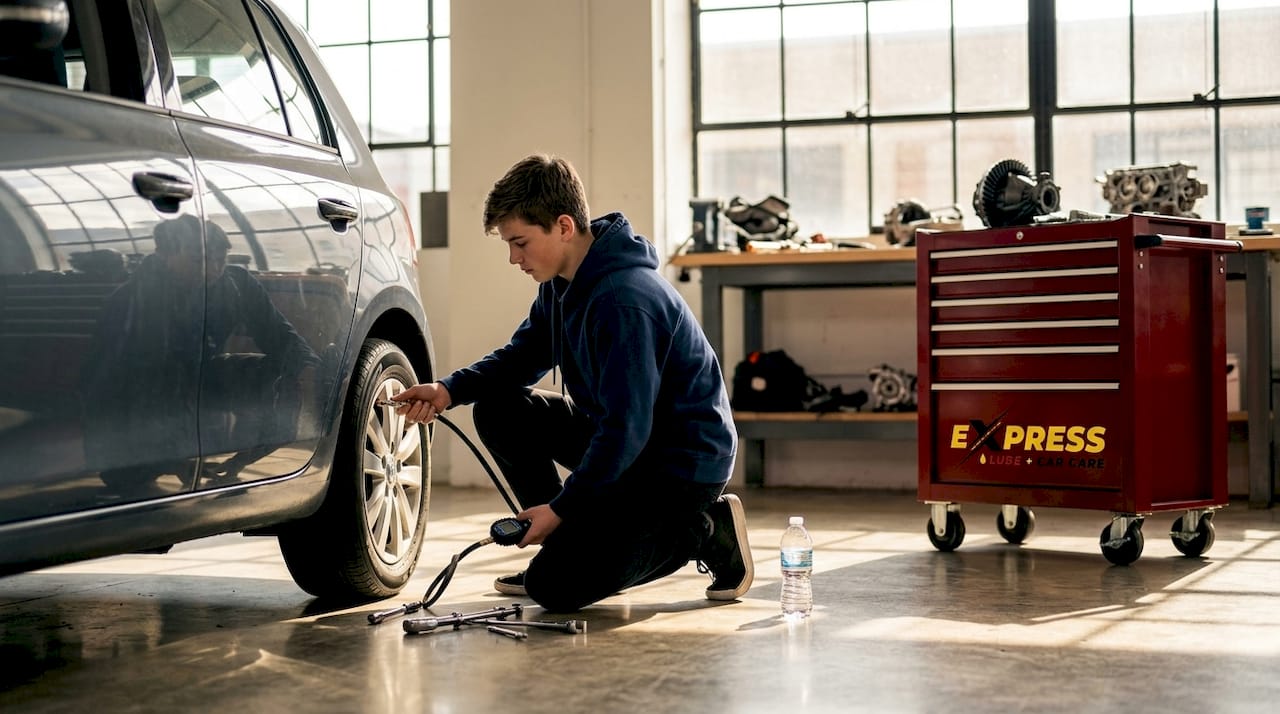
Oil and filter changes are your single most important service. Engine oil lubricates hundreds of moving parts. When it breaks down or gets dirty, those parts grind against each other, and repair bills follow. Oil changes every 5,000 to 7,500 miles, monthly tire pressure checks, and annual brake inspections are the foundation of a healthy vehicle. Check your owner’s manual for the exact interval your car recommends, and follow it. For oil change tips specific to your vehicle type, it helps to know whether your car takes conventional or synthetic oil before your first appointment.
Tire pressure is something you can check yourself in under two minutes. Under-inflated tires wear unevenly, reduce fuel efficiency, and increase blowout risk. Over-inflated tires reduce traction. The correct pressure for your vehicle is printed on a sticker inside the driver’s door, not on the tire sidewall. That number on the tire is the maximum, not the recommended level. Use a simple tire pressure gauge, available at any auto parts store for a few dollars.
Brake inspections should happen at least once a year, or any time you notice squealing, grinding, or a soft feeling when you press the pedal. Brakes are not something to defer. A $150 brake pad replacement can quickly become a $600 rotor replacement if you wait too long.
Fluid levels cover your coolant, transmission fluid, brake fluid, power steering fluid, and windshield washer fluid. Check them monthly by opening the hood and looking at the reservoir markers. Most are easy to read without any tools. Build a car maintenance schedule by mileage so each fluid check is tied to a specific odometer milestone, not just a vague reminder.
Pro Tip: Learning to check your oil and tire pressure yourself is more than a money-saver. It builds real confidence and gives you early warning of problems before they turn into breakdowns.
Adapt your maintenance schedule to Arlington’s driving conditions
Understanding routine tasks is crucial, but your local conditions also shape how often and how urgently you need to act. Arlington’s climate and traffic patterns are genuinely harder on vehicles than most new drivers realize.
Texas heat does two things worth understanding. First, it causes tire pressure to rise as temperatures climb, which means a tire that’s correctly inflated in the morning can be overinflated by afternoon. Second, heat accelerates battery degradation. Car batteries in hot climates typically last three to four years, compared to five or more years in cooler regions. Check your battery terminals for corrosion each season.
Short trips, which are common when you’re new to driving and mostly running local errands, are surprisingly tough on engines. When a car doesn’t reach full operating temperature, moisture and unburned fuel build up in the oil, breaking it down faster. Severe driving conditions like frequent short trips and extreme heat can cut recommended maintenance intervals in half. This means you may need oil changes more often than the standard recommendation suggests.
Heavy stop-and-go traffic on I-20 or Loop 360 puts extra strain on your brake pads and transmission fluid. Here’s a simple framework for adapting your schedule to Arlington’s realities:
- Switch to synthetic oil if you’re mostly doing city driving. It holds up better under heat and short-trip conditions than conventional oil.
- Check tire pressure weekly during summer months, not just monthly. Heat changes it fast.
- Inspect your battery every spring before temperatures peak. A three-year-old battery in Texas is already living on borrowed time.
- Flush your coolant (the liquid that keeps your engine from overheating) per your owner’s manual’s severe service schedule, often every 30,000 miles rather than 50,000.
- Service your transmission more frequently if you do a lot of highway merging and city braking. Fluid that looks dark or smells burned needs attention.
Before any long drives or seasonal changes, a quick car service check before a road trip can prevent an avoidable breakdown 200 miles from home.
Pro Tip: Schedule your biggest maintenance services in March and October, just before the worst heat and any cold snaps. You’ll catch problems at the best possible time.
Use monthly walk-around inspections to catch problems early
Beyond scheduled maintenance, there’s a habit that veteran car owners swear by and almost no new driver practices from day one: the monthly walk-around. It takes about five minutes and acts like a personal inspection station now that the state isn’t doing it for you.
Monthly walk-around checks for leaks, tire pressure, and all lights can prevent safety hazards and significant liability. Think of it as a quick conversation with your car. You’re asking, “Is anything wrong that I can’t hear or feel yet?”
Here’s how to do it properly:
- Start with the tires. Walk around and visually check each one for obvious low pressure or any nails, screws, or visible damage. Then use your gauge to confirm inflation.
- Look under the car. A puddle or wet spot under a parked vehicle is your car sending up a flare. Clear fluid near the front could be air conditioning condensation (normal) or coolant (not normal). Dark, oily spots usually mean an oil leak.
- Test all your exterior lights. Turn on your headlights, then walk around. Test your brake lights by pressing the pedal with a brick or having someone help. Check turn signals and hazards front and rear.
- Check your windshield and mirrors. Cracks grow with temperature changes. Confirm mirrors are intact and properly adjustable.
- Open the hood and do a quick visual. Look for frayed belts, corrosion on battery terminals, or fluid levels that look low.
Pair this with your monthly review of the car inspection checklist and you’ll catch the kinds of issues that quietly turn into $800 repair bills.
Pro Tip: Always check tire pressure when the tires are cold, meaning the car hasn’t been driven for at least three hours. Driving heats the air inside the tire and gives you an artificially high reading.
Budget smartly to manage car maintenance costs as a new driver
Knowing how to maintain your car means little without managing the costs that come with it. New driver vehicle upkeep can catch you off guard financially if you don’t plan ahead.
Here’s what typical annual maintenance costs look like for a standard sedan:
| Service | Typical cost range |
|---|---|
| Oil changes (2-4 per year) | $120 to $300 |
| Tire rotation | $50 to $120 |
| Brake inspection and pad replacement | $150 to $400 |
| Air filter replacement | $20 to $50 |
| Tire replacement (full set) | $400 to $1,500 |
| Battery replacement | $100 to $200 |
| Total estimated annual | $840 to $2,570 |
The 8% rule is a useful guardrail: keep your total monthly car expenses, including your car payment, insurance, fuel, and maintenance, below 8% of your monthly income. If the math doesn’t work, something needs to change before it becomes a crisis.
A few smart moves that make a real difference:
- Save 1% of your car’s value per year into a dedicated car fund. A $15,000 car means putting $150 aside monthly for surprises.
- Never skip scheduled maintenance to save money short-term. A $60 oil change skipped once can become a $4,000 engine repair.
- Get quotes for bigger repairs. Prices vary significantly between shops, and a reputable independent shop with certified technicians often costs less than a dealership for the same work.
- Use a maintenance app to track service history and get reminders so nothing slips through the cracks.
Pro Tip: Set up a monthly automatic calendar reminder on your phone labeled “car check.” It takes less than a minute to schedule and eliminates the “I forgot” excuse that leads to skipped services and bigger bills later.
Our take: the maintenance mindset is the real skill
Here’s something we don’t see said enough: the biggest gap between new drivers and experienced ones isn’t mechanical knowledge. It’s mindset. Most experienced drivers aren’t car experts. They just stopped treating maintenance as optional.
New drivers often wait for something to go wrong before they act. That reactive approach is exactly how a $40 tire rotation turns into a $600 tire replacement, or a $100 battery test turns into a $2,000 tow and alternator repair. The car isn’t failing you. You’re failing to check in on it.
There’s also a psychological pattern worth naming. When you’re new to driving, the car feels like it’s either “fine” or “broken.” In reality, every vehicle exists on a spectrum, and most problems announce themselves quietly before they announce themselves loudly. A slight vibration, a subtle smell, a longer stopping distance. These are not random events. They’re early warnings that reward attention.
We’ve seen it firsthand here in the DFW area. The drivers who come in for regular auto repair services in Arlington rarely face the dramatic, wallet-emptying repairs. They catch things early. They ask questions. They show up before the dashboard light comes on.
Our advice? Treat your car like a relationship. Check in regularly, respond when something seems off, and don’t wait for a crisis to show that you care. That mindset, more than any single maintenance tip, is what separates drivers who love their cars from drivers who are constantly stressed by them.
Your next step starts here at Express Lube & Car Care
You’ve now got a real foundation for keeping your car safe, legal, and affordable to maintain in Arlington. But knowing what to do and having someone you trust to help you do it are two different things.
At Express Lube & Car Care, we’re a full-service shop with ASE-certified technicians who handle everything from oil changes and tire rotations to brake repairs and fluid services. We’re a RepairPal Certified Shop and a CarFax Top-Rated Service Center, and we’ve built our reputation on being the shop DFW drivers actually trust. Whether you need a quick oil change or a full vehicle inspection, we make it easy to stay on top of your car’s health without the stress. Stop by and let’s make sure your car is ready for whatever the road brings next.
Frequently asked questions
Are car inspections mandatory in Texas for new drivers?
No, Texas eliminated mandatory safety inspections for most non-commercial vehicles as of 2025, but drivers are still legally required to keep their vehicles in safe operating condition.
How often should new drivers check their tire pressure?
Check tire pressure monthly at minimum, and weekly during Texas summers when heat causes significant pressure fluctuations that affect both safety and fuel efficiency.
What is the “8% rule” in car maintenance budgeting?
The 8% rule means keeping all monthly car expenses, including payments, insurance, fuel, and maintenance, below 8% of your monthly income to avoid financial strain.
Can new drivers perform oil changes themselves?
While it’s possible with some practice, most beginners are better served by a trusted independent shop, where experienced technicians can handle it efficiently and flag any other issues they spot while they’re under the hood.
What should new drivers do if a dashboard warning light stays on?
Get it checked by a mechanic within 24 hours. A warning light that persists is your car’s way of telling you something is wrong before it becomes a safety risk or a catastrophically expensive repair.