

If your vents are blowing warm air, you hear screeching or grinding when the AC kicks on, or the compressor clutch won’t engage at all, your compressor is likely on its way out. Turn the AC off, avoid long drives if a pulley seems seized, and get it looked at soon. The rest of this guide walks through the checks you can do yourself, what a shop will test, and what repairs typically cost.
TL;DR:
- Early signs of compressor failure include warm air output, screeching noises, and clutch engagement issues, often combined with oil leaks or belt damage.
- Diagnosing the problem requires checking electrical signals, belt condition, refrigerant levels, and using leak detection dyes, especially for modern variable-displacement compressors.
- Delaying repairs can lead to internal damage, metal debris circulation, and significantly higher costs due to contaminated parts and full system flushes.
- Costs for replacement vary widely depending on vehicle and compressor type, but proper diagnosis should always include a system leak check and refrigerant recoveries.
- Prompt attention and a full diagnostic from qualified technicians help prevent bigger repairs, with warranties and financing options available at reliable shops.
Table of Contents
- AC Compressor Failure Symptoms Every Driver Should Know
- What Each Symptom Usually Means (and How to Check It Safely)
- Stop and Assess: What to Do the Moment You Notice a Problem
- Repair or Replace: What It Actually Costs
- How Professional Technicians Actually Diagnose a Failing Compressor
- Sources
- FAQ
AC Compressor Failure Symptoms Every Driver Should Know
Your compressor is the heart of the AC system, and when it starts to fail, it rarely does so quietly. Here’s what to watch for, ranked roughly by how often drivers report each one:
- Warm or weak air from the vents. The fan runs fine, but nothing coming out feels cold, even on max settings.
- Screeching when the AC engages. This usually means the belt is slipping against a pulley that isn’t turning freely.
- Grinding or rattling noises. These point to worn bearings or internal parts breaking apart inside the compressor housing.
- Clunking sounds under the hood. Often a sign of a component seizing up completely.
- The compressor clutch won’t engage. You won’t hear the telltale click, and the front pulley just spins without turning the compressor shaft.
- Oily residue or dye traces near fittings. Refrigerant leaks leave behind oily film that collects dust and grime around hose connections.
- A screeching, smoking, or visibly frayed drive belt. A seized compressor can lock the pulley and force the belt to fight a losing battle.
- Cooling that comes and goes. The AC works for a few minutes, then quits, then maybe comes back.
- Blown fuses or tripped relays. Electrical symptoms often mean the compressor’s clutch coil is drawing more current than it should.
Notice more than one of these at once? That’s usually a bad sign. A single symptom might be minor. Two or three together often mean the compressor itself, not just a peripheral part, is failing.
What Each Symptom Usually Means (and How to Check It Safely)
Not every warning sign points to the same problem, so matching the symptom to the likely cause saves you time and money before you even call a shop.
- Warm air often traces back to low refrigerant, a failed clutch, or internal compressor damage. Low-pressure cutout switches are designed to stop the compressor from running when refrigerant drops too low, which can mimic a dead clutch even though the compressor itself is fine.
- Screeching almost always means the belt is slipping against a pulley that’s resisting rotation. Pop the hood, look at the belt for glazing or fraying, and see if the pulley spins freely by hand with the engine off.
- Grinding or rattling points to bearing failure or broken internals. This is the symptom that leads to what techs call “black death,” a mix of metal shavings and burnt oil that circulates through the entire AC loop once the compressor breaks down internally.
- Clutch not engaging can mean three different things: no 12-volt signal reaching the clutch coil, a low-refrigerant safety switch cutting power, or a physically worn clutch mechanism. Testing for voltage at the clutch connector with a multimeter, engine off, key on, tells you quickly whether the electrical side is the culprit.
- Oily residue signals failing seals or O-rings. Shops use UV dye leak detection to trace exactly where refrigerant is escaping, since dye glows under a blacklight even in tiny amounts.
Pro Tip: Before assuming the worst, rule out the cheap stuff first. A clogged cabin air filter, a failing blower motor, or a thermostat setting left on “auto” can all mimic weak cooling without any compressor involvement at all.
Stop and Assess: What to Do the Moment You Notice a Problem
Some symptoms call for immediate caution, not a wait-and-see approach. Ignoring the wrong warning sign can turn a compressor repair into a much bigger job.
- Pull over and shut off the engine if you smell burning rubber or see smoke near the belt area.
- Turn off the AC entirely to reduce strain on a compressor that may be seizing.
- Skip long highway drives if you suspect the pulley has locked; a seized pulley can damage the serpentine belt, as explained in this AGM Battery cold weather guide for reliable starts, and take the alternator or power steering pump down with it.
- Watch your dashboard for warning lights tied to battery charging or power steering assist. These can appear if belt-driven accessories lose function.
- Write down when the noise started, what it sounds like, and whether you’ve had refrigerant topped off or AC work done recently. That timeline helps a technician narrow down the cause faster.
Repair or Replace: What It Actually Costs
A clutch replacement or a targeted seal repair makes sense when the compressor itself is mechanically sound and the problem is isolated to one component. Full replacement becomes the right call once you’re dealing with grinding noises, metal contamination, or a seized pulley, since internal damage rarely stays contained.
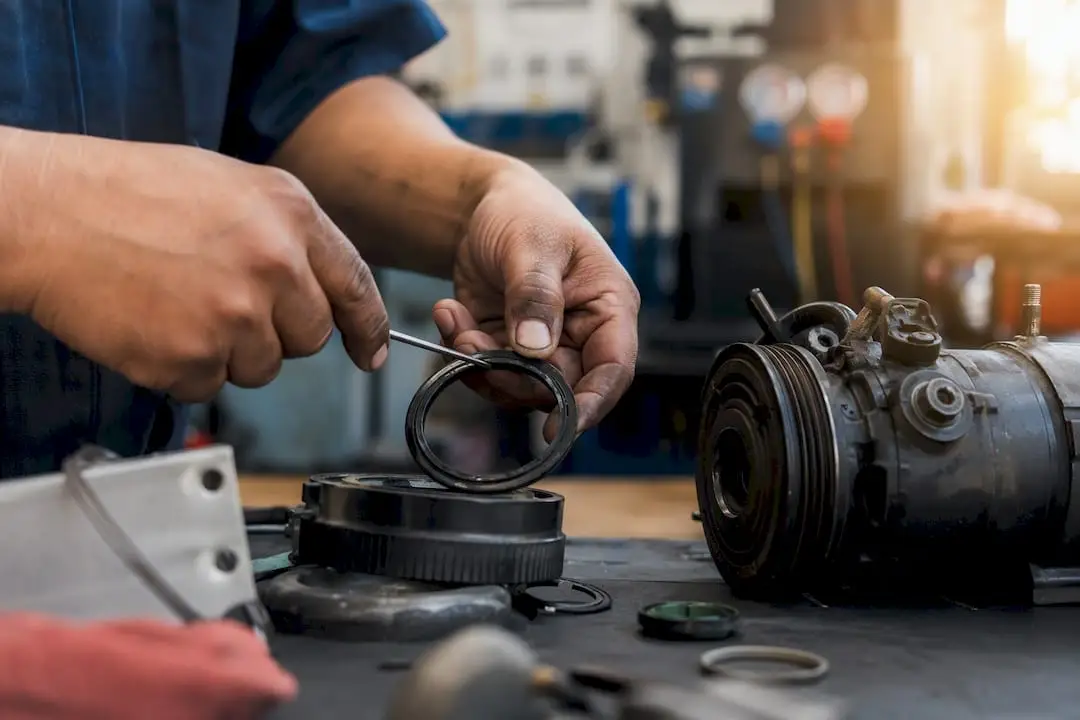
Technicians commonly recommend a full system flush after internal failure. Metal debris and burnt oil circulate through hoses, the condenser, and the expansion valve, and skipping the flush means that debris can destroy a brand-new compressor within weeks.
According to RepairPal’s cost estimator, compressor replacement costs vary widely depending on vehicle make, compressor type, and labor time, and proper refrigerant recovery and recharge are required parts of the job, not optional extras.
Watch out for a red flag: any quote for a compressor swap that doesn’t include a system flush or leak inspection. That’s a shortcut that often leads to a second failure within months, and you’ll want to weigh that against repair versus replace guidance before signing off on any estimate.
How Professional Technicians Actually Diagnose a Failing Compressor
A trained tech doesn’t guess. The process starts with a visual inspection of the belt, pulley, and visible fittings, followed by listening checks with the engine running and the AC engaged.
Next comes the electrical test: checking for 12 volts at the clutch connector to rule out wiring or relay issues before assuming the compressor itself has failed. From there, manifold gauge readings get compared against manufacturer performance charts to confirm whether the compressor is actually moving refrigerant at the expected rate.
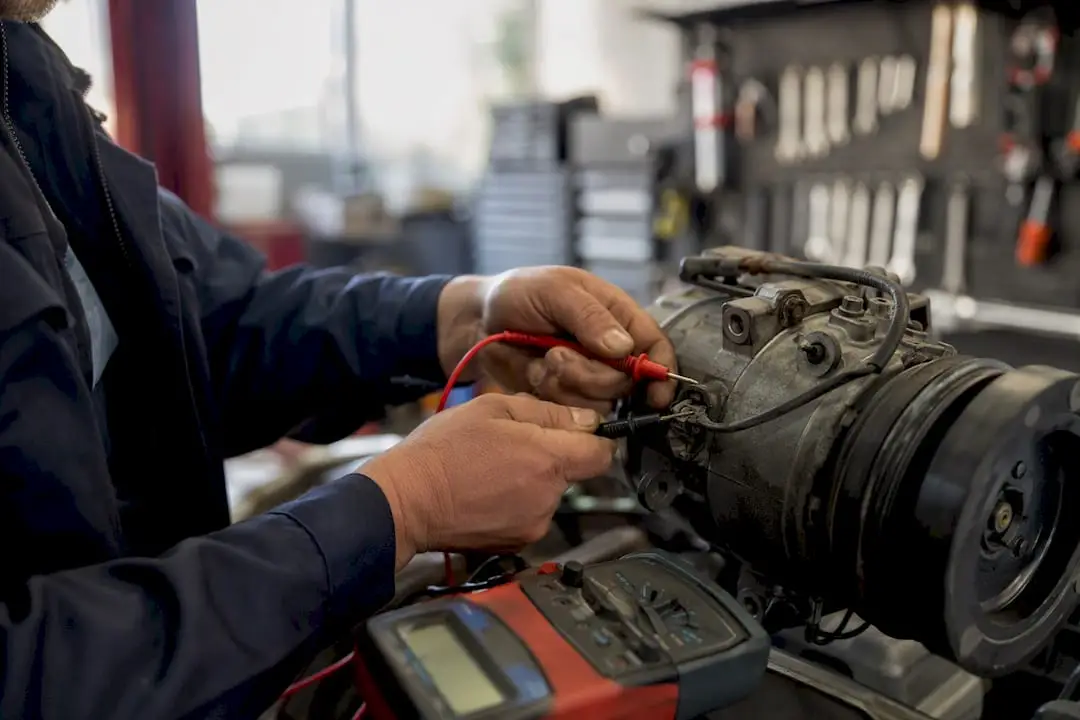
Leak detection relies on UV dye, and any refrigerant removed from the system has to be recovered with certified equipment rather than vented into the air, since environmental regulations require proper recovery.
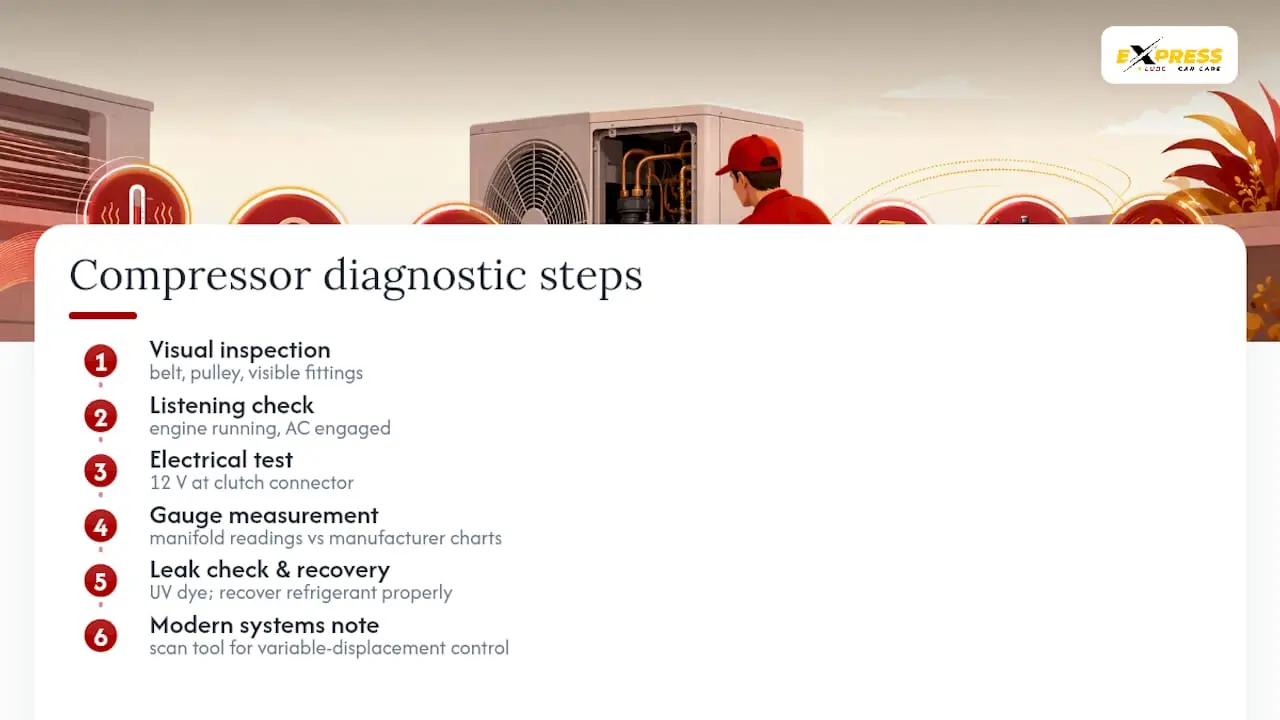
One wrinkle for newer vehicles: variable-displacement compressors don’t have a traditional clutch at all, so a simple voltage test won’t tell you much. These systems need a scan tool to check the control valve’s duty cycle instead.
Pro Tip: If your car is from the last decade or so, don’t assume a “clutch test” applies. Many modern compressors run continuously and modulate output electronically, so the diagnostic playbook is different.
Shop perspective: catching failures early saves you from the bigger bill
Every compressor problem we’ve reviewed follows the same pattern: the sooner it gets diagnosed, the fewer components end up damaged. A grinding noise ignored for two more weeks doesn’t stay a grinding noise. It becomes contaminated lines, a ruined condenser, and a bill three times the size. Express Lube & Car Care runs the full diagnostic sequence, manifold gauges included, before recommending anything, and backs the work with a real warranty and an estimate you can actually read.
— Hassan
Schedule Your AC Diagnostic With Express Lube & Car Care
Warm air blowing through your vents in July isn’t something to put off, and neither is a compressor that’s grinding its way toward a bigger repair. Express Lube & Car Care runs a full diagnostic sequence on every AC visit, clutch testing, manifold gauge readings, and leak checks, so you’re not paying twice for a job done halfway.

Every repair comes backed by a 24-month, 24,000-mile warranty, and if a bigger repair like a full compressor replacement is on the table, financing options can spread out the cost instead of hitting your wallet all at once. Our ASE-certified technicians walk you through exactly what’s wrong and what it’ll take to fix it before any work starts. Schedule your AC diagnostic and repair appointment online or give us a call, and expect a straight answer about whether you’re looking at a simple fix or a full replacement.
Sources
- AC compressor replacement cost – RepairPal
- Carparts
- Automotive AC repair diagnostics guide – KBB
- Diagnosing variable-displacement compressors – Motor
FAQ
What happens when an AC compressor fails?
The system loses its ability to circulate refrigerant properly, leading to warm air, and if the failure is internal, metal debris can contaminate the entire loop, which is why a full flush is often required afterward.
What’s the average cost to replace an AC compressor?
Costs vary by vehicle, compressor type, and labor time, and RepairPal’s estimator notes that proper refrigerant recovery and recharge add to the total beyond just the part and labor.
What is the average lifespan of a car AC compressor?
Most compressors last for many years of normal use, but that lifespan drops sharply with electrical issues, refrigerant leaks, or belt problems that force the unit to work harder than it should.
Will the AC still run with a bad compressor?
It might run intermittently or blow weak air, but a compressor with internal damage or a seized pulley can drag down the serpentine belt and affect the alternator, so continuing to run it isn’t worth the risk.
Can a bad AC compressor be repaired instead of replaced?
Sometimes. A failed clutch or a leaking seal can often be repaired on its own, but grinding noises or metal contamination usually mean full replacement, plus a system flush, is the safer call.