
TL;DR:
- Auto repair financing allows vehicle owners to borrow money upfront and repay it over time through fixed monthly payments. Choosing the right option involves comparing total costs, understanding interest rates, and avoiding deferred interest traps for better financial management. Proper planning and clear estimates help ensure affordable repairs without unnecessary interest expenses.
Auto repair financing is a method of borrowing money upfront to cover vehicle repair costs, then repaying that amount over time through fixed monthly installments that include interest and fees. Think of it as a financial bridge between a broken-down car and a working one. Understanding how auto repair financing works means knowing your options, reading the fine print, and choosing terms that fit your budget without costing you more than necessary. Personal loans, repair shop payment plans, and credit cards are the three main paths most car owners take.
What are the main auto repair financing options?
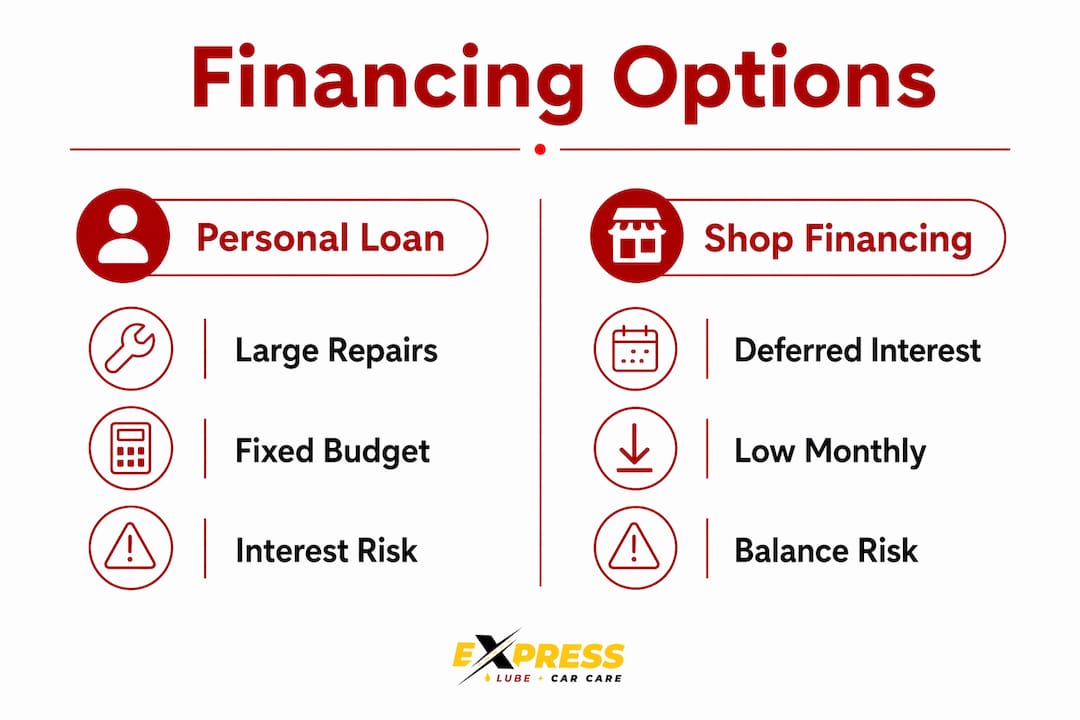
Auto repair loans are personal loans used to pay repair expenses upfront, with fixed monthly repayments that include interest and fees. Lenders evaluate your credit score, income, and debt-to-income ratio before approving you. The result is a predictable payment schedule, which makes budgeting easier.
Here is a quick breakdown of the three most common auto repair financing options:
- Personal loans: These are unsecured loans that do not require your vehicle as collateral. You borrow a fixed amount, repay it over a set term, and pay interest on the full balance. Loan amounts can range from $1,000 to $250,000 depending on the lender and your credit profile.
- Repair shop financing: Many shops partner with third-party lenders like Synchrony Financial or offer in-house payment plans. Shop financing applications are often completed on-site with immediate approval possible. Terms vary widely, and some plans include interest-free promotional periods.
- Credit cards: An existing card with available credit or a new card with a 0% APR promotional offer can cover repair costs. This option works well if you can pay the full balance before the promotional period ends.
| Option | Best For | Key Risk |
|---|---|---|
| Personal loan | Large repairs, fixed budgets | Interest cost over full term |
| Shop financing | Immediate approval needed | Deferred interest traps |
| Credit card | Short-term, small repairs | High APR after promo ends |
Pro Tip: Before you commit to any option, get a written repair estimate first. That number tells you exactly how much to borrow, and borrowing the right amount saves you real money.
How do loan terms and interest rates affect your total cost?
APRs on auto repair loans typically range from 6.25% to 35.99%, with repayment terms stretching from 12 to 120 months. That is a wide range, and where you land on it depends heavily on your credit score. A borrower with excellent credit might lock in 7% APR, while someone with fair credit could face 28% or higher on the same loan amount.

Loan term length is where many car owners make a costly mistake. Longer loan terms lower your monthly payment but increase the total interest you pay over the life of the loan. A $3,000 repair loan at 20% APR costs significantly more over 60 months than over 24 months, even though the monthly payment feels more comfortable on the longer plan.
Fees add another layer of cost. Origination fees, late payment penalties, and prepayment charges can all inflate your total repayment amount. Always ask for the full fee schedule before signing.
Pro Tip: Compare offers using the total repayment amount, not just the monthly payment. Two loans with the same monthly cost can have very different total price tags depending on their terms.
Your credit profile directly shapes the APR you receive, which makes shopping multiple lenders one of the most effective ways to reduce your financing cost. Check at least two or three lenders before accepting any offer. Even a few percentage points difference in APR adds up to real dollars over a 36-month term.
Understanding how parts pricing works alongside labor costs helps you build a more accurate repair estimate, which in turn helps you borrow the right amount from the start.
What is the difference between true 0% APR and deferred interest?
This is the most misunderstood area of auto repair credit solutions, and it catches a lot of people off guard. True 0% APR and deferred interest sound similar but work very differently.
True 0% APR means no interest accrues during the promotional period. If you pay the full balance before the promo ends, you owe nothing beyond the original repair cost. This is the deal you actually want.
Deferred interest is a different animal entirely. Deferred interest promotions accrue interest throughout the promotional period. That interest is just sitting in the background, waiting. If you have not paid the full balance by the time the promo expires, the entire accrued interest gets charged to your account retroactively. One day before the deadline, you could owe hundreds of dollars in surprise charges.
Here is how to protect yourself:
- Read the financing disclosure carefully. Look for the phrase “deferred interest” or “interest will be charged from the date of purchase.”
- Check your monthly statement for the promotional expiration date and the balance subject to deferred interest.
- Calculate your payoff amount by dividing the total balance by the number of promo months. Pay at least that amount each month.
Treat a deferred interest offer like a countdown clock, not a free pass. The interest is always running. Your job is to clear the balance before time runs out.
Minimum payments on deferred interest plans are designed to keep you in the plan longer. Minimum payments rarely clear the full balance in time, which is exactly how lenders profit from these offers. Pay more than the minimum every single month.
How to plan and manage your auto repair payments effectively
Smart payment management starts before you sign anything. Follow these steps to stay in control from day one.
- Get a written estimate first. Borrow exactly the estimated repair cost. Overborrowing means paying interest on money you did not need. Underborrowing means scrambling for more funds mid-repair. A precise estimate from your mechanic is your most useful tool here. You can learn more about how repair estimates work before you walk into any shop.
- Calculate your required monthly payment. Divide the total financed amount by the number of months in your promotional or loan period. That number is your target payment, not the minimum shown on your statement.
- Set up autopay. Autopay removes the risk of a missed payment, which can trigger late fees and, on deferred interest plans, cancel your promotional terms entirely.
- Choose the shortest term you can afford. A shorter loan term costs more per month but saves money overall. Think of the monthly payment as the price of speed. Paying faster is almost always cheaper in total.
- Watch for the minimum payment trap. If your statement shows a minimum payment that is far below your calculated payoff amount, ignore it. Pay your calculated amount every month without exception.
Pro Tip: Set a calendar reminder two months before any promotional period ends. That gives you time to make a lump-sum payment if your balance is higher than expected.
Knowing how to negotiate repair prices before you finance can also reduce the total amount you need to borrow. A lower repair bill means a smaller loan and less interest paid overall.
Key takeaways
Auto repair financing works best when you borrow precisely, compare total costs across lenders, and treat any deferred interest offer as a strict deadline rather than a flexible benefit.
| Point | Details |
|---|---|
| Know your financing type | Personal loans, shop plans, and credit cards each carry different costs and approval processes. |
| APR range is wide | Rates run from 6.25% to 35.99%; your credit score is the biggest factor in where you land. |
| Deferred interest is not free | Interest accrues silently and hits retroactively if you miss the full payoff deadline. |
| Borrow the exact repair amount | Use a written mechanic estimate to avoid paying interest on funds you did not need. |
| Total cost beats monthly payment | Always compare the full repayment amount across loan offers, not just the monthly figure. |
What i have learned about making auto repair financing work
I have seen car owners make the same mistake over and over: they focus entirely on the monthly payment and ignore everything else. A $75 monthly payment sounds manageable until you realize you are paying it for five years on a $2,500 repair. That is not a good deal by any measure.
The fine print on deferred interest offers is where the real danger lives. Most people skim the disclosure, assume “0% financing” means no interest ever, and then get blindsided by a retroactive charge that wipes out any savings they thought they had. Reading that disclosure carefully, every word of it, is not optional.
My honest advice is to treat financing as a tool with a cost, not a solution. The best use of auto repair payment plans is when you have a clear payoff timeline and the discipline to stick to it. If you are not confident you can pay the balance in full before a promo ends, a straightforward personal loan with a fixed APR is a safer and often cheaper choice in the long run.
Shopping around matters more than most people realize. Two lenders can offer the same loan amount with APRs that differ by 10 percentage points or more. That gap translates directly into hundreds of dollars over a typical loan term. Spend 30 minutes comparing offers before you sign anything. It is one of the highest-return uses of your time in this whole process.
— Hassan
Get reliable repairs and transparent financing at Expresslubearlington
When a repair bill catches you off guard, the last thing you need is more uncertainty about how to pay for it.
Expresslubearlington is an ASE and RepairPal Certified repair shop serving drivers across the DFW area. Our ASE-certified technicians provide accurate written estimates upfront so you know exactly what you are financing before you commit to anything. We work with financing options to help you manage costs without cutting corners on quality. Stop by, get your estimate, and ask us about payment options that fit your situation. Drivers across Arlington trust us because we make the repair process straightforward from the first conversation to the final payment.
FAQ
What exactly is auto repair financing?
Auto repair financing is a personal loan or payment plan used to cover vehicle repair costs upfront, repaid over time with fixed monthly payments that include interest and fees.
Does auto repair financing require good credit?
Lenders evaluate credit score, income, and debt-to-income ratio when approving auto repair loans. Better credit scores qualify for lower APRs, but options exist for a range of credit profiles.
What is the risk of deferred interest shop financing?
Deferred interest plans accrue interest throughout the promotional period and charge it retroactively if the full balance is not paid by the deadline. Minimum payments rarely clear the balance in time.
How much can i borrow for auto repairs?
Personal auto repair loans typically range from $1,000 to $250,000 depending on the lender and your creditworthiness. Borrowing exactly the estimated repair cost avoids paying interest on excess funds.
How do i compare auto repair loan offers effectively?
Compare the total repayment amount across offers, not just the monthly payment. Factor in APR, loan term length, origination fees, and any promotional conditions before choosing a lender.