
If you see fraying, cracking, or glazing on the belt, hear metallic grinding, or notice the tensioner indicator sitting outside its normal range, replace the serpentine belt now rather than waiting. Those cues, along with any sudden loss of power steering or battery charging, mean you should follow your owner’s manual schedule and book a professional inspection. AAA’s maintenance guidance backs this up, and a qualified auto repair shop can check the whole belt-drive system in one visit.
TL;DR:
- Even with a shiny, crack-free appearance, modern EPDM belts may still require replacement due to rib wear or tension issues.
- Metallic grinding noises suggest failing bearings in pulleys or tensioners, requiring immediate inspection and potential replacement.
- Replacing only the belt without checking pulleys, tensioner, and alignment often leads to early failure and additional repair costs.
- Most serpentine belt replacements can be completed the same day, especially if the engine is accessible and no additional parts need replacing.
- Regular visual and auditory inspections, along with immediate attention to symptoms, can prevent sudden breakdowns and costly engine damage.
Table of Contents
- What a serpentine belt does and why failure matters
- Symptoms, noises, and signs your drive belt needs attention
- Inspection checklist: what to check before you book a shop
- DIY replacement versus professional service: what actually matters
- What Express Lube & Car Care does during a serpentine belt replacement
- Cost and time: what affects your estimate
- How a serpentine belt replacement is done
- Why preventive belt checks pay off
- Schedule your serpentine belt inspection today
- FAQ
- Sources
What a serpentine belt does and why failure matters
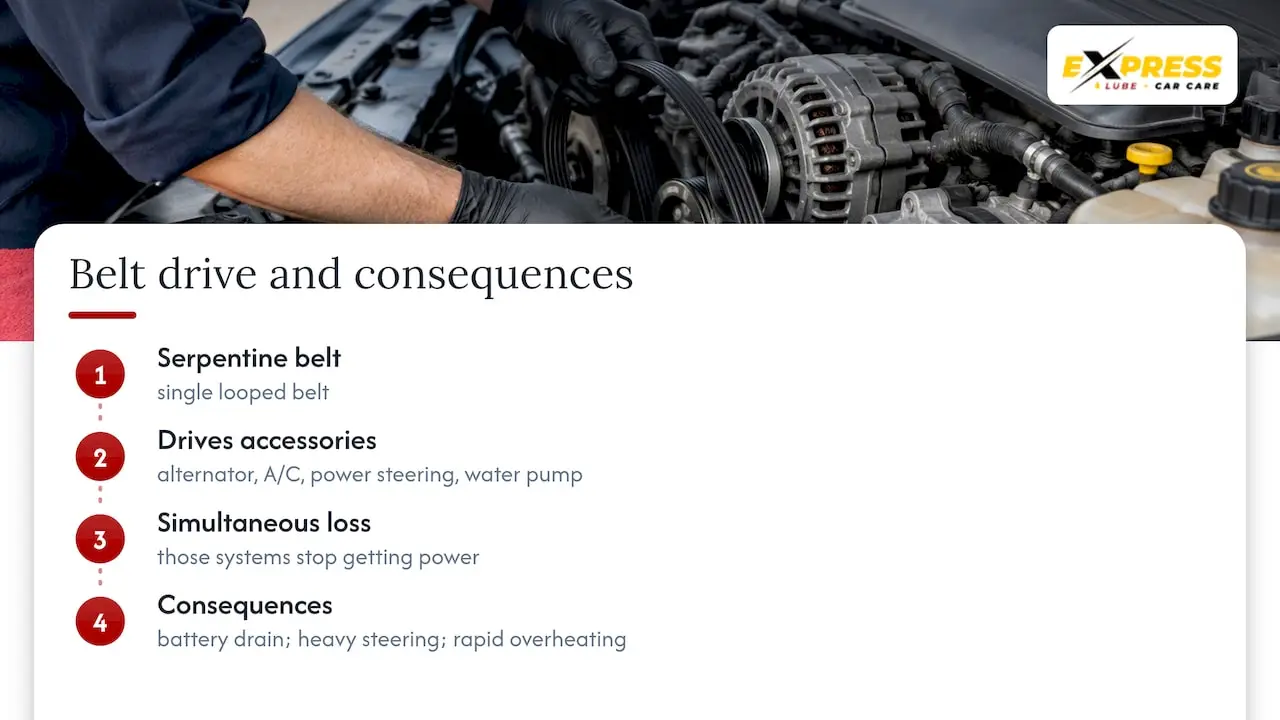
Think of the serpentine belt as the one worker running several machines at once. A single belt loops around multiple pulleys to drive your alternator, A/C compressor, power steering pump, and often the water pump. When it snaps or slips badly, those systems stop getting power at the same time.
That’s why a belt failure feels sudden and serious. Lose the alternator and your battery drains fast. Lose power steering and the wheel gets heavy, especially at low speeds. Lose water pump drive and the engine can overheat within minutes, which risks a much bigger repair bill than the belt itself.
Serpentine belts aren’t the same as timing belts, which run internally and control valve timing instead of accessories; a snapped timing belt is often a bigger mechanical problem. If you want the distinction explained in more depth, our guide to timing belt service covers it. Your owner’s manual lists the replacement interval for your specific engine, and that number should be your baseline, not a generic rule of thumb, as explained in the Brown’s Performance Timing belt Guide – Taylor’d Tuning.
Symptoms, noises, and signs your drive belt needs attention
Your ears usually catch a belt problem before your eyes do. A squeal or chirp when you start the car or switch on the A/C often points to slippage. A whine or growl while driving can mean the tensioner or a pulley is wearing out. Metallic grinding is the most urgent sound: it usually signals a failing bearing in the tensioner, idler pulley, or crankshaft pulley, according to AAA.
Visual clues matter too:
- Fraying, cracking, or missing chunks along the belt’s ribs
- A shiny, glazed surface, which reduces grip on the pulleys
- Small rubber “pills” built up on the ribs
- Oil or coolant contamination on the belt
- A tensioner wear indicator sitting outside its marked range
EPDM belts complicate the visual check. Most modern belts are made from EPDM rubber rather than older neoprene, and AAA notes that EPDM often resists the obvious cracking that used to be the clear warning sign. A belt can look fine and still have worn ribs underneath, so technicians check rib wear and overall tension instead of relying on a visual scan alone.
Inspection checklist: what to check before you book a shop
With the engine off and cool, a few minutes under the hood can tell you a lot:
- Look along the visible edge of the belt for cracking, fraying, or glazing.
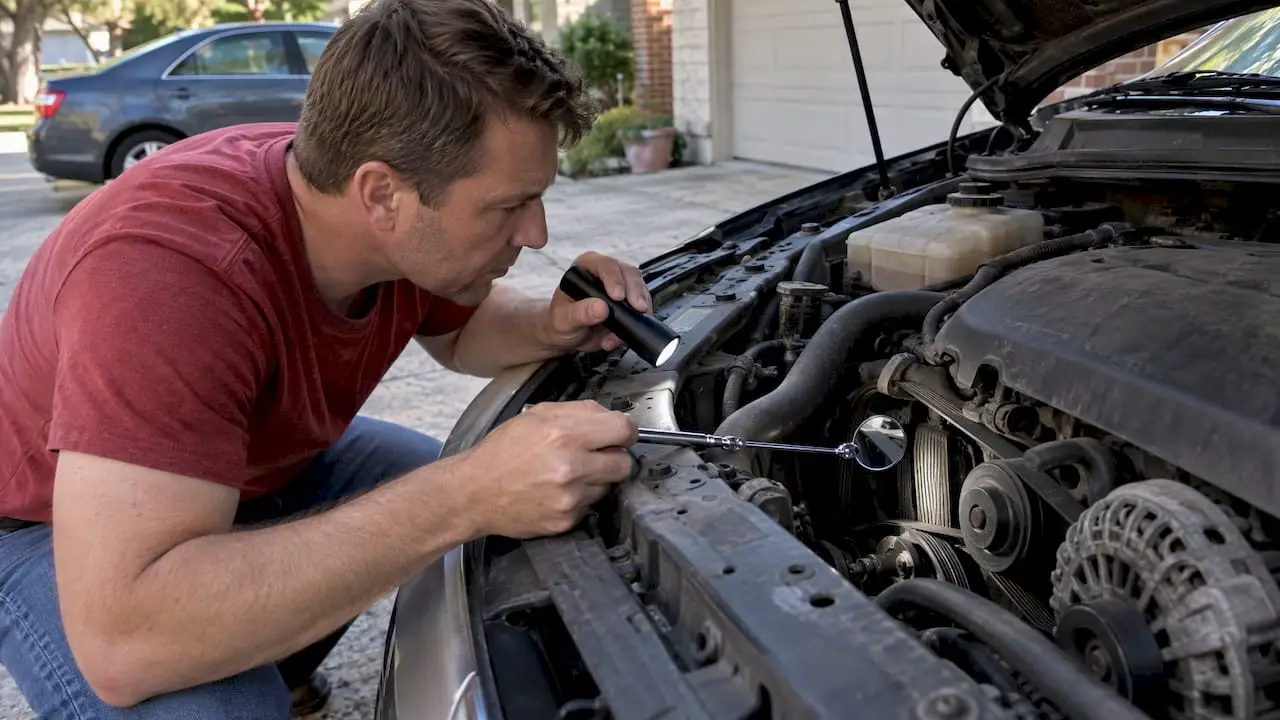
- Flip a flashlight under the belt to check the ribbed underside for pilling or missing sections.
- Check for oil or coolant residue on the belt or nearby pulleys.
- If your vehicle has a tensioner wear indicator, confirm it sits within the marked range.
- Press on the belt between two pulleys to check for excessive give, which suggests a weak tensioner.
Stop and call a shop immediately if you hear metallic grinding, lose power steering assist, notice the dash charging light come on, or see visible damage to a pulley. Car Care Council guidance recommends checking belts as part of routine care rather than waiting for a breakdown, and your manufacturer’s interval is the schedule to follow for replacement timing.
Pro Tip: Keep a flashlight and a small mirror on a stick in your glove box. Both make checking the underside of the belt, where most wear actually shows up, much easier.
DIY replacement versus professional service: what actually matters
A straightforward serpentine belt swap on an accessible engine is within reach for a confident DIYer with the right tools: a serpentine belt tool or breaker bar to relieve tensioner spring pressure, the correct routing diagram, and sometimes a specific socket to reach the tensioner bolt. Where it gets tricky is tight engine bays, confusing routing on V6 and V8 layouts, and tensioners that fight back against hand tools.
A shop brings a wider check beyond just swapping the belt:
- Spinning each accessory pulley by hand to feel for bearing roughness or play
- Checking the tensioner and idler pulleys for wear, since a weak tensioner often causes the belt that replaced it to fail early too
- Confirming pulley alignment, since misalignment chews through a new belt fast
- Torquing fasteners to spec and road testing before handing the car back
AA1Car’s guidance on belt tensioners points out that replacing only the belt while ignoring a leaking seal, worn idler, or misaligned pulley often means doing the job twice. Fixing the root cause the first time usually costs less over the life of the vehicle.
What Express Lube & Car Care does during a serpentine belt replacement
Our ASE-certified technicians start every serpentine belt job with a digital vehicle inspection, complete with photos and video, so you can see exactly what we found before any work begins. We inspect the tensioner, idler pulleys, and accessory bearings alongside the belt itself and replace any of those parts that show wear, not just the belt.
Once the new belt is installed and properly tensioned, we road test the vehicle to confirm everything runs quietly and the charging and steering systems respond normally. Most serpentine belt jobs are completed same-day, and qualifying repairs are backed by our 24-month/24,000-mile warranty. You can book a visit through our services page.
Cost and time: what affects your estimate
A serpentine belt itself is a relatively inexpensive part, but your total bill depends on more than the belt alone. Vehicle make and model drive a lot of the variation: some engines have the belt sitting right up front, while others bury it behind other components that take longer to remove. If the tensioner or idler pulleys need replacing too, that adds parts and labor on top of the belt.
A straightforward belt swap on an accessible engine is typically a quicker job than one that also involves tensioner or idler replacement, which takes longer due to extra disassembly. Regional labor rates and whether accessory components show additional wear both shift the final number. Ask any shop for a written estimate, and ask to see photos of any worn parts they recommend replacing. That documentation helps you understand exactly what you’re paying for and compare it against the actual condition of your vehicle.
How a serpentine belt replacement is done
Here’s the general sequence a technician follows, which helps explain why this isn’t always a quick driveway fix:
- Secure the vehicle with the engine off and fully cooled.
- Relieve tension on the automatic tensioner using the correct tool.
- Remove the old belt and set it aside for comparison.
- Inspect all pulleys, the tensioner, and related bearings for wear or play.
- Clean debris and residue off the pulley surfaces.
- Route the new belt exactly per the underhood routing diagram.
- Release the tensioner so it seats the belt and sets proper tension automatically.
- Road test the vehicle and recheck belt alignment and noise afterward.
Shops often recommend replacing the tensioner or idler pulleys at the same time if either shows wear, since a weak tensioner can wear out a brand-new belt in a fraction of the time it should last. Never attempt any of this with the engine running: the tensioner spring and spinning pulleys can cause serious injury.
Why preventive belt checks pay off
A belt rarely fails without warning. The sounds and visual cues are there, and catching them early, especially on EPDM belts that hide wear well, is far cheaper than a roadside breakdown. Our ASE-certified team, recognized by RepairPal and CARFAX, treats that early check as the job, not an afterthought.
— Express Lube & Car Care
Schedule your serpentine belt inspection today
You don’t need to guess whether that squeal is serious. Our ASE-certified technicians check your full belt-drive system, document everything with photos through our digital vehicle inspection, and handle most serpentine belt jobs the same day you bring the car in.

Visit our services page to book a serpentine belt inspection or replacement, or explore our maintenance services to keep the rest of your vehicle on schedule too.
FAQ
How do I know if my serpentine belt needs replacing?
Look for fraying, cracking, glazing, or missing rib sections, and listen for squealing at startup or grinding noises while driving. AAA guidance recommends replacing the belt when inspection reveals any of these signs rather than waiting for a failure.
How long does a serpentine belt replacement take?
A straightforward belt swap on an accessible engine is generally quicker than one that also requires tensioner or idler pulley replacement. Many auto repair shops complete most serpentine belt jobs the same day.
Can I drive with a worn or squealing serpentine belt?
Driving on a worn belt risks sudden loss of power steering, battery charging, or engine cooling, so it’s safer to get it inspected promptly. The Car Care Council advises arranging inspection as soon as you suspect a problem rather than waiting for a breakdown.
Why does my belt look fine but still need replacing?
Modern EPDM belts often don’t crack visibly even when worn, so a clean look doesn’t guarantee a healthy belt. AAA notes that rib wear and tension matter more than appearance alone for these materials.
Should I replace the tensioner with the belt?
If the tensioner or idler pulleys show wear or play, replacing them alongside the belt helps prevent an early repeat failure. AA1Car’s guidance explains that leaving a weak tensioner in place often shortens the life of a brand-new belt.
Sources
- AAA time-stamped car maintenance checklist
- Allstate: serpentine belts / Car Care Council guidance
- The serpentine belt: one belt to rule them all (AAA Automotive)
- AA1Car: belt tensioners and drive-system diagnosis