

Most carmakers set the timing belt interval between 60,000 and 100,000 miles, with some going as high as 120,000 miles, plus a backup age limit of several years. Your exact number lives in your owner’s manual or your VIN-based maintenance schedule, not on a sticker someone guessed at. Skip it, and on an interference engine you’re gambling with a repair bill that dwarfs the belt itself.
TL;DR:
- Confirm whether your engine uses a belt or a chain through the manual, VIN schedule, or a mechanic; chains generally need no scheduled replacement.
- Replacement typically costs $400 to $1,400, and shops often replace the tensioner, idler pulleys, and water pump while access is already open.
- A belt may fail without clear warning, so ticking, rough idling, misfires, or hard starting warrant inspection rather than waiting for a definitive symptom.
- For a used car without replacement records, treat the belt as due if it is near its interval and negotiate the expected service cost.
- Frequent towing, hot climates, dusty roads, and mostly short trips can accelerate wear, so ask a mechanic to inspect the belt during routine service.
Table of Contents
- Typical Timing Belt Intervals: Mileage and Age Ranges Explained
- How to Confirm Whether You Have a Timing Belt or a Timing Chain
- Signs and Symptoms That a Timing Belt May Be Failing
- Typical Replacement Cost and What the Service Usually Includes
- How Driving Conditions Change Your Replacement Timing
- Buying a Used Car: Check the Timing Belt History First
- What to Expect at the Shop: Our Timing Belt Workflow
- Why We Take Timing Belt Maintenance Seriously
- Schedule Your Timing Belt Service With Us
- FAQ
- Sources
Typical Timing Belt Intervals: Mileage and Age Ranges Explained
Here’s the honest answer: there’s no single magic number, but there is a dependable range. Consumer Reports puts the common window at 60,000 to 100,000 miles, while AAA notes some manufacturers stretch that to 120,000 miles. Why the spread? Belt material, how the engine is designed, and how cautious the automaker wants to be all play a role. A rubber composite belt wears differently than one reinforced with fiber, and engines that pack components tightly tend to run hotter, which ages rubber faster.
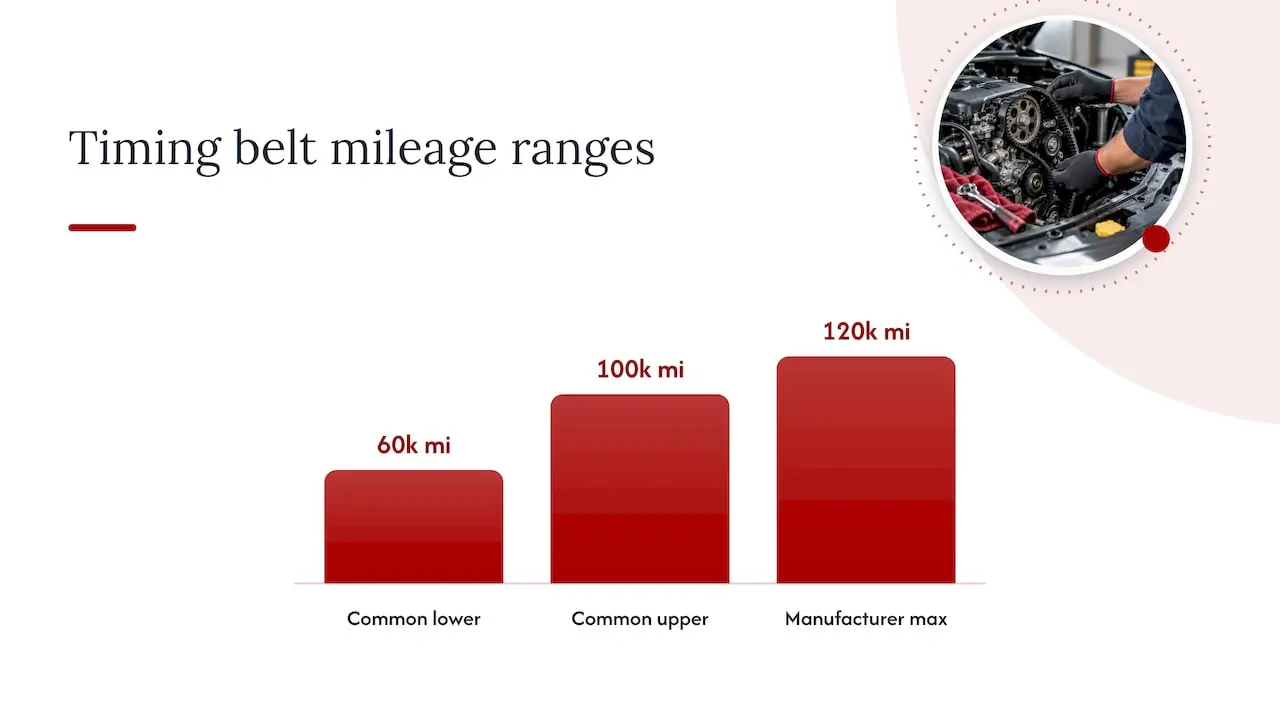
Age matters just as much as mileage. A belt sitting under the hood for eight years has absorbed heat cycles and dry rot risk even if the odometer barely moved, which is why many manufacturers set a time limit alongside the mileage figure.
Run through this quick check to see where you stand:
- Pull up your mileage: are you within 10,000 miles of 60,000, or already past 100,000?
- Check your vehicle’s age: has it been five years or more since the belt was last replaced, regardless of mileage?
- Compare both numbers to your owner’s manual entry, since the manual overrides any general range.
If either number is close or already crossed, it’s time to schedule a look.
How to Confirm Whether You Have a Timing Belt or a Timing Chain
Not every engine uses a belt at all. RepairPal points out that some vehicles run timing chains instead, and chains are built to last the life of the engine without a scheduled swap. That distinction changes everything about whether this article even applies to you, so confirm it first.
- Check your printed owner’s manual under the maintenance schedule section for the words “timing belt” or “timing chain.”
- Log into your manufacturer’s owner portal using your VIN to pull the official digital schedule.
- Look for a maintenance sticker on the radiator support or under the hood noting the last service mileage.
- Dig up old service records or receipts that mention a prior timing belt job.
- If the manual is silent or your paperwork is incomplete, ask a mechanic to visually confirm the system during an inspection.
Signs and Symptoms That a Timing Belt May Be Failing
A worn belt doesn’t always announce itself, which is exactly the problem. As AAA puts it, belts rarely give a clear warning before they snap, so you’re often watching for subtle clues rather than one obvious red flag.
- A ticking or clicking noise coming from the front of the engine, especially at idle.
- A rough or uneven idle that wasn’t there before.
- Random misfires or a check engine light with no obvious trigger.
- Trouble starting the engine, as if it’s cranking but not quite catching.
- Visible cracking, fraying, or glazing on the belt itself if you can see it.
One symptom alone might mean something minor. A few showing up together is your engine sending up a flare, and that’s when it’s worth stopping the guesswork and getting it looked at before you drive much farther.
Typical Replacement Cost and What the Service Usually Includes
Budgeting for this job catches a lot of drivers off guard, mostly because it’s not just the belt you’re paying for. AAA’s repair budgeting guide puts the typical range around $400 to $1,400, depending on your vehicle and how much else gets replaced along the way. That’s a wide band, and the reason is simple: labor hours and engine accessibility vary enormously between a straightforward front-mounted belt and one buried behind half the engine’s accessories.
Most jobs cover more than the belt itself:
- The timing belt.
- The tensioner and idler pulleys that keep it properly seated.
- Often the water pump and related seals, since they typically fail around the same mileage and sit in the same spot.
Replacing the water pump and tensioner alongside the belt isn’t upselling. It’s because your mechanic is already elbow-deep in that part of the engine, and coming back later to redo the labor just to swap a $40 part rarely makes sense.
How Driving Conditions Change Your Replacement Timing
The mileage number on paper assumes average driving. Push your vehicle harder and that number shrinks.
- Frequent towing or hauling heavy loads strains the belt and the components it drives.
- Consistently hot climates accelerate rubber aging, even with low mileage.
- Dusty or gritty driving conditions can work contaminants into the belt area over time.
- A pattern of mostly short trips means the engine rarely reaches optimal operating temperature, which adds wear in other ways.
Pro Tip: Ask your mechanic to eyeball the timing belt area during your next oil change or fluid service visit. It costs you nothing extra and catches problems early.
Buying a Used Car: Check the Timing Belt History First
A used car with no timing belt paperwork is a car you should price accordingly.
- Ask the seller directly for receipts or service records showing when the belt was last replaced.
- Check under the hood for a maintenance sticker noting the service date and mileage.
- If no proof exists and the car is near or past the typical interval, factor a replacement into your offer or negotiate the price down.
- Treat a documented, recent timing belt replacement as a genuine selling point, since it signals a well-maintained vehicle and makes resale easier down the line.
What to Expect at the Shop: Our Timing Belt Workflow
When you bring a vehicle in for this job, the process follows a consistent sequence. We start with an inspection to confirm what we’re dealing with, then remove the covers and accessories blocking access to the belt. From there, we replace the belt along with the tensioner, idler pulleys, and typically the water pump if it’s due. We verify timing alignment carefully before closing everything back up, then road test the vehicle to confirm smooth operation.
Labor is usually the biggest piece of the cost, since accessing the belt on most engines means working around several other components first.
- We handle every step of the process with professional care.
- You can review our timing belt replacement page for service details and booking.
Pro Tip: Bring your VIN or past service records to your appointment. It helps us confirm your exact manufacturer interval instead of relying on general guidelines.
Why We Take Timing Belt Maintenance Seriously
We treat timing belt service as one of the few maintenance items where waiting too long can cost you an entire engine, not just a part. Our digital inspections include photos so you can see exactly what we’re looking at, and our ASE-certified technicians back every job with a 24 month or 24,000 mile warranty on qualifying repairs. If your records are unclear, we’d rather check now than guess later.
— Express Lube & Car Care
Schedule Your Timing Belt Service With Us
We perform timing belt replacements and related maintenance locally, backed by certified technicians and a digital inspection process that shows you what is happening under your hood. Our approach reflects a commitment to quality and transparency.

When you book, bring your VIN or any past service records you have. It helps us confirm your manufacturer’s exact interval rather than relying on general ranges.
- Call or book online through our timing belt service page to check availability.
- Mention your mileage and any symptoms you’ve noticed so we can prioritize the inspection.
- Ask about bundling the job with other maintenance services if you’re due for anything else.
Qualifying repairs come with our 24 month or 24,000 mile warranty, so you’re covered after the work is done.
FAQ
How often should a timing belt be changed?
Most manufacturers recommend replacement somewhere between 60,000 and 120,000 miles, often paired with an age limit of several years. Your owner’s manual or VIN-based schedule gives the exact figure for your specific vehicle.
What’s the average cost to replace a timing belt?
Budgets typically fall between $400 and $1,400, depending on your vehicle and whether the water pump and tensioner are replaced at the same time; for a deeper look at how maintenance costs can vary, see Lamborghini maintenance costs. The RepairPal estimator can give you a ballpark figure specific to your make and model.
Can a timing belt last 150,000 miles?
It’s possible on some vehicles, but it pushes well past the common replacement window of 60,000 to 120,000 miles that most manufacturers recommend. Running a belt that far increases the risk of failure, especially since belts rarely give clear warning before they break.
What are signs of a failing timing belt?
Common symptoms include a ticking noise near the front of the engine, rough idling, misfires, or trouble starting. Many belts show few or no warning signs at all, which is why following the mileage and age guidelines matters more than waiting for symptoms to appear.
Sources
- When Should Timing Belts Be Replaced? | AAA Club Alliance
- Consumer Reports’ Guide to Car Maintenance
- How much to budget for car repairs | AAA blog
- RepairPal timing belt replacement estimator