

Most car owners know maintenance costs money. What surprises them is how much and how unpredictably. The car care cost breakdown looks simple on the surface until a $554 check engine repair shows up out of nowhere and wipes out a month’s budget. Average total car care costs run roughly $1,656 per year for 15,000 miles driven. But that average hides a wide range shaped by your car’s brand, age, mileage, and whether you’ve been keeping up with maintenance. This article breaks all of it down so you can stop guessing and start planning.
Table of Contents
- Key takeaways
- What is car care cost breakdown: the two buckets you need
- How your car’s brand shapes the cost breakdown
- How age and mileage change what you’ll spend
- Practical strategies for budgeting car care costs
- EVs, hybrids, and luxury cars: cost breakdowns that differ
- My honest take on where drivers go wrong
- Keep your car care budget working at Expresslubearlington
- FAQ
Key takeaways
| Point | Details |
|---|---|
| Annual costs vary widely | Average car care runs about $1,656 per year, but brand and age push that number up or down significantly. |
| Routine and repair belong together | Combining maintenance and repair into one monthly budget protects you from financial shocks. |
| Brand choice has long-term impact | Honda owners spend roughly $583 annually versus $1,623 for Porsche owners, a difference that compounds over time. |
| Vehicle age raises the stakes | Costs rise sharply after the warranty expires, especially past 100,000 miles when major components start failing. |
| EVs offer real long-term savings | Electric vehicle owners can save $7,000 to $11,000 over 7 to 15 years compared to gas-powered vehicles. |
What is car care cost breakdown: the two buckets you need
Most people think about car costs in two separate mental compartments: “regular stuff” and “when something breaks.” That split feels logical, but it’s the exact mindset that leads to financial stress at the worst possible time.
Routine maintenance covers the predictable work your car needs on a schedule. Think oil changes every 5,000 to 7,500 miles, tire rotations every 6,000 miles, air filter replacements, fluid checks, and brake inspections. These aren’t surprises. They’re built into owning a vehicle. Individually, each service feels manageable, usually $30 to $200 per visit.
Unexpected repairs are a different story. A dead battery runs $150 to $300. New brake pads and rotors together often hit $300 to $600 per axle. And a check engine light repair now costs an average of $554, up 33% in a single year. These aren’t exotic failures. They happen to normal cars driven by normal people.
Here’s where car owners get tripped up. They budget $50 a month for an oil change fund and assume that covers everything. Then a sensor fails. Or a caliper seizes. And suddenly there’s a $700 repair with no financial cushion to absorb it.
- Oil changes: $60 to $120 every 5,000 to 7,500 miles
- Tire rotation: $25 to $60 every 6,000 miles
- Air filter replacement: $20 to $50 annually
- Battery replacement: $150 to $300 every 3 to 5 years
- Brake pad replacement: $150 to $300 per axle (pads only)
- Coolant flush: $100 to $150 every 2 to 3 years
Pro Tip: Track every service visit in a simple spreadsheet or free app. After 12 months, you’ll have a real number for what your specific car actually costs, and that number is always more useful than a national average.
How your car’s brand shapes the cost breakdown
Here’s something most car buyers don’t calculate before signing: the brand you choose locks you into a cost profile for as long as you own that vehicle. And the spread is massive.
Annual maintenance costs range from $583 for Honda to $1,623 for Porsche. That’s not a small rounding error. Over 10 years, you’re looking at a $10,000 difference between those two extremes.

| Vehicle Category | Average Annual Maintenance Cost | Notable Examples |
|---|---|---|
| Asian brands (reliable) | $583 to $700 | Honda, Toyota, Mazda |
| Domestic brands | $750 to $950 | Chevrolet, Ford, Buick |
| European/Luxury imports | $1,700 to $2,900 | BMW, Mercedes, Porsche |
Why do European and luxury vehicles cost so much more? Two reasons: labor rates and parts availability. A mechanic working on a BMW often needs specialized tools and manufacturer-specific software for diagnostics. Labor and parts costs hit luxury and European import owners particularly hard because OEM parts pricing is significantly higher and the hourly shop rates for certified technicians reflect that complexity.
“Luxury and European vehicles require a 40 to 60% higher maintenance budget compared to domestic cars, averaging $1,700 to $2,900 annually.” — Compare Auto Repairs
Trucks and SUVs add another layer. Larger vehicles carry higher tire costs, heavier brake wear, and more complex suspension systems. If you own a full-size pickup or a three-row SUV, your vehicle upkeep cost breakdown will consistently run higher than a sedan owner’s, even within the same brand family.
How age and mileage change what you’ll spend
Your car’s birthday matters more than most people realize. Here’s a simple way to think about it: the younger the car, the more predictable the costs. The older the car, the more expensive and unpredictable they get.
Years 1 to 3 (under warranty). Routine maintenance is your only real expense. You’re looking at oil changes, tire rotations, and maybe a cabin air filter. Budget roughly $500 to $800 per year. Manufacturer warranties cover most mechanical failures, so your out-of-pocket exposure is low.
Years 4 to 7 (post-warranty sweet spot). The warranty is gone, but the car is still relatively young. You’ll start seeing brake work, battery replacement, and possibly a set of new tires. Budget $900 to $1,400 per year. This is also when your maintenance schedule by mileage becomes a real planning tool rather than a suggestion.
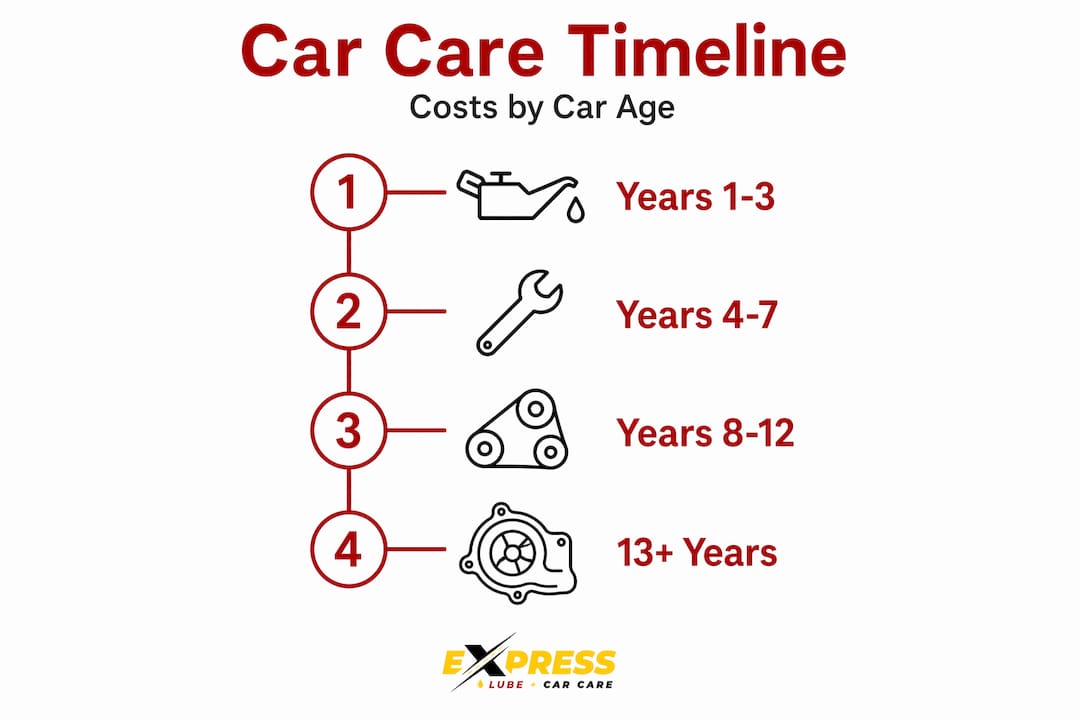
Years 8 to 12 (the expensive zone). This is where major component replacements start appearing. Timing belts on older engines often need replacement around 90,000 to 105,000 miles, running $500 to $1,000. Alternators fail. Suspension components wear out. Budget $1,400 to $1,800 per year.
Years 13 and beyond. You’re playing a different game now. Water pumps, transmission services, struts, and other high-cost repairs become routine possibilities. Budget $1,800 to $2,500 or more depending on the make and model.
| Vehicle Age | Annual Budget Range | Key Milestones to Watch |
|---|---|---|
| 1 to 3 years | $500 to $800 | Oil changes, tire rotations |
| 4 to 7 years | $900 to $1,400 | Brakes, battery, tires |
| 8 to 12 years | $1,400 to $1,800 | Timing belt, alternator, suspension |
| 13+ years | $1,800 to $2,500+ | Water pump, transmission, struts |
Pro Tip: Once your car crosses 100,000 miles, pull a full inspection report. Knowing what’s worn or close to failing lets you prioritize repairs before they become emergencies, and emergency pricing is always higher.
Practical strategies for budgeting car care costs
The single most effective shift you can make is treating your car like a subscription service with a variable monthly rate. Stop thinking of maintenance and repairs as separate categories. Combine them into one vehicle care fund. Combining these into a single monthly budget builds a buffer that absorbs the shock when the unexpected repair arrives.
Here’s a practical framework:
- Calculate your starting point. Take your car’s age, brand, and mileage. Use the ranges in the table above to pick a realistic annual budget. Divide by 12. That’s your monthly deposit.
- Add a buffer for older cars. If your vehicle is over seven years old, add 20% to that monthly number. Older cars don’t send warning signs before expensive repairs.
- Get multiple estimates before authorizing major work. For any repair over $300, it’s worth a second quote. Knowing how repair estimates work in Texas shops helps you spot inflated labor charges or unnecessary upsells.
- Consider negotiating. Many drivers don’t realize repair prices aren’t always fixed. Learning how to negotiate repair prices can save you meaningful money on larger jobs.
- Be skeptical of extended warranties. They sound reassuring, but read the exclusions carefully. Many cover only catastrophic drivetrain failures while excluding the sensors, electrical components, and wear items that actually fail most often.
Monthly car maintenance costs should run $100 to $150 per month for most drivers, rising to $150 to $210 per month for high-mileage or older vehicles. If those numbers feel high, compare them to the alternative: a $1,800 repair with nothing saved.
Pro Tip: Preventative maintenance is the cheapest repair you’ll ever pay for. A $120 coolant flush prevents a $900 head gasket job. A $60 tire rotation extends tire life by 15,000 to 20,000 miles. The math almost always favors staying on schedule.
EVs, hybrids, and luxury cars: cost breakdowns that differ
Not all car care cost analysis looks the same. Electric vehicles and hybrids operate on genuinely different cost curves, and luxury vehicles carry their own complicated profile.
Here’s what the data actually shows about EVs and hybrids:
- Lower routine maintenance costs. No oil changes. Fewer brake replacements thanks to regenerative braking. Fewer moving parts overall means fewer things to service on a schedule.
- Real long-term savings. EV owners can save $7,000 to $11,000 over 7 to 15 years compared to gas vehicle owners when you account for fuel and maintenance together.
- Higher upfront and battery costs. If the battery pack fails outside of warranty, replacement costs can run $5,000 to $15,000 depending on the vehicle. That single expense can erase years of maintenance savings.
- Electricity price sensitivity. The annual savings math for EVs changes depending on your local electricity rates and whether gas prices rise or fall. Operating cost advantages fluctuate year to year based on energy markets.
Luxury vehicles tell a different story. The prestige of the badge comes with a service cost that most buyers underestimate. Specialized technicians, proprietary parts, and complex electronics systems all contribute to what is car care cost breakdown for a luxury owner: significantly more than they expected when they drove off the lot.
My honest take on where drivers go wrong
I’ve watched a lot of car owners wrestle with this, and the pattern I keep seeing is the same mistake played out in different driveways. People plan for the car they hope they have instead of the car they actually have.
In my experience, the most financially stressed car owners aren’t driving luxury vehicles. They’re driving eight-year-old sedans they treat like new ones. They budget for oil changes only and then wonder why every repair feels like a crisis. The moment you accept that an aging vehicle carries aging costs, the whole relationship with your car budget changes.
What I’ve found actually works is this: pick a monthly number that feels slightly uncomfortable to set aside. If $130 a month feels a little high for your current car, that’s probably about right. Because when the alternator goes at 95,000 miles, you’ll be glad you didn’t pick the comfortable number.
I’ve also seen owners transform their spending habits simply by learning which brand they’d bought into. A driver who switched from a domestic sedan to a German import and immediately started budgeting like they were still driving the domestic car. Two years later, the repair bills told a completely different story. Knowing your vehicle’s cost profile isn’t pessimism. It’s just good planning.
— Hassan
Keep your car care budget working at Expresslubearlington

Understanding your car care cost breakdown is the first step. The second step is finding a shop you can trust to keep those costs predictable and fair. At Expresslubearlington, our ASE-certified technicians handle everything from routine oil changes to complex repairs with the same level of precision and transparency. We’re a RepairPal Certified Shop and a CarFax Top-Rated Service Center, which means our pricing and workmanship are independently verified. Check out our oil change specials in Arlington to start building your maintenance routine without breaking your budget. We also offer detailed repair estimates so you always know what you’re paying for before we turn a wrench. Stop by and let’s build a service plan that actually fits your vehicle and your wallet.
FAQ
What does a typical car care cost breakdown include?
A complete vehicle upkeep cost breakdown includes routine maintenance (oil changes, tire rotations, fluid services), unexpected repairs (brakes, battery, sensors), and tires. Annual totals average around $1,656 for 15,000 miles driven.
How much should I budget monthly for car maintenance?
Most drivers should set aside $100 to $150 per month, rising to $150 to $210 for older or high-mileage vehicles. Combining routine and repair costs into one fund prevents financial surprises.
Does my car’s brand affect how much maintenance costs?
Yes, significantly. Annual costs range from $583 for Honda to $1,623 for Porsche, with luxury and European brands consistently requiring larger budgets due to parts and labor complexity.
Are electric vehicles cheaper to maintain than gas cars?
Generally yes. EV owners avoid oil changes and experience less brake wear, and savings of $7,000 to $11,000 over 7 to 15 years are realistic. However, battery replacement costs can offset those savings if they occur outside of warranty.
When do car repair costs start rising sharply?
Costs increase noticeably after the manufacturer warranty expires (typically years 4 to 7) and rise steeply after 100,000 miles when timing belts, alternators, and suspension components commonly need replacement.