

Most car owners use “oil change” and “lube and oil service” as if they mean the same thing. They don’t. Knowing what does lube and oil service include gives you a real picture of what your car actually gets at each visit, and why skipping or shortchanging that service costs you far more in the long run. This guide breaks down every component of a full lube and oil service, explains the benefits of lube and oil maintenance, and helps you figure out exactly how often to schedule it for your specific vehicle and driving habits.
Table of Contents
- Key takeaways
- What a standard oil change actually does
- What’s included beyond the oil change
- Benefits of staying on top of lube and oil service
- How often to schedule lube and oil services
- My take on why the full service matters more than most people think
- Get your full lube and oil service done right
- FAQ
Key takeaways
| Point | Details |
|---|---|
| More than just oil | A lube and oil service includes chassis lubrication, fluid checks, and a multi-point inspection beyond the oil change itself. |
| Filter matters too | Replacing the oil filter is as critical as the oil itself, since a faulty installation can cause leaks post-service. |
| Know your interval | Most vehicles need service every 7,500 to 12,000 miles, but your driving habits and manufacturer guide should set the real schedule. |
| Early detection saves money | Multi-point inspections catch small problems before they become expensive repairs. |
| Tire pressure is included | Most lube service packages adjust tire pressure, which directly affects fuel economy and safety. |
What a standard oil change actually does
Think of engine oil as your engine’s circulatory system. It keeps hundreds of moving metal parts from grinding against each other, carries heat away from critical components, and suspends tiny contaminants so they don’t score your cylinder walls. When that oil breaks down, everything suffers.
A standard oil change covers three core tasks. First, the technician drains the old, degraded oil completely from the engine. Second, the old oil filter gets swapped out for a fresh one. Third, fresh oil is added to the correct level for your engine. That’s the baseline. No more, no less.
Here’s what most people miss: oil changes should happen at least every 12 months or 12,000 miles, whichever comes first. But that’s a general baseline, not a universal rule. Synthetic oil, newer engines, and easy highway driving can stretch that interval. Short trips, dusty environments, and stop-and-go city driving shorten it.
The oil filter swap is where a lot of people get tripped up. That filter catches metal particles, sludge, and debris before they can circulate back into your engine. An old, clogged filter forces dirty oil through, which defeats the entire purpose of a fresh fill. What’s worse, improper filter installation can cause leaks shortly after service, a silent but damaging failure you might not notice until real damage is done.
Pro Tip: After any oil change, check beneath your car 24 hours later. A small puddle of oil near the drain plug or filter is your early warning that something wasn’t seated correctly.
- Drain and replace old engine oil completely
- Install a new oil filter with correct torque and sealing
- Refill with the right oil grade and quantity for your engine
- Check and confirm oil level is within the safe range
- Reset the oil life monitor if your car has one
For a deeper look at how to get the most from each visit, the oil change tips guide at Expresslubearlington covers what to watch for before, during, and after service.
What’s included beyond the oil change
This is where the real value of a full lube and oil service shows up. And this is also where the service gets its name. “Lube” refers to the lubrication of chassis and suspension components that standard oil changes don’t touch. Grease fittings on ball joints, tie rod ends, and driveshaft joints all need fresh lubricant to move smoothly and resist wear.
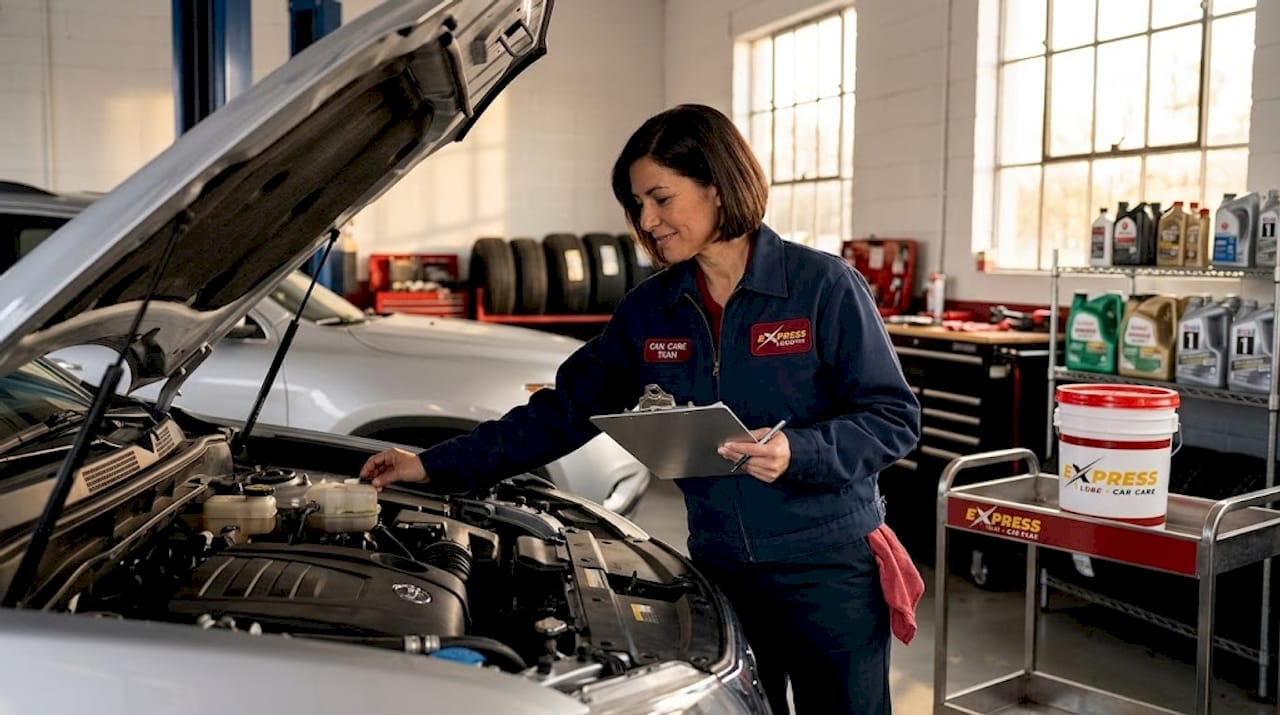
Quick lube services typically include multi-point inspections and fluid top-offs alongside the oil change, aiming for fast, efficient visits that don’t require you to book a full appointment weeks in advance. A full lube service package at a dealership or certified shop goes even further.
Here’s what a comprehensive lube and oil service commonly includes:
- Engine oil drain and refill with up to 5 quarts of conventional or synthetic oil
- Genuine oil filter replacement matched to your vehicle’s specifications
- Chassis lubrication of all accessible grease fittings on suspension and steering parts
- Tire pressure check and adjustment to manufacturer-specified PSI
- Windshield washer fluid top-off to keep visibility clear
- Brake fluid level check with a visual inspection of the reservoir
- Power steering fluid check and top-off if needed
- Multi-point vehicle inspection covering belts, hoses, battery, lights, and more
Tire pressure inspection and adjustment is a standard element in most lube packages, and it matters more than most people realize. Tires at the wrong pressure wear unevenly, reduce fuel economy, and affect how the car handles in an emergency.
Pro Tip: Ask your service provider for a written copy of the multi-point inspection checklist. It gives you a snapshot of your car’s condition and flags items to watch before they become repairs.
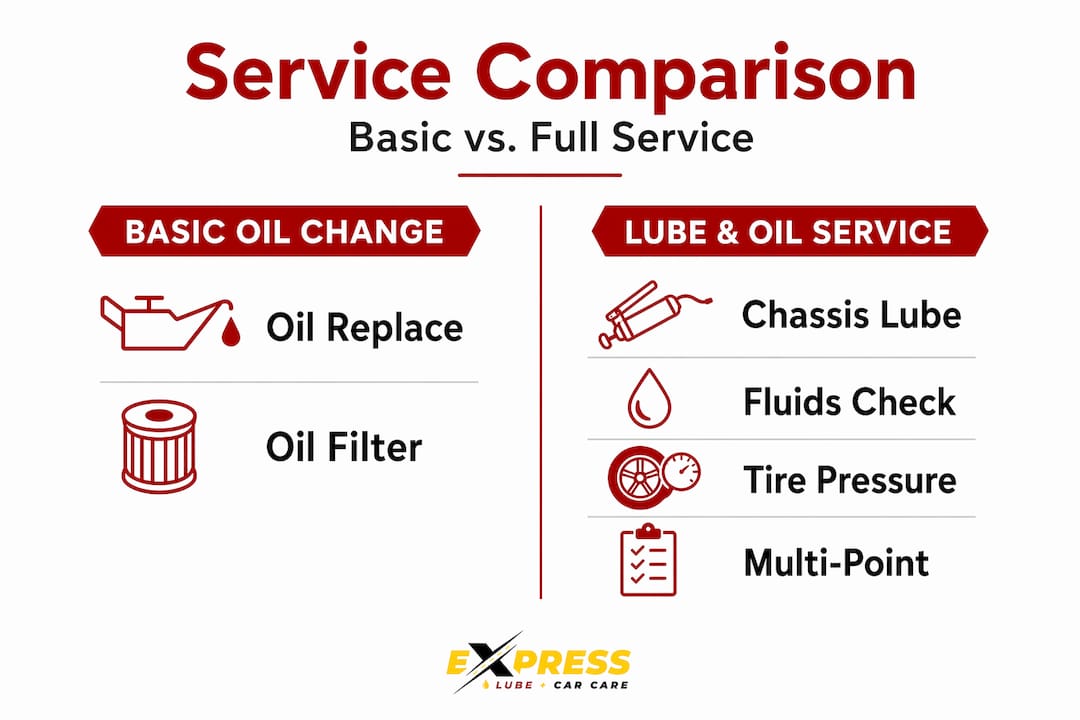
The table below shows how a basic oil change compares to a full lube and oil service:
| Service Element | Basic Oil Change | Full Lube and Oil Service |
|---|---|---|
| Engine oil replacement | Yes | Yes |
| Oil filter replacement | Yes | Yes |
| Chassis lubrication | No | Yes |
| Tire pressure adjustment | Sometimes | Yes |
| Fluid top-offs | No | Yes |
| Multi-point inspection | No | Yes |
| Battery and belt check | No | Yes |
The gap between these two service types is significant. If you’ve been booking a basic oil change and assuming your car is fully covered, now you know what you’ve been missing.
Benefits of staying on top of lube and oil service
Regular lube and oil service is one of the highest-return maintenance habits you can build. Let’s talk about what you actually get out of it.
Routine maintenance contributes directly to improved fuel efficiency and extends engine lifespan by reducing friction and catching early mechanical issues before they compound. That’s not a marketing claim. Engines that run on clean oil and properly lubricated components simply work less hard, and working less hard means burning less fuel.
The benefits of lube and oil go well beyond the engine itself:
- Reduced engine wear: Clean oil with proper viscosity keeps metal surfaces separated. Dirty, degraded oil turns into an abrasive sludge that scores cylinder walls and bearing surfaces.
- Cooler running temperatures: Fresh oil transfers heat away from the combustion chamber more efficiently. Old oil loses this capacity.
- Early problem detection: Multi-point inspections catch cracking belts, low brake fluid, and failing hoses before they leave you stranded.
- Better fuel economy: Low tire pressure and dirty oil both drag down your MPG. A lube service corrects both.
- Extended vehicle life: Cars maintained on a consistent oil maintenance guide schedule routinely last well past 200,000 miles. Neglected cars often don’t make it to 100,000 without major repairs.
- Safety assurance: Brake fluid checks, tire pressure adjustments, and light inspections directly affect how safely your car performs when you need it most.
“The cheapest repair is the one you prevent. A $60 lube service that catches a cracked belt saves you from a $400 tow and a $600 repair.”
That’s the real math on this. Missing routine service feels like saving money. It’s actually a slow accumulation of risk that pays out all at once in the worst possible moment.
How often to schedule lube and oil services
This part trips up a lot of car owners because the answer genuinely depends on several factors. There’s no single correct interval that applies to every vehicle in every situation.
Here’s a practical framework for figuring out your schedule:
- Start with your owner’s manual. Manufacturer recommendations should be your first reference point. They’re calibrated to your specific engine design, oil capacity, and expected driving conditions.
- Use 7,500 to 12,000 miles as your baseline window. Most modern vehicles with synthetic oil fall somewhere in this range under normal driving conditions.
- Adjust for your actual driving habits. Short trips under 5 miles don’t let the engine fully warm up, which means more moisture and fuel contamination in the oil. Those drivers need more frequent service.
- Factor in your environment. Dusty roads, extreme heat, and cold climates all accelerate oil degradation and increase wear on chassis components.
- Watch for warning signs between scheduled visits. Dark, gritty oil on the dipstick, a burning oil smell, or the oil light flickering are all signals your car is telling you not to wait.
Oil change intervals are best viewed as flexible guidelines shaped by driving habits, environment, and manufacturer advice rather than rigid rules you follow blindly. Your car maintenance schedule by mileage guide can help you map out the right intervals across all your vehicle’s maintenance needs.
Stat to know: Drivers who follow their manufacturer’s maintenance schedule report fewer unexpected breakdowns and significantly lower average repair costs over the vehicle’s lifespan compared to those who skip or delay routine service.
My take on why the full service matters more than most people think
I’ve worked around car maintenance long enough to notice a pattern. Most of the people who come in with serious engine problems didn’t skip maintenance out of laziness. They just didn’t know what they were paying for. They thought an oil change covered everything. It doesn’t.
What I’ve found is that the multi-point inspection is the part of a lube and oil service that quietly saves the most money. It’s easy to skip when you’re busy. It feels like an upsell. But I’ve personally watched a routine lube service flag a cracked serpentine belt that would have snapped on the highway two weeks later. That’s a $75 fix that prevented a $400 tow and a very bad afternoon.
The other thing I’d tell you honestly: not every shop does the full version of what a lube and oil service is supposed to include. Ask specifically what’s on the checklist before you hand over your keys. A shop that can’t or won’t tell you exactly what they inspect is a shop that probably isn’t doing all of it.
Balancing cost and maintenance is real. But the data is pretty clear. Consistent lube service, done right, is one of the lowest-cost ways to protect the most expensive machine most of us own outside of our homes.
— Hassan
Get your full lube and oil service done right
At Expresslubearlington, we don’t cut corners on what a lube and oil service is supposed to include. Our ASE-certified technicians handle the full package: engine oil and filter replacement, chassis lubrication, fluid top-offs, tire pressure adjustment, and a thorough multi-point inspection. Every visit. No exceptions.
We’re a RepairPal Certified Shop and a CarFax Top-Rated Service Center, which means you can trust that the work gets done right the first time. Check out our current oil change specials to see how affordable proper maintenance can be. And if you want to know more about getting the most from every service visit, our car owner’s oil guide has you covered.
Stop by and let us show you what thorough service actually looks like.
FAQ
What does lube and oil service include?
A full lube and oil service includes an engine oil and filter change, chassis lubrication, tire pressure adjustment, fluid top-offs, and a multi-point vehicle inspection. The exact components vary by provider, so always ask for a written service checklist.
How is a lube service different from a basic oil change?
A basic oil change only covers draining and replacing the engine oil and filter. A lube and oil service adds chassis lubrication, fluid level checks, tire pressure adjustment, and a multi-point inspection of belts, hoses, brakes, and lights.
How often should I get a lube and oil service?
Most vehicles need service every 7,500 to 12,000 miles or at least once a year. Your owner’s manual and manufacturer’s schedule should be your primary guide, adjusted for your specific driving conditions.
What happens if I skip lube and oil service?
Skipping service allows oil to degrade into sludge, increases engine wear, and leaves small problems undetected until they become expensive repairs. Chassis components without fresh lubrication wear faster and can cause handling problems.
Is tire pressure really part of a lube service?
Yes. Tire pressure checks and adjustments are a standard part of most lube and oil service packages because proper inflation affects fuel economy, tire wear, and vehicle safety.