

Most car owners have heard the term “full-service car care” thrown around at the shop, but very few know what it actually covers. If you’ve ever assumed it just means an oil change with a tire pressure check, you’re not alone. Understanding what does full-service car care mean is the difference between staying ahead of expensive repairs and getting blindsided by a breakdown. This article breaks down every component, clears up the confusion, and gives you the practical knowledge to make smarter decisions about your vehicle’s maintenance.
Table of Contents
- Key takeaways
- What full-service car care actually means
- Full service vs. other types of car services
- Why the benefits of full-service car care go beyond convenience
- When to schedule a full service and how to prepare
- My take on why this matters more in 2026
- Experience real full-service car care at Expresslubearlington
- FAQ
Key takeaways
| Point | Details |
|---|---|
| More than oil changes | Full-service car care covers fluids, filters, brakes, tires, suspension, electrical, and exhaust systems. |
| Schedule every 12,000 miles | Most vehicles benefit from a full service annually or at 12,000-mile intervals. |
| Protects resale value | A documented full-service history makes your car more attractive and valuable to buyers. |
| Distinct from detailing | Detailing focuses on appearance; full-service auto maintenance addresses mechanical health. |
| Catch problems early | Multi-point inspections during full service spot faults before they become costly repairs. |
What full-service car care actually means
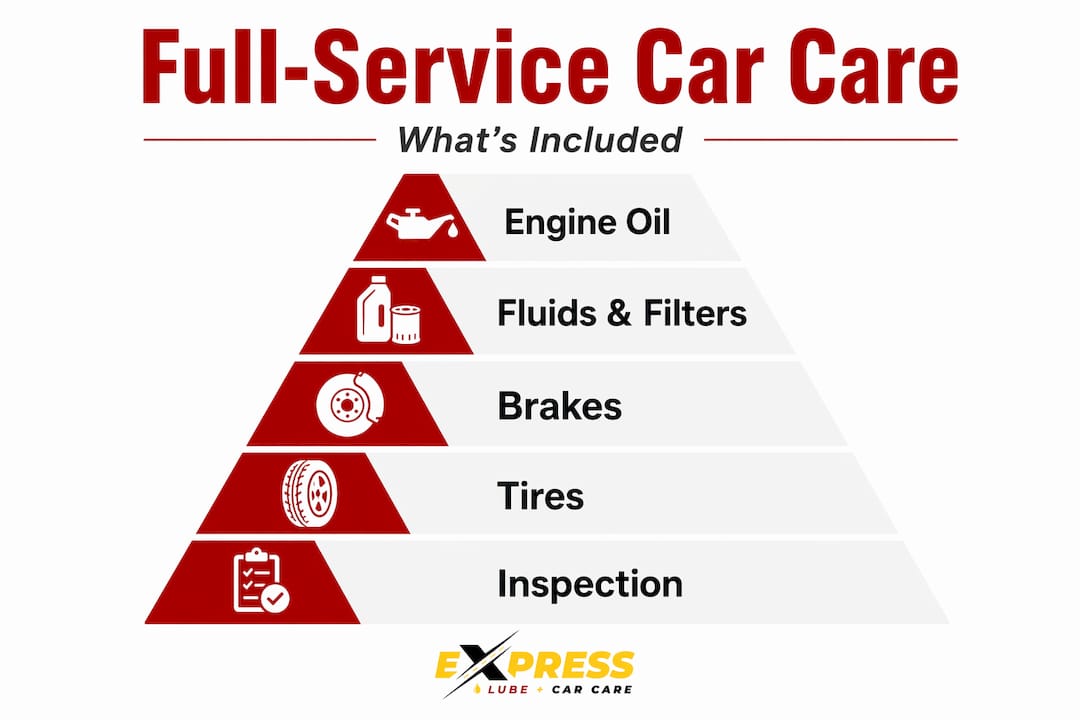
Let’s set the record straight. Full-service car care is not a glorified oil change. It is a comprehensive vehicle maintenance checkup that evaluates and addresses virtually every major system in your vehicle at once. Think of it like a physical exam at the doctor’s office. You are not just checking one thing. You are getting the whole picture.
A true full service includes a multi-point inspection covering fluids, filters, brakes, tires, suspension, steering, electrical, and exhaust components. That is a significant scope, and it is why full-service visits take longer than a quick lube stop. You can realistically expect 3 to 5 hours depending on your vehicle’s needs and what the inspection turns up.
Here is what a standard full service typically covers:
- Engine oil and filter replacement
- Coolant, brake fluid, power steering fluid, and transmission fluid checks
- Air filter and cabin filter inspection or replacement
- Brake pad thickness and brake system inspection
- Tire condition, tread depth, and pressure check
- Suspension and steering component check
- Exhaust system inspection for leaks or damage
- Battery health and electrical system check
- Belts and hoses inspection
- Seat belt and safety system check
That list is the meaning of full-service car care made tangible. Each item on it protects a different part of your vehicle’s reliability and safety.
Pro Tip: Always ask your shop for a written checklist of what was inspected and what was replaced. It takes 30 seconds to request and gives you a full paper trail for resale purposes.
Full service vs. other types of car services
Understanding what full-service vehicle service means gets even clearer when you compare it side by side with other common services. A lot of drivers use these terms interchangeably, and that confusion costs them.
| Service Type | What It Covers | Mechanical Focus | Appearance Focus |
|---|---|---|---|
| Full service | All major systems: fluids, filters, brakes, tires, suspension, electrical, exhaust | Yes, extensive | No |
| Basic oil change | Engine oil and filter only | Minimal | No |
| Tune-up | Spark plugs, ignition system, air filter, fuel system | Yes, but limited | No |
| Interim service | Partial checks, oil change, key fluid top-offs | Moderate | No |
| Full detail | Paint decontamination, interior deep clean, protective coatings | No | Yes, extensive |
The oil change is the most misunderstood comparison. A standard oil change touches your engine oil and filter. That is one item from a list of ten or more. An interim service steps it up a notch with some fluid top-offs and a few checks, but it does not go deep into brakes, suspension, or electrical systems the way a full service does.
The detailing comparison is worth a moment of attention. A full detail is a top-to-bottom reconditioning of your car’s surfaces, covering paint decontamination, interior deep cleaning, and protective coatings. It is genuinely impressive work for your car’s appearance. But it does nothing for your brake pads, your coolant level, or the health of your serpentine belt. Full-service auto maintenance and mobile detailing serve completely different purposes, and you honestly need both on a regular schedule.
A tune-up is another common point of confusion. Tune-ups focus on the ignition and fuel delivery systems: spark plugs, ignition coils, air filters, and sometimes fuel injectors. That is a meaningful service, but it is a subset of what a full service covers. Think of a tune-up as working on one instrument while a full service tunes the entire orchestra.
Why the benefits of full-service car care go beyond convenience
Getting a full service is not just about checking boxes. It is about keeping your car safe, extending its life, and protecting your wallet over the long term.
“Regular inspections during full service can catch faults early, preventing costly repairs and unsafe driving conditions.”
Here is what that looks like in practice:
- Brake inspection catches worn pads early. Replacing brake pads costs roughly $150 to $300 per axle. Ignoring them until the rotors are damaged pushes that bill past $600 easily.
- Suspension checks reveal worn bushings or shocks. Left unchecked, bad suspension damages tires unevenly, meaning you replace tires far sooner than necessary.
- Battery health checks prevent unexpected no-starts. A dead battery on a cold morning is a minor inconvenience. One that fails mid-highway is a genuine safety issue.
- Coolant system checks prevent overheating. Engine overheating is one of the most expensive failures a car can experience. A single missed coolant flush can lead to a cracked head gasket.
Beyond repairs, full-service history improves a vehicle’s resale value by showing meticulous care. When a buyer sees documented, consistent maintenance records, they see a car that has been taken seriously. That confidence translates directly into higher offers. If you want to understand exactly how service history affects what buyers will pay, check out these proven resale tips that go deeper on the subject.
When to schedule a full service and how to prepare
Knowing what full-service car care covers is only half the equation. The other half is knowing when to go and how to get the most out of the visit.
- Follow mileage intervals. Full-service maintenance every 12,000 miles or once per year is the widely accepted standard. If you drive in extreme conditions, like stop-and-go city traffic, extreme heat, or towing loads regularly, bump that to every 7,500 to 10,000 miles.
- Watch for warning signs. Dashboard warning lights, unusual vibrations, pulling to one side, strange smells, or a decrease in fuel economy are all signals that a full inspection should not wait for the calendar.
- Check your owner’s manual. Manufacturers build specific service schedules into their manuals. These schedules account for your engine type, drivetrain, and climate recommendations. Your manual is the most accurate guide you have.
- Choose a certified shop. Look for ASE-certified technicians and shops with RepairPal certification or a strong CarFax rating. These credentials are not just marketing. They represent real accountability to industry standards. You can use a car maintenance schedule guide to stay on track between full service visits.
- Ask the right questions before you commit. Ask what is included in the service price, what will be replaced versus just inspected, and how long the visit will take. A reputable shop will answer all of this without hesitation.
Pro Tip: Before your full service appointment, jot down any odd sounds, smells, or behaviors your car has shown in recent weeks. Give that list to your technician at drop-off. It points them directly to potential problem areas and saves diagnostic time.
My take on why this matters more in 2026

I have talked to a lot of car owners over the years who thought they were staying on top of maintenance simply because they changed their oil on time. That is like saying you brush your teeth so you do not need to see a dentist. It is not wrong, but it is a very incomplete picture of what your vehicle actually needs.
What I have seen over and over is that the owners who skip full-service visits are not doing it because they do not care. They do it because nobody ever clearly explained what a full service actually includes. They hear a price tag and assume it is just a fancier oil change with extra steps. So they skip it. And then six months later, they are facing a $1,200 repair that a $50 brake inspection would have prevented.
Modern vehicles are more technologically complex than ever. More sensors, more software-driven systems, more interdependent components. That complexity makes full-service inspections more useful now than they were ten years ago, not less. An ASE-certified technician running a comprehensive check today can spot a failing oxygen sensor, a marginal battery, or early suspension wear before your car’s computer even throws a warning light.
My honest advice? Stop thinking of a full service as optional maintenance. It is the baseline for responsible ownership. And if you want to make your car last longer, comprehensive scheduled servicing is the single most reliable way to get there.
— Hassan
Experience real full-service car care at Expresslubearlington
At Expresslubearlington, full-service car care is exactly what it sounds like: thorough, honest, and done right the first time. Our ASE and RepairPal certified technicians go well beyond oil changes, covering every major system your vehicle depends on. We are proud to be a CarFax Top-Rated Service Center, and that recognition reflects our commitment to doing the job properly every single time. Whether you are coming in for a scheduled full service or responding to a warning sign, we have the tools and expertise to give you a clear picture of your vehicle’s health. Drivers across the DFW area count on us to keep their cars running safely and smoothly. Come see why.
FAQ
What does a full-service car care visit include?
A full service covers engine oil and filter replacement, fluid checks and top-offs, brake inspection, tire condition check, suspension and steering inspection, electrical system check, exhaust inspection, and belt and hose evaluation. It is a comprehensive check of every major vehicle system.
How often should you get a full service?
Most vehicles should receive a full service every 12,000 miles or once per year, whichever comes first. Drivers in demanding conditions like heavy traffic, extreme heat, or frequent towing may benefit from servicing at shorter intervals.
Is a full service the same as an oil change?
No. An oil change only replaces your engine oil and filter. A full service includes the oil change as one component among many, also addressing brakes, tires, suspension, fluids, filters, electrical systems, and more.
How is full-service car care different from detailing?
Full-service auto maintenance addresses the mechanical health and safety of your vehicle. Detailing focuses entirely on appearance through cleaning, paint decontamination, and protective coatings. Both are valuable, but they serve completely different purposes.
Does full-service history affect resale value?
Yes. A documented full-service history signals to buyers that the vehicle has been well maintained, which directly supports a higher asking price and faster sale.