

The auto repair industry operates through a structured system of vehicle diagnostics, parts sourcing, labor billing, and customer authorization that most car owners never see. Understanding how auto service works gives you real power at the counter. You stop guessing at estimates and start asking the right questions. This guide breaks down mechanic shop operations from the moment you hand over your keys to the moment you drive away, with honest insight into what shops charge, why repairs take time, and how to work with your technician instead of against them.
How the auto repair industry works from drop-off to delivery
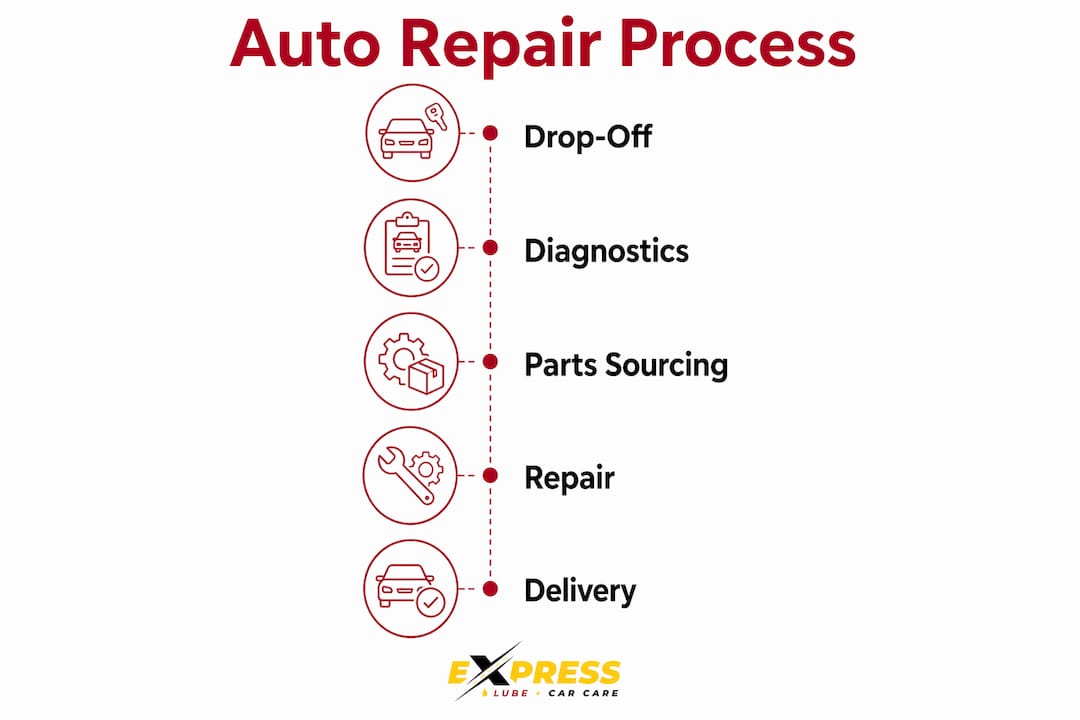
The auto repair process follows a defined sequence, and knowing each step helps you set realistic expectations. Here is what happens behind the scenes:
- Vehicle intake. A service advisor records your VIN, mileage, and complaint. The VIN decodes your vehicle’s exact build, which determines compatible parts and applicable technical service bulletins from the manufacturer.
- Diagnostic inspection. A technician connects a scan tool, performs a visual inspection, or runs a road test to identify the root cause. This is not guesswork. It is a structured process of elimination.
- Customer authorization. Before any parts are ordered or labor begins, the shop contacts you with a written estimate. Nothing moves forward without your approval.
- Parts ordering and staging. Once you authorize the repair, parts are ordered from the supply chain and staged at the technician’s bay. Keeping parts close to the bay matters more than it sounds. Idle technician time costs roughly $0.53 per minute for a technician earning $32 per hour, so every trip away from the bay eats into efficiency.
- Repair execution. The technician completes the work, documents findings, and performs a quality check before the vehicle returns to the service advisor.
- Final invoice and delivery. You receive an itemized invoice explaining every charge before you pay.
Pro Tip: When you drop off your vehicle, write down your complaint in plain language before you arrive. “Grinding noise when braking at highway speeds” is far more useful to a technician than “something sounds wrong.”
The types of auto repair services a shop offers also shape how work is triaged and assigned. Routine oil changes move fast. Complex electrical faults wait in a diagnostic queue.

How labor is priced and billed at a repair shop
Labor pricing is where most car owners feel lost, and that confusion is understandable. The number on your invoice rarely matches the clock time a technician spent on your car. Here is why.
Most shops bill using flat-rate labor, a system where each repair job carries a pre-assigned time value from a guide like Mitchell1 or AllData. If the guide says a water pump replacement takes 3.5 hours, you pay for 3.5 hours whether the technician finishes in 3 hours or 4. This system rewards skilled, experienced technicians and creates predictable pricing for customers.
| Billing Method | How it works | Best for |
|---|---|---|
| Flat-rate billing | Charges a fixed time per job from a labor guide | Most standard repairs and maintenance |
| Actual hours | Charges time the technician clocked on the job | Diagnostic work, unusual repairs |
| Diagnostic fee | One flat-rate hour, typically $75 to $200 | Initial fault finding before repair authorization |
Diagnostic fees typically charge one flat-rate labor hour, ranging from $75 to $200, and are often credited toward the final repair if you approve the work. This protects the shop’s time and ensures technicians are paid for skilled diagnostic work, not just turning wrenches.
A shop’s posted labor rate is not arbitrary. Labor rate calculation targets roughly three times the loaded hourly cost of a technician to cover wages, benefits, tools, and overhead. Healthy shops target a 65 to 70% gross margin on labor and typically collect around 90% of billed hours after discounts and warranty adjustments. That 10% gap represents goodwill discounts, warranty redo work, and internal adjustments.
Pro Tip: Ask your service advisor whether the diagnostic fee applies toward the repair total. At most reputable shops, it does. If it does not, that is worth knowing before you authorize anything.
Understanding how auto repair estimates work in Texas shops gives you a clearer picture of what you are actually paying for and why labor costs vary between shops.
How parts sourcing and pricing work in auto repair shops
Parts pricing follows a layered supply chain that adds margin at every level. Parts move from manufacturers to warehouse distributors, then to jobbers like NAPA or O’Reilly Auto Parts, and finally to repair shops. Each tier adds service value and margin. By the time a part reaches your vehicle, it has passed through three or four hands.
Shops do not apply a flat percentage markup on every part. That approach fails on both ends. A 40% markup on a $5 filter is barely worth billing. A 40% markup on a $900 ABS module is difficult to justify to a customer. Instead, most shops use a tiered markup matrix where lower-cost parts carry higher percentage markups and high-value parts carry lower ones. Tiered markup systems recover overhead and inventory costs fairly across different part prices.
Here is what that looks like in practice:
- Parts under $25: markup of 100% or more
- Parts between $25 and $100: markup of 50 to 80%
- Parts between $100 and $300: markup of 30 to 50%
- Parts over $300: markup of 20 to 30%
Shops also manage inventory using min-max stocking for fast-moving items like oil filters, brake pads, and belts. Dead-stock audits clear out slow-moving parts that tie up cash. When a part like a brake caliper is replaced, the old unit is returned to the supplier for a core charge refund, which reduces the net cost of the new part. This core return process is a real financial mechanism, not just a formality.
Consolidating supplier relationships improves volume-based pricing tiers, which is why shops that buy heavily from one jobber often get better pricing than shops that spread purchases across many suppliers. That savings can flow back to you as a customer.
What factors affect repair timelines and how you can help
Auto repair shops operate like hospital emergency rooms, triaging vehicles based on complexity and urgency. A quick oil change gets fast-tracked. A no-start condition with intermittent faults joins a diagnostic queue. That triage system is not random. It reflects how technician time and bay space are allocated.
Several factors can stretch a repair timeline beyond what anyone expects:
- Parts delays. A part ordered Monday morning from a local jobber may arrive same-day. A specialty part for a European vehicle may take three to five days. Mis-shipments add another cycle.
- Software updates. Modern software flashing can turn a planned 10-minute update into a 3-hour troubleshooting session if connectivity or tool compatibility issues arise.
- ADAS recalibration. Approximately 65% of collision repairs require Advanced Driver Assistance Systems recalibration after work affecting sensors, glass, or vehicle geometry. This step cannot be skipped. It is a safety requirement.
- Authorization delays. Slow customer responses commonly add hours or days to a repair timeline. When a vehicle loses its slot in the technician’s schedule, it goes back in the queue.
Pro Tip: Keep your phone available and respond to shop calls quickly. A 15-minute callback window keeps your vehicle moving. A 4-hour delay can push your car to the next day.
What best practices separate trustworthy shops from the rest
Profitability and customer trust are not opposites. The shops that earn both follow a consistent set of practices that you can look for as a consumer.
Transparent, itemized invoices are the baseline. Every line item should describe the part, the labor operation, and the time charged. Vague entries like “misc. repairs” are a red flag. Shops that itemize invoices and communicate recommended future work build long-term customer relationships because they treat you as a partner in your vehicle’s care, not a transaction.
Technician efficiency is tracked through flag hours versus clock hours. Monitoring flag hours against actual time worked reveals whether a shop is running efficiently or losing money on poorly estimated jobs. A well-run shop keeps these numbers close. That discipline keeps pricing fair and prevents cost overruns from landing on your invoice.
| Best practice | What it means for you |
|---|---|
| Itemized invoices | You see exactly what you paid for, part by part |
| Recommended deferred work | You learn about future issues before they become emergencies |
| ASE-certified technicians | Work meets a nationally recognized competency standard |
| RepairPal or CarFax certification | Third-party verification of pricing fairness and quality |
| Written estimates before work | No surprises on the final bill |
Certifications matter more than most car owners realize. ASE and RepairPal certification signals that a shop meets external standards for pricing, workmanship, and customer communication. These are not self-awarded badges. They require ongoing verification.
Key takeaways
The auto repair industry runs on a structured workflow of diagnostics, parts sourcing, flat-rate labor billing, and customer authorization, and understanding each step puts you in control of every repair decision.
| Point | Details |
|---|---|
| Flat-rate labor billing | You pay a guide-set time per job, not the clock time a technician spent. |
| Diagnostic fees are standard | Fees of $75 to $200 are normal and often credited toward approved repairs. |
| Parts follow a tiered supply chain | Markup varies by part cost; shops use matrices, not flat percentages. |
| Authorization speed affects timelines | Responding quickly to shop calls keeps your vehicle in the repair queue. |
| Certifications signal trustworthiness | ASE, RepairPal, and CarFax ratings verify quality and pricing fairness. |
What I’ve learned watching car owners navigate repair shops
I have spent years watching car owners walk into shops feeling like they are about to lose a negotiation. Most of that anxiety comes from one thing: not knowing the rules of the game. Once you understand that flat-rate billing is a standardized system, not a number a service advisor invented, the whole experience shifts.
The single most underused tool a car owner has is the written estimate. You have the right to see it before any work begins. Read every line. Ask what each labor operation means. A good service advisor will explain it without hesitation. One who deflects or rushes you past the estimate is showing you something important about how that shop operates.
Modern vehicles have genuinely changed the complexity of repairs. ADAS recalibration, software flashing, and module programming are not upsells. They are real technical requirements that take real time. When a shop explains that your repair includes a recalibration step, that is transparency, not padding.
My honest recommendation is to choose a shop with third-party certification before you need a major repair. Finding a certified shop in your area before an emergency means you are not making that decision under pressure. You want to walk in as a known customer, not a stranger with a broken car.
— Hassan
Trusted auto repair and maintenance in Arlington, TX
If this breakdown of mechanic shop operations has you thinking about your own vehicle’s needs, the next step is straightforward.
Expresslubearlington is a RepairPal Certified Shop and a CarFax Top-Rated Service Center serving drivers across the DFW area. Our ASE-certified technicians handle everything from routine maintenance to complex repairs with written estimates, itemized invoices, and zero surprises. Right now, you can save with $45 off mechanical repairs on your next visit. Whether you are due for an oil change or facing a more involved repair, our team is ready to walk you through every step. Visit our certified repair services page to learn what our credentials mean for your vehicle.
FAQ
What is flat-rate labor billing in auto repair?
Flat-rate billing charges a fixed time per repair job based on a labor guide, not the actual clock time a technician spent. This creates predictable pricing for customers and rewards efficient, experienced technicians.
How much does a diagnostic fee typically cost?
Diagnostic fees generally range from $75 to $200, equivalent to one flat-rate labor hour. Most shops credit this fee toward the final repair cost if you approve the work.
Why do auto repairs sometimes take longer than expected?
Delays come from parts availability, software update complications, ADAS recalibration requirements, and slow customer authorization. Responding quickly to shop calls is the single fastest way to keep your repair on schedule.
How do auto repair shops price parts?
Shops source parts through a multi-tier supply chain and apply tiered markup matrices rather than flat percentages. Lower-cost parts carry higher markups; high-value parts carry lower ones to keep pricing fair across the board.
What certifications should I look for in a repair shop?
ASE certification confirms technician competency. RepairPal and CarFax certifications verify pricing fairness and service quality through third-party review. Shops holding all three have met external standards, not just self-reported them.