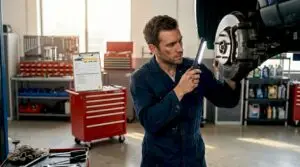

TL;DR:
- Regular drivetrain maintenance helps prevent costly repairs by keeping components like the transmission, differential, axles, and joints well-lubricated and in good condition.
- Neglecting routine service can lead to severe damage and expenses exceeding $18,000, while early symptom detection saves money and extends vehicle lifespan.
Drivetrain maintenance is defined as the routine inspection, lubrication, fluid replacement, and repair of the components that transfer engine power to your wheels, including the transmission, driveshaft, differential, axles, and CV and U-joints. Most car owners think about oil changes and tire rotations, but the drivetrain is the real workhorse moving your vehicle forward. Neglect it, and you are looking at repair bills that can reach five figures. Keep up with it, and your car rewards you with smooth acceleration, better fuel efficiency, and years of reliable driving.
What is drivetrain maintenance and which components does it cover?
The drivetrain is every mechanical part between your engine’s output and your wheels. The transmission converts engine torque into usable wheel speed. The driveshaft carries that rotational force to the differential, which splits power between the left and right wheels. Axles then deliver that power directly to each wheel. CV joints (constant velocity joints) and U-joints (universal joints) allow the axles and driveshaft to flex as your suspension moves.
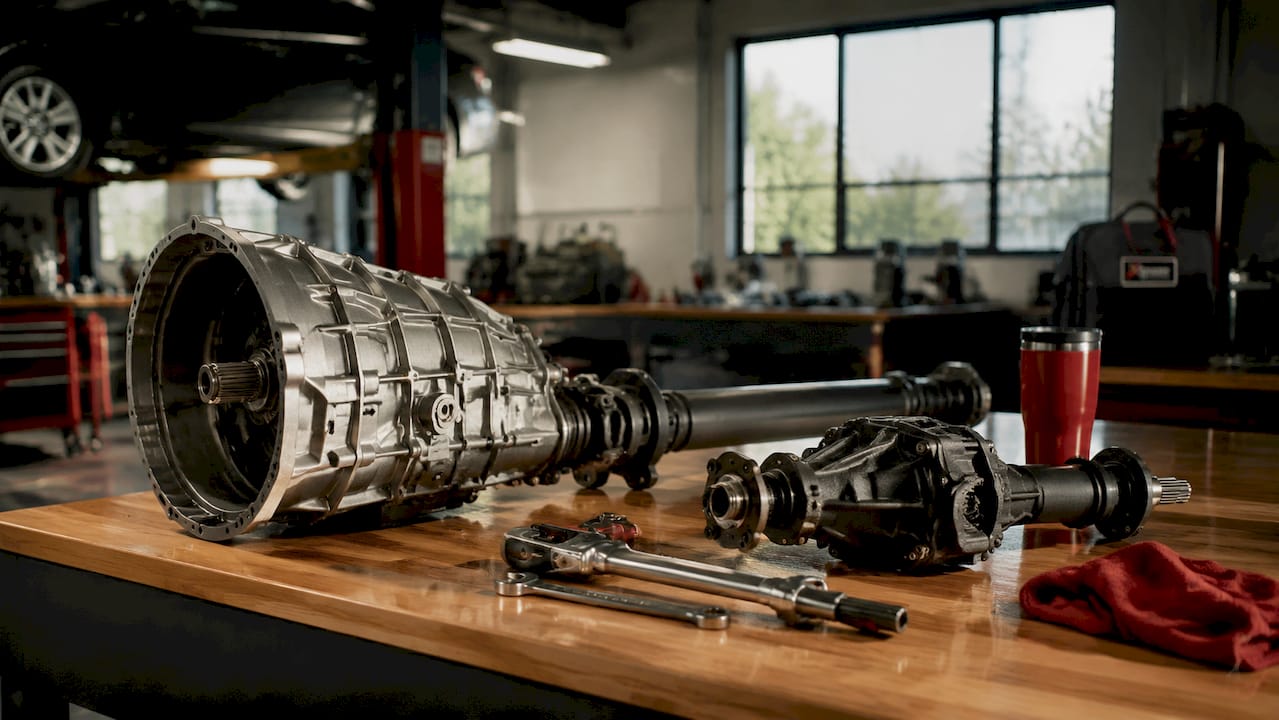
Each of these parts has specific upkeep needs. The transmission requires clean fluid to lubricate its gears and clutch packs. The differential needs gear oil to protect its ring and pinion gears. CV joints rely on grease packed inside rubber boots, and U-joints need periodic lubrication through grease fittings or scheduled replacement.
Drivetrain type also shapes your maintenance schedule by mileage. Front-wheel-drive (FWD) vehicles have CV joints at both ends of each axle. Rear-wheel-drive (RWD) vehicles use a driveshaft and U-joints. All-wheel-drive (AWD) and four-wheel-drive (4WD) systems combine elements of both, adding a transfer case that also needs its own fluid changes. More components mean more maintenance touch points.
- Transmission: Fluid change every 30,000–60,000 miles; inspect for leaks at every service
- Differential (front, rear, or both): Gear oil change every 30,000–60,000 miles under normal use
- Transfer case (AWD/4WD only): Fluid change on the same general schedule as the differential
- CV joints: Inspect boots at every oil change; replace cracked or torn boots immediately
- U-joints: Check for play and roughness; lubricate or replace per manufacturer schedule
- Axle seals and bearings: Inspect for leaks and noise; replace seals before fluid loss causes damage
Pro Tip: If you drive an AWD or 4WD vehicle, ask your technician to check the transfer case fluid at every drivetrain service. It is one of the most commonly skipped fluids, and running it low causes expensive damage fast.
How often should you schedule drivetrain service?
Industry standards recommend differential fluid changes every 30,000–60,000 miles for normal driving conditions. That interval drops to 15,000–40,000 miles under severe duty, which includes towing, off-road driving, stop-and-go city traffic, or extreme heat. Severe conditions are more common than most drivers realize. If you tow a trailer even occasionally, your drivetrain qualifies as working under severe duty.
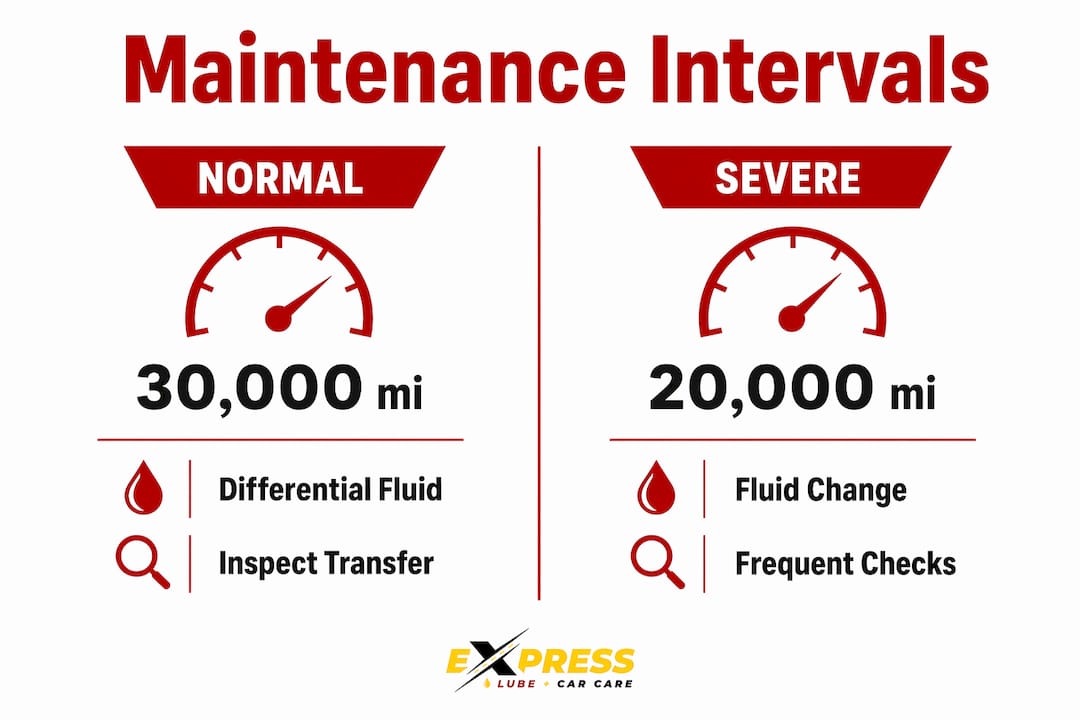
Real-world driving under severe conditions shortens fluid service intervals by 20–40% compared to manufacturer recommendations. That means a fluid rated for 60,000 miles may need replacement at 36,000–48,000 miles if you drive hard. Adjusting your schedule to match your actual driving habits protects your investment.
Drivetrain fluids are not lifetime fluids, regardless of what a sticker or owner’s manual might suggest. Neglecting fluid changes leads to metal particle contamination, which accelerates wear on every surface the fluid touches. Replacing fluid every 3–5 years, even if you have not hit the mileage threshold, is a sound practice for low-mileage drivers.
| Service | Normal conditions | Severe conditions |
|---|---|---|
| Differential fluid change | 30,000–60,000 miles | 15,000–40,000 miles |
| Transfer case fluid change | 30,000–60,000 miles | 15,000–40,000 miles |
| CV boot inspection | Every oil change | Every oil change |
| U-joint inspection | Every 12 months | Every 6 months |
| Axle seal inspection | Every 12 months | Every 6 months |
What are the signs of drivetrain issues you should not ignore?
Symptoms like vibration, clunking, leaking fluid, grinding noises during turns, and poor acceleration are the drivetrain’s way of sending up a flare. None of these are normal wear sounds. Each one points to a specific problem that gets worse, and more expensive, the longer you wait.
A clunking sound when you shift from park to drive usually signals worn U-joints. Vibration that increases with speed often points to a driveshaft imbalance or a failing CV joint. Grinding or humming from the rear of the vehicle under load suggests the differential fluid is low or contaminated. A torn CV boot is easy to spot visually: look for dark grease splattered around the inner wheel well.
Visual inspections alone may miss internal U-joint wear. A joint can look clean and intact while already failing internally. Checking for play by gripping the driveshaft and trying to rotate it by hand reveals looseness that the eye cannot catch. Measuring driveshaft runout with a dial indicator is the professional method for detecting hidden imbalance.
- Vibration at highway speed: Check driveshaft balance and CV joints first
- Clunking on acceleration or deceleration: Inspect U-joints and differential mounts
- Grinding noise in turns: Worn CV joint; replace before the joint fails completely
- Fluid puddle under the rear of the vehicle: Differential or axle seal leak; address immediately
- Shudder when engaging 4WD: Transfer case fluid may be low or the clutch pack is worn
Pro Tip: Fluid analysis, where a small sample is sent to a lab for particle testing, detects wear contamination before visible damage appears. Fleet operators use this technique routinely. It works just as well for personal vehicles and can prevent major repairs before they start.
What does drivetrain maintenance actually cost, and what does neglect cost?
Routine drivetrain service is genuinely affordable. A differential fluid change costs $80–$320 depending on vehicle type and whether you have a front, rear, or both differentials serviced. A U-joint replacement runs around $320 as a planned repair. These are manageable numbers that fit into any maintenance budget.
Neglect flips those numbers dramatically. Here is what deferred maintenance actually costs:
- Differential failure: Repair costs range from $4,200 to $18,000 depending on the vehicle and severity of damage. A single missed fluid change can set this in motion.
- Emergency U-joint replacement: A U-joint that fails on the road costs approximately $3,200 in emergency repairs, roughly ten times the cost of planned maintenance.
- CV axle replacement: Ignoring a torn CV boot leads to joint failure. Replacing the full axle assembly costs significantly more than replacing the boot alone.
- Roadside assistance and towing: A drivetrain failure that leaves you stranded adds towing fees and lost time on top of the repair bill.
The math is straightforward. Preventative maintenance costs a fraction of reactive repairs. A systematic service approach, covering inspection, fluid assessment, part replacement, and a test drive to confirm restored performance, is the standard used by certified technicians to catch problems before they compound. You can read more about the financial case for auto repair to see how these numbers stack up across common vehicle systems.
Practical drivetrain care tips you can use between services
Staying on top of drivetrain health between professional visits does not require a lift or specialized tools. A few consistent habits make a real difference.
- Check for fluid leaks regularly. After your car sits overnight, look at the ground beneath the rear axle and under the transmission. A fresh oil spot is a signal worth investigating the same week, not next month.
- Inspect CV boots at every oil change. Crouch down and look at the inner wheel wells. Boots should be smooth and intact. Cracks, tears, or grease splatter mean the boot needs replacement before the joint fails.
- Avoid aggressive driving habits that stress the drivetrain. Hard launches from a stop, aggressive cornering, and towing beyond your vehicle’s rated capacity all accelerate wear on U-joints, CV joints, and the differential.
- Keep the drivetrain clean. Mud and road salt pack into joints and seals, accelerating corrosion. A rinse under the vehicle after off-road driving or winter road exposure extends component life.
- Act on abnormal noises immediately. A new clunk or vibration is not something to monitor for a few weeks. It is a reason to schedule an inspection within days.
Pro Tip: For high-mileage vehicles, inspecting axle boots and seals every 6 months instead of annually catches age-related cracking before it becomes a costly failure. Rubber degrades with heat and time, not just mileage.
The line between DIY care and professional service is clear. You can check for leaks, inspect boots, and listen for noises. Diagnosing internal differential wear, measuring driveshaft runout, or replacing a U-joint safely requires a lift, proper tools, and trained hands.
Key Takeaways
Regular drivetrain maintenance prevents failures costing up to $18,000 by catching fluid contamination, worn joints, and seal leaks before they become emergencies.
| Point | Details |
|---|---|
| Service intervals vary by conditions | Change differential fluid every 30,000–60,000 miles; cut that interval by 20–40% under severe duty. |
| Fluids are never truly lifetime | Replace drivetrain fluids every 3–5 years even if mileage thresholds have not been reached. |
| Early symptoms save money | Vibration, clunking, and fluid leaks are warnings; addressing them early avoids repairs costing thousands. |
| CV boot inspections matter | A torn boot costs little to fix; a failed CV joint from a neglected boot costs far more. |
| Routine service ROI is clear | A $320 U-joint replacement prevents a $3,200 emergency repair from a joint that fails on the road. |
Why drivetrain maintenance deserves a spot at the top of your priority list
I have seen the same pattern play out more times than I can count. A car owner comes in with a vibration they noticed three months ago. They figured it was nothing. By the time they show up, what started as a worn U-joint has turned into a damaged driveshaft and a differential that has been running low on fluid. The repair bill is four times what it would have been.
The frustrating part is that drivetrain problems almost always announce themselves early. The clunk, the shudder, the tiny puddle under the car. These are not random events. They are the system telling you it needs attention. The owners who catch them early spend very little. The ones who wait spend a lot.
My honest advice: build a relationship with a certified mechanic shop you trust and put drivetrain inspections on a regular calendar, not just when something feels wrong. A technician who knows your vehicle’s history spots changes faster than one seeing it for the first time. That relationship pays for itself.
The other thing I tell every driver: do not assume your vehicle is fine because it drives fine. Internal U-joint wear and early differential fluid contamination produce no symptoms you can feel until the damage is already significant. Scheduled inspections catch what your senses cannot.
— Hassan
Drivetrain service at Expresslubearlington: what to expect
Expresslubearlington is a full-service shop with ASE-certified and RepairPal-certified technicians who handle drivetrain maintenance from differential fluid changes to CV axle replacements. Every service follows a systematic process: inspection, fluid assessment, part repair or replacement, and a test drive to confirm the fix.
Expresslubearlington backs its work with a 24-month repair warranty and offers auto repair financing for drivers who need to spread out the cost of larger repairs. Drivers across the DFW area trust Expresslubearlington because the shop combines fast turnaround with the kind of thorough, honest service that keeps vehicles running for the long haul. Schedule your drivetrain inspection today and get ahead of problems before they get expensive.
FAQ
What is drivetrain maintenance in simple terms?
Drivetrain maintenance is the routine care of the components that move power from your engine to your wheels, including fluid changes, inspections, and part replacements for the transmission, differential, axles, and joints.
How do I know if my drivetrain needs service?
Vibration, clunking sounds, grinding during turns, fluid leaks under the vehicle, and sluggish acceleration are all signs that drivetrain components need inspection or repair.
Are drivetrain fluids really lifetime fluids?
No. Drivetrain fluids collect metal particles over time and break down chemically. Replacing them every 30,000–60,000 miles, or every 3–5 years for low-mileage drivers, prevents contamination-related failures.
Does my driving style affect how often I need drivetrain service?
Yes. Towing, off-road driving, and frequent stop-and-go traffic qualify as severe duty and shorten service intervals by 20–40% compared to normal highway driving.
What happens if I ignore a torn CV boot?
A torn CV boot lets grease escape and allows dirt and water into the joint. The joint fails quickly without lubrication, turning a low-cost boot replacement into a full CV axle replacement.