

For Texas heat, the single best move is to run a full synthetic motor oil that matches your OEM-specified viscosity grade and carries a current API or ILSAC certification. That combination gives your engine the thermal stability and oxidation resistance it needs when summer temperatures in the DFW area routinely push past 100°F. Manufacturers specify viscosity grades and performance specs in the owner’s manual, and full synthetic base stocks hold that viscosity far more reliably under heat stress than conventional oils do.
Here are the viscosity ranges that cover most Texas driving situations:
- 5W-30 — the most common OEM recommendation for modern passenger cars; excellent thermal stability for daily commuting
- 5W-40 — a step up in high-temperature film strength; suits turbocharged engines and aggressive highway driving
- 10W-40 or 10W-30 — better suited to older or high-mileage engines where a slightly thicker film at operating temperature helps compensate for worn clearances
Always confirm against your owner’s manual before buying anything.
Table of Contents
- Which synthetic oil should you use for your Texas driving situation?
- Why does full synthetic oil actually hold up better in extreme heat?
- How do you pick the right synthetic oil for your specific vehicle?
- What maintenance adjustments does Texas heat actually require?
- Which synthetic oil brands work well in Texas heat?
- When should you stop guessing and call a technician?
- Key Takeaways
- The part most drivers get wrong about synthetic oil in Texas
- Get the right synthetic oil installed right, the first time
- Useful sources
- FAQ
Which synthetic oil should you use for your Texas driving situation?
Texas driving is not one-size-fits-all. A teacher doing a 12-mile round trip through Arlington traffic has very different engine demands than a contractor towing a trailer through Waco in July. Here is how to match your situation to the right oil.
Daily commuting in hot urban Texas. A 5W-30 full synthetic is the go-to for most modern cars. Stop-and-go traffic in cities like Dallas or Fort Worth keeps the engine cycling between hot and hotter, and a quality 5W-30 synthetic handles that thermal cycling without thinning out.

Highway driving and stop-and-go city heat. If your OEM permits it, a 5W-40 gives you a thicker protective film at operating temperature. Turbocharged engines especially benefit here because turbo bearings run at extreme temperatures even after the engine shuts off.
Towing, hauling, or heavy loads. Go thicker at the high end: 10W-40 or even 15W-50 where the OEM allows. Pay attention to HTHS (high-temperature high-shear) viscosity when you can find it on the product’s technical data sheet. HTHS is a measure of how thick the oil stays under the kind of shearing forces that happen inside a loaded engine’s bearings. Higher HTHS means better film protection when you’re pulling weight in 105°F heat.
High-mileage engines. A full synthetic formulated specifically for high-mileage vehicles (typically 75,000+ miles) is worth the extra few dollars. These formulas include seal conditioners and slightly adjusted additive packages. Check out car care tips for high-mileage vehicles for a broader maintenance picture. If you’re switching from conventional oil on a neglected engine, plan your first two changes at shorter intervals to let the synthetic’s detergents clean gradually without clogging the filter.
Track or performance driving. Stick with a 5W-40 or 10W-60 full synthetic that explicitly lists track or motorsport use. Verify OEM approval codes on the bottle before you buy.
Pro Tip: Never choose an oil based on marketing language alone. “Advanced formula” and “maximum protection” mean nothing without an API certification mark and a viscosity grade that matches your owner’s manual.
Why does full synthetic oil actually hold up better in extreme heat?
The short answer: synthetic base stocks are engineered molecules, not refined crude. That matters a lot when your engine is baking in a Texas parking lot.
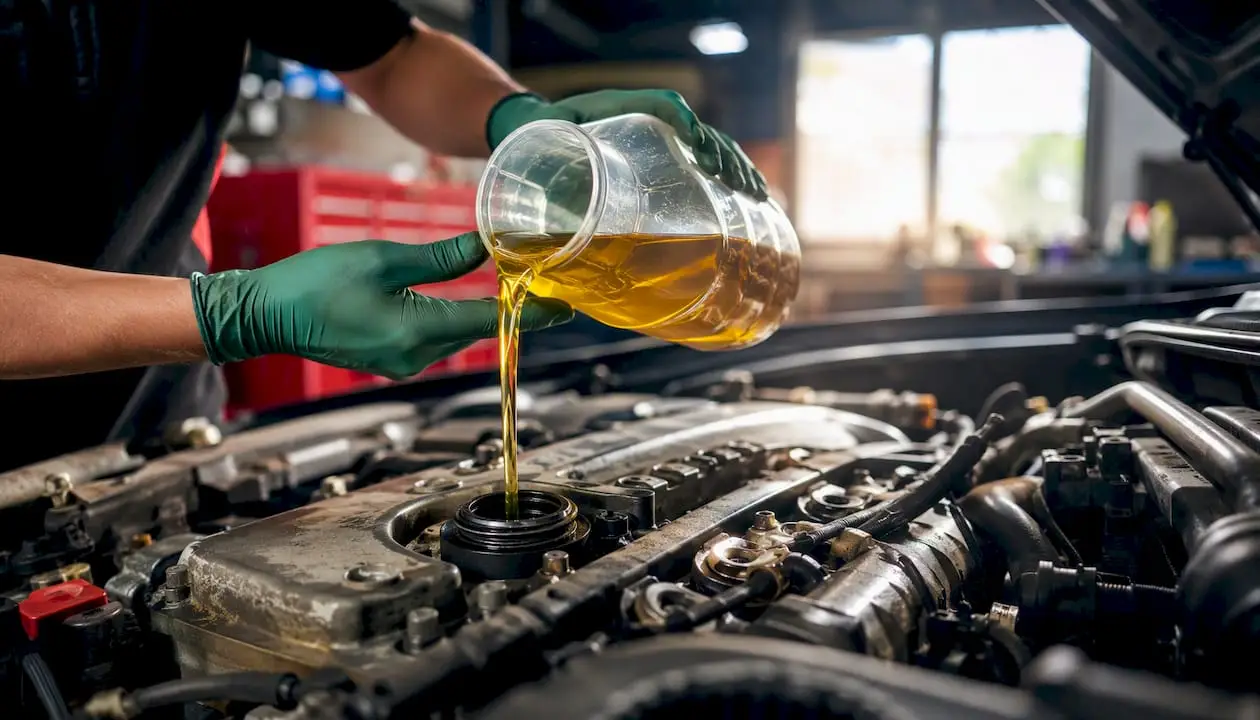
Viscosity index is the measure of how much an oil’s thickness changes as temperature rises. A higher viscosity index means the oil stays closer to its rated thickness across a wide temperature range. Synthetic oils have a naturally higher viscosity index than conventional mineral oils, so they thin out less dramatically when things get hot.
Oxidation resistance is where the gap really shows. AAA research found that synthetic oils outperformed conventional oils by 47% across tests covering shear stability, deposit formation, volatility, pumpability, and oxidation resistance. Oxidation is what turns oil into sludge, and sludge is what kills engines slowly and silently.
Shear stability refers to the oil’s ability to resist breaking down under mechanical stress. Inside a running engine, oil molecules get literally torn apart by moving parts. Synthetic molecules hold their structure better, which means the oil keeps doing its job longer.
HTHS viscosity (high-temperature high-shear) is the technical standard that predicts real-world film strength under load. SAE J300 defines the viscosity grades and HTHS minimums that determine whether an oil can maintain a protective film at engine operating temperatures. The “30,” “40,” and “50” in a grade name each correspond to a minimum kinematic viscosity at 100°C and a minimum HTHS value.
| Property | Full Synthetic | Conventional Mineral Oil |
|---|---|---|
| Viscosity index | High | Moderate |
| Oxidation resistance | Significantly higher | Degrades faster under heat |
| Shear stability | Excellent | Moderate |
| HTHS film strength | Meets or exceeds grade minimums | Can drop below minimums at high temp |
| Sludge resistance | Strong | Prone to sludge in severe service |
| Volatility (oil burn-off) | Low | Higher, especially at sustained heat |
Full synthetic motor oils provide better thermal stability, combat sludge, and protect turbochargers more effectively than conventional oils. For Texas summers, that is not a luxury. It is the baseline.
How do you pick the right synthetic oil for your specific vehicle?
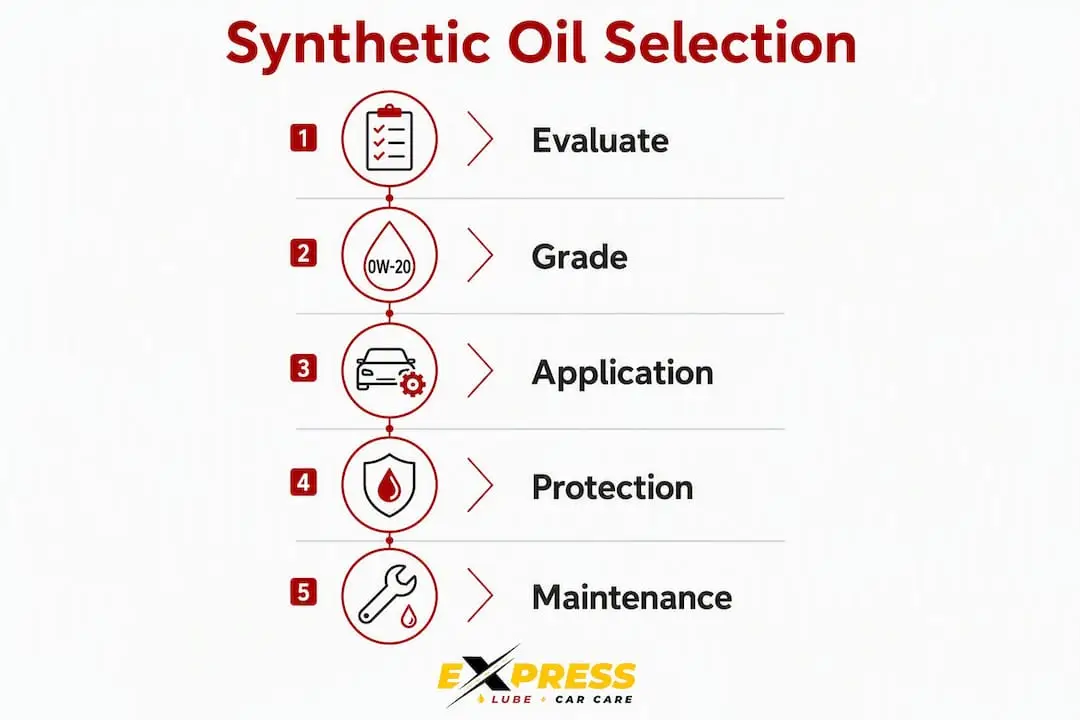
Think of this as a four-step checklist you run every time you’re due for a change.
-
Open the owner’s manual first. Find the required SAE viscosity grade (e.g., 5W-30) and any OEM approval codes (such as dexos1, BMW LL-04, or MB 229.5). These codes are not suggestions. They tell you which additive packages the manufacturer tested against your engine’s tolerances.
-
Check the bottle for API and ILSAC certifications. Look for the API donut and starburst symbols. API’s Engine Oil Licensing and Certification System verifies that an oil meets current performance standards. Newer API categories, such as API SQ, address modern engine demands with improved additive packages for heat protection. An oil meeting a current API category is almost always a safer choice than one certified only to an older standard.
-
Match the second viscosity number to your use case. The “30,” “40,” or “50” tells you how thick the oil is at operating temperature. For most Texas daily drivers, 30 is fine. For towing, heavy loads, or older engines with looser tolerances, 40 or 50 gives more cushion. API guidelines and SAE J300 testing define exactly what each grade must deliver in terms of HTHS and kinematic viscosity.
-
Factor in HTHS when you’re towing or running hard. If you can find the technical data sheet for a product, look for the HTHS value. For towing and heavy-load situations, choose an oil with HTHS at or above the OEM’s minimum, or higher when the OEM permits flexibility.
- If your owner’s manual lists conflicting or ambiguous viscosity options, ask an ASE-certified technician.
- Switching a high-mileage engine from conventional to synthetic? Get professional guidance on interval timing. Read more about why oil change intervals differ before you decide.
- Never override the owner’s manual based on a brand’s marketing claims, no matter how convincing the packaging looks.
What maintenance adjustments does Texas heat actually require?
Living in an extreme-heat region counts as “severe service,” and severe service accelerates oxidation and sludge formation even in synthetic oil. That means your standard oil-change interval may need to shrink, and your between-change checks need to get more frequent.
Here is what to add to your routine during Texas summers:
- Check oil level weekly when temperatures are above 95°F. Heat accelerates oil consumption, and running even a quart low puts extra stress on bearings and cylinder walls.
- Inspect oil color and consistency monthly. Fresh synthetic is amber and flows easily. Dark, gritty, or syrupy oil is telling you something is wrong.
- Check coolant level and condition. Oil and coolant work together to manage engine temperature. A low or degraded coolant system makes the oil work harder.
- Inspect belts, hoses, and radiator airflow. Heat cracks rubber and weakens hoses faster than anything else. A blown hose in August on I-30 is a bad day.
- Watch for leaks under the vehicle after parking. Heat causes seals to expand and contract repeatedly, which accelerates wear.
Real-world sampling in Houston showed that mineral-based oils lost oxidation resistance noticeably after 2,000–4,000 miles in hot conditions. Synthetic oils held up significantly longer, but “longer” is not “forever.” If you’re doing a lot of towing, idling in traffic, or short trips that never fully warm the engine, shorten your interval regardless of what the bottle says.
Pro Tip: When switching a neglected or high-mileage engine to full synthetic for the first time, do the first two oil changes at a shorter interval, around 3,000–4,000 miles. Synthetic detergents will loosen old deposits, and you want those flushed out before they clog an oil passage or filter.
Which synthetic oil brands work well in Texas heat?
These four brands show up consistently in Texas shops and cover the full range of use cases. None of them is universally “the best” — the right pick depends on your vehicle’s OEM specs and your driving situation.
Mobil 1 is probably the most widely available full synthetic in the U.S. and comes in a broad range of viscosity grades including 5W-30, 5W-40, and 10W-40. It is well-suited to daily commuting and turbocharged engines, and its Extended Performance line is designed for longer intervals under normal (not severe) service. Always verify the API certification on the specific bottle you’re buying, since Mobil 1 product lines vary.
Amsoil is a direct-to-consumer brand with a strong reputation among towing and performance enthusiasts. Their Signature Series line offers 5W-30 and 5W-40 options with high HTHS values, which makes them a solid pick for trucks pulling trailers through Texas summers. Amsoil products are available online and through select dealers; check OEM approval codes carefully before ordering.
Valvoline offers both full synthetic and high-mileage synthetic formulations across 5W-30, 5W-40, and 10W-40 grades. Their High Mileage line includes seal conditioners and is widely available at retail stores across Texas. For drivers with vehicles over 75,000 miles, it is a practical and accessible option. Finding the best oil for high-mileage cars involves more than just brand selection, so read up before you commit.
Motul is a French brand with a strong presence in performance and motorsport applications. Their 8100 series (5W-30, 5W-40) and 300V line (for track use) carry ACEA approvals alongside API ratings, which makes them a good fit for European vehicles or performance cars that specify ACEA standards. Availability in Texas is growing but still more limited than the other three; specialty auto shops and online retailers are your best bet.
| Brand | Best for | Common SAE grades | Oil type | Severe-service interval guidance |
|---|---|---|---|---|
| Mobil 1 | Daily driving, turbocharged engines | 5W-30, 5W-40, 10W-40 | Full synthetic | Shorten from standard interval in severe service |
| Amsoil | Towing, performance, extended drain | 5W-30, 5W-40 | Full synthetic | Follow Amsoil’s severe-service guidance on label |
| Valvoline | High-mileage engines, daily use | 5W-30, 5W-40, 10W-40 | Full synthetic / high-mileage synthetic | Standard to shortened depending on engine condition |
| Motul | Performance, European OEM specs | 5W-30, 5W-40, 15W-50 | Full synthetic | Shorten in track or severe-service conditions |
One rule applies to all four: if the product’s API certification or OEM approval code does not match what your owner’s manual requires, put it back on the shelf.
When should you stop guessing and call a technician?
Some oil questions have clear answers you can handle yourself. Others are signals that something deeper is going on, and guessing wrong costs you an engine.
Get a professional evaluation if you notice any of these:
- Oil level drops more than a quart between changes
- Oil looks dark and gritty within 1,000–2,000 miles of a fresh change
- Oil pressure warning light comes on, even briefly
- You hear a ticking or knocking sound when the engine is hot
- You smell burning oil from the engine bay after driving
A technician can run an oil analysis, pressure-test the lubrication system, inspect the turbocharger or valve train for contamination, and check the cooling system for anything that’s making the oil work overtime. These are not DIY jobs.
At Expresslubearlington, every oil change comes with a digital vehicle inspection so you can see exactly what the technician sees. The shop’s ASE-certified technicians and RepairPal certification mean you’re getting a verified standard of workmanship, not just a quick drain-and-fill. CarFax’s Top-Rated designation reflects real customer feedback on turnaround time and service quality. And the 24-month/24,000-mile warranty means that if something goes wrong with covered work, you’re protected.
Synthetic oils outperformed conventional oils by 47% across AAA’s test battery — covering shear stability, deposit formation, volatility, pumpability, and oxidation resistance. In Texas heat, that margin is the difference between an engine that lasts and one that doesn’t.
Key Takeaways
Full synthetic oil that matches your OEM viscosity grade and carries a current API certification is the most reliable protection for any engine facing Texas heat.
| Point | Details |
|---|---|
| Match OEM viscosity first | Check your owner’s manual for the required SAE grade before choosing any brand or product. |
| Synthetic outperforms conventional in heat | AAA testing showed a 47% performance advantage for synthetics across oxidation, shear, and deposit tests. |
| Texas heat = severe service | Shorter oil-change intervals and weekly oil-level checks are the right response to extreme-heat driving conditions. |
| HTHS matters for towing | For heavy loads or towing, prioritize oils with higher HTHS values to maintain film strength under pressure. |
| Expresslubearlington handles the whole process | ASE-certified technicians verify OEM specs, source approved full synthetics, and back the work with a 24-month/24,000-mile warranty. |
The part most drivers get wrong about synthetic oil in Texas
There is a widespread assumption that switching to a premium synthetic brand automatically solves heat-related engine wear. It does not. The brand is almost irrelevant if the viscosity grade is wrong or the API certification is outdated.
What actually matters is the combination: the right grade for your engine’s tolerances, the right additive package for your duty cycle, and the right interval for your driving conditions. A 5W-40 Mobil 1 in an engine that specifies 5W-30 is not “extra protection.” It can actually restrict cold-start oil flow and put more strain on the oil pump. More is not always better.
The other thing drivers underestimate is how quickly Texas heat turns “normal service” into “severe service.” Short trips, extended idling in traffic, and sustained high ambient temperatures all push oil toward its limits faster than the standard interval assumes. Treating your Texas summer driving as severe service, checking oil condition between changes, and shortening intervals when needed is worth far more than spending extra on a premium brand and then running it 7,500 miles in August heat.
Get the right synthetic oil installed right, the first time
Expresslubearlington takes the guesswork out of oil selection for Texas drivers. The shop’s ASE-certified technicians verify your OEM viscosity spec, confirm the correct API-certified full synthetic for your engine and duty cycle, and install it with a full digital vehicle inspection so you know exactly what condition your car is in.

Every service comes backed by a 24-month/24,000-mile warranty and the credibility of RepairPal certification and CarFax’s Top-Rated designation. Transparent pricing, inspection photos you can actually see, and fast turnaround are the standard here, not the exception.
Ready to stop second-guessing your oil choice? Book your oil change at Expresslubearlington and let the team handle the spec-matching, sourcing, and installation while you get back on the road with confidence.
Useful sources
These are the primary references behind the technical claims in this article. Each one is worth bookmarking if you want to go deeper.
- Consumer Reports: Should you use synthetic oil in your car? — Covers severe-service classification and why synthetics help in extreme-heat regions.
- SAE J300 Engine Oil Viscosity Classification — The standard that defines every viscosity grade number on an oil bottle.
- API Engine Oil Licensing and Certification System — Explains what the API donut and starburst symbols on oil bottles actually certify.
- API Guidelines for SAE Viscosity-Grade Engine Testing — Technical document covering HTHS requirements and viscosity read-across methodology.
- STLE: Lubrication Fundamentals — Deep-dive reference on SAE J300 grades and HTHS viscosity in automotive engine lubrication.
FAQ
What is the best synthetic oil for hot weather?
A full synthetic that matches your OEM-specified viscosity grade and carries a current API or ILSAC certification is the best choice for hot weather. For most modern vehicles, that means a 5W-30 or 5W-40 full synthetic from a brand like Mobil 1, Valvoline, Amsoil, or Motul.
Which engine oil grade is better for extreme heat: 5W-30 or 5W-40?
Both grades work in Texas heat, but 5W-40 provides a thicker protective film at operating temperature, which benefits turbocharged engines, towing situations, and aggressive driving. Use whichever grade your owner’s manual specifies; never go thicker than OEM allows just because it feels like more protection.
Is 10W-30 or 10W-40 better for hot weather in older engines?
For older or high-mileage engines with worn tolerances, 10W-40 generally provides better film strength at operating temperature than 10W-30. That said, always confirm against your owner’s manual, since using a grade the OEM does not approve can affect oil pressure and warranty coverage.
Is 230°F too hot for engine oil?
Normal engine operating temperatures fall in a typical range. Sustained higher temperatures accelerate oil oxidation and thermal breakdown, especially in conventional oils. A quality full synthetic handles occasional higher temperatures better than conventional oil, but persistent overheating is a cooling system problem that no oil grade alone can fix.
When should you shorten your oil-change interval in Texas?
If your driving qualifies as severe service, which includes frequent short trips, extended idling in traffic, sustained high ambient temperatures, or towing, you should shorten your interval below the standard recommendation. Consumer Reports confirms that extreme-heat regions accelerate oil degradation, making more frequent changes or oil-condition monitoring a smart call for Texas drivers.