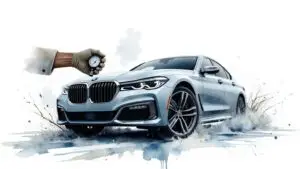

A brake is a device that slows or stops motion by absorbing energy from a moving object, and “brake” also works as a verb meaning to slow down or stop. That energy doesn’t just vanish. Friction converts your car’s kinetic energy into heat, while newer systems like regenerative braking capture that energy for reuse instead of wasting it.
- Noun: “The brake pedal felt spongy this morning.”
- Verb: “Brake early when the road is wet.”
- Both senses point to the same job: killing momentum, safely and predictably.
Key Takeaways
A brake is a mechanical device or action that removes kinetic energy from a moving object, most often converting it into heat through friction, though regenerative and eddy-current systems recover or dissipate that energy differently.
| Point | Details |
|---|---|
| Brake works as noun and verb | It names the device (pedal, mechanism) and the action of slowing or stopping. |
| Energy scales with speed squared | Doubling speed quadruples the energy your brakes must absorb during a stop. |
| Common types serve different jobs | Disc, drum, hydraulic, regenerative, eddy-current, and parking brakes each suit specific vehicles or equipment. |
| Front brakes wear faster | They handle roughly 80 to 90 percent of total stopping force in passenger vehicles. |
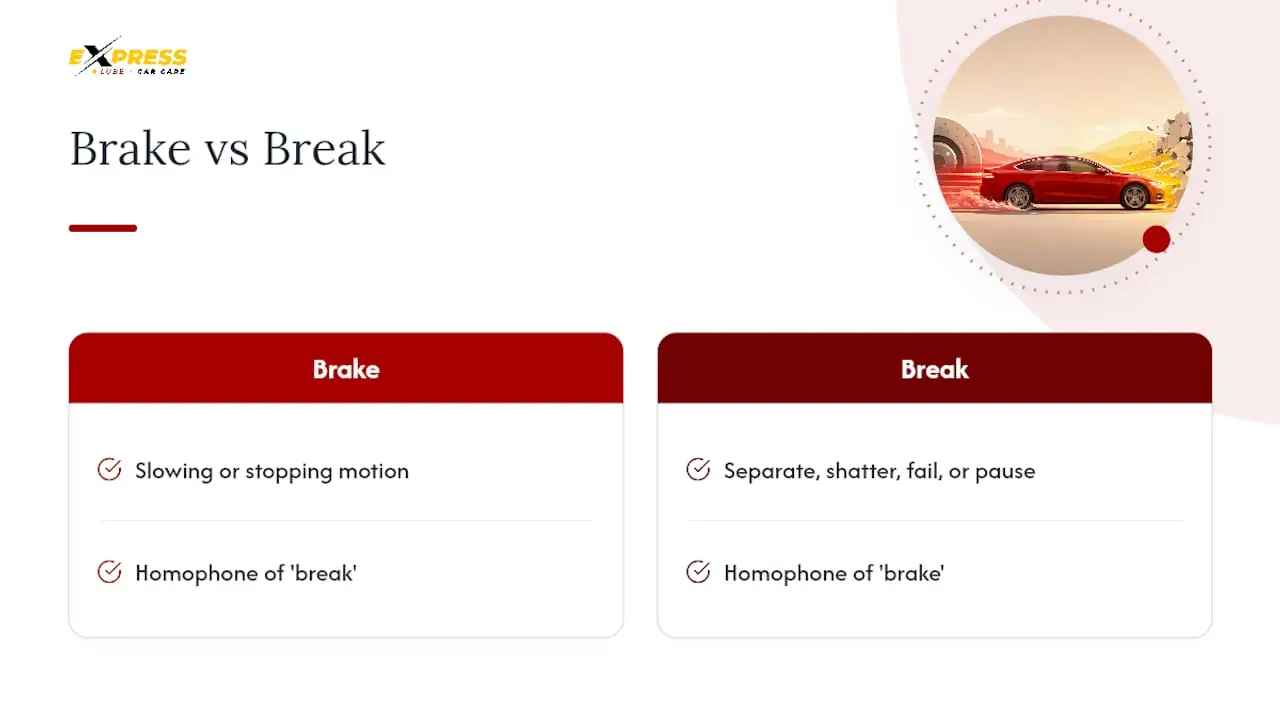
| Brake and break are not interchangeable | Brake relates to slowing motion; break means to separate, shatter, or pause. |
Table of Contents
- What Does “Brake” Mean? Noun and Verb Explained
- How Do Brakes Work?
- What Are the Common Types of Brakes?
- How Do You Use “Brake” in a Sentence?
- What Is the Difference Between Brake and Break?
- When Should You Get Your Brakes Inspected?
- Why the Definition of “Brake” Matters More Than It Seems
- Ready to Get Your Brakes Checked?
- Sources
- FAQ
What Does “Brake” Mean? Noun and Verb Explained
As a noun, “brake” usually means the physical device, the pedal you press, or the parking mechanism that holds your car in place on a hill. Engineers also use it to describe entire systems, like a “brake assembly” on industrial equipment. As a verb, it means the action itself: to reduce speed or come to a stop.
The word traces back to Middle English “brake,” originally referring to a mechanical lever or crushing tool before it settled into its modern meaning tied to controlling motion.
A few examples across contexts:
- Noun (device): “Replace the rear brake before the road trip.”
- Noun (mechanism): “Set the parking brake before you get out.”
- Verb (action): “She braked hard to avoid the deer.”
- Verb (gradual): “The train began to brake as it approached the station.”
Cyclists, machinists, and drivers all use the same word, but the mental picture shifts depending on the braking system involved.
How Do Brakes Work?
Every brake exists to do one job: remove kinetic energy from something in motion. When you press the pedal, the brake system does work against your car’s forward motion, and that work has to go somewhere. In friction brakes, it becomes heat, sometimes enough to make rotors glow orange during a hard stop on a mountain grade.
Not every system relies purely on friction. Regenerative brakes, common in hybrids and EVs, convert kinetic energy into electricity that recharges the battery instead of just heating up metal. Eddy-current brakes use magnetic resistance to slow rotating parts, a method you’ll find in some trains and industrial machinery. Both approaches trade friction for something more efficient at reclaiming energy.
Here’s the part most drivers underestimate: stopping energy doesn’t scale in a straight line. It scales with the square of your speed. Double your speed and you quadruple the energy your brakes have to absorb, which is why highway stops generate so much more heat than parking-lot stops. Add weight to that equation (a loaded truck bed, a trailer, five passengers instead of one) and the energy climbs even further.
- Friction brakes: convert motion into heat via pads or shoes.
- Regenerative brakes: convert motion into stored electrical energy.
- Eddy-current brakes: use magnetic fields to create resistance without contact.
Pro Tip: If you’re hauling a heavy load or driving mountain switchbacks, give yourself extra following distance. Your brakes are absorbing far more energy per stop than they would on a flat, unloaded commute.
What Are the Common Types of Brakes?
Different jobs call for different hardware, and knowing the terms helps when a technician explains what’s wrong with your car.
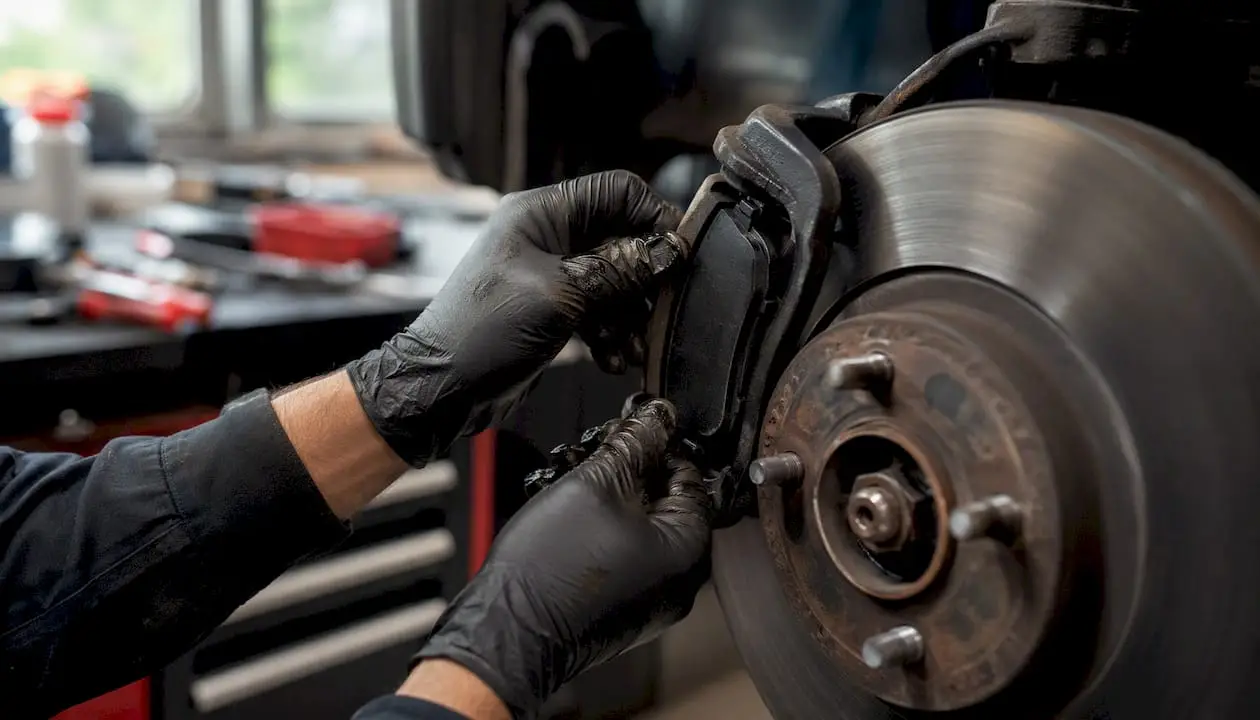
- Disc brakes: Pads clamp onto a spinning rotor, common on the front wheels of nearly every modern car because they dissipate heat well and resist fade.
- Drum brakes: Shoes press outward against the inside of a drum. Cheaper to produce, still used on rear wheels of many economy vehicles, but they trap heat more than discs.
- Hydraulic brakes: Use fluid pressure to transfer pedal force to the pads or shoes. This is the actuation method behind most disc and drum systems in cars.
- Regenerative brakes: Found in hybrids and EVs, these recover energy instead of burning it off as waste heat.
- Eddy-current brakes: Rely on magnetic drag rather than contact, useful in trains and some industrial equipment where friction wear would be a constant maintenance headache.
- Parking (hand) brakes: A mechanical, cable-actuated system that holds the vehicle stationary without relying on hydraulic pressure, which matters if your hydraulic system ever fails.
Bicycles use simplified versions of these same principles, usually rim brakes or small hydraulic disc brakes, while aircraft and some heavy machinery combine friction brakes with entirely different systems, like drag chutes, for extreme stopping needs.
How Do You Use “Brake” in a Sentence?
Seeing the word in context makes the grammar click faster than any definition alone.
- “Hit the brake, there’s a squirrel in the road.”
- “He tapped the brake pedal three times before it caught.”
- “You should brake gradually on ice, not slam it.”
- “The cyclist squeezed the brake lever going downhill.”
- “Set the parking brake on this incline.”
- “The mechanic said the emergency brake needed adjusting.”
- “Brake for pedestrians, always.”
Notice how “brake” shows up as both the object being acted on (the pedal, the lever) and the action itself.
What Is the Difference Between Brake and Break?
These two words sound identical but mean entirely different things, and mixing them up is one of the most common homophone mistakes in American English. “Brake” always relates to slowing or stopping motion. “Break” usually means to separate, shatter, fail, or pause.
- “I need to brake before the curve.” (slowing down)
- “I need a break from studying.” (a pause)
- “Don’t break the glass.” (shatter)
- “The brake cable snapped.” (device failure, not the verb “break,” even though it sounds tempting to write it that way)
Pro Tip: Use this quick mental check: brake stops movement, break shatters or pauses something. If your sentence is about wheels, pedals, or slowing down, it’s brake. Everything else is probably break.
When Should You Get Your Brakes Inspected?
Your brakes send warning signals long before they fail completely, and catching them early is cheaper and safer than waiting; consider professional Brake Repair Services | Haynes Firestone for trusted local maintenance.
- A high-pitched squeal when you brake, often a wear indicator doing its job.
- Grinding metal-on-metal sound, meaning pads are likely gone.
- A soft or spongy pedal that sinks further than usual.
- The car pulling to one side under braking.
- A dashboard brake warning light staying lit.
- Longer stopping distances or a burning smell after repeated hard stops (a sign of brake fade).
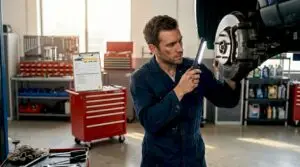
Front brakes typically handle roughly 80 to 90 percent of total stopping force in a standard passenger vehicle, since weight shifts forward under braking. That’s exactly why front pads and rotors wear out faster than the rear set, and why they deserve closer attention at every inspection. If you’re noticing any of the symptoms above, it’s worth having an ASE-certified technician check your pads, rotors, and fluid before a minor issue becomes a safety problem.
Why the Definition of “Brake” Matters More Than It Seems
Understanding what a brake actually does, absorbing energy rather than magically erasing it, changes how you think about maintenance. As an ASE-certified technician, I’ve seen plenty of drivers treat brake noise as background static instead of a signal worth acting on. That squeal or grind is your car telling you exactly where the wear is concentrated, usually the front.
Knowing the terminology (pads, rotors, fade, regenerative) doesn’t just help you sound informed. It helps you catch problems before they turn into a stranded car or a repair bill three times larger than it needed to be. That’s the real value of a clear definition: it turns confusion into action.
Ready to Get Your Brakes Checked?
Reading about brake fade and pad wear is useful, but nothing replaces a hands-on inspection from someone trained to catch problems early. Expresslubearlington’s ASE-certified technicians handle everything from a simple pad swap to full brake system diagnostics, backed by a 24-month, 24,000-mile warranty on covered repairs. If cost is a concern, Expresslubearlington also offers auto repair financing so a brake job doesn’t have to wait. Stop by and let a professional confirm what those warning signs actually mean before they turn into a bigger repair.
Sources
FAQ
What Are the Two Meanings of Brake?
“Brake” is a noun for the device that slows or stops motion (like a pedal or mechanism) and a verb meaning to slow down or stop, as in “brake before the turn.”
What Is the Difference Between Brake and Break?
“Brake” always relates to slowing or stopping motion, while “break” means to separate, shatter, fail, or take a pause. They’re homophones with completely unrelated meanings.
What Is the Definition of a Brake?
A brake is a mechanical device that slows or stops motion by absorbing kinetic energy, typically converting it into heat through friction, though some systems convert it into electricity or use magnetic resistance instead.
Is It “Break” or “Brake” at Work?
It depends on the meaning: if you’re stepping away to rest, you’re taking a “break.” If you’re referring to a vehicle’s stopping mechanism, it’s “brake,” with no overlap between the two.