

If your car’s AC not blowing cold, the culprit is almost always one of three things: a refrigerant leak, a failing compressor, or blocked airflow from a dirty cabin filter or clogged condenser. If the blower still runs but the air feels warm, work through the quick checks below before you call anyone. If you hear grinding, smell burning, or the engine temp climbs, stop driving and get it looked at.
TL;DR:
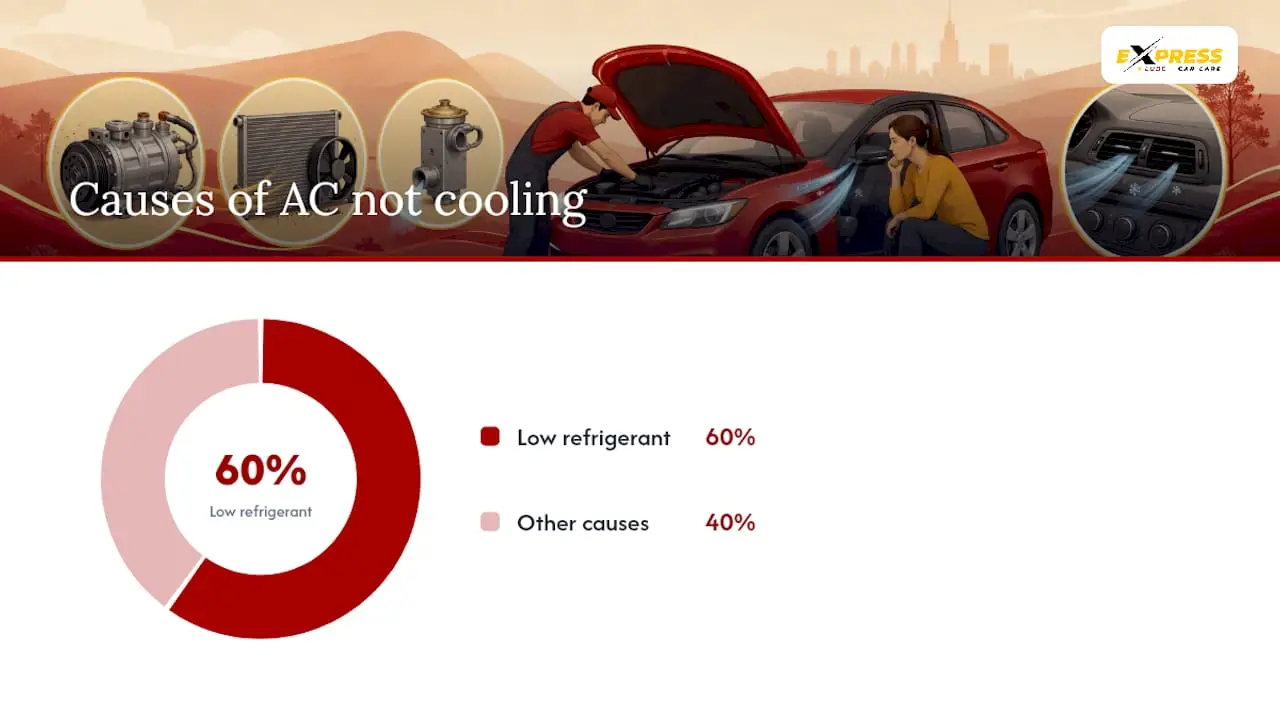
- Low refrigerant from leaks causes about 60% of car AC issues and requires thorough leak detection before recharging to prevent repeated failures.
- Clogged condenser fins or a malfunctioning condenser fan are common causes of warm air at idle, often fixable with quick cleaning or part replacement.
- Compressor failure typically presents with noise or clutch disengagement, demanding 3 to 5 hours of work and is among the most expensive repairs.
- Many problems, like a dirty cabin filter or a blocked condenser, can be diagnosed and fixed in under an hour, saving time and money.
- Proper professional diagnosis using manifold gauges, leak detection, and electrical testing is essential to avoid recurring problems and unnecessary repairs.
Table of Contents
- Why Is My Car AC Not Cold? Quick Self-Checks First
- What Does a Professional AC Diagnostic Actually Involve?
- Common Causes of Car AC Blowing Warm Air (and What They Cost You in Time)
- Is It Safe to Drive With AC Blowing Warm at Idle?
- What to Tell Your Mechanic About Your Car AC Problem
- Why Skipping a Real Diagnosis Costs You More Later
- Get Your Car’s AC Diagnosed the Right Way
- Sources
- FAQ
Why Is My Car AC Not Cold? Quick Self-Checks First
Before you assume the worst, rule out the easy stuff. A lot of “my AC is broken” calls turn out to be a $30 fix.
Start with the controls themselves. Make sure the AC button is actually engaged, the system is set to recirculate rather than fresh air, the temperature dial is at max cool, and the blower is on high. It sounds obvious, but a bumped setting is more common than you’d think, especially in cars with touchscreen climate controls that are easy to nudge by accident.
Next, feel the air at every vent, not just the one closest to you. Note whether the cooling changes between idle and highway speeds, because that difference is a real diagnostic clue, not just an annoyance. Pop the hood and look at the front of the condenser, the thin radiator-like unit right behind your grille, for caked-on bugs, leaves, or an oily film. That oily residue is often a sign of a refrigerant leak, since the oil that lubricates the compressor travels with the refrigerant and leaves a trace wherever it escapes.
Here’s a simple order to work through:
- Confirm AC settings: max cool, recirculate, blower on high.
- Compare airflow and temperature across all vents.
- Check idle cooling versus highway cooling.
- Inspect the condenser for debris or oily film.
- Check when your cabin air filter was last replaced.
A clogged cabin filter chokes airflow enough to make a perfectly healthy AC system feel weak, and it’s one of the fastest fixes on this list.
Pro Tip: Never crack open the AC service ports or dump a store-bought recharge can into the system without a real diagnosis first. If there’s a leak, you’re just adding refrigerant to a system that will lose it again, and some of those cans contain sealants that can gum up components a technician would otherwise repair cleanly.
What Does a Professional AC Diagnostic Actually Involve?
Once you’ve ruled out the obvious, a shop visit turns guesswork into an actual answer. Here’s what that process typically looks like.
- Visual inspection of the condenser, hoses, fittings, compressor, and drive belt for wear, cracks, or leaks.
- Pressure testing with manifold gauges on the high and low sides of the system, since the pattern of those readings tells a technician a lot.
- Leak detection using UV dye that glows under a blacklight, an electronic sniffer that detects refrigerant vapor, or nitrogen pressure testing for leaks that hide well.
- Electrical diagnosis, checking compressor clutch voltage, fuses, relays, pressure switches, and pulling any related codes with a scan tool.
- Airflow testing of the cabin filter, blower motor, and blend door actuator.
- Post-repair validation, evacuating the system, recharging to the manufacturer’s spec, and checking vent temperature before you drive off.
The manifold gauges do a lot of the heavy lifting here. Rapid compressor cycling on the gauges usually points to low refrigerant, while pressures that read equalized on both sides often mean the compressor itself is failing, according to AutoZone’s diagnostic guidance. A high-side spike with a low-side that stays flat often points to a restricted condenser instead. This is exactly why a real gauge reading beats a guess.
Low refrigerant caused by an undetected leak is behind roughly 60% of AC-not-cooling complaints, which is why leak detection isn’t optional. Skipping it and just topping off the system almost guarantees you’ll be back in the same seat within months.
Common Causes of Car AC Blowing Warm Air (and What They Cost You in Time)
Different failures show up in different ways, and matching your symptoms to the list below helps you understand what you’re likely dealing with before you even book an appointment.
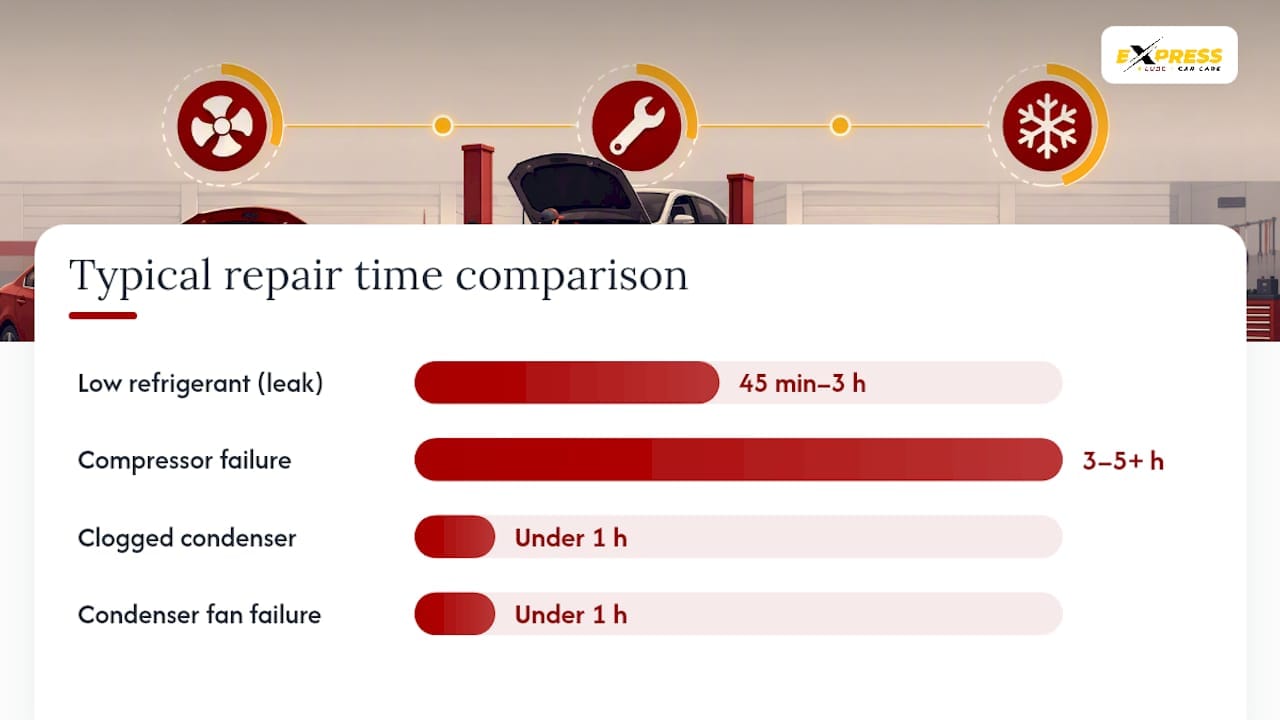
Low refrigerant from a leak is the most frequent cause, and it usually shows up as weak, lukewarm air that never quite gets cold no matter the setting. Leaks tend to hide at O-rings, the compressor shaft seal, or condenser and evaporator joints. A straightforward recharge takes about 45 to 90 minutes, but if a leak needs to be found and sealed first, add another 1 to 3 hours. A basic recharge often runs around $200, though the number climbs fast if a leak repair is involved.
Compressor failure announces itself with a clutch that won’t engage, a loud grinding noise, or a belt that squeals under load. This is a bigger job, typically 3 to 5 hours or more, and it’s also the most expensive common repair since the compressor is the heart of the system.
A clogged or blocked condenser produces a telltale pattern: cold air on the highway, warm air at idle. Airflow through the condenser fins matters more at low speed since there’s no forward wind helping it along, so debris buildup hits idle cooling first.
Condenser fan failure creates the same warm-at-idle symptom, but for an electrical reason instead of a physical blockage. It’s often one of the quicker, less expensive repairs on this list because it’s a straightforward component swap.
Blend door actuator problems show up as uneven vent temperatures or a clicking sound behind the dashboard, and replacement is a moderate job depending on dash access.
Expansion valve or evaporator issues cause intermittent cooling or a system that freezes up and stops blowing air altogether. Evaporator work is the most time-consuming repair here, sometimes running 4 to 8 hours, because the evaporator sits buried behind the dashboard.
| Cause | Key symptom | Typical repair time |
|---|---|---|
| Low refrigerant / leak | Weak or warm air overall | 45 min to 3 hours |
| Compressor failure | No clutch engagement, grinding noise | 3 to 5+ hours |
| Clogged condenser | Cold at speed, warm at idle | Under 1 hour to clean/replace |
| Condenser fan failure | Warm at idle only | Under 1 hour |
| Blend door actuator | Uneven vents, clicking sound | 1 to 3 hours |
| Expansion valve/evaporator | Intermittent cooling, freeze-up | 4 to 8 hours |
Is It Safe to Drive With AC Blowing Warm at Idle?
If the blower still runs and the air is simply not cold, you can generally make a short drive to a shop without risking further damage. Just skip the long highway trip until someone’s had a look, especially if you noticed the warm-at-idle pattern that points to a condenser or fan issue.
Some symptoms mean stop now, not later:
- Grinding or screeching noise from the compressor area.
- A burning smell from under the hood or through the vents.
- Visible smoke.
- The engine temperature gauge climbing toward the red.
Continuing to run an AC system that’s low on refrigerant can wear down the compressor faster, since refrigerant carries the oil that lubricates it. Waiting turns a moderate repair into a bigger one. Ask the shop about same-day diagnostic openings and parts lead times, since compressor and evaporator jobs sometimes hinge on part availability.
What to Tell Your Mechanic About Your Car AC Problem
The more specific you are, the faster and cheaper the diagnosis. Walk in ready to answer:
- Exactly what the air does, warm the whole time or just no airflow at all, and when it started.
- Whether it changes with vehicle speed, idle versus highway, or comes and goes randomly.
- Any unusual noise or smell when the AC runs.
- Whether you’ve already added a store-bought recharge can or had recent AC work done, since that changes what the technician checks first.
Then ask a few pointed questions back: what were the actual pressure readings, what leak detection method was used, can you get a written diagnostic report with parts and labor broken out separately, and does the repair come with a written warranty. If the system is being opened up, ask whether the receiver/drier or accumulator is being replaced too, since leaving old contamination in a freshly recharged system is a common reason repairs fail early.
Why Skipping a Real Diagnosis Costs You More Later
The single biggest mistake we see is a quick refrigerant top-off with no leak search behind it. It feels like a fix for a week or two, then the cold air fades right back out, and by then the compressor may have been running dry long enough to suffer real wear. A proper diagnostic with manifold gauges, UV dye or electronic leak detection, and a written estimate before any work starts is what actually stops the cycle. At Express Lube & Car Care, that’s the only way we approach an AC complaint, and it’s also why a cabin filter swap is often the fastest, cheapest fix we hand a customer instead of a bigger bill.
Get Your Car’s AC Diagnosed the Right Way
Express Lube & Car Care runs a full AC diagnostic, manifold gauge testing, UV and electronic leak detection, and electrical checks on the compressor clutch and switches, then hands you a written quote before any repair starts. Our technicians are ASE-certified, and we’re proud to be a RepairPal Certified Shop and a CarFax Top-Rated Service Center, the kind of track record that comes from fixing things right the first time.

Plenty of AC problems can be handled same day. A cabin air filter swap takes about 15 minutes, and many recharges and leak checks fit into a single visit, while bigger jobs like compressor or evaporator work get scheduled with a clear timeline so you’re never guessing when your car comes back. If a larger repair is on the table, financing options are available, and every repair is backed by our 24-month, 24,000-mile warranty. Head over to our AC repair page to schedule a diagnostic appointment and get your cold air back before it gets warmer out.
Sources
This guide draws on diagnostic and repair-time data from Kelley Blue Book’s breakdown of AC cost causes, AutoZone’s step-by-step AC diagnostic guide, timing estimates from HowLongFor’s car AC repair guide, and shop-process detail from a professional auto shop’s diagnostic walkthrough.
- Why Is My AC Not Blowing Cold? | Diagnosis & Causes
- Diagnosing car AC problems — AutoZone DIY
- Howlongfor
- Why Is My AC Blowing Hot Air? | Kelley Blue Book
FAQ
Why Is My Car AC Not Cold at Idle but Cold While Driving?
This points to a clogged condenser or a failing condenser fan, since airflow through the condenser fins matters most when there’s no forward wind at low speed.
Why Is My Car AC Blowing Warm Air All of a Sudden?
A sudden shift to warm air usually means a refrigerant leak has finally dropped the charge too low, or the compressor clutch has stopped engaging.
Can a Dirty Cabin Air Filter Cause Warm AC Air?
A clogged cabin filter won’t make the air warm, but it restricts airflow enough that the cold air you do get feels weak, and it’s worth checking before assuming a bigger problem.
Is It Safe to Use a DIY AC Recharge Can?
It’s risky, since it adds refrigerant without finding or fixing a leak, and some cans contain sealants that can complicate a proper professional repair later.
How Much Does It Cost to Fix a Car AC That’s Not Blowing Cold?
A simple recharge often runs around $200, while compressor replacement or evaporator work costs considerably more depending on the vehicle and parts needed.