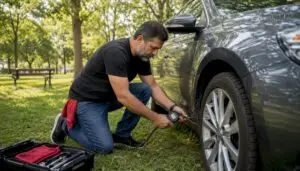

For most everyday drivers, a quality ceramic brake pad delivers the best balance of quiet operation, low dust, and long rotor life. That verdict holds whether you’re grinding through Arlington rush hour or logging highway miles on a daily commute. The exception? If you tow a trailer, live in the mountains, or drive a heavier truck that sees aggressive use, semi-metallic pads handle heat better and resist fade more reliably. Organic pads are worth considering only on light, low-speed vehicles where budget is the primary concern.
Before you buy anything, confirm compatibility with your vehicle’s OEM friction spec and rotor condition. If you’re unsure, an ASE-certified shop can run a quick inspection and point you in the right direction.
Quick stat: Front brake pads carry roughly 70% of your vehicle’s braking load, which is why they wear faster and deserve the most attention when you’re comparing pad options.
Table of Contents
- How ceramic, semi-metallic, and organic pads compare for daily driving
- Five quick criteria to pick the right pad for your commute
- What brake pads actually cost and how long they last
- DIY vs. professional installation and the bedding procedure you can’t skip
- Diagnosing squeal, vibration, dust, and uneven wear
- Why an ASE-certified shop does more than just swap the pads
- Key Takeaways
- What the shop floor actually teaches you about brake pads
- Get your brake pads replaced right at Expresslubearlington
- Useful sources and further reading
- FAQ
How ceramic, semi-metallic, and organic pads compare for daily driving
Understanding what each pad is actually made of explains why they behave so differently on your daily commute. Think of it like choosing tires: the compound determines the trade-offs, and no single option wins on every dimension.
To understand how these materials interact with your braking system at a deeper level, the brake pad technical guide from Expresslubearlington breaks down the mechanics clearly.
Ceramic pads
Ceramic pads are made from dense ceramic fibers, bonding agents, and small amounts of metal. They run quietly, shed very little visible dust, and stay consistent across the temperature range most commuters ever see. Modern ceramics have also been reformulated to comply with EPA rules that reduced allowable copper content to 0.5% by weight by 2025, replacing copper with alternative heat-management materials. The result: cleaner wheels, quieter stops, and gentler treatment of your rotors.
Semi-metallic pads
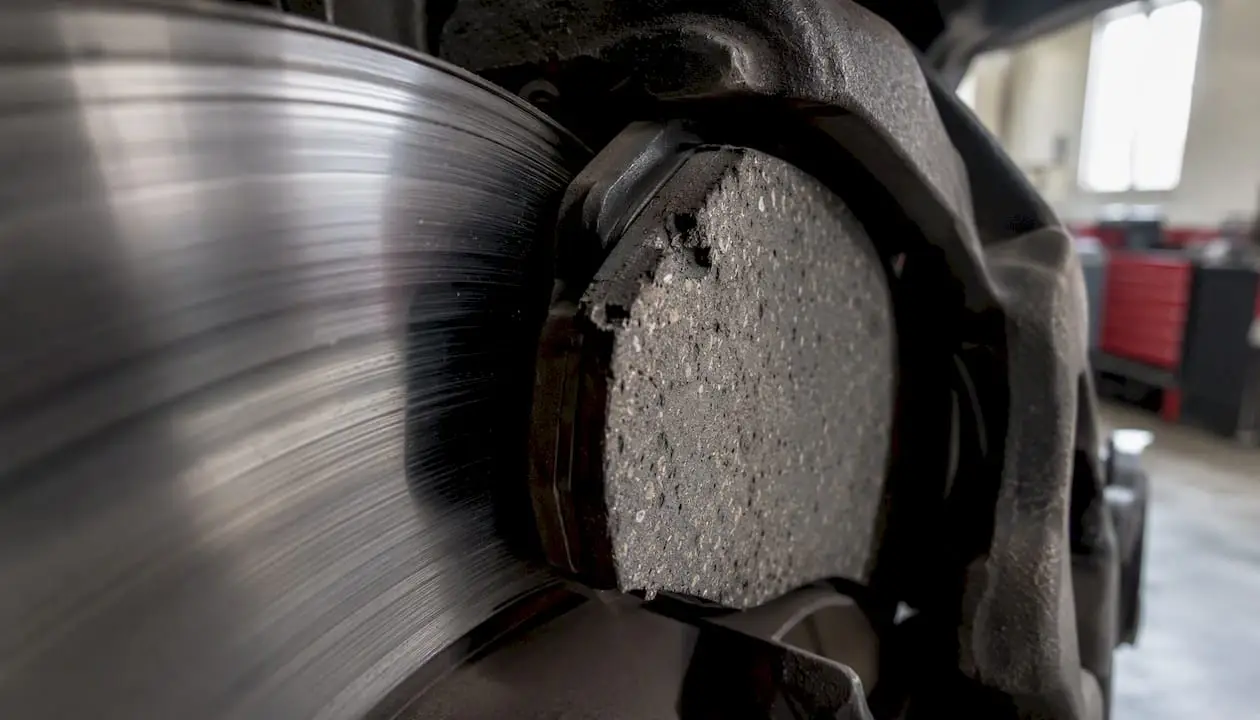
These contain 30–70% metal content, which gives them exceptional heat dissipation and fade resistance. That’s exactly what you need when descending a mountain grade or hauling a loaded trailer. The trade-off on a daily commuter is real, though: semi-metallics run louder, coat your wheels in dark dust, and are harder on rotors, especially during cold-morning stops when the metal compound hasn’t warmed up. High-performance semi-metallic pads often need operating temperatures that a cold city commute never reaches, making them feel grabby and unresponsive until warm.
Organic pads
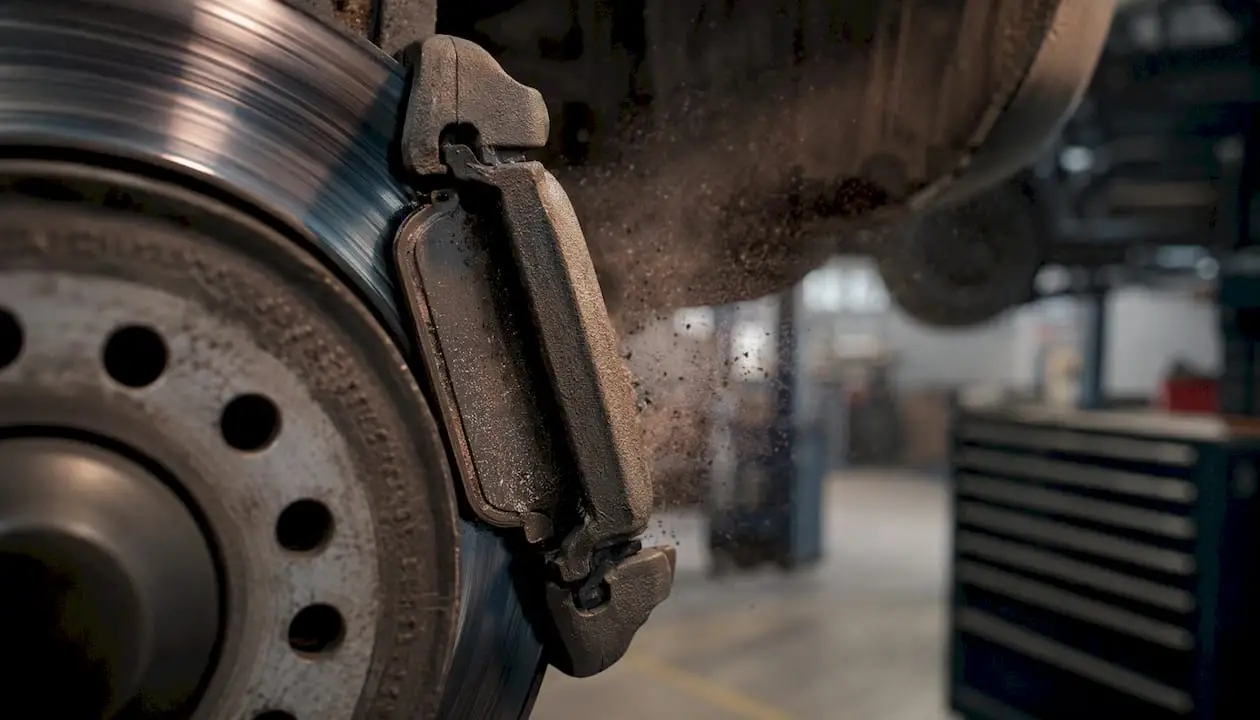
Organic (or “NAO” — non-asbestos organic) pads use materials like rubber, glass, and Kevlar fibers. They’re the softest and quietest option, and typically the cheapest. The catch is lifespan: they wear down faster than either ceramic or semi-metallic, and they can fade under repeated hard stops. For a light sedan doing low-speed suburban errands, they’re serviceable. For anything heavier or more demanding, they’re a false economy.
Pro Tip: Ask for the friction rating (usually a two-letter FMSI code on the box, like “FF” or “GG”) when comparing pads. A higher second letter means more bite — but also more rotor wear. For daily driving, an “EE” to “FF” rating is the sweet spot.
| Pad Type | Best For | Noise | Brake Dust | Heat/Fade Resistance | Rotor Friendliness | Parts Cost (per axle) | Typical Lifespan |
|---|---|---|---|---|---|---|---|
| Ceramic | City/highway daily driving | Low | Very low | Moderate | High | $70–$150 | 40,000–60,000 mi |
| Semi-metallic | Towing, mountain driving, heavy vehicles | Moderate–high | High | Excellent | Moderate | $40–$90 | 40,000–60,000 mi |
| Organic | Light vehicles, low-speed use | Very low | Low–moderate | Poor | High | $25–$60 | 20,000–25,000 mi |
Five quick criteria to pick the right pad for your commute
Not every driver needs the same pad, and the wrong choice costs you money in rotor wear, noise complaints, or premature replacement. Run through these five questions before you buy.
-
What does your vehicle weigh, and what does the OEM spec say? Heavier SUVs and trucks generate more heat per stop. Check your owner’s manual or door jamb sticker for the OEM friction rating. A pad that doesn’t match that spec can feel spongy or wear unevenly.
-
What does your typical drive look like? Stop-and-go city driving heats pads repeatedly in short cycles. Ceramics handle that pattern well. Long highway stretches with infrequent braking are even gentler on any pad type.
-
Do you tow or haul regularly? If you pull a trailer even occasionally, semi-metallic pads are the safer call. The extra heat load from towing can push ceramics past their comfort zone and cause fade.
-
How much does noise and wheel dust bother you? If dark, dusty wheels after a week of driving irritate you, ceramics are your answer. If you’re replacing pads on a work truck and noise is a non-issue, semi-metallic is fine.
-
What’s your budget and how long do you plan to keep the vehicle? Ceramics cost more upfront but typically outlast organic pads by a wide margin and are gentler on rotors. On a vehicle you’re keeping for years, that math usually favors ceramics.
Red flags to watch for: Pads labeled “track only” or “race compound” are not street-safe for daily use. No return policy or warranty on a pad is a sign to keep shopping. And if a pad’s friction rating is mismatched to your vehicle’s OEM spec by more than one letter grade, get a second opinion before installing.
What brake pads actually cost and how long they last
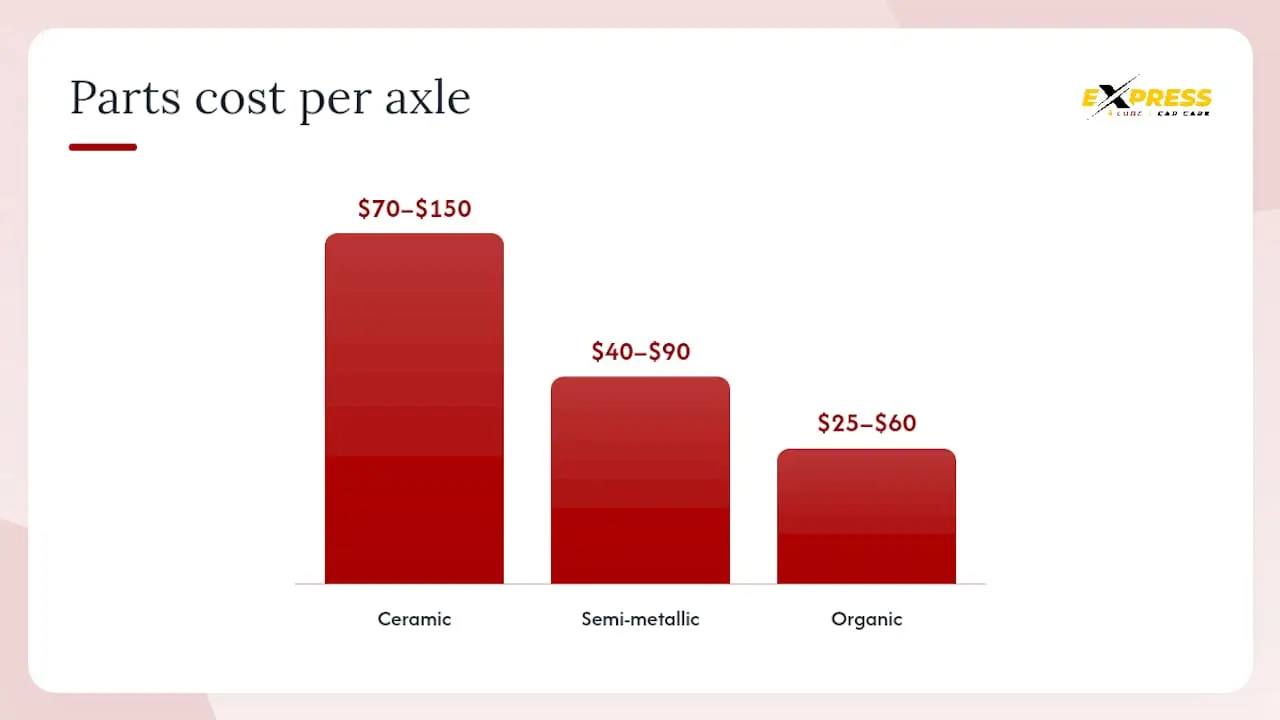
Parts costs per axle break down like this: organic/economy pads run $25–$60, semi-metallic $40–$90, and ceramic $70–$150. Labor at an independent shop typically adds $75–$150 per axle; dealerships run $100–$200. So a full ceramic front-axle job at an independent shop lands somewhere between $145 and $300 all-in, depending on your vehicle.
Lifespan varies more than most people expect. Average pad life falls around 25,000–37,000 miles, but ceramics on a highway-heavy commuter can push well past that. Stop-and-start city driving, towing, and heavy loads all shorten the cycle. Organic pads on a city commuter might need replacement every 20,000–25,000 miles.
| Pad Type | Parts (per axle) | Labor (independent) | Labor (dealer) | Estimated Lifespan |
|---|---|---|---|---|
| Organic | $25–$60 | $75–$150 | $100–$200 | 20,000–25,000 mi |
| Semi-metallic | $40–$90 | $75–$150 | $100–$200 | 40,000–60,000 mi |
| Ceramic | $70–$150 | $75–$150 | $100–$200 | 40,000–60,000 mi |
Here’s the lifetime value math: a ceramic pad set at $120 that lasts 60,000 miles costs you $2 per thousand miles in parts. A semi-metallic set at $65 that lasts 60,000 miles costs about $1.08 per thousand miles in parts, while an organic set at $40 that lasts 25,000 miles costs $1.60 per thousand miles in parts — but if it wears your rotors faster and you resurface them once ($80–$120 per axle), the organic option ends up costing more. Knowing when your brakes actually need replacing keeps you from spending money too early or waiting too long.
DIY vs. professional installation and the bedding procedure you can’t skip
When DIY makes sense
Straightforward single-piston calipers on most front-wheel-drive sedans and compact SUVs are genuinely manageable for a mechanically confident owner with a basic tool kit: a floor jack, jack stands, a C-clamp or caliper piston tool, and a torque wrench. If your rotors are within spec and you’re doing a straight pad swap, DIY is reasonable.
Walk away from DIY when you’re dealing with integrated parking brake calipers (common on rear axles of many modern vehicles), warped rotors that need resurfacing, AWD systems with complex brake bias, or any vehicle still under a manufacturer warranty that requires documented service.
The 30/30/30 bedding procedure — don’t skip this
Bedding is the process of transferring a thin, even layer of friction material from the new pad onto the rotor surface. Skip it, and you risk glazing: a heat-smeared, uneven friction layer that causes pedal vibration and reduced stopping power. Technicians recommend avoiding severe braking for the first 400–500 miles after installation, and completing a controlled bedding sequence before that.
The 30/30/30 method works like this:
- Find a safe, empty road or parking lot with no traffic behind you.
- Accelerate to approximately 30 mph.
- Apply moderate, steady brake pressure to slow to about 5 mph. Do not come to a complete stop.
- Allow 30 seconds of cool-down driving between each stop — keep moving gently, don’t park.
- Repeat this sequence 30 times.
- After the final stop, drive at low speed for 5–10 minutes to let everything cool down before parking.
Safety note: Never park immediately after the bedding sequence. Hot pads sitting against a stationary rotor can create uneven deposits. Keep rolling until the brakes feel cool to the touch.
| Factor | DIY Install | Professional Install |
|---|---|---|
| Time | 2–4 hours | 1–2 hours |
| Tools needed | Jack, stands, piston tool, torque wrench | Full shop equipment |
| Rotor measurement | Rarely done | Always done |
| Slider lubrication | Often missed | Standard step |
| Warranty | None | Shop warranty (varies) |
| Best when | Simple caliper, good rotors, confident mechanic | Complex caliper, worn rotors, warranty required |
Diagnosing squeal, vibration, dust, and uneven wear
Brake symptoms are your car sending up a flare. Here’s how to read them.
- High-pitched squeal on every stop: This is usually the wear indicator doing its job. Wear indicators are intentional design features that warn you at roughly 3 mm of remaining material — the squeal is a grace signal before metal-on-metal contact. Check pad thickness visually through the wheel spokes. If material is at or below ¼ inch (6.4 mm), replace immediately.
- Squeal only when cold (first few stops of the day): Often normal with semi-metallic pads. If it clears after warming up, it’s usually not a safety issue. Persistent cold squeal on ceramics may indicate missing or damaged anti-squeal shims.
- Pulsing or vibrating pedal: Classic glazing symptom. Overheated resin transfers unevenly to the rotor, creating high spots you feel as a rhythmic pulse. A repeat bedding sequence sometimes resolves mild glazing; a warped or heavily glazed rotor needs resurfacing or replacement. For a deeper look at brake noise causes and fixes, the Expresslubearlington diagnostic guide walks through each scenario.
- Excessive dark dust on wheels: Normal with semi-metallic pads. On ceramics, heavy dust suggests the pad compound may not be what the box claimed, or the caliper slider is sticking and dragging.
- Uneven wear (one side worn more than the other): Almost always a stuck caliper slider. Clean and lubricate the slider pins. If the caliper piston won’t retract smoothly, the caliper needs replacement — not a DIY job for most owners.
- Grinding metal-on-metal sound: Stop driving. This means the friction material is gone and metal is contacting metal. Continuing to drive risks rotor damage and brake failure. Book service immediately.
For a full symptom checklist, the brake problem symptoms guide at Expresslubearlington covers what each sound and sensation typically means.
Why an ASE-certified shop does more than just swap the pads
A pad swap sounds simple. What a trained technician actually does during a professional brake job is a different story — and the difference shows up in how long your next set of pads lasts.
Look for these credentials when choosing a shop: ASE certification (the industry’s recognized standard for technician competency), RepairPal certification, and CarFax Top-Rated recognition. These aren’t just badges — they represent documented training, verified customer satisfaction, and accountability to third-party standards. You can evaluate ASE-certified mechanics using a straightforward checklist if you’re comparing shops.
What a professional brake job actually includes: A qualified technician measures rotor thickness and runout (to confirm the rotor is within spec before installing new pads), cleans all hardware contact surfaces, lubricates caliper slider pins, torques all fasteners to factory specification, performs a post-install test drive, and delivers a digital inspection report documenting the work. These steps reduce rework, protect your rotors, and give you a documented service record.
Most DIY installs skip rotor measurement and slider lubrication. Those two omissions are the leading cause of premature pad wear and comeback jobs. A stuck slider drags the pad against the rotor constantly, burning through a new set of pads in a fraction of the expected mileage.
Expresslubearlington backs every brake job with a 24-month/24,000-mile warranty, so if something isn’t right after the service, you’re covered without an argument.
Key Takeaways
Ceramic pads are the right default for most daily drivers, but the correct pad type, proper bedding, and a professional installation together determine whether your brakes last several tens of thousands of miles or more.
| Point | Details |
|---|---|
| Ceramic is the daily-driver default | Ceramic pads offer the best noise, dust, and rotor-wear balance for city and highway commuting. |
| Semi-metallic for heavy use | Choose semi-metallic when towing, driving mountain grades, or operating a heavier vehicle regularly. |
| Bedding is not optional | The 30/30/30 procedure prevents glazing and vibration; avoid hard stops for the first 400–500 miles. |
| Realistic cost expectations | Ceramic pads run $70–$150 per axle in parts; labor adds $75–$200 depending on shop type. |
| Expresslubearlington for professional installs | ASE-certified technicians, rotor measurement, slider lubrication, and a 24-month/24,000-mile warranty are included. |
What the shop floor actually teaches you about brake pads
Here’s an opinion worth hearing: the brake pad material debate gets way more attention than it deserves, while the bedding procedure gets almost none. Drivers spend hours comparing ceramic versus semi-metallic specs, then install the pads, drive straight onto the highway, and wonder why they have a pulsing pedal six months later.
The pad type matters, but it’s the second decision. The first decision is rotor condition. Putting new pads on rotors that are at minimum thickness, scored, or already slightly warped is like putting new tires on a bent rim. You’ll get noise, vibration, and premature wear no matter how good the pad compound is. A rotor measurement takes two minutes with a micrometer. Shops that skip it are cutting corners that cost you money.
The second thing most owners underestimate is caliper slider health. A slider that hasn’t been cleaned and lubricated in 50,000 miles will drag the new pad against the rotor constantly. You’ll burn through a $120 ceramic set in 15,000 miles and blame the pad brand. The pad isn’t the problem.
My honest recommendation: if you’re replacing pads on a vehicle with more than 60,000 miles on the original rotors, have a technician measure them before you commit to a pad-only job. The $20 it costs to check could save you $200 in rotor replacement six months from now.
Get your brake pads replaced right at Expresslubearlington
Ceramic pads are the smart choice for most daily drivers in the DFW area, and Expresslubearlington makes the whole job straightforward. Every brake pad replacement at our Arlington shop includes a full inspection, pad replacement with fresh hardware and lubricant, rotor measurement to confirm you’re not wasting new pads on worn rotors, a post-install test drive, and a digital inspection report you can keep for your records.
Every brake job is backed by our 24-month/24,000-mile warranty, and if cost is a concern, auto repair financing is available so you’re not forced to delay a safety-critical repair. Our ASE-certified technicians are RepairPal Certified and CarFax Top-Rated, which means you’re getting documented, accountable workmanship, not a quick pad swap. Book your brake service at expresslubearlington.com/brakes-pads/ or stop by the shop in Arlington today.
Useful sources and further reading
- Ceramic vs. Semi-Metallic Brake Pads: How They Work and What They’re Made Of
- Ceramic vs Semi-Metallic vs Organic Brake Pads: Selection Guide
- 5 signs you need new brake pads — GEICO
- What is the 30 30 30 rule for brakes? — ICOOH
- When to Replace Brake Pads in 2026: Signs, Costs & What Happens If You Wait
- Brake Pads Buying Guide | Superspares
- Why Brake Inspection Frequency Matters for Safety – Express Lube & Car Care
FAQ
What brake pads are best for daily driving?
Ceramic pads are the top choice for most daily drivers. They run quietly, produce minimal dust, and are gentle on rotors across the temperature range typical commuters encounter.
What is the 30/30/30 rule for brakes?
The 30/30/30 rule means performing 30 stops from approximately 30 mph to 5 mph, with about 30 seconds of cool-down driving between each stop. This controlled bedding sequence prevents glazing and ensures even friction transfer to the rotor.
Are ceramic brake pads better for daily driving than semi-metallic?
For most commuters, yes. Ceramic pads are quieter, produce less dust, and wear rotors more slowly. Semi-metallic pads are the better call when you tow, drive mountain grades, or need superior heat resistance under heavy loads.
How long do brake pads typically last on a daily driver?
Pad life commonly falls around 40,000–60,000 miles on average, though aggressive driving, city stop-and-go conditions, or towing can shorten that range noticeably.
Can I install brake pads myself?
DIY is reasonable on vehicles with simple single-piston calipers and rotors in good condition. For integrated parking brake calipers, warped rotors, or AWD systems, a professional installation is the safer and more cost-effective choice.
This article is general information for educational purposes. Confirm brake specifications, service intervals, and safety requirements with a qualified technician or your vehicle’s manufacturer documentation.