
TL;DR:
- Car repair invoices often include stacked fees, vague line items, and uncredited diagnostics, which can lead to overcharges. Understanding invoice components, labor rates, parts types, and certifications helps consumers identify fair charges and avoid hidden costs. Transparency and written explanations from certified shops ensure better control and trust in automotive repairs.
That moment when you pick up your car and the bill is $300 more than the estimate? You’re not alone. A car repair invoice is a detailed record of every labor charge, part, fee, and warranty term tied to your vehicle’s service, and knowing how to read one line by line puts you back in control. Most overcharges aren’t outright fraud. They are stacked fees, uncredited diagnostics, and vague line items that nobody questions because the invoice looks like a foreign language.
Here’s what a standard auto repair invoice covers:
- Labor charges: The shop’s hourly rate multiplied by billed time for each repair task
- Parts and materials: OEM, aftermarket, rebuilt, or used components, each priced separately
- Diagnostic fees: The cost to identify the problem before any repair begins
- Shop supplies/environmental fees: Consumables and disposal costs, sometimes bundled
- Taxes: Sales tax on parts, labor, or both, depending on your state
- Warranty information: Coverage terms on parts and labor, listed per line item
Every legitimate invoice should also show your vehicle’s year, make, model, and VIN, a sequential invoice number, and the date of service. If any of those basics are missing, ask before you sign.
How to decode common line items on your car repair invoice
Think of your invoice like a receipt from a restaurant. Each line should tell you exactly what you ordered and what it cost. When it doesn’t, that’s your cue to ask.
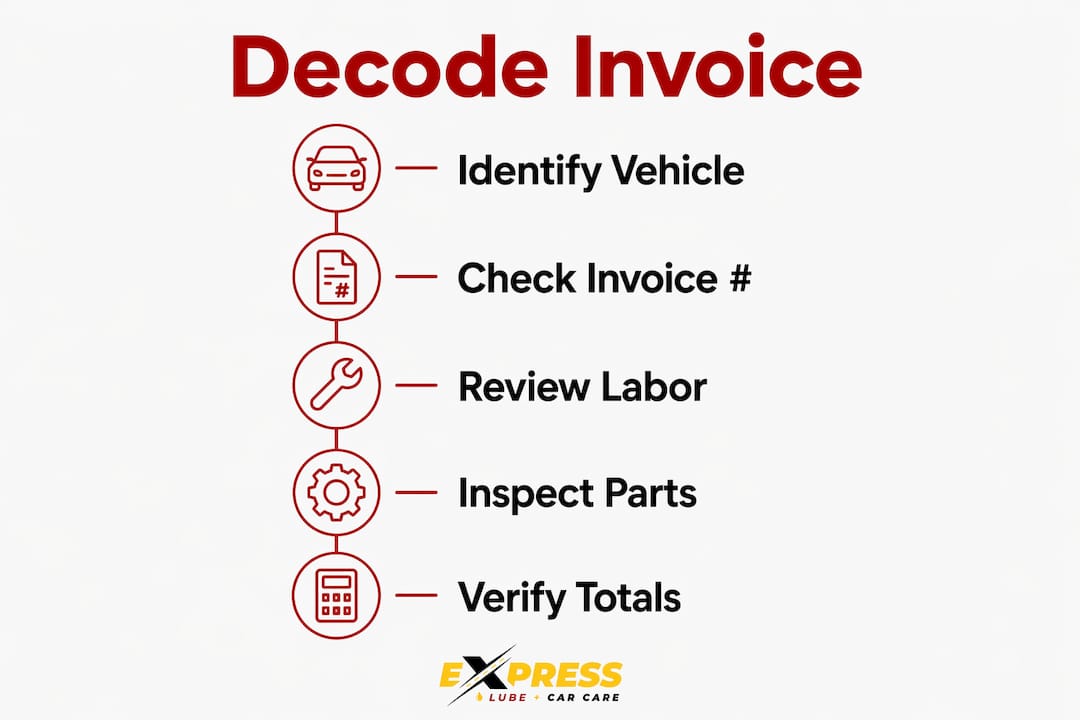
Labor is almost always the largest line item. It’s billed as the shop’s hourly rate multiplied by the time assigned to each job. Parts come next, listed individually with part numbers and prices. After that, you’ll typically see a diagnostic fee, shop supplies, environmental/disposal fees, and taxes.
Common abbreviations that trip people up:
- R&R: Remove and Replace (or Remove and Reinstall). If it’s paired with a part number, the part was swapped out.
- NFF: No Fault Found. The tech couldn’t reproduce your complaint. Ask for a road test with the mechanic if this shows up.
- SOP / SO: Special Order Part. Confirm the ETA and schedule installation before you leave.
- TSB: Technical Service Bulletin. The manufacturer recognized a known issue. If your car is out of warranty, use this as leverage with the manufacturer’s consumer affairs department.
Red flags to watch for on any invoice:
- Vague line items like “misc. fees” with no explanation
- Shop supplies charged at more than $20 or 5% of total labor
- A diagnostic fee that wasn’t credited toward the repair
- Any charge you didn’t authorize in writing beforehand
Pro Tip: At drop-off, tell the service writer in writing that you require a phone call before any additional work above a set dollar amount. Reputable shops accommodate this without hesitation.
How labor charges actually work, and what “flat-rate” means for you
Labor billing follows a system most car owners never hear about. Shops bill from a flat-rate labor guide that assigns a standard time to each repair, regardless of how long the mechanic actually takes. If the guide says a brake job takes 2.5 hours and the tech finishes in 90 minutes, you still pay for 2.5 hours. That’s industry standard, not a scam, but it does mean labor charges aren’t strictly tied to clock time.

You can read a deeper breakdown of how labor rates are calculated and what drives the numbers at different shop types. As a general benchmark, independent shops in mid-size metros usually charge moderate labor rates per hour, while dealerships typically have higher hourly rates. Specialty shops for European or diesel vehicles often go higher.
Where billing gets abusive:
- Stacked labor: Replacing an alternator and a battery in the same visit shouldn’t be billed as full standalone labor for both. Overlapping work should share labor time.
- Hidden diagnostic time: If you already paid a diagnostic fee, additional diagnostic time buried inside the repair labor is double billing.
- Specialty rate switches: Some shops quietly bump the labor rate for “diagnostic” or “specialty” work without telling you. Always ask if the rate changes for any line item.
Questions worth asking before you approve: Learn more about servicing included in car leasing to avoid unexpected repair charges.
- What is the hourly labor rate, and does it change for any part of this job?
- How many hours are being billed, and is that based on a flat-rate guide?
- Is the diagnostic fee included in the repair labor or charged separately?
Pro Tip: Ask for the labor rate and billed hours as separate line items in writing. A shop that won’t show you both is a shop worth reconsidering.
How part types affect your invoice and repair quality
Parts are where two invoices for the same repair can look wildly different. The type of part installed changes the price, the warranty, and sometimes the long-term outcome of the repair.
- OEM (Original Equipment Manufacturer): Made by or for your vehicle’s manufacturer. Factory fit, factory quality, and the highest price point. Shops must disclose which part type they’re using, so if you’re paying OEM prices, confirm you’re getting OEM parts.
- Aftermarket: Made by a third party. Quality varies widely by brand. Can be a smart choice for common repairs; less reliable for safety-critical systems without vetting the brand.
- Rebuilt/reconditioned: Used parts restored to working condition. Usually carry a limited warranty and cost less than new. Good for older vehicles where new OEM parts cost more than the car is worth.
- Used/salvage: Pulled from another vehicle. Lowest cost, shortest or no warranty. Acceptable for body panels or non-critical components.
On markup: a 30–50% markup above wholesale is standard. Markups above 100% should come with a specific explanation from the service advisor.
Before you approve any repair, ask: What type of part is being installed, who made it, and what warranty covers it? If the shop warranties both the part and the labor, that’s worth paying a little more for.
What certifications tell you about a shop’s billing practices
Certifications aren’t just wall decorations. They signal that a shop meets external standards for technician skill, repair quality, and billing transparency, and that matters when you’re trying to figure out if a charge is fair.
Key trust signals to look for:
- ASE-certified technicians: The National Institute for Automotive Service Excellence sets the standard for technician competency in the U.S. ASE certification means the tech passed rigorous testing in their specialty area.
- RepairPal Certification: RepairPal-certified shops commit to fair pricing, quality repairs, and a minimum 12-month/12,000-mile warranty on parts and labor.
- CarFax Top-Rated Service Center: Recognition based on verified customer reviews and service history, a signal of consistent, trustworthy service.
Expresslubearlington holds all three of these credentials, which is why DFW drivers trust the shop for everything from routine oil changes to complex repairs. You can learn more about what shop certification means for your repair experience and billing confidence.
What to expect from a certified shop’s invoice:
- Clear line items for every charge, no bundled mystery fees
- Written estimates before work begins, with your signature required
- Warranty terms listed per repair, not buried in fine print
- A willingness to explain any charge you don’t recognize
You have every right to ask questions before you pay. A shop that gets defensive when you point to a line item is telling you something important.
Expresslubearlington: invoices you can actually read
At Expresslubearlington, every invoice is built around transparency. Our ASE-certified technicians document the complaint, the cause, and the correction for every job, so you know exactly what was wrong and what we did about it. No mystery fees, no surprise charges, and no work done without your written authorization first.
We’re a RepairPal Certified Shop and a CarFax Top-Rated Service Center, and we back every repair with a 24-month warranty on parts and labor. If you want to keep repair costs predictable, start with oil change tips that protect your engine between visits. Stop by our Arlington location and see what a straightforward invoice actually looks like.
Key Takeaways
A car repair invoice you can decode line by line is your best defense against overcharges, stacked fees, and uncredited diagnostics.
| Point | Details |
|---|---|
| Labor uses flat-rate guides | You pay standard book time, not actual wrench time; always ask for hours and rate separately. |
| Parts type changes the price | OEM, aftermarket, rebuilt, and used parts carry different costs and warranties; confirm which is on your invoice. |
| Standard markup is 30–50% | Markups above 100% need a specific explanation from the service advisor before you approve. |
| Diagnostic fees can double-bill | If a diagnostic fee was charged, it should be credited toward the repair or clearly separated, not embedded in labor too. |
| Certifications signal fair billing | ASE, RepairPal, and CarFax Top-Rated recognition indicate shops that meet external standards for transparency and quality. |
FAQ
What should every car repair invoice include?
At minimum: shop and customer details, vehicle VIN and mileage, a sequential invoice number, itemized labor with hours and rate, itemized parts with part numbers, fees, taxes, total due, and warranty terms.
Is flat-rate labor billing legal and fair?
Yes. Most U.S. shops bill from flat-rate guides that assign standard times to repairs. You pay the guide time, not the clock time, which is industry standard practice.
How do I know if a parts markup is too high?
A 30–50% markup above wholesale is normal. Above 100% should come with a clear reason; ask the service advisor to explain it before authorizing the work.
When should a diagnostic fee be credited toward the repair?
Most shops credit the diagnostic fee toward the repair if you proceed with the service. Diagnostic fees often involve a fee; confirm the credit policy before the shop begins any inspection.
What does R&R mean on a repair invoice?
R&R stands for Remove and Replace (or Remove and Reinstall). If it appears next to a part number, the old part was swapped out for a new one.