

A blinking TPMS light is your car’s way of sending up a flare — not just about tire pressure, but about the monitoring system itself. When that amber telltale flashes rather than glows steady, it usually signals a sensor or communication fault, not simply a low tire. Your first move: visually check all four tires, grab a handheld gauge, and compare each reading to the recommended tire pressure on your door-jamb sticker.
Here’s what to do right now:
- Look at each tire. If one is visibly flat or the sidewall is bulging, stop driving and change or repair it before anything else.
- Check cold PSI on all four tires (and your spare if it has a sensor). Inflate any low tire to the door-jamb placard pressure.
- Restart the car and watch the light. If it flashes for 60–90 seconds and then goes solid, that sequence is actually federally defined behavior — NHTSA’s TPMS final rule requires the malfunction telltale to flash for at least 60 seconds and no longer than 90 seconds, then stay lit until the fault is corrected.
- If tires are properly inflated and the light still blinks, you’re likely dealing with a sensor or module fault, not a pressure problem.
Pro Tip: Always check tire pressure when the tires are cold — meaning the car has been parked for at least three hours or driven fewer than a mile. Hot tires read higher and can mask a real underinflation issue.
Key Takeaways
A blinking TPMS light signals a system or sensor malfunction, not just low pressure — check tire PSI first, but expect a sensor or module diagnosis if the light persists.
| Point | Details |
|---|---|
| Flashing vs. solid light | Flashing 60–90 seconds then solid means a TPMS malfunction; solid alone means low tire pressure. |
| Sensor battery lifespan | TPMS sensor batteries typically last 5–10 years; replacement requires a full sensor swap and programming. |
| First DIY steps | Check cold PSI on all four tires, inflate to door-jamb placard, restart, and drive 10–15 minutes. |
| When to see a shop | Persistent blinking after correct pressure, visible tire damage, or unresolvable DTCs require professional diagnosis. |
| Expresslubearlington | ASE-certified technicians in Arlington perform full TPMS diagnostics with a 24-month/24,000-mile warranty on covered repairs. |
Table of Contents
- What does a blinking TPMS light actually mean?
- Common reasons your TPMS light keeps flashing
- How to troubleshoot a blinking TPMS light step by step
- How to reset or relearn your TPMS system
- What does TPMS sensor replacement actually cost?
- When should you stop troubleshooting and see a mechanic?
- How an ASE-certified shop diagnoses a blinking TPMS light
- TPMS diagnosis and repair at Expresslubearlington in Arlington, TX
- Sources
- FAQ
What does a blinking TPMS light actually mean?
The TPMS telltale on your dashboard has two distinct personalities, and knowing which one you’re looking at changes everything.
According to Steer’s TPMS guide, a solid warning usually means the system measured a tire below the defined underinflation threshold — you can generally drive to a nearby air pump at moderate speed, but don’t ignore it.
Flashing then solid: This is the malfunction sequence. Per the NHTSA rule, the light flashes for 60–90 seconds after start-up, then stays on continuously. The system detected a fault — a dead sensor, a communication error, or a module problem — and it will repeat this sequence every time you start the car until the fault is resolved.
| Light Behavior | What It Means | Urgency |
|---|---|---|
| Solid amber | One or more tires underinflated | Inflate tires soon; drive carefully |
| Flashing 60–90 sec, then solid | TPMS system/sensor malfunction detected | Diagnose sensor or module fault |
| Flashing continuously | Possible ongoing communication error | Check pressures; scan for DTCs |
A few things worth knowing:
- Some vehicles perform a bulb-check at start-up, briefly lighting the TPMS telltale before it goes off — that’s normal and not a fault.
- If both a malfunction and low pressure exist simultaneously, some vehicles will show both indicators at once.
- Always check your owner’s manual. Some manufacturers use a separate malfunction indicator light (MIL) rather than the standard horseshoe-and-exclamation symbol.
Common reasons your TPMS light keeps flashing
Not all blinking warnings trace back to the same root cause. Here’s a ranked look at what’s most likely going on under the hood.
Dead or depleted sensor battery. TPMS sensors run on sealed internal batteries with a typical service life of about 5–10 years. Once the battery dies, the sensor stops transmitting entirely, and the system flags a communication fault. There’s no battery-only fix — the entire sensor unit gets replaced.
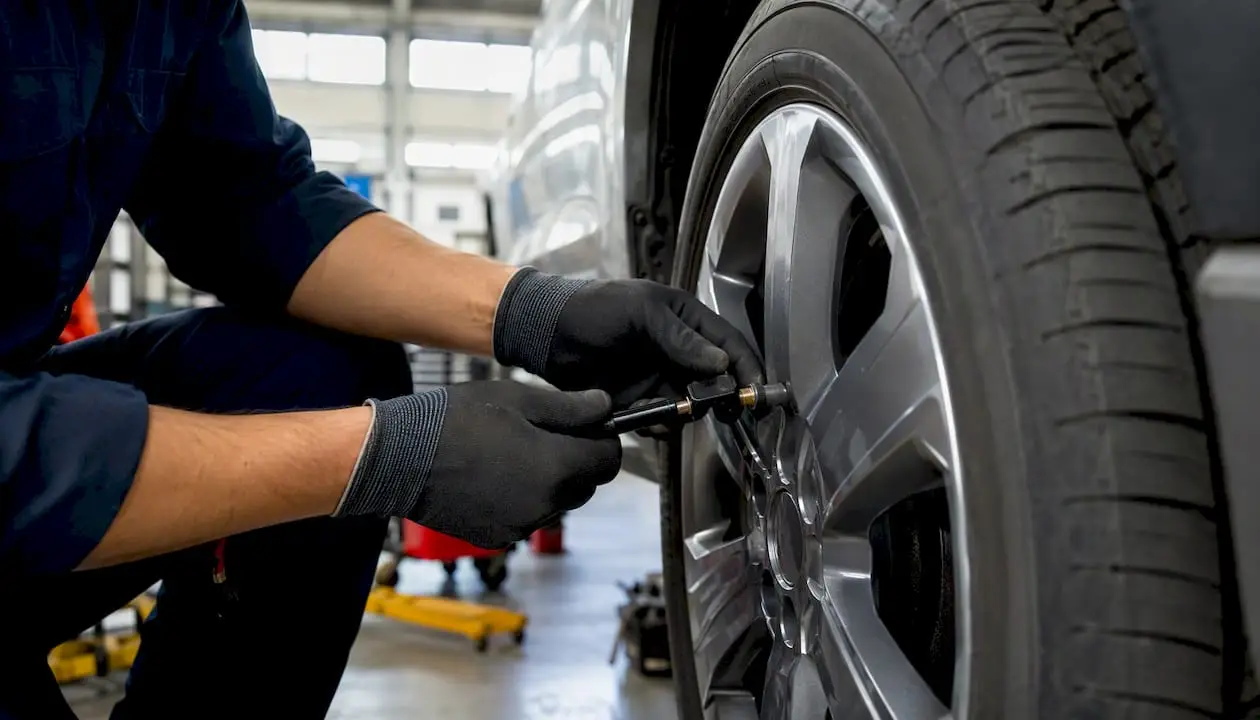
Damaged sensor or detached valve stem. Potholes, curb strikes, and careless tire mounting can physically damage a sensor or knock the valve stem loose. A sensor that’s cracked or separated from the wheel simply can’t send data.
Communication fault between sensors and the receiver module. The TPMS receiver or antenna can fail independently of the sensors themselves. Interference is also a real factor: nearby high-power transmitters — airports, police stations, broadcasting towers — can temporarily disrupt TPMS signals. If the light blinks only in one location and clears once you drive away, RF interference is worth suspecting.

Temperature-driven pressure drop. Tires lose roughly 1 PSI for every 10°F drop in ambient temperature, per Carista’s TPMS explainer. A cold snap overnight can push a borderline tire below threshold and trigger the light.
Unregistered or mismatched sensors after wheel work. Aftermarket wheels, a tire rotation at a shop that doesn’t perform a relearn, or a sensor swap without programming will leave the module looking for sensor IDs that no longer match. The result is a persistent fault code.
Pro Tip: If you recently had tires mounted or rotated and the TPMS light started blinking shortly after, ask the shop whether they performed a sensor relearn. Skipping that step is one of the most common causes of post-service TPMS faults.
How to troubleshoot a blinking TPMS light step by step
Work through these steps in order. Most of the time, you’ll find the answer before reaching step four.
-
Safety check first. Walk around the car before you do anything else. A visibly flat tire or a bulging sidewall means stop — don’t drive on it. Change to the spare or call for roadside assistance.
-
Cold PSI check on all four tires (and the spare). Use a quality handheld gauge, not the one built into the gas station air hose. Compare each reading to the door-jamb placard — not the max PSI printed on the tire sidewall, which is a different number. Inflate any low tire to placard spec.
-
Visual and valve stem inspection. Look for nails, screws, or cuts in the tread. Check each valve stem for damage or looseness. Think back: did you recently have tires mounted, rotated, or replaced? Recent wheel work is a common trigger.
-
Restart and drive 10–15 minutes. Many TPMS systems need a short drive at highway speed to re-evaluate sensor data after pressures are corrected. If the light clears within a few miles, the issue was likely a pressure drop. If it flashes again at the next start-up, the fault is still active.
-
Scan for diagnostic trouble codes. If the light persists after correct pressure and a short drive, it’s time to read the codes. OBD2/TPMS-capable tools like Carista can pull TPMS diagnostic trouble codes (DTCs) and sometimes perform relearns — useful for identifying sensor communication errors or ID mismatch codes before you book a shop visit. Think of it as triage, not a guaranteed full fix.
One more scenario worth checking: if the light blinks only near a specific location (an airport, a stadium, a police station) and clears on its own, temporary RF interference may be the culprit rather than a failed component.
How to reset or relearn your TPMS system
Resetting the TPMS light is only effective when the underlying cause is actually resolved. Here’s what each method can and can’t do.
-
Inflate and drive reset. Correct all four tires to placard PSI, then drive for 10–15 minutes at speeds above 25 mph. Many systems will auto-clear once they confirm stable pressure readings from all sensors. This works for pressure-triggered warnings, not sensor faults.
-
Factory TPMS reset button. Some vehicles (many Honda and Toyota models, for example) have a dedicated TPMS reset button, usually located under the steering column or in the glove box. With the ignition on, hold the button until the TPMS light blinks three times, then release. Drive for 10–15 minutes to complete the relearn.
-
Vehicle settings menu relearn. Many modern vehicles from Ford, GM, BMW, and others include a TPMS calibration option in the infotainment or instrument cluster menu. The owner’s manual will walk you through the exact sequence, which usually involves confirming correct tire pressures first.
-
OBD2/TPMS scan tool relearn. Tools like Carista or dedicated TPMS scanners can read fault codes, register new sensor IDs, and clear stored DTCs. This is the right move after a sensor replacement or wheel swap. Keep in mind: many relearns still require a shop-grade tool (Autel or ATEQ-style) to fully sync new sensor IDs with the module.
-
When the shop is the only option. If sensors are non-responsive, the module itself is faulty, or a relearn attempt fails repeatedly, a tire shop with professional TPMS programming equipment is the practical next step. TireGrades notes that a blinking light that won’t clear often points to a control module issue or persistent communication error that DIY tools can’t fully resolve.
Pro Tip: Before buying a TPMS scan tool, check whether your vehicle’s year, make, and model is supported. Coverage varies significantly between tools, and some older or less common platforms require manufacturer-specific software.
What does TPMS sensor replacement actually cost?
Setting realistic expectations before you walk into a shop saves time and prevents surprises.
TPMS sensor batteries are sealed inside the sensor housing, so when the battery fails after its typical 5–10 year lifespan, the whole sensor unit is replaced. Parts and labor costs vary by vehicle and region, but here’s a general picture:
A few variables that move the needle:
- OEM sensors from the dealership typically cost more than quality aftermarket units.
- Shops that need to dismount and remount the tire to access the sensor add that labor to the bill.
- Regional labor rates in the DFW area differ from national averages, so always get a written estimate.
Diagnosis and a pressure check can take 15–30 minutes. A full sensor replacement with relearn typically runs 30–90 minutes per corner, depending on shop workflow and whether tire dismount is required.
When should you stop troubleshooting and see a mechanic?
Some TPMS situations are genuinely DIY-friendly. Others aren’t — and pushing past those limits wastes time and can leave a safety issue unresolved.
Stop troubleshooting on your own and book a shop visit when:
- The light keeps blinking after you’ve confirmed correct pressure on all four tires and driven for at least 10–15 minutes.
- You see visible tire damage — a nail, a cut, a bulge, or a cracked sidewall.
- Multiple sensors appear to be failing at the same time.
- A basic OBD2 scan returns sensor communication errors or ID mismatch codes you can’t clear.
- The car has had recent tire or wheel work and the light appeared immediately after.
What the shop will actually do: A qualified technician will verify PSI and do a visual inspection first, then connect a TPMS scan tool to pull all active DTCs. From there, they’ll use an on-wheel sensor activation tool to test each sensor’s response individually. If a sensor is dead or the module isn’t receiving signals, they’ll trace it to the specific component — sensor, valve core, antenna, or receiver module — before recommending a repair. You’ll get a written estimate before any work begins.
Questions worth asking before you approve the repair:
- Is sensor programming included in the quoted price?
- What’s the warranty on parts and labor?
- Will the technician test-drive the vehicle to confirm the light stays off?
How an ASE-certified shop diagnoses a blinking TPMS light
There’s a meaningful difference between a quick code read and a real diagnostic. Here’s the workflow an ASE-certified technician follows to get it right the first time.
Step 1 — Pressure verification and visual inspection. Every diagnostic starts here. The technician checks all four tires against the door-jamb placard and inspects each wheel for physical damage, missing valve caps, or loose valve stems.
Step 2 — TPMS scan for DTCs. A professional TPMS scan tool reads all stored and pending fault codes. Common codes include sensor communication errors and ID mismatch faults — the kind that a basic OBD2 reader might miss or misinterpret.
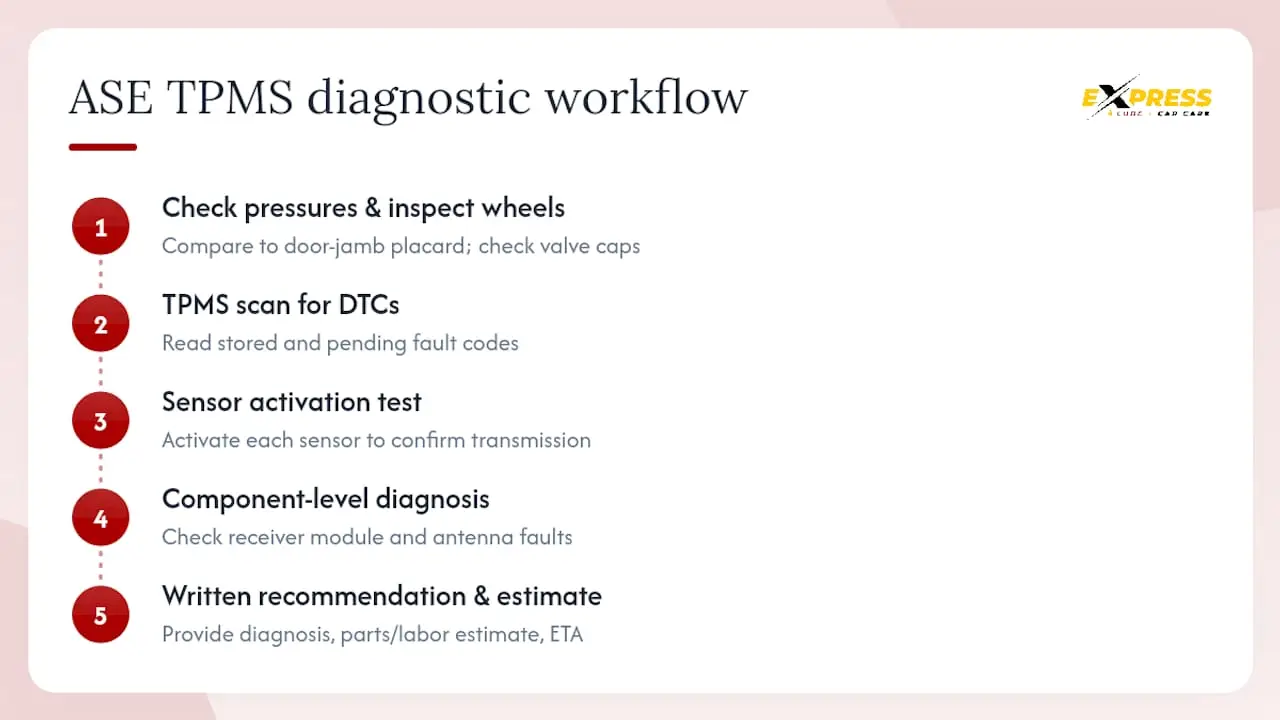
Step 3 — Sensor activation test. Using an on-wheel activation tool, the technician triggers each sensor individually to confirm it’s transmitting. A sensor that doesn’t respond to activation is confirmed failed, not just suspected.
Step 4 — Component-level diagnosis. If sensors all respond but the fault persists, the technician checks the receiver module and antenna for faults. This step separates a $60 sensor replacement from a more involved module repair.
Step 5 — Written recommendation and estimate. You receive a clear diagnosis, a parts-and-labor estimate, and an expected completion time before any repair begins.
At Expresslubearlington, ASE-certified technicians perform every step of this process, and covered repairs come with a 24-month/24,000-mile warranty. That warranty covers both parts and labor — so if the repair doesn’t hold, you’re protected.
Pro Tip: Ask the shop to show you the TPMS scan results on screen before approving the repair. Seeing the actual fault codes makes it much easier to understand what’s being fixed and why.
A note from the shop
Most of the time, a blinking TPMS light traces back to one of two things: a sensor battery that’s reached the end of its 5–10 year life, or a sensor that lost communication after tire work. Both are straightforward repairs when diagnosed correctly. If you’ve checked your pressures, driven for a few miles, and the light is still flashing, the safest move is to let an ASE-certified technician read the codes and confirm exactly which component needs attention. We’d rather you come in for a 20-minute scan than drive around with an unresolved fault.
TPMS diagnosis and repair at Expresslubearlington in Arlington, TX
A blinking TPMS warning doesn’t have to mean a stressful afternoon of guesswork. Expresslubearlington’s ASE-certified technicians in Arlington handle the full diagnostic sequence: pressure verification, TPMS code scan, sensor activation testing, and sensor replacement with programming — all under one roof.

Every covered repair includes a 24-month/24,000-mile warranty, and if you’re watching your repair budget, there’s currently $45 off mechanical repairs available for Arlington drivers. Bring your car in for a TPMS diagnostic, and you’ll leave with a clear answer, a written estimate, and a test-drive confirmation that the light stays off. Stop by or schedule your appointment today at Expresslubearlington — no guesswork, just a straight answer and a repair that’s backed in writing.
Sources
- TPMS final rule (NHTSA)
- TPMS Light On? Complete Tire Pressure Guide + Reset – Steer
- Why Is My Tire Pressure Light Blinking? (TPMS Fault) | TireGrades
- TPMS malfunction indicator – Kia owners manual webhelp
FAQ
Why is my TPMS light blinking but my tires look fine?
A blinking TPMS light usually indicates a sensor or system fault rather than a pressure problem. Even if all four tires look normal, a dead sensor battery, a communication error, or a module fault can trigger the flashing sequence.
Can I fix a TPMS error myself?
You can handle basic steps — inflating tires to placard PSI, driving to allow the system to re-evaluate, and using an OBD2/TPMS tool like Carista to read fault codes. However, sensor replacement and relearn programming typically require shop-grade tools and an ASE-certified technician.
How much does it cost to replace a TPMS sensor?
A full sensor replacement generally runs $50–$150 per corner, covering parts, programming, and labor. OEM sensors cost more than quality aftermarket units, and shops that need to dismount the tire add that labor to the total.
How do you manually turn off the TPMS light?
Inflate all tires to the door-jamb placard pressure, then use the vehicle’s TPMS reset button (if equipped) or the settings menu relearn sequence. Drive for 10–15 minutes to allow the system to confirm stable readings. If the light returns at the next start-up, a sensor or module fault needs professional diagnosis.