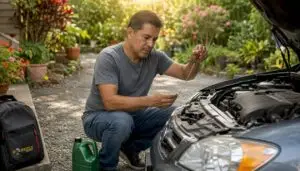

Seasonal car maintenance is defined as a proactive, scheduled upkeep approach that aligns your vehicle’s servicing with changing weather conditions, covering monthly basic checks and full inspections four times per year. Think of it as your car’s wardrobe change. Just as you swap out heavy coats for light jackets, your vehicle needs specific attention every time the weather shifts. Tires, fluids, batteries, brakes, and filters all respond differently to heat, cold, rain, and road salt. Staying ahead of those changes is the difference between a reliable daily driver and a roadside breakdown waiting to happen.
What is seasonal car maintenance and why does it matter?
Seasonal car maintenance, also called scheduled preventive maintenance, is the practice of inspecting and servicing your vehicle at each season transition to protect it from weather-related wear. The industry standard, as outlined by Motor Advises, calls for monthly basic checks and comprehensive inspections four times annually. That rhythm exists because your car faces genuinely different threats in January than it does in July.
The stakes are real. Dead batteries top the list of winter roadside failures, tire problems spike every spring, and cooling system failures peak during summer heat. A coolant flush runs $100 to $150 at most shops, which sounds like a lot until you compare it to a tow truck, a rental car, and an emergency repair bill. Seasonal vehicle upkeep is not about spending more money. It is about spending it at the right time, on the right things, before a small problem becomes an expensive one.
Consistent seasonal care also protects your resale value and lowers your total cost of ownership over time. A well-documented maintenance history tells any future buyer that the vehicle was treated with care. That translates directly to a higher asking price and a faster sale.
What are the essential maintenance tasks for each season?
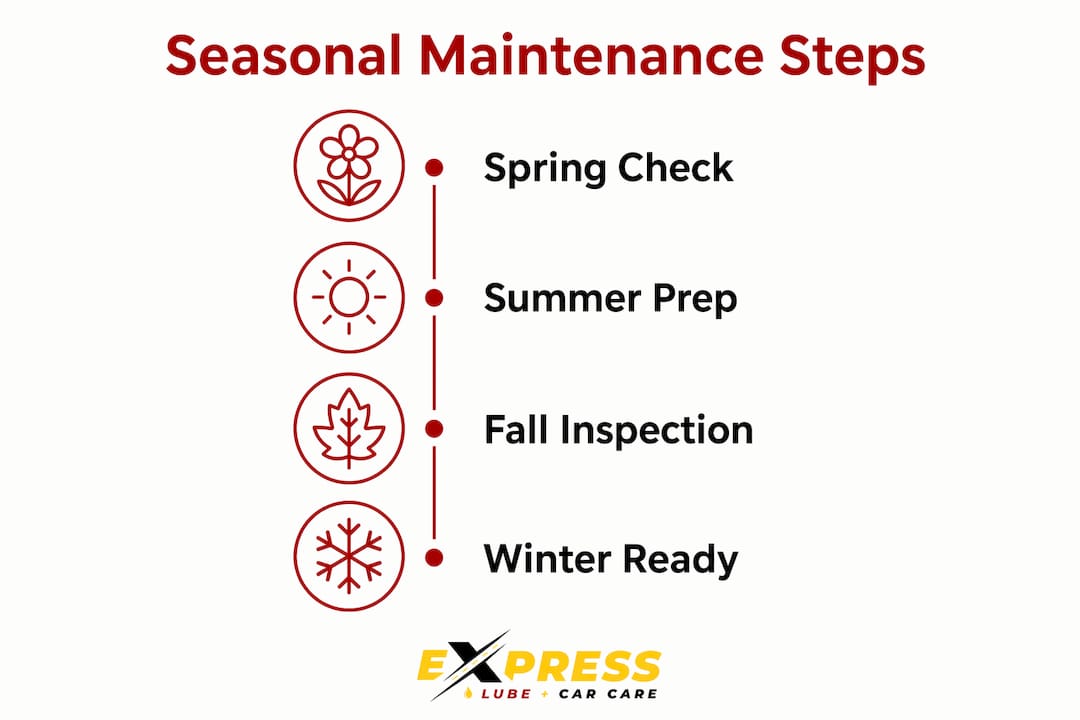
Each season brings its own checklist. Here is what to focus on as the calendar turns.
Spring
- Inspect tires for pothole damage and uneven tread wear caused by winter roads
- Switch from winter tires to all-season or summer tires once temperatures stay above 45°F
- Check brakes for worn pads or rotors after months of cold-weather stress
- Wash the undercarriage thoroughly to remove road salt before it causes corrosion
Summer
- Inspect the coolant system and top off or flush as needed (coolant flushes average $100 to $150)
- Test battery health, since heat permanently degrades batteries faster than cold ever will
- Check the air conditioning system before the first heat wave, not during it
- Monitor tire pressure weekly, as hot pavement raises pressure and affects handling
Fall
- Change the oil and replace the engine air filter before cold weather thickens fluids
- Mix engine coolant with the correct antifreeze ratio for your region’s winter lows
- Test the heater and defroster systems while you still have time to fix them
- Inspect tires for tread depth and consider scheduling your winter tire swap
Winter
- Switch to winter tires if you live in a region with consistent snow or ice
- Test battery charge and inspect the charging system before temperatures drop below freezing
- Verify antifreeze and coolant levels meet cold-weather specs
- Replace windshield wipers with winter-rated blades and switch to washer fluid rated for freezing temperatures
Pro Tip: Check your tire pressure every time the temperature drops 10°F or more. Tires lose roughly 1 PSI for every 10-degree drop, and underinflated tires wear out faster and handle poorly in wet or icy conditions.
How do changing weather conditions affect vehicle components?
Weather does not just inconvenience drivers. It physically changes how your car’s components behave at a chemical and mechanical level.
| Component | Weather threat | What happens |
|---|---|---|
| Tires | Temperature drop | Pressure drops ~1 PSI per 10°F, causing wear and handling loss |
| Battery | Summer heat | Heat permanently accelerates internal degradation, leading to winter failures |
| Suspension | Freeze-thaw cycles | Pothole damage spikes in spring, stressing alignment and shocks |
| Engine oil | Short cold trips | Oil never reaches full operating temp, causing sludge buildup over time |
| Undercarriage | Road salt | Accelerated corrosion on brake lines, exhaust, and frame components |
The battery story is one most drivers get backward. People assume cold kills batteries, and while extreme cold does reduce cranking power, it is actually summer heat that causes permanent battery wear. The battery that dies on a January morning was likely damaged the previous August. That is why a fall battery test is one of the highest-value checks on any seasonal auto care checklist.
Short city trips create a sneaky problem for engine oil. When your engine never fully warms up, moisture and combustion byproducts stay suspended in the oil instead of burning off. Over time, this leads to sludge buildup that can clog oil passages and accelerate wear. If most of your driving is short errands around town, you need more frequent oil changes than the mileage alone would suggest.
Pro Tip: After any winter with heavy road salt exposure, schedule an undercarriage wash and inspection in early spring. Salt does not just rust the body panels you can see. It attacks brake lines, fuel lines, and frame components that are much more expensive to replace.
What is the recommended schedule for seasonal maintenance?
Knowing what to do is only half the equation. Knowing when to do it is what keeps your car out of the shop.
- Monthly: Check tire pressure when tires are cold (before driving), top off windshield washer fluid, visually inspect for fluid leaks under the car, and check engine oil level with the dipstick.
- Every season (4 times per year): Schedule a full inspection covering brakes, battery health, all fluid levels and conditions, air filter, cabin filter, and tire tread depth. This is your seasonal transition appointment.
- Every 5,000 to 7,500 miles: Change the engine oil and filter. Full-synthetic oils can extend that interval to 15,000 miles in some vehicles, but always cross-reference with your owner’s manual.
- Annually: Inspect belts and hoses for cracking or brittleness, test the battery’s cold cranking amps (CCA), and check wheel alignment if you notice any pulling or uneven tire wear.
- As needed: Address any warning lights, unusual sounds, or handling changes immediately. These are your car sending up a flare. Ignoring them turns a $50 fix into a $500 repair.
The owner’s manual is your most underused resource. Manufacturers build maintenance schedules around real engineering data for your specific engine, transmission, and climate rating. Pairing that guidance with a mileage-based maintenance schedule gives you the most complete picture of what your car actually needs and when.
How can you handle basic seasonal maintenance yourself?
You do not need to be a mechanic to stay on top of the basics. Consistent habits like checking tire pressure and fluid levels are genuinely within reach for any car owner, and they catch problems before they become dangerous.
Here is what you can do at home without special tools:
- Tire pressure: Use a simple tire gauge (available at any auto parts store for under $10) and check pressure when tires are cold, meaning the car has been parked for at least three hours. Compare the reading to the sticker inside your driver’s door, not the number on the tire sidewall.
- Engine oil level: Pull the dipstick, wipe it clean, reinsert it fully, then pull it again. The oil should sit between the two marks and look amber to light brown. Dark black oil or a milky appearance signals it is time for a professional look.
- Cabin and engine air filters: Both are usually accessible without tools. Hold them up to a light source. If you cannot see light through the filter material, it is time for a replacement. A clogged cabin filter reduces your HVAC efficiency and air quality noticeably.
- Visual hose and belt inspection: Look for cracks, fraying, or soft spots. Brittle rubber is a sign that heat cycles have done their damage.
- Windshield washer fluid: This one is purely a top-off job. Just make sure you use a fluid rated for freezing temperatures before fall arrives.
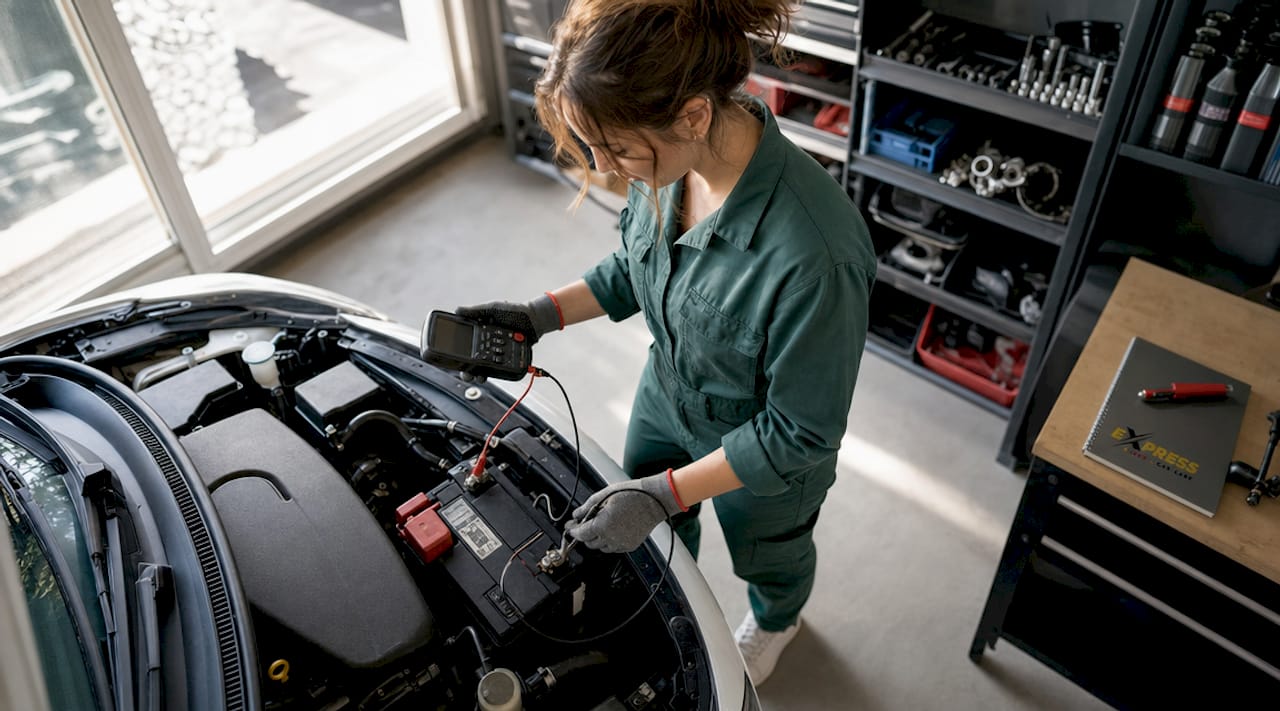
For battery testing, coolant flushes, and brake inspections, professional equipment gives you results a visual check simply cannot. A battery load tester measures actual cranking capacity under stress, which is the only reliable way to know if your battery will survive winter. These are the tasks where a trusted shop earns its value.
Pro Tip: Always check tire pressure in the morning before your first drive of the day. Driving heats the air inside the tire and raises the reading, which can make an underinflated tire look fine when it is not.
Key takeaways
Seasonal car maintenance is the most cost-effective way to prevent breakdowns, protect resale value, and keep your vehicle safe across every weather condition it faces.
| Point | Details |
|---|---|
| Definition and frequency | Seasonal maintenance means monthly basic checks plus four full inspections per year at each season change. |
| Weather impacts components | Tire pressure, battery life, oil quality, and suspension all change measurably with temperature and road conditions. |
| Battery risk is seasonal | Summer heat permanently degrades batteries, making fall battery testing one of the highest-value checks you can do. |
| DIY basics are accessible | Tire pressure, fluid levels, and filter checks require no special skills and catch most problems early. |
| Professional help has a clear role | Battery load testing, coolant flushes, and brake inspections need shop-grade equipment for reliable results. |
Why I think most drivers are one season behind on their car
Here is something I have seen play out more times than I can count: a driver comes in for a winter battery replacement, and when we test it, the battery has been failing since August. They drove through fall with a compromised battery and got lucky. Most people think about car care reactively, meaning they act after something goes wrong. But addressing minor issues early is what separates drivers who spend $150 on a coolant flush from drivers who spend $1,500 on an overheated engine.
The other thing I want to push back on is the idea that modern cars “take care of themselves.” Yes, synthetic oils last longer. Yes, onboard diagnostics catch more faults. But a dashboard warning light is not a maintenance schedule. It is a last resort. The vehicles I see with the longest, most trouble-free lives belong to owners who treat seasonal upkeep as a habit, not a reaction. Seasonal maintenance as an investment is not a marketing phrase. It is the math of small, predictable costs versus large, unpredictable ones. The math always favors the proactive driver.
— Hassan
Keep your car ready for every season with Expresslubearlington
At Expresslubearlington, our ASE-certified technicians and RepairPal-certified shop handle every item on your seasonal auto care checklist, from battery load testing and tire swaps to coolant flushes and full brake inspections. We are recognized as a Top-Rated Service Center by CarFax, and drivers across the DFW area trust us because we give straight answers and get the work done right the first time. Do not wait for a warning light to tell you something is wrong. Schedule your seasonal vehicle inspection before the next weather shift hits, and let our team make sure your car is ready for whatever comes next.
FAQ
What is seasonal car maintenance in simple terms?
Seasonal car maintenance is the practice of inspecting and servicing your vehicle four times per year to match its condition to changing weather demands. It covers tires, fluids, battery, brakes, and filters at each season transition.
How often should I get a seasonal car inspection?
The recommended schedule calls for monthly basic checks and a comprehensive inspection at each season change, totaling four full inspections per year. Always cross-reference with your vehicle’s owner’s manual for model-specific intervals.
Can I do seasonal car maintenance myself?
Car owners can handle tire pressure checks, fluid top-offs, and filter inspections at home without special tools. Battery load testing, coolant flushes, and brake inspections require professional equipment for accurate results.
Why does my battery die in winter if heat is the real problem?
Summer heat permanently degrades a battery’s internal structure, reducing its capacity. The weakened battery then fails under the high cranking demand of cold winter starts, making fall battery testing the most effective preventive step.
How does tire pressure change with the seasons?
Tire pressure drops approximately 1 PSI per 10°F decrease in ambient temperature. Checking pressure monthly and after any significant temperature swing keeps tires at the correct inflation for safe handling and even tread wear.