
A 100k mile service means replacing the parts that don’t last forever: engine oil and filter, spark plugs, coolant, transmission and brake fluid, plus a full timing belt swap if your engine has one. Expect to spend somewhere between $500 and $900 for a comprehensive visit. Before anything else, pull your service records or owner’s manual and confirm whether the timing belt has already been done.
TL;DR:
- Replacing the timing belt is crucial if your engine has one and has not been documented as replaced, as failure can cause expensive engine damage.
- Expect to spend between $500 and $900 for a full 100,000-mile service, with costs rising for vehicles that have labor-intensive engines or premium parts.
- Critical items include a complete fluid exchange, spark plug inspection or replacement, and brake system checks, as these are essential for safety and efficiency.
- Keep detailed service records to avoid unnecessary repeat repairs, especially since many components wear quietly and are easy to overlook.
- Use an ASE-certified shop that provides transparent, itemized quotes and digital inspections, and verify what work has already been completed before authorizing new repairs.
Table of Contents
- What Does a 100k Mile Service Include? The Full Checklist
- How Much Does a 100k Mile Service Cost?
- Timing Belt or Chain: Why This One Decision Changes Everything
- Fluids That Fail Quietly: What Each One Is Actually Doing
- What Happens During the Shop Visit?
- Why ASE-Certified Technicians and Verified Records Matter Here
- The 100k Service Most Owners Get Wrong
- Ready for Your 100k Mile Service? Here’s the Faster, Safer Way to Handle It
- Sources
- FAQ
What Does a 100k Mile Service Include? The Full Checklist
Think of 100,000 miles as a threshold, not just a number on the odometer. Parts that were fine to ignore at 60,000 miles start turning into real risks now, and the checklist that mattered at 30k or 60k looks very different from the one that matters here.
Here’s what a genuinely thorough 100k mile interval service should cover:
- Engine oil and filter — swap it if you’re at or near your interval, and consider an oil change with fresh filter media rather than a quick top-off.
- Spark plugs and ignition components — many modern plugs are rated to last up to 100,000 miles, but worn plugs quietly rob you of fuel efficiency, so inspect them even if you’re not sure they need replacing.
- Timing belt or chain — belt-equipped engines need this checked now; chains generally don’t need replacement but still deserve a listen for rattling.
- Brake system — pads, rotors, calipers, hoses, and a brake fluid exchange.
- Suspension and steering — struts, shocks, ball joints, and tie rod ends, all of which wear out silently until they don’t.
- Cooling system — hoses, belts, and a coolant flush.
- Battery and charging system — a load test tells you more than a visual check ever will.
- Filters — air and cabin air filters, often overlooked but cheap insurance for engine and HVAC performance.
- Tires — tread depth, uneven wear patterns, and alignment.
Not every item on that list carries the same urgency. If your engine has a timing belt and you don’t have proof it’s been replaced, that jumps to the top of the list, full stop. Brakes and suspension come next, since those affect how your car stops and handles. Fluids and filters matter, but they’re rarely going to leave you stranded on the highway the way a snapped belt or worn-out ball joint can.
Pro Tip: Keep a simple folder, digital or physical, with every repair receipt and inspection sheet. When you hit 100k, that folder is the fastest way to figure out what’s already been done and what’s still outstanding, instead of paying to re-diagnose work a previous mechanic already completed.
How Much Does a 100k Mile Service Cost?
A comprehensive 100,000 mile service typically runs between $500 and $900, though that range swings hard depending on what your specific car needs and whether the timing belt is part of the job.
Common services include spark plug replacement, timing belt replacement with water pump and tensioner as a major cost, coolant flushes, transmission fluid service varying by type, and brake fluid exchange, each with varying costs depending on vehicle and service specifics.
A basic visit covering inspection plus fluid services tends to land toward the lower end of that range. A full service that includes timing belt work pushes toward the higher end, sometimes past it if the shop finds additional wear during inspection.
Imported vehicles, tight engine bays that add labor time, and premium parts all push costs up. For those looking to maintain or resell such vehicles, consulting a premium car consignment service can help maximize their vehicle’s value. So does anything the technician finds mid-inspection that wasn’t on the original estimate. That’s exactly why you should get an itemized, written estimate before work begins, and compare it line by line against any other quote you’re considering. A vague “it’ll be around $700” isn’t a quote. It’s a guess.
Timing Belt or Chain: Why This One Decision Changes Everything
This is the single question that separates a routine 100k mile tune-up from a much bigger repair bill, so it’s worth nailing down early.
Check your owner’s manual first. If that’s not handy, a VIN lookup or a quick call to your shop with your engine family will confirm it. Some manufacturers spec belt replacement between roughly 60,000 and 105,000 miles, which means 100k is often right in the danger zone if it hasn’t happened yet.
Here’s why this matters so much: on an interference engine, a snapped timing belt lets the pistons and valves collide, which usually means bent valves and a repair bill that can rival the cost of the engine itself. A belt swap runs a few hundred dollars. A ruined engine does not.
- If your engine has a timing belt and there’s no documented replacement, treat it as not done and schedule the work.
- Replace the water pump, tensioner, and pulleys at the same time. It’s more labor now, but it saves you from paying for a second tear-down later.
- If you have a timing chain, you likely don’t need replacement at 100k, but it’s still worth a listen for chatter or rattling at startup.
Fluids That Fail Quietly: What Each One Is Actually Doing
Fluids don’t announce trouble the way a squealing brake does. They just slowly stop doing their job, and by the time you notice, something else has already suffered for it.
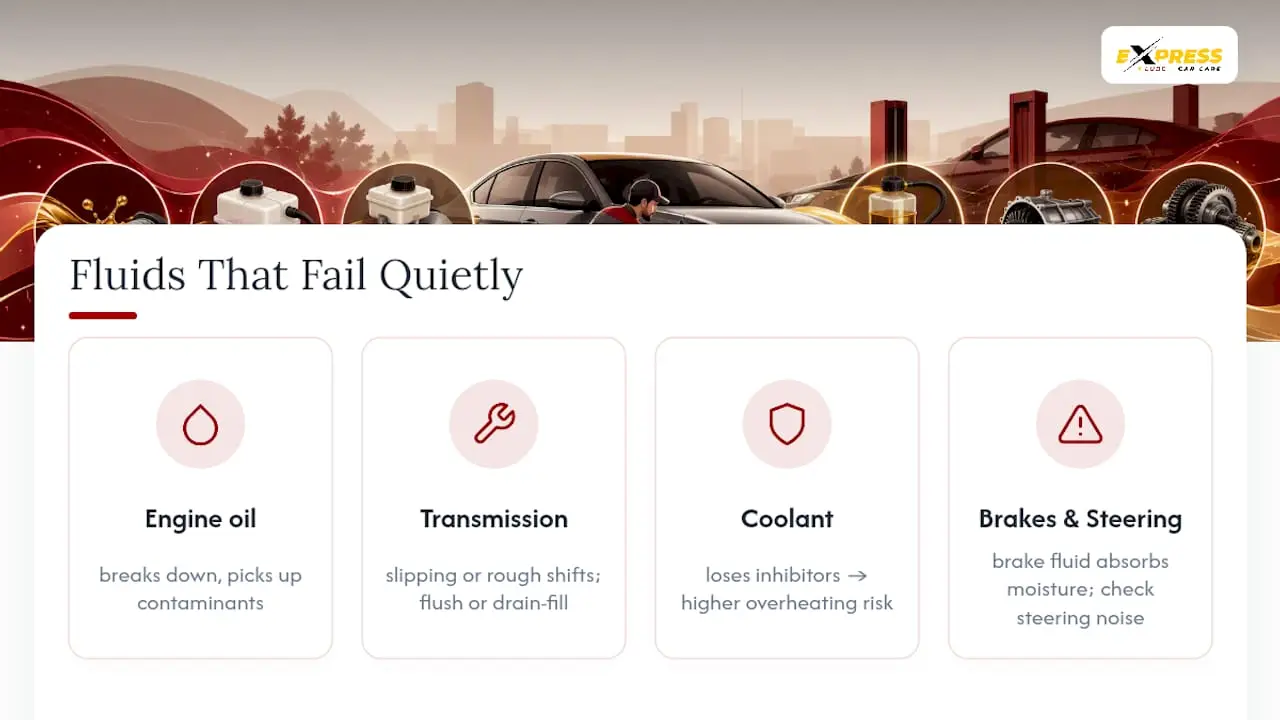
Engine oil breaks down and picks up contaminants over time. If you’re unsure how well your engine has held up, an oil analysis can tell you more than a visual check ever will. Transmission fluid that’s overdue often shows up as slipping or rough shifts, and depending on your transmission, a flush or a simple drain-and-fill will be recommended. Coolant loses its corrosion inhibitors over the years, which raises overheating risk even if the coolant level looks fine. Brake fluid absorbs moisture from the air over time, which lowers its boiling point and can leave you with a soft or spongy pedal exactly when you need firm stopping power most.
Power steering fluid and differential fluid, where applicable, deserve a look too, especially if you’ve noticed unusual noise while turning.
Pro Tip: A soft brake pedal and a musty smell from the vents are two of the most overlooked warning signs at high mileage. Neither one screams for attention the way a warning light does, but both point straight to fluid trouble.
What Happens During the Shop Visit?
A proper high-mileage visit isn’t a quick glance under the hood. Here’s what a legitimate 100k mile inspection and service should look like from start to finish:
- The inspection. Most shops run a 30 point or 60 point inspection covering fluids, brakes, suspension, belts, hoses, and the battery. A thorough 100k inspection and service typically takes 3 to 6 hours of labor, more if the technician uncovers additional issues.
- The estimate. Ask for an itemized, written breakdown, not a lump number. You should be able to see OEM versus aftermarket part options and pricing for each.
- The documentation. A shop that offers digital inspection photos lets you see exactly what a worn brake pad or a cracked hose actually looks like, instead of just taking someone’s word for it.
- The records check. Bring whatever service history you have so the shop doesn’t repeat work you already paid for.
Watch for red flags: a shop that won’t itemize, pushes you to approve work on the spot, or refuses to show inspection photos when asked. Those are signs to get a second opinion before signing off.
Why ASE-Certified Technicians and Verified Records Matter Here
A 100k mile service touches nearly every major system on your car, which is exactly why the technician’s credentials matter more here than at a routine oil change. Expresslubearlington’s ASE-certified technicians handle these inspections with the training that high-mileage diagnostics actually demand, backed by our standing as a RepairPal Certified Shop and recognition as a CarFax Top-Rated Service Center.
Every 100k visit includes a digital inspection with photos, an itemized estimate before any work starts, and a 24 month, 24,000 mile warranty on covered repairs. Bring your VIN, owner’s manual, or whatever service records you have, and we’ll build an estimate around what your specific vehicle actually needs.
The 100k Service Most Owners Get Wrong
Most advice on this topic treats every checklist item as equally urgent, and that’s where owners waste money or, worse, delay the wrong thing. A worn cabin air filter and an unreplaced timing belt do not belong on the same priority tier, yet plenty of shops present them that way on a single flat quote.
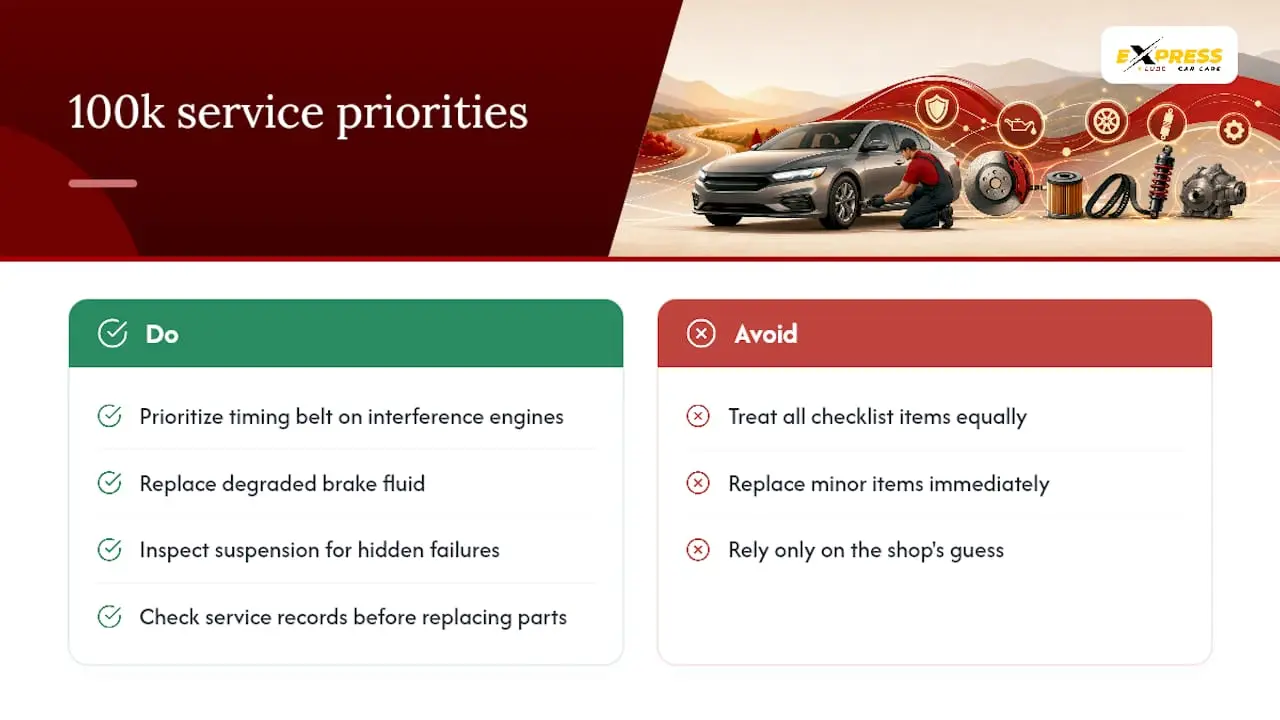
The research is clear on where the real risk sits: interference engines with unknown timing belt history, degraded brake fluid, and suspension components that have quietly failed a visual inspection. Everything else, air filters, cosmetic wear, minor fluid top-offs, can usually wait a few thousand miles without consequence.
What conventional advice underrates is the value of your own paperwork. A stack of old receipts is often worth more than a shop’s guess, because it turns a vague “better safe than sorry” replacement into a targeted, evidence-based repair. If you only do one thing differently at 100k, make it this: find out what’s actually been replaced before you agree to replace it again.
— Hassan
Ready for Your 100k Mile Service? Here’s the Faster, Safer Way to Handle It
Skipping the guesswork on a 100k mile service means working with a shop that shows you the problem instead of just quoting you a number. Expresslubearlington gives you a digital inspection with photos, an itemized estimate broken down by part and labor, and technicians who are ASE-certified specifically for the kind of diagnostic work a high-mileage vehicle demands.
If the estimate comes back higher than expected, especially with a timing belt job in the mix, financing options can spread the cost instead of forcing you to defer safety-critical work. Every repair is backed by a 24 month, 24,000 mile warranty, so you’re not paying twice for the same problem within that window. Bring your VIN or service records to Expresslubearlington and get a written, itemized estimate before anything is touched. That’s the whole point: know what you’re paying for, and why, before you approve it.
Sources
- Carparts
- 100,000 Mile Service – What’s the Cost? – Openbay blog
- 6 Maintenance Items That Become Critical at 100,000 Miles – DAX Street
- 100k Service Guide: An Essential Car Maintenance Checklist – Carfect
FAQ
How Much Does a 100k Mile Service Cost?
A comprehensive 100k mile service typically costs between $500 and $900, though timing belt replacement or additional repairs found during inspection can push the total higher.
What Service Is Recommended at 100,000 Miles?
At 100,000 miles, expect fresh engine oil and filter, spark plug inspection or replacement, a coolant and brake fluid service, transmission fluid check, timing belt replacement on belt-equipped engines, and a full brake and suspension inspection.
What Do They Do for a 100k Mile Service?
A shop runs a 30 point or 60 point inspection covering fluids, brakes, suspension, belts, hoses, and the battery, then replaces or services whatever has reached the end of its service life, a process that typically takes 3 to 6 hours of labor.
Do I Need to Replace My Timing Belt at 100,000 Miles?
If your engine has a timing belt and you don’t have documented proof it’s already been replaced, assume it has not been done and schedule replacement, since manufacturers often specify intervals between roughly 60,000 and 105,000 miles.
Is a 100k Mile Service Different for Hybrids or Diesel Vehicles?
Hybrids typically need the same brake, suspension, and fluid services but often see less brake wear thanks to regenerative braking, while diesel engines usually skip spark plugs but need closer attention to fuel filters and, in many cases, don’t use a timing belt at all.