
Most white smoke exhaust you see on a cold morning is just condensation, and it’ll disappear within a couple of minutes of driving. But if that white smoke exhaust sticks around after your engine reaches full operating temperature, especially with a faint sweet smell, you’re likely looking at coolant burning inside a cylinder, and that calls for a diagnosis sooner rather than later. If you’re also losing coolant or seeing your temperature gauge climb, stop driving and have the car inspected promptly.
TL;DR:
- Persistent white smoke with a faint sweet smell indicates coolant burning inside the engine, often caused by a blown head gasket or cracked cylinder head.
- Diagnosing the issue requires tests like pressure testing the cooling system, combustion-gas analysis, and inspection of oil and coolant levels to confirm coolant intrusion.
- Continuing to drive with unresolved coolant leaks risks severe engine damage such as warped heads or hydrolocking, especially if the temperature gauge climbs or coolant loss persists.
- Diesel engines producing white smoke typically suffer from fuel injection problems or glow plug failures, not coolant issues, and smell like diesel fuel.
- Early, thorough testing prevents costly repairs by identifying specific causes like head gasket failure or turbo seal leaks before extensive engine damage occurs.
Table of Contents
- Why Is My Exhaust White? Steam, Coolant, or Oil Smoke
- What’s Actually Causing Your Car to Smoke White
- How Do You Diagnose White Smoke From Your Exhaust?
- What Tests Do Shops Use to Confirm the Cause?
- When Should You Stop Driving and Call for a Tow?
- What Repairs Fix Persistent White Smoke?
- Why Early Testing Matters More Than Guessing
- Get Your White Smoke Exhaust Diagnosed the Right Way
- Where to Learn More About Exhaust Smoke Diagnosis
- Sources
- FAQ
Why Is My Exhaust White? Steam, Coolant, or Oil Smoke
Not all white smoke exhaust means the same thing, and your nose is actually one of your best diagnostic tools here. Learning to read the smoke, the smell, and the timing tells you almost everything you need to know before a technician ever pops the hood.
- Wispy, thin vapor on a cold start: This is condensation from your exhaust system and it’s completely normal. It fades within a minute or two as the pipes warm up.
- Dense, persistent white smoke with a faint sweet smell: This points to coolant reaching the combustion chamber, since coolant burning tends to carry that sweet, syrupy odor from the ethylene glycol in antifreeze.
- Blue or gray smoke with an acrid, burnt smell: That’s oil, not coolant, usually from worn rings or valve seals.
- White smoke with a raw diesel odor: That’s unburnt fuel, not coolant, and it’s common in diesel engines.
Cold, humid mornings and short trips make condensation more visible, so don’t panic if you see a puff of white smoke exhaust before your commute even starts — learn how to diagnose the source first to stop car odour for good. The real test is what happens once the engine’s warm.
What’s Actually Causing Your Car to Smoke White
The engine underneath the hood determines which causes are realistic, and gasoline and diesel engines tend to fail in different ways.
On a gasoline engine, harmless water vapor is the most common explanation, especially in cold weather. When smoke persists past warm-up, the next suspects are coolant intrusion problems: a blown head gasket, a cracked cylinder head, or a failed intake manifold gasket. Any of these lets coolant leak into a cylinder, where it burns and exits as thick white smoke exhaust. Head gasket failures typically show up alongside steady coolant loss with no visible puddle, milky oil, and a rough idle or single-cylinder misfire.
- Turbocharged engines: A leaking turbo center housing (CHRA) can let coolant or oil seep into the intake tract, often showing up as smoke specifically under boost or hard acceleration.
- Oil-burning: Worn piston rings or bad valve guide seals let oil into the combustion chamber, producing smoke that’s more gray-blue than pure white and smells like burnt oil rather than something sweet.
- Diesel-specific causes: Persistent white smoke in diesel engines is frequently traced to unburnt or partially burnt fuel from failing injectors, worn glow plugs, or incorrect injection timing, rather than coolant at all. It typically smells like diesel fuel, not antifreeze.
Each of these has a distinct fingerprint once you know what to look, smell, and listen for.
How Do You Diagnose White Smoke From Your Exhaust?
You don’t need a lift and a scan tool to narrow things down. Run through this checklist before you decide whether to drive to a shop, keep monitoring, or call for a tow.
- Run the warm-up test. Start the engine cold and watch the exhaust. If the white smoke fades within a few minutes as the engine reaches operating temperature, that pattern usually points to normal condensation rather than a mechanical problem.
- Check your coolant reservoir while the engine is cold, then check it again after a few days of driving. Steady, unexplained loss is a red flag.
- Pull the oil filler cap and dipstick. A milky, frothy residue on either one suggests coolant is mixing with your oil.
- Do a smell test at a safe distance from the tailpipe. Sweet means coolant, oily and acrid means burnt oil, raw fuel odor means unburnt diesel.
- Check for stored trouble codes. A basic OBD-II scan, or a visit to have your check engine light diagnosed, can catch misfire or fuel-trim codes tied to the same problem.
Pro Tip: Snap a photo or short video of the smoke and jot down when it happens, cold start, idle, or under acceleration. That detail helps a technician zero in on the cause faster instead of starting from scratch.
What Tests Do Shops Use to Confirm the Cause?
Guessing from smoke color alone can send you down the wrong repair path, which is why a proper diagnostic sequence matters more than symptoms alone.
Technicians typically start with a cooling-system pressure test, which pressurizes the system to rule out external leaks before assuming anything internal. From there, a combustion-gas or block test checks the coolant itself for exhaust gases, a telltale sign that combustion gases are leaking past a head gasket or cracked head. This structured sequence, pressure test first, then block test, then compression checks, is the standard way to separate a simple external leak from internal coolant intrusion.
- Compression and leak-down tests pinpoint which cylinder is losing pressure and roughly why.
- Borescope inspection lets a technician actually look inside the cylinder for cracks or gasket damage without pulling the head.
- OBD-II live data flags misfires, fuel-trim anomalies, and odd coolant-temperature sensor readings while the engine runs.
- Diesel-specific checks include injector balance testing, glow-plug verification, and confirming fuel pressure and injection timing are correct.
When Should You Stop Driving and Call for a Tow?
Some white smoke exhaust situations are wait-and-watch. Others are drop-everything situations. Know the difference before you’re stuck on the shoulder.
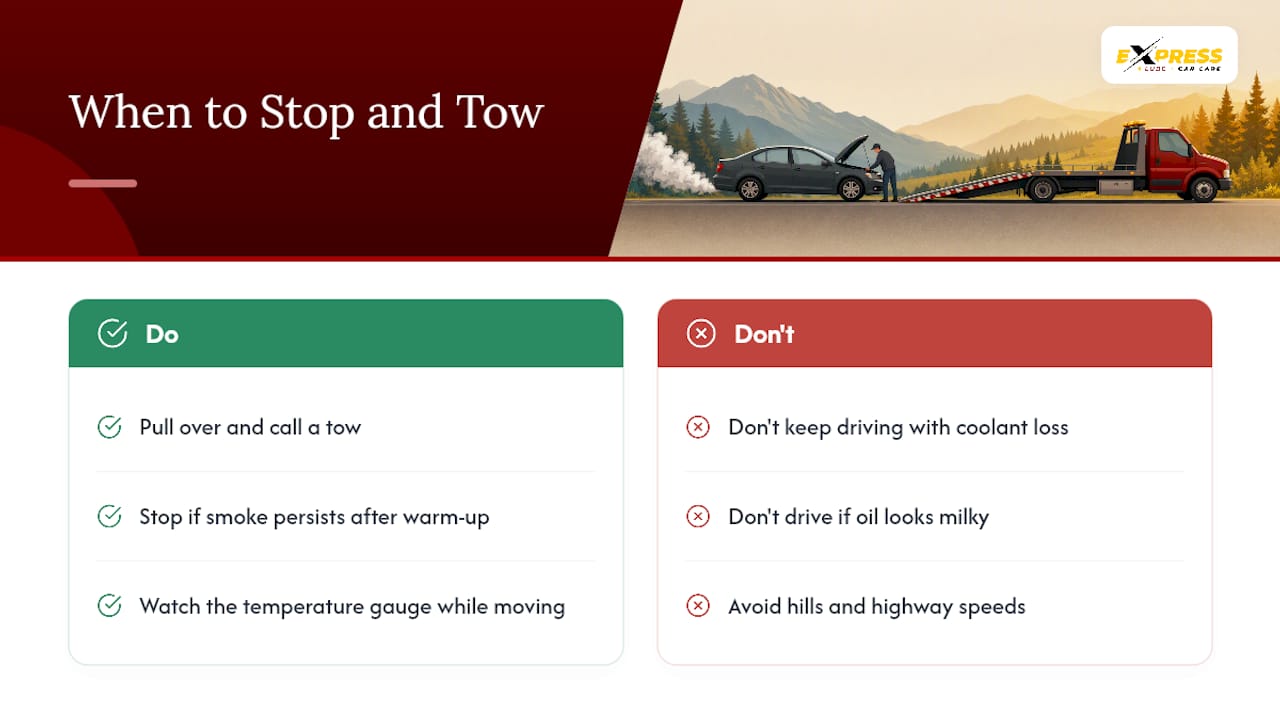
Pull over and arrange a tow if you notice any of these together: white smoke that doesn’t stop after warm-up, coolant that keeps disappearing with no visible leak, a temperature gauge climbing toward the red, milky oil on the dipstick, or steady bubbles rising in the coolant expansion tank.
Continuing to drive on a coolant-burning engine risks warping the cylinder head, contaminating your oil supply, or, in bad cases, hydrolocking the engine when liquid coolant floods a cylinder that’s trying to compress air. If you absolutely must move the car before a tow arrives, keep the trip short, avoid hills and highway speeds, and watch the temperature gauge the entire way.
What Repairs Fix Persistent White Smoke?
Diagnostics come first, always, because they tell a shop exactly what to fix instead of throwing parts at a guess. Once the cause is confirmed, the repair scope depends entirely on what those tests find.
- Head gasket replacement, sometimes paired with head machining if the surface is warped from overheating.
- Intake manifold gasket replacement, a smaller job than head work but still requires confirming the leak location first.
- Turbocharger seal replacement when a leaking CHRA is pulling coolant or oil into the intake.
- Injector service or timing correction on diesel engines showing unburnt fuel symptoms.
A shop that documents its findings, with digital inspection photos and video of the failed component, gives you a paper trail that matters later. It backs up warranty claims and gives the next buyer or technician a clear record if the car changes hands.
Why Early Testing Matters More Than Guessing
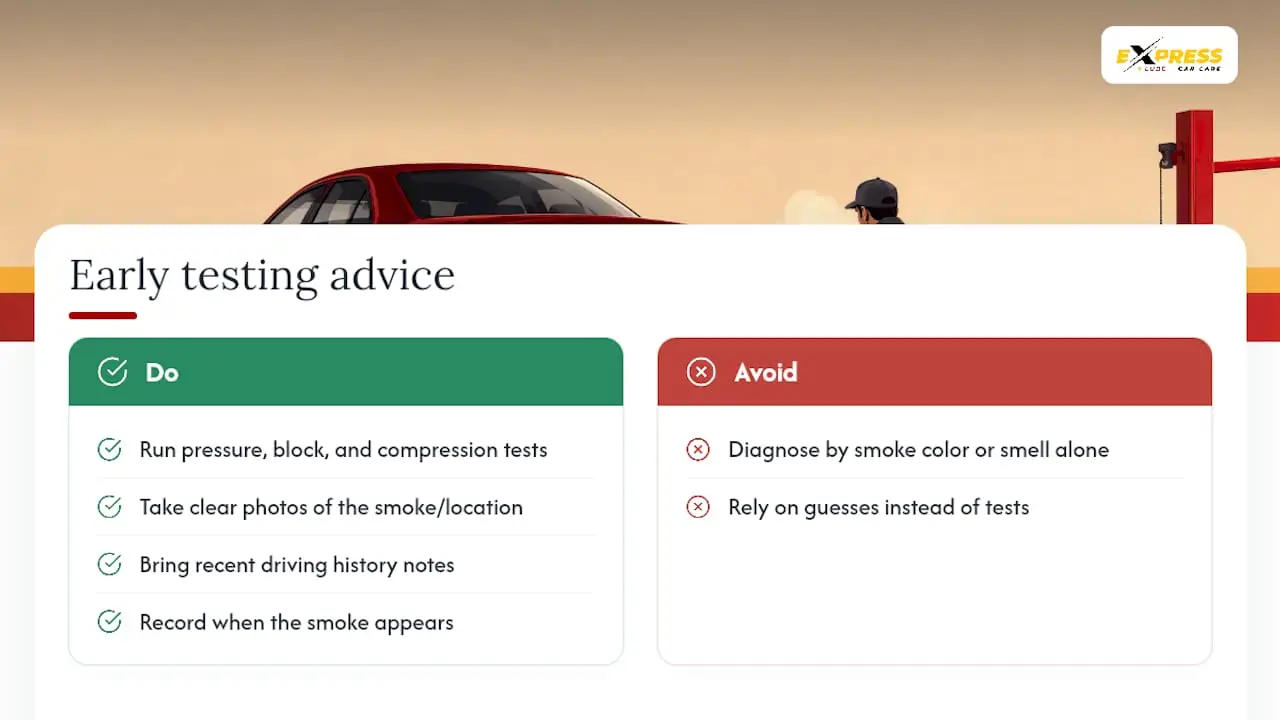
We rely on pressure tests, block tests, and compression checks, not just the color or smell of smoke, because symptoms alone can point a technician in the wrong direction. Catching a coolant leak early, before it warps a head or contaminates the oil, almost always means a smaller repair bill. Bring us photos, your recent driving history, and notes on when the smoke shows up. It speeds up an accurate diagnosis considerably.
Get Your White Smoke Exhaust Diagnosed the Right Way
Guesswork on a white smoke exhaust problem usually ends up costing more than a proper diagnostic visit would have in the first place. A full sequence of diagnostic tests, including cooling-system pressure testing, combustion-gas block testing, compression and leak-down checks, borescope inspection, and turbo and fuel-system evaluation, provides repair recommendations based on what’s actually happening inside the engine rather than a guess from the parking lot.

Experienced technicians document every finding with digital vehicle inspections, including photos and video, for full transparency before work begins. This level of transparency is a key benefit for customers seeking trusted workmanship and fair pricing. If your car’s showing persistent white smoke, unexplained coolant loss, or a climbing temperature gauge, don’t wait it out. Visit our engine diagnostics and repair page to see what’s involved, or head straight to our services page to schedule an appointment. If your red-flag symptoms are severe, arranging a tow-in is the safer call than driving it in yourself.
Where to Learn More About Exhaust Smoke Diagnosis
For deeper reading on diesel-specific white smoke causes, UTI’s technician training resource breaks down injector and glow-plug faults. For a plain-language walkthrough of the warm-up test and block testing, see Toolsource’s diagnostic guide.
Sources
- What causes white smoke from diesel engines? – UTI
- White smoke from exhaust: steam or coolant? – Steer
- White smoke or just steam? Exhaust and cooling-system diagnosis – Toolsource
- How to tell if your head gasket is blown – The Motor Guy
- White smoke from exhaust: what to do – Edmunds
FAQ
How Do I Fix White Smoke From My Exhaust?
The fix depends entirely on the cause: if it’s condensation, there’s nothing to fix. If a diagnostic test confirms coolant intrusion, the repair might involve a head gasket replacement, intake manifold gasket, or turbo seal work, and diesel-specific injector or timing issues need injector service instead. A proper diagnosis before repair keeps you from replacing the wrong part.
Does White Smoke From Exhaust Always Mean a Blown Head Gasket?
No. A blown head gasket is one common cause of persistent white smoke, but it’s not the only one. Cracked heads, failed intake manifold gaskets, turbo seal leaks, and diesel injector or glow-plug faults can all produce similar smoke, which is why a block test or compression check matters more than assumptions.
Is It Bad to Drive With White Smoke From the Exhaust?
Thin vapor on a cold start is fine to drive through. Persistent white smoke after warm-up, especially paired with coolant loss, milky oil, or an overheating engine, means you should stop driving and get it towed, since continuing can warp the cylinder head or hydrolock the engine.
Why Is My Car Letting Out White Smoke When Idling?
White smoke at idle after the engine is fully warm often points to coolant leaking into a cylinder at a steadier rate than it would under load, sometimes tied to a head gasket or cracked head. If it clears within a minute of a cold start, it’s just condensation working its way out of the exhaust system.