
If you notice stiffness when turning, whining or groaning noises, fluid under the front of your car, or a dashboard warning light, steering repair is likely needed. Pull over and stop driving if the wheel feels unpredictable or hard to control, then schedule a professional diagnostic right away. Catching these signs early usually keeps a small fix from becoming a bigger, costlier one.
TL;DR:
- Low steering fluid, worn pumps, or leaks cause stiffness, whining noises, and puddles, with early attention preventing costly future repairs.
- Hydraulic systems rely on fluid pressure, while electric systems depend on sensors and modules; each requires different diagnostic approaches.
- Worn tie rods, cracked hoses, or failing pumps typically need targeted part replacements, with costs ranging from affordable hose repairs to expensive rack or module fixes.
- Delaying repairs risks increased damage, uneven tire wear, loss of control, and potential safety hazards, especially in systems with electronic faults.
- Performing simple DIY checks like fluid levels, fluid color, belt condition, and noting symptom patterns can help speed up professional diagnostics.
Table of Contents
- How Steering Systems Work: Hydraulic vs Electric
- Common Warning Signs That Point to Steering Repair
- Causes Mapped to Repairs: What Usually Needs Fixing
- Typical Repair Options and Realistic Cost Ranges
- What to Do Right Now if Steering Degrades or Fails
- Safe DIY Checks Before You Visit a Shop
- Express Lube & Car Care: How We Handle Steering Repairs
- Diagnostic Procedures and Tools Technicians Use for Steering Issues
- How Steering Problems Affect Safety and Drivability
- Signs a Steering Repair Is No Longer Worth It
- Routine Maintenance That Helps Prevent Steering Failure
- Steering System Components and What Each One Does
- Hydraulic vs Electric: How Repair Approaches Differ
- Our Take on Steering Repair
- Schedule a Steering Inspection or Repair at Express Lube & Car Care
- FAQ
- Sources
How Steering Systems Work: Hydraulic vs Electric
Most vehicles use one of two steering setups, and knowing which one you have helps explain what might be going wrong. Hydraulic power steering relies on a pump, pressurized hoses, fluid, and a rack-and-pinion assembly to make turning the wheel feel light and responsive. When fluid runs low or a hose develops a leak, that system loses pressure and steering gets noticeably harder.
Electric power steering, often called EPS, swaps the pump and fluid for a motor and sensors that assist the wheel electronically. There’s no fluid to check, but EPS faults usually trace back to sensors, wiring, or the control module rather than a leak you can see.
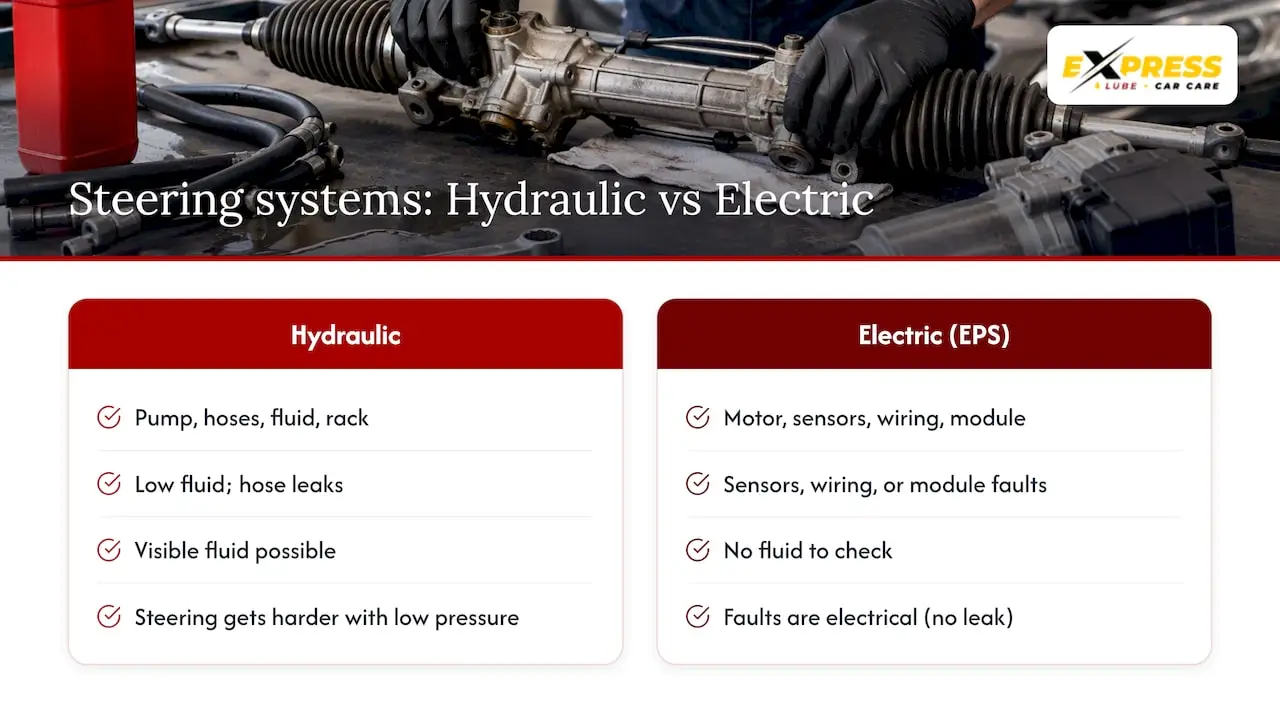
Tie rods, ball joints, the steering rack, and the pump (on hydraulic systems) are the parts that fail most often. A worn pump or a cracked hose is typically a quicker, less expensive fix than a full rack replacement, which is why pinpointing the failing part matters before you get an estimate.
Common Warning Signs That Point to Steering Repair
Your car usually gives you a heads-up before steering trouble turns into a real safety issue. Paying attention to how each symptom shows up helps you describe the problem accurately when you call a shop.
- Stiff steering at low speeds, especially during parking or slow turns, often points to low fluid, a weak pump, or a slipping belt.
- Whining, groaning, or squealing noises when turning usually mean the fluid is low or dirty, the pump is wearing out, or a belt needs attention.
- Fluid puddles under the front of the vehicle, often pink or amber in color, signal a leak in the reservoir, a hose, or the pump itself.
- Steering wheel vibration or pulling to one side can point to worn suspension components rather than the steering system alone.
- Dashboard warnings or a sudden loss of assist often mean an electronic fault in an EPS system, and in rare cases, an open safety recall.
A burning smell while turning is another signal worth taking seriously, since it can mean the fluid is overheating or critically low.
Causes Mapped to Repairs: What Usually Needs Fixing
Once a technician identifies the symptom, the cause usually falls into one of a few categories, and each points to a different repair. A fluid leak or contaminated fluid typically calls for hose or seal replacement along with a full fluid flush. A worn pump or a cracked, glazed belt usually means pump replacement or belt service, both relatively contained jobs.
Worn steering or suspension parts, like tie rods, ball joints, or the rack itself, call for targeted part replacement and a broader inspection, since one worn component often stresses its neighbors. EPS electronics or motor faults need a diagnostic scan first, which may lead to a module repair or, in some cases, a manufacturer recall fix rather than a shop repair at all.
Delaying any of these tends to raise the final bill. A small leak left unaddressed starves the pump of lubrication, and a struggling pump puts extra strain on the rack. What starts as a $150 hose fix can turn into a pump and rack job if it sits too long.
Typical Repair Options and Realistic Cost Ranges
Steering repair costs vary widely depending on the part involved and your specific vehicle, so treat these as general reference points rather than a quote. Industry cost overviews suggest hose replacement tends to be the most affordable repair, pump replacement sits in the mid-range, and a rack-and-pinion or full steering assembly replacement runs considerably higher.
A few things move that number up or down: your local labor rate, whether the shop uses OEM or aftermarket parts, how many labor hours the job takes, and whether EPS diagnostics are involved, since electronic troubleshooting often takes longer than a visual inspection. Before any work starts, ask for a written breakdown of parts and labor, along with the warranty terms that apply to the repair.
What to Do Right Now if Steering Degrades or Fails
A sudden loss of power steering assist is startling, but the wheel doesn’t stop working entirely. Manual steering still functions, it just takes significantly more physical effort, especially at low speeds.
- Ease off the gas, signal, and steer to a safe shoulder or parking area as soon as you can.
- Check your dashboard for warning lights and note exactly what’s lit up.
- Look up your 17-digit VIN on the NHTSA vehicle safety resources site to check for open recalls affecting steering components.
- If you suspect overheating or a fire risk tied to a recall, park outside and away from structures rather than in a garage.
- Call for a tow or professional pickup instead of driving a vehicle that doesn’t feel safe to control.
A recent recall on certain Jeep Wrangler and Gladiator models warned that a power-steering component could overheat and pose a fire risk, with owners told to park outside until the free recall repair was completed. It’s a reminder that some steering issues are more than an inconvenience.
Safe DIY Checks Before You Visit a Shop
You don’t need a lift or a tool chest to gather useful information before your appointment. A few minutes of observation can speed up diagnosis and sometimes save you a second visit.
- Check your power steering fluid level and color against your owner’s manual before topping anything off yourself.
- Photograph any puddles and note the fluid’s color and smell, since that detail helps a technician narrow down low fluid or leak issues fast.
- Listen for belt squeal at startup and again while turning the wheel fully in each direction.
- Write down when the symptom shows up, whether that’s on a cold start, at low speed, or right after hitting a pothole.
Pro Tip: A quick phone video of the noise or vibration, recorded from the driver’s seat, often tells a technician more than a verbal description ever could.
Express Lube & Car Care: How We Handle Steering Repairs
Our technicians provide skilled diagnostic work to help identify steering issues accurately. When you bring in a steering concern, we start with a digital vehicle inspection that includes photos and videos for transparency before any repair begins.
We provide a written estimate covering parts and labor before any work begins. When you call to schedule, it helps to have your symptoms and any photos you’ve taken ready so we can move straight into diagnostics.
Diagnostic Procedures and Tools Technicians Use for Steering Issues
Diagnosing a steering complaint starts with a conversation: when the noise happens, how the wheel feels, and whether anything changed recently. From there, a technician moves into hands-on checks. A visual inspection covers hoses, the reservoir, the pump, and the rack for cracks, wetness, or corrosion that point to a leak’s exact location.
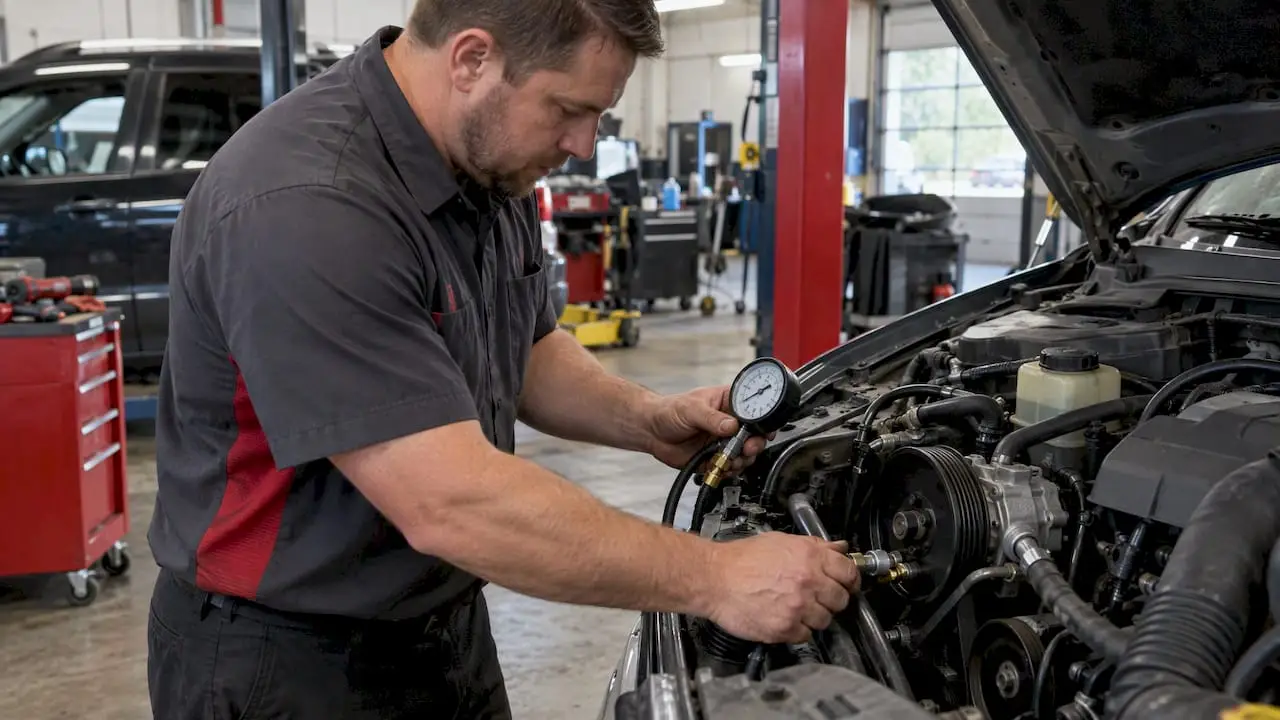
For hydraulic systems, a pressure test on the power steering pump can confirm whether it’s producing adequate flow, since a pump that looks fine can still be failing internally. Technicians also check belt tension and condition, since a loose or glazed belt can mimic a failing pump.
A steering alignment check, which measures how the wheels sit relative to each other and the vehicle’s frame, helps separate a true steering problem from a suspension or tire wear issue that just feels similar behind the wheel. On EPS-equipped vehicles, diagnosing electronic faults requires a code scan and sometimes manufacturer-specific software, since EPS performance depends on accurate motor parameter estimation and controller tuning, and a miscalibrated system can feel off without throwing an obvious symptom.
Putting these checks together, a leak, a weak pump, worn linkage, or an electronic fault, lets a shop pinpoint the actual cause instead of guessing and replacing parts one at a time.
How Steering Problems Affect Safety and Drivability
Steering is the one system with zero margin for guesswork, since it’s your direct link to controlling the vehicle’s direction. A stiff or unpredictable steering wheel slows your reaction time in an emergency, exactly when a split-second correction matters most.
Reduced assist also makes routine maneuvers harder than they should be. Parking lot turns, highway lane changes, and quick swerves to avoid debris all demand more physical effort when the system isn’t working right, and that extra effort can mean a delayed or incomplete response.
Beyond the obvious safety angle, a failing steering component often creates uneven tire wear, since a misaligned rack or worn tie rod changes how the tires contact the road. That shows up later as reduced grip in wet conditions or a car that drifts without you touching the wheel.
Ignoring symptoms doesn’t just risk a bigger repair bill. It risks losing control at the moment you need it most, which is why any noticeable change in how your steering feels deserves a prompt look rather than a wait-and-see approach.
Signs a Steering Repair Is No Longer Worth It
Most steering problems are repairable, but a few signs suggest replacement makes more sense than another round of patching. If the steering rack itself shows internal leaking or scoring rather than just a worn seal, repairing it piecemeal often costs more over time than replacing the unit outright.
Corrosion is another red flag, especially on hoses, lines, or the pump housing in vehicles that have seen years of road salt or moisture exposure. Rust compromises metal in ways that a single part swap can’t fully address, and a corroded component tends to fail again soon after a partial fix.
Repeated failures of the same part are a signal too. If a hose or pump has already been replaced once and the same symptom returns within a short span, that often points to a deeper issue, like debris circulating in the system, that a straightforward swap won’t solve.
Finally, an EPS system with persistent electronic faults that a diagnostic scan and software update can’t resolve may point to a failing motor or control module, which is a more significant repair than a simple sensor replacement. At that point, a technician’s full assessment is worth more than guessing which part to replace next.
Routine Maintenance That Helps Prevent Steering Failure
Steering problems rarely appear out of nowhere. Routine inspections catch low fluid, worn belts, and minor leaks before they turn into failures, which matters because modern systems can go longer between scheduled checks, and that longer interval means drivers sometimes skip steering checks entirely until a symptom shows up.
A few habits keep you ahead of trouble. Check your power steering fluid level periodically if you have a hydraulic system, and look underneath your car occasionally for any new spots on the driveway. Pay attention to belt condition at your regular oil change, since a belt that’s starting to crack or glaze is easy to replace before it fails.
Following your vehicle’s fluid replacement schedule keeps contaminants from building up in the system, which protects the pump and rack from premature wear. Bundling a steering check into your regular preventive maintenance visits means a technician is already looking at belts, hoses, and fluid condition as part of routine service, rather than only after something feels wrong.
Steering System Components and What Each One Does
Understanding the main parts makes it easier to follow what a technician is telling you. The steering rack converts the turning motion of the steering wheel into side-to-side movement that points your front wheels, and it’s one of the costlier parts to replace if it wears out internally.
Tie rods connect the steering rack to the wheel hubs, transmitting that side-to-side motion to the wheels themselves. Worn tie rod ends are a common source of looseness or clunking you might feel through the wheel, especially over bumps.
The power steering pump, found on hydraulic systems, pressurizes fluid to reduce the effort needed to turn the wheel. It’s driven by a belt connected to the engine, which is why a failing belt often shows up as a steering symptom.
The steering column houses the shaft that connects your steering wheel to the rack, along with components for tilt, telescoping, and in many vehicles, ignition and safety features. A column issue is less common than rack or pump wear, but it can cause looseness or play in the wheel itself.
Each part depends on the others working correctly, which is why a worn tie rod can eventually stress the rack, or a failing pump can accelerate hose wear.
Hydraulic vs Electric: How Repair Approaches Differ
The repair path for a steering complaint looks different depending on which system your vehicle has. Hydraulic systems are largely mechanical: fluid, hoses, a belt-driven pump, and the rack. Diagnosing them often starts with a visual check for leaks, followed by a pressure test on the pump if the leak isn’t obvious, and repairs tend to involve physical parts you can see and replace.
Electric power steering shifts the diagnostic process toward electronics. There’s no fluid to check or belt to inspect, so a technician relies on a code scan and sensor data to find the fault. EPS performance depends on precise motor parameter estimation and controller tuning, according to SAE technical research on EPS stability, meaning a fault isn’t always a broken part. Sometimes it’s a calibration or software issue that needs a manufacturer-level diagnostic tool rather than a wrench.
This difference affects both time and cost. A hydraulic pump swap is a fairly contained mechanical job, while an EPS fault might require specialized scan tools or even a software update from the manufacturer before a shop can confirm what’s actually wrong. A shop equipped for both systems, with the right diagnostic equipment and trained technicians, avoids the guesswork that drives up repair costs on electronic faults.
Our Take on Steering Repair
Steering problems rarely fix themselves, and waiting rarely saves money. The pattern we see most often is a small symptom, a faint whine or a slightly stiff wheel, that a driver assumes will go away. It doesn’t, and the eventual fix usually costs more than it would have a few weeks earlier.
Our approach is straightforward: get the vehicle in front of a technician as soon as something feels off, get a transparent diagnostic with photos and a written estimate, and make the repair decision with real information instead of guesswork. If you notice any of the signs covered here, don’t wait for them to get worse before booking a look.
— Express Lube & Car Care
Schedule a Steering Inspection or Repair at Express Lube & Car Care
If any of these symptoms sound familiar, the next step is a diagnostic appointment, not another week of wondering. We handle steering and suspension repair alongside diagnostics and fluid exchange services, so whether the issue turns out to be a simple leak or something deeper in the rack, we can address it in one visit.

- Our technicians diagnose the issue with a digital vehicle inspection, including photos and videos you can review yourself.
- Written estimates cover parts and labor before any work starts, so there are no surprises.
Browse our full list of services or reach out directly to get your steering checked before a minor noise turns into a bigger repair.
FAQ
What to do if steering fails?
Slow down gradually, signal, and steer to a safe shoulder as soon as possible, since manual steering still works even without power assist, just with more effort. Check your dashboard for warning lights, and if the vehicle doesn’t feel safe to continue driving, call for a tow rather than risking the drive.
How much is power steering to get fixed?
Costs depend heavily on the specific part and your vehicle, but general industry ranges suggest hose repairs are the most affordable, pump replacement is mid-range, and a full rack-and-pinion replacement costs considerably more. Ask your shop for a written parts-and-labor estimate specific to your vehicle before agreeing to any repair.
Can a steering wheel be restored?
A steering wheel’s grip and control depend on the full system behind it, including the rack, pump, and linkage, rather than the wheel alone. If stiffness or vibration has crept in, a diagnostic inspection identifies which component needs attention to restore normal steering feel.
What causes power steering to be stiff?
Stiff steering, especially at low speeds, is commonly tied to low or contaminated fluid, a weak pump, or a slipping belt. On electric power steering systems, stiffness can instead point to a sensor or electronic fault that requires a diagnostic scan to identify.
Sources
- Warning signs of a power steering leak | AAA Club Alliance
- Vehicle safety resources | NHTSA
- Impact of electric motor drive dynamics on performance and stability of electric power steering systems | SAE