
If your steering feels loose, your wheel shakes, or you hear a clunk every time you turn, worn tie rod ends are a likely cause, and the issue deserves prompt attention. These symptoms often point to real steering wear, not just road noise. We recommend getting the front end inspected soon, and avoiding highway speeds if the steering feels unpredictable. The usual fix is straightforward: replace the worn part, then align the wheels.
TL;DR:
- Two or more symptoms together, or a visibly torn boot, warrant an inspection without delay; avoid highway driving if steering feels loose or unpredictable.
- A rocking tire can offer clues: side to side play points toward a tie rod, while vertical movement often suggests a ball joint.
- Only inspect underneath a vehicle supported by jack stands; home checks suggest a fault, but technicians confirm play against specifications and measure toe alignment.
- Technicians replace the worn inner or outer end and align the wheels afterward; vehicles with ADAS features also need proper calibration.
- A torn boot lets grease escape and grit enter, accelerating wear; routine oil changes or tire rotations offer a chance to spot damage early.
Table of Contents
- Symptoms: what they feel like, sound like, and how to observe them
- Why tie rods fail: wear mechanisms and common triggers
- Safe, practical checks drivers can do and what technicians will do
- Distinguishing tie-rod symptoms from ball joints, tires, and rack or bushing issues
- Repair expectations: replacement, alignment, timing, and safety
- Practical maintenance to extend tie-rod life and catch problems early
- ASE-style inspection checklist and what an Express Lube & Car Care technician documents
- An ASE technician’s take on when to stop waiting
- Book a tie rod inspection with our Arlington technicians
- FAQ
- Sources
Symptoms: what they feel like, sound like, and how to observe them
A failing tie rod end rarely stays quiet about it. The steering wheel often feels loose or slow to respond, like there’s a half-second gap between what your hands do and what the front wheels do. Some drivers describe it as the car “wandering” slightly within the lane, even on a straight road.
Vibration is another telltale sign. A shimmy that shows up at certain speeds, often worsening the faster you go, can mean play in the steering linkage. If you’ve already read our guide on steering wheel vibration, you know vibration has several possible sources, but tie rod wear is a common one worth ruling out early.
Then there’s the noise. A knocking or clunking sound during low-speed turns, especially in a parking lot, or a clunk every time you roll over a bump, often traces back to a worn ball-and-socket joint at the tie rod end.
According to MOOG Parts, the main tie rod end symptoms include loose or delayed steering response, steering wheel shake, wandering or pulling, uneven front-tire wear, and clunking or grinding from the front end, particularly over bumps or during slow turns.
Here’s what to watch for:
- Steering that feels loose, delayed, or vague, especially at low speed.
- A shimmy or shake in the wheel that changes with speed.
- Knocking or clunking from the front end during turns or over bumps.
- Uneven wear on the inside or outside edge of a front tire.
- Visible grease residue or a torn rubber boot near the steering linkage.
Worn tie rods can throw off toe alignment, which shows up as lopsided tread wear on one edge of a front tire, according to MOOG. That kind of wear pattern is a clue, not proof. A full inspection still matters before anyone replaces a part.
Why tie rods fail: wear mechanisms and common triggers
Tie rod ends work like a ball-and-socket joint every time you turn the wheel, and that constant motion wears the joint down over years of normal driving. Age and mileage alone will eventually loosen it.
A torn protective boot speeds up that timeline considerably. Once the rubber boot splits, grease escapes and road grit gets in, and that contamination grinds away at the joint far faster than clean wear would. Potholes, curb strikes, and minor collisions can also bend or damage the tie rod directly, sometimes instantly turning a healthy part into a failing one.
Corrosion and dried-out lubrication play a role too, particularly on vehicles that sit outside in harsh weather or go a long time between inspections. Design also matters: inner and outer tie rods wear differently because they handle different loads and movements.
Common failure triggers include:
- Years of normal steering cycles wearing down the ball-and-socket joint.
- A torn boot letting grease out and dirt in.
- Pothole, curb, or collision impacts bending or damaging the rod.
- Corrosion or dried lubrication on parts exposed to the elements.
Pro Tip: A torn boot is often the earliest warning sign of trouble, so catching it during a routine inspection can prevent a much bigger repair later.
Safe, practical checks drivers can do and what technicians will do
Before booking an appointment, a few simple checks can tell you whether a tie rod problem is likely. None of these require tools beyond a flashlight, and all of them should be done with the vehicle safely supported.
- Look underneath the front end with a flashlight for a torn rubber boot, grease streaks, or rust buildup on the tie rod.
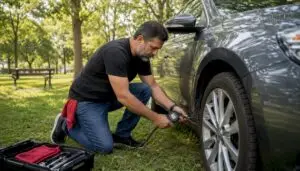
- If the vehicle is safely lifted, grab the front tire at the 3 and 9 o’clock positions and rock it in and out to feel for play, following proper jack stand safety.
- With the front end raised and an assistant turning the steering wheel slowly left and right, watch the outer tie rod end for movement that looks loose or sloppy.
- Note exactly where you felt or saw play, since that detail helps a technician narrow down the cause faster.
This home test can point toward a likely culprit, but it cannot replace a shop’s measurements, according to GSP North America. If your vehicle isn’t properly supported on jack stands, or if you’re not confident doing this safely, skip the DIY check and have a technician handle it instead.
A technician’s inspection goes further than a visual check or a quick wiggle test. They measure toe alignment, check play against manufacturer specifications, and document findings with photos and video for a clear record of what’s worn and what isn’t.
Pro Tip: Never put your hands near a spinning wheel or a running engine during a steering check. Always use jack stands, never just a floor jack, when working underneath the vehicle.
Distinguishing tie-rod symptoms from ball joints, tires, and rack or bushing issues
Loose steering, clunking, and uneven tire wear can come from a tie rod end, a ball joint, a worn tire, or a loose rack bushing, and the symptoms often overlap enough to fool a quick guess. We’ve written a separate ball joint failure symptoms guide that covers how that part behaves differently under load.
The key is where the play shows up during a wheel-rock test. Movement felt at the top and bottom of the tire often points to a ball joint or control arm bushing, while side-to-side looseness tends to trace back to the tie rod. Tread wear patterns and vibration behavior can offer additional clues, but they’re rarely conclusive on their own.
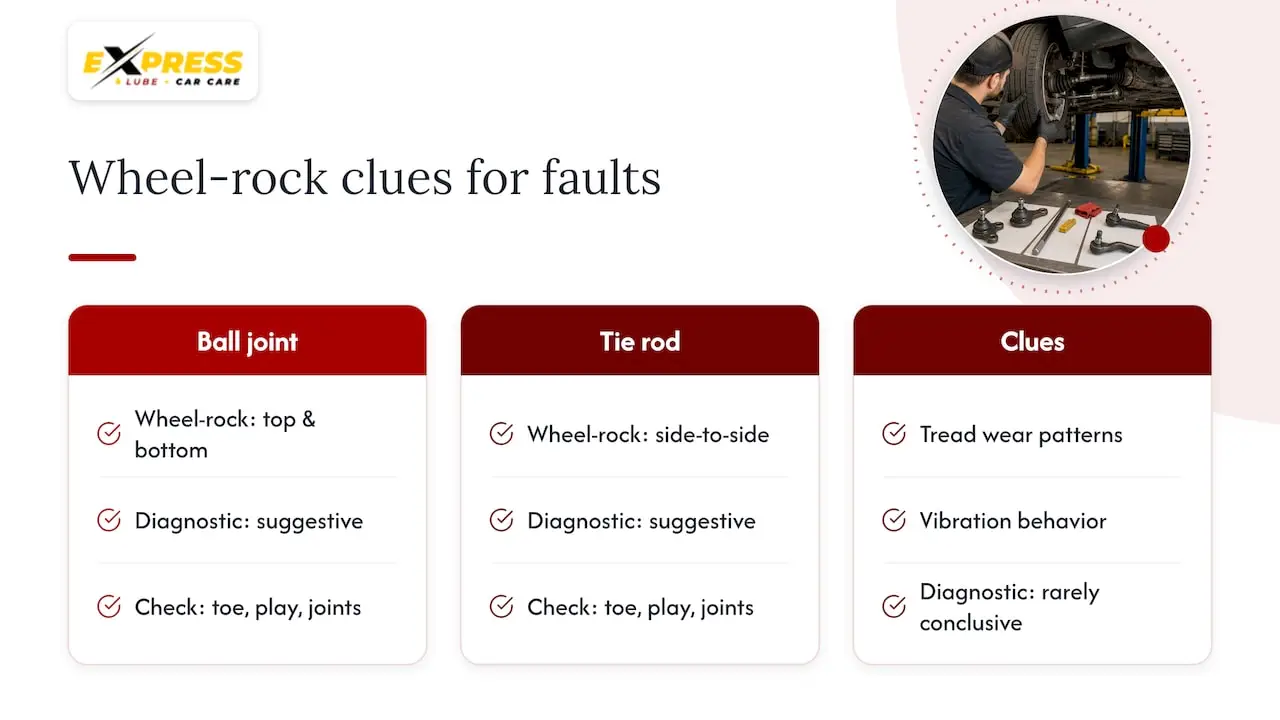
That’s exactly why inspection and measurement beat guesswork every time. A technician checking toe, play, and joint condition directly will catch what symptom-matching alone might miss.
Repair expectations: replacement, alignment, timing, and safety
Replacing the worn tie rod end, either the inner or outer piece depending on where the wear is, is the standard fix, and for vehicles with ADAS features, this also includes proper ADAS calibration essential for your vehicle’s safety and performance. The process involves confirming the looseness, swapping in the new part, and tightening the hardware to the manufacturer’s torque specification, according to Delphi.
A wheel alignment afterward isn’t optional. Replacing a tie rod changes the geometry of the steering linkage, and skipping alignment invites uneven tire wear almost immediately. RepairPal confirms that replacement followed by alignment is the standard repair sequence for a failed tie rod end, not a tightening or lubrication fix.
Timing depends on a few variables:
- Parts availability can make the job same-day in many cases.
- Seized or corroded hardware can add time to the repair.
- Additional wear found during inspection, like a damaged boot on a neighboring part, may expand the scope.
- A documented toe measurement taken before the old part comes off helps keep the new alignment close to correct from the start.
If your steering already feels uncertain, hold off on highway speeds and long trips until the front end has been checked. A loose tie rod end affects how precisely the wheels respond to your input, and that margin matters most at higher speeds.
Practical maintenance to extend tie-rod life and catch problems early
Catching tie rod wear early usually comes down to looking in the right place at the right time. Checking the rubber boots during an oil change, tire rotation, or routine inspection costs nothing extra and can flag a problem months before it becomes a symptom you feel in the steering wheel.
A torn boot should get repaired or replaced promptly, since contamination from a torn boot accelerates wear on the joint inside, according to Drive Heavy Duty Parts. Where grease fittings are present, keeping them serviced matters too.
A few habits help over the long run:
- Have tie rod boots checked at every oil change or tire rotation.
- Repair torn boots quickly rather than waiting for symptoms to appear.
- Slow down for known rough patches and potholes when you can.
- Build tie rod checks into periodic maintenance visits, including fleet service intervals.
Pro Tip: Keeping photo records of boot condition at each visit makes it easy to track wear over time and catch a problem before it turns into a symptom.
ASE-style inspection checklist and what an Express Lube & Car Care technician documents
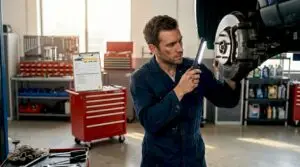
When we inspect a vehicle for tie rod wear, we lift it and check for play at the 3 and 9 o’clock wheel positions, watching the tie rod itself for vertical or horizontal movement. We squeeze the boot to check for grease loss and confirm whether the play is coming from the tie rod or somewhere else, like a rack bushing.
Inspecting tie rods matters during alignment work because damaged or mismatched tie-rod lengths can signal deeper suspension damage, and adjusting around a bent component can cause bump steer.
Tire Review
Before removing the worn part, we record the toe measurement, replace what’s worn, torque everything to spec, and complete the alignment. Every finding gets documented with photos and video as part of our digital vehicle inspection.
Pro Tip: Ask to see the inspection photos. A clear before-and-after record makes it easy to see exactly what was worn and what was fixed.
An ASE technician’s take on when to stop waiting
Two or more of these symptoms together, or a visibly torn boot, is our trigger for getting it checked without delay. Documented inspection and post-repair alignment protect both your safety and your tires.
— Express Lube & Car Care
Book a tie rod inspection with our Arlington technicians
We run inspections backed by digital documentation, so you see exactly what’s worn before any work begins. Our steering and suspension repair service covers tie rod replacement and the alignment that follows it, often completed the same day.

Booking is simple: schedule a diagnostic visit, review the documented findings with our technician, and approve the replacement and alignment if the inspection confirms it. Start by browsing our full service list or reaching out directly.
FAQ
What happens if you drive on bad tie rods?
Driving on a badly worn tie rod end reduces your control over steering precision, and in severe cases the joint can separate entirely, causing sudden loss of steering on that wheel. Uneven tire wear and continued front-end noise are also likely the longer it goes unaddressed.
How urgent is a tie rod replacement?
It depends on severity: a slight clunk or minor looseness warrants a prompt inspection, while a steering wheel that feels loose or unpredictable at speed means you should avoid highway driving until a technician checks it. Replacement itself, once confirmed, is typically handled quickly, often the same day depending on parts and findings.
How to tell if it’s a ball joint or tie rod?
The clearest way is a wheel-rock test during inspection: play felt at the top and bottom of the tire often points to a ball joint, while side-to-side looseness tends to trace back to the tie rod. Our ball joint symptoms guide breaks down how that part’s wear pattern differs.
What do bad tie rod ends feel like?
Most drivers notice a loose or delayed feeling in the steering wheel, sometimes paired with a knocking sound during slow turns or over bumps. A steering shimmy that changes with speed and uneven wear on one edge of a front tire are additional signs worth checking.
Sources
- Symptoms of bad tie rods | MOOG Parts
- Tie rod end – RepairPal
- How to replace an outer tie rod end | Delphi
- How to inspect tie rods | Tire Review