
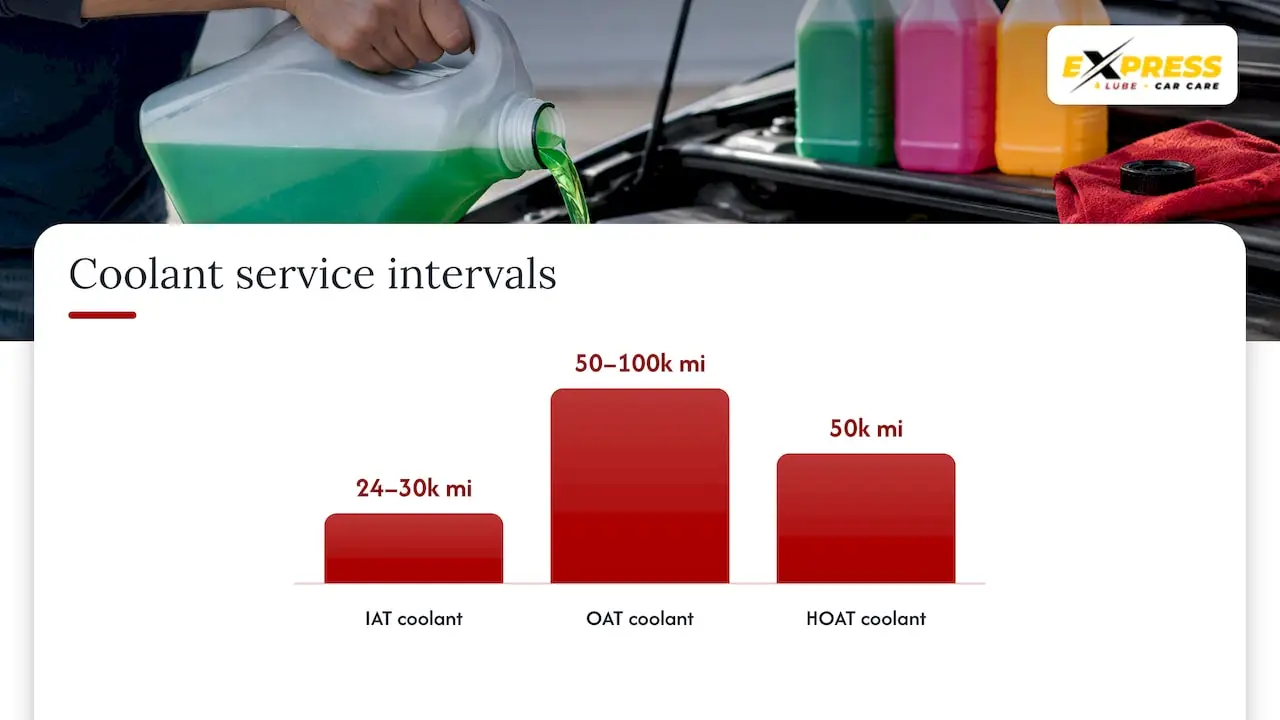
Your coolant flush interval depends mostly on the coolant in your system: older green coolant usually needs service every two years or about 24,000–30,000 miles, while modern long-life coolants often run five years or 50,000–100,000 miles, according to AAA. Your owner’s manual overrules every rule of thumb. If you can’t tell what’s in your radiator, we can test it for you at Express Lube & Car Care.
TL;DR:
- Green IAT coolant often needs service every two years or 24,000–30,000 miles; long life OAT and HOAT fluids commonly last five years or 50,000 miles.
- Manufacturer schedules can differ sharply: some Subaru schedules start at 11 years or 137,500 miles, while maintenance minder guidance may change under severe conditions.
- Rusty coolant, falling levels, sweet smells, leaks, weak cabin heat, or overheating call for inspection; shut off the engine if the gauge enters the red.
- Check coolant with a cold engine, use only the specified formulation, and get a full flush when changing types or correcting incompatible mixtures.
Table of Contents
- How often to flush coolant based on its chemistry
- Why your owner’s manual is the final word
- Signs you need a coolant flush now
- How to check coolant condition safely at home
- What shortens or stretches your coolant interval
- What a coolant flush costs and what the service includes
- What happens to old coolant and why disposal matters
- Benefits of regular coolant flushes beyond hitting the date
- What happens when you skip coolant flushes
- Shop perspective: follow the schedule, then confirm with the fluid
- Book a coolant check or cooling system service with us
- FAQ
- Sources
How often to flush coolant based on its chemistry
Coolant isn’t one product. Coolants come in different formulations, and their service intervals vary.
- IAT (inorganic additive technology): The classic green coolant. It protects well but its additives get used up fast, so plan on replacement about every two years or 24,000–30,000 miles.
- OAT (organic acid technology): Often orange or red. These are built to last longer, commonly about five years or 50,000–100,000 miles.
- HOAT (hybrid organic acid technology): A blend of the two, often orange or yellow. Many call for about five years or 50,000 miles, though some automakers specify far longer intervals, as AAA’s coolant guide explains.
A word of caution on color. Check your owner’s manual rather than identifying coolant type by color alone. Brand names for these formulas also vary, and some modern factory fills are designed for very long service life. When the color and the manual disagree, trust the manual.
One more AAA tip worth repeating: if you’re switching from one coolant type to another, a full flush is recommended.
Why your owner’s manual is the final word
Generic intervals are a starting point. Automakers set their own, and the gap can be huge. Toyota’s guidance tells owners to follow the manufacturer’s recommended interval, and notes that silicate-containing coolants commonly need replacing around two years or 30,000 miles. Some Subaru schedules, on the other hand, list a first coolant replacement after 11 years or 137,500 miles, then every six years or 75,000 miles.
Here’s how to find your number:
- Check the maintenance section of your owner’s manual, or the automaker’s online service schedule for your exact model and year.
- Read your maintenance minder codes if your car has one. Honda’s Maintenance Minder guide shows that “inspect” and “replace” entries can differ by model and by severe service conditions.
- Look at your service history. If a past repair or shop visit swapped in a different formulation, the factory interval may no longer apply. Get the fluid tested before assuming.
Our car fluid replacement schedule puts coolant in context with your other fluids.
Signs you need a coolant flush now
Don’t wait for the calendar if your car is already telling you something is off.
- Discolored, rusty or sludgy fluid in the reservoir or radiator.
- A sweet smell after driving, which often points to a leak.
- A coolant level that keeps dropping between top-offs.
- Overheating episodes, even brief ones.
- A heater that blows lukewarm air when the engine is warm.
- Visible leaks or puddles under the car.
A shop can confirm the cause with a cooling system pressure test and a visual inspection of hoses, the radiator and the cap. If your temperature gauge spikes into the red, pull over safely and shut the engine off. Driving on an overheating engine is how a coolant problem turns into an engine problem. Our overheating guide explains what to do next.
How to check coolant condition safely at home
You don’t need special tools for a first look. Do it with a cold engine, every time. A hot cooling system is under pressure and can spray scalding fluid.
- Park on level ground and let the engine cool completely.
- Find the translucent coolant reservoir and read the level against the hot and cold marks, as AAA’s fluid guide describes.
- Note the color and clarity. Ask a technician to assess any change or visible debris.
- If you need to top off, add only the coolant type your manufacturer specifies.
- Use test strips if you like, which estimate freeze and boil protection. For pH and contamination checks, leave it to a shop.
Pro Tip: Snap a photo of the reservoir each time you check it. A slow change in color or level is easier to spot side by side than from memory.
What shortens or stretches your coolant interval
There is no single interval that fits every car. Follow the vehicle’s maintenance schedule and consider its service history and operating conditions.
- Severe service: Towing, extreme heat, lots of short trips and heavy idling all cut coolant life, a point that automakers like Honda flag in their schedules too.
- Age and mileage: Coolant becomes acidic and loses its rust-fighting ability over time, per AutoZone. Past about 75,000 miles, AAA suggests testing at regular intervals, and if results look good, a flush may be delayed.
- Mixed chemistries: If incompatible coolants ever got blended, plan on a full flush rather than hoping for the best.
- Past repairs: Any repair that drained the system may have introduced different fluid. Ask what went back in.
What a coolant flush costs and what the service includes
Cost varies with the vehicle, the coolant it requires and the labor involved, so we won’t pin a number on it here. Prices also differ from shop to shop; check our website for current pricing.
Ask the shop what its coolant service includes, and whether it uses the coolant specified for your vehicle.
Use the coolant type specified by your vehicle’s manufacturer. Ask the shop to document the service. Learn more about our radiator and cooling system service.
What happens to old coolant and why disposal matters
Used coolant is not something to pour down a driveway or storm drain. Antifreeze has a sweet smell and taste, which can attract pets and wildlife, and it is a harmful fluid in the wrong place. Used coolant can also pick up contaminants from your engine as it circulates, so a drained batch is more than leftover fluid.
If you do the job yourself, do not pour used coolant down a driveway or storm drain. Contact your local waste authority or a recycling facility to ask whether it accepts used coolant and how it should be handled.
When we service your cooling system, handling the old fluid is part of the job, not something you have to sort out afterward. That’s one real advantage of letting a shop do it: you drive away with fresh coolant and no jug of used antifreeze rolling around in your trunk. If you’re unsure whether your own DIY plan covers disposal, that alone can be a good reason to book a service instead.
Benefits of regular coolant flushes beyond hitting the date
Sticking to the schedule is the headline, but the payoff goes further than that.
Coolant can become acidic and lose its rust-preventing capability over time. AutoZone recommends testing or replacing coolant at regular intervals.
A coolant service can address fluid condition and help identify whether the system needs further attention.
Ask whether the service includes an inspection and documentation of the work. Our preventive maintenance guide covers how small, scheduled services protect bigger parts.
What happens when you skip coolant flushes
Skipping service rarely causes an instant failure. Instead, the damage builds quietly. Worn-out coolant becomes acidic and corrodes components from the inside, and by the time you see overheating or puddles, the harm is usually already done, as AutoZone’s practitioner guidance notes. That’s why waiting for obvious symptoms typically costs more than routine preventive flushes.
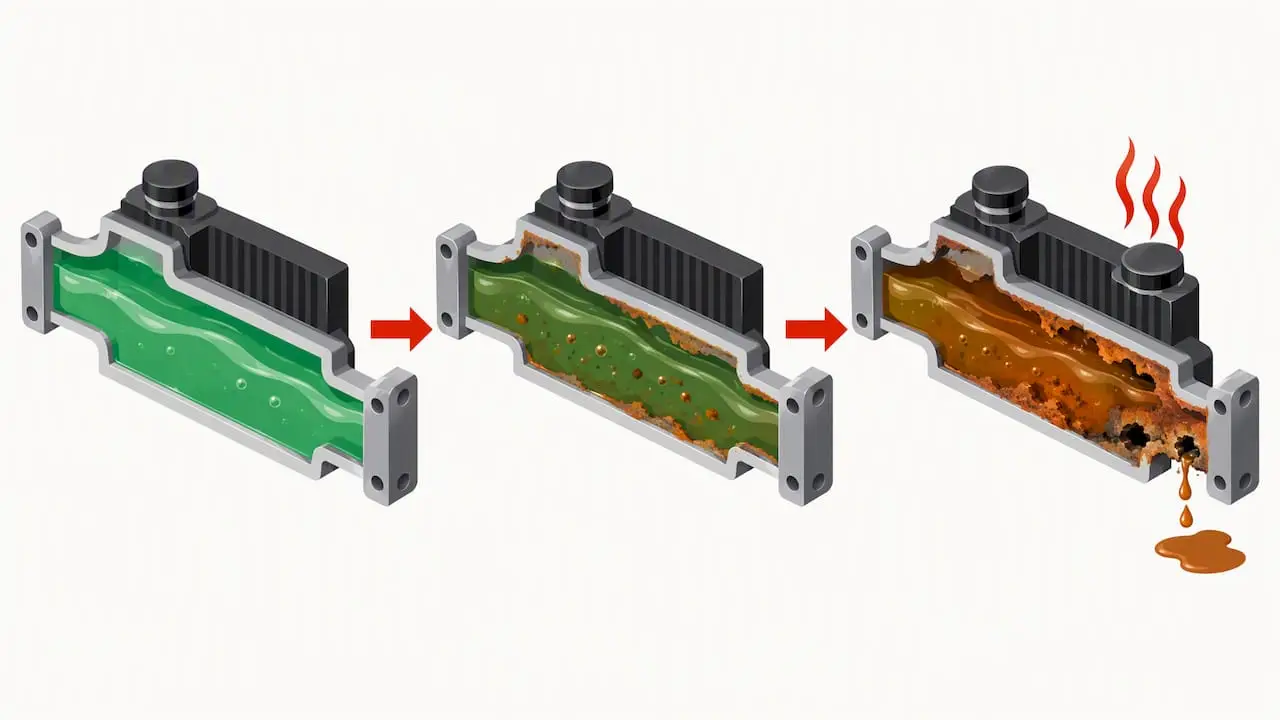
Coolant condition and cooling-system problems can contribute to overheating. If you notice a warning sign, have the vehicle inspected.
Overheating can lead to serious engine damage. If your vehicle overheats, stop driving when it is safe to do so and seek professional help. Learn about our engine repair services.
None of this means you should panic about a missed date. It means test the fluid now, then decide.
Shop perspective: follow the schedule, then confirm with the fluid
We treat the manufacturer’s interval as the plan and the fluid’s actual condition as the reality check. A vehicle’s use and history can affect whether its coolant needs attention before the scheduled service. Vehicle history matters too, since a past repair can change what’s circulating in the system.
When the interval is unclear or you suspect contamination, a professional inspection is the right next step. Our team handles radiator and cooling service. Contact us to ask about the inspection and documentation available.
— Express Lube & Car Care
Book a coolant check or cooling system service with us
If you’d rather know than guess, we’re ready to help. Contact Express Lube & Car Care to ask about coolant testing, cooling-system service and the work available for your vehicle. Browse our maintenance services and book a coolant check with Express Lube & Car Care today, so a small question never becomes a big repair.

FAQ
How often do you really need a coolant flush?
It depends on the coolant and the vehicle. Green IAT coolant often needs service about every two years or 24,000–30,000 miles, while OAT and HOAT long-life coolants commonly run about five years or 50,000–100,000 miles, per AAA. Your owner’s manual has the final word.
At what mileage should a coolant flush be done?
A common rule of thumb is every two years or 30,000 miles, though Kelley Blue Book notes that exact intervals vary by model. Newer vehicles with long-life coolant often go much farther, so check your manual before scheduling.
How long can I go without a coolant flush?
Not past the manual’s interval, and sooner if the fluid looks rusty or your car runs hot. Coolant gradually turns acidic and stops protecting against rust, so an old fill puts the radiator, water pump and engine at risk. Testing is a smart middle step if you’re unsure.
What is the average cost of a coolant flush?
Cost depends on your vehicle, the coolant it requires and the labor involved, so no single figure fits everyone. Check our website for current pricing, and ask what the service includes so you can compare like with like.
Sources
- What Coolant Does My Car Need? | AAA Automotive
- How Often to Change Engine Coolant
- Do I Need a Coolant System Flush?
- How Often Do I Need to Change Coolant?