
Most engine overheating traces back to a cooling-system failure like low coolant, a leak, a stuck thermostat, a dying water pump, or a clogged radiator, and sometimes to low oil starving the engine of the lubrication it needs to manage friction heat. If your temperature gauge spikes or a warning light comes on, pull over safely and shut the engine off. Don’t try to “drive it out.”
TL;DR:
- Most overheating issues stem from cooling-system failures, such as low coolant, leaks, or a stuck thermostat, which impair heat transfer from the engine.
- Modern vehicles, including hybrids and EVs, feature complex thermal-management systems that, when combined with conditions like towing or high ambient temperatures, increase overheating risk.
- Symptoms indicating overheating include high temperature gauge readings, steam, coolant leaks, and sudden drops in engine performance, requiring immediate safety measures.
- Routine maintenance, timely inspection of hoses, belts, and coolant levels, and proper coolant mixture are critical in preventing overheating incidents.
- Diagnosing the root cause involves pressure testing the cooling system and inspecting key components, with professional repair recommended for leaks, head gasket issues, or internal damage.
Table of Contents
- How your cooling system keeps the engine from cooking itself
- What happens when an engine overheats
- Common causes of engine overheating and why each one raises the temperature
- Symptoms and warning signs to watch for
- What to do right now if your car overheats
- How a shop diagnoses the real cause of overheating
- Preventing overheating with routine maintenance
- When overheating points to major repair
- How weather, towing, and heavy loads raise your overheating risk
- The radiator cap’s role in preventing overheating
- Adding coolant or water safely in an emergency
- Overheating differences between gas and diesel engines
- What technicians look for first when a car comes in overheated
- Getting your cooling system checked at Express Lube & Car Care
- Sources
- FAQ
How your cooling system keeps the engine from cooking itself
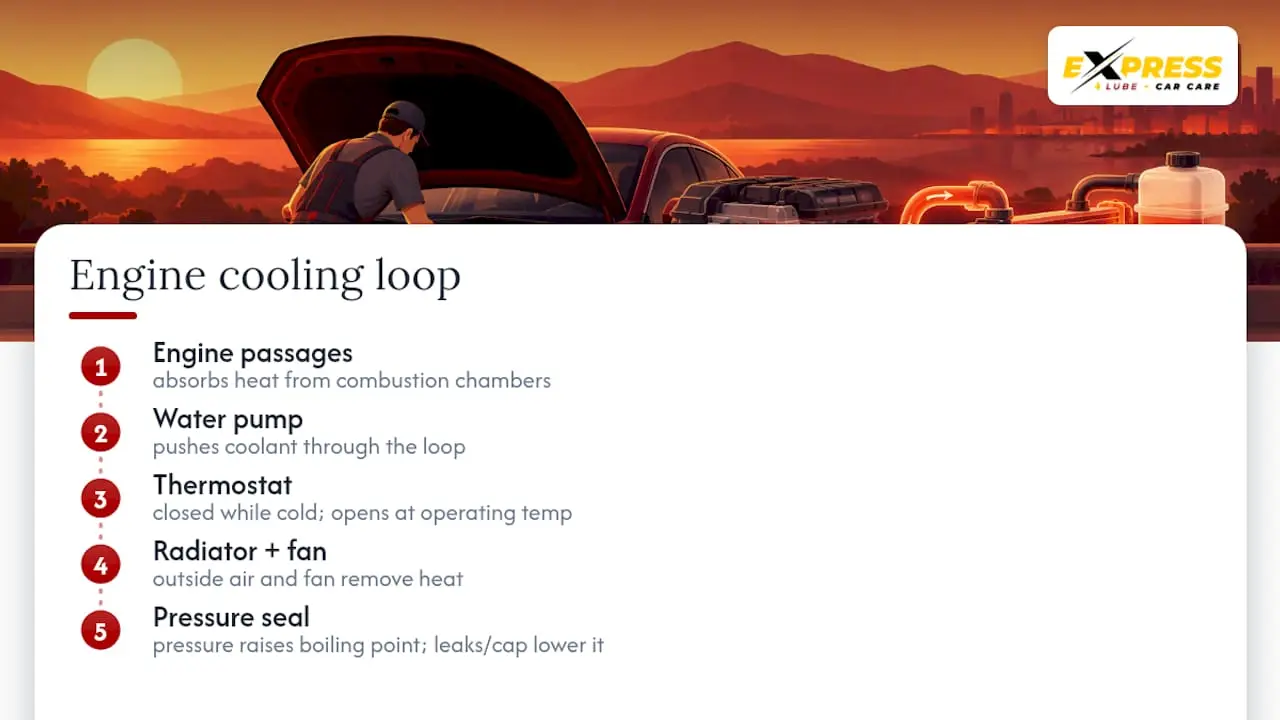
Think of your cooling system as the engine’s personal climate control. Coolant flows through passages cast right into the engine block, soaking up heat from the metal around the combustion chambers. The water pump keeps that coolant moving, pushing it out to the radiator, where outside air (helped along by the cooling fan) pulls the heat out and sends the now-cooled fluid back to do it all again.
The thermostat is the traffic cop in this loop. It stays closed while the engine warms up, then opens to let coolant flow to the radiator once things reach operating temperature. Get the coolant mixture wrong, or lose the system’s pressure seal, and the whole loop stops working the way it’s supposed to: pressure raises the boiling point of coolant, so a leak or a cracked cap doesn’t just lose fluid, it lowers the temperature at which your coolant starts to boil.
Hybrids and EVs complicate this picture further. These vehicles often run multiple coolant loops for the engine, battery, and power electronics, and modern thermal-management systems add components that can turn a simple belt or hose failure into a more complicated diagnosis.
What happens when an engine overheats
Push past a safe operating temperature and you’re not just dealing with an inconvenience. Metal expands unevenly under extreme heat, and cylinder heads can warp, engine blocks can crack, and head gaskets can blow, letting coolant and combustion gases mix where they shouldn’t. In the worst cases, moving parts expand enough to seize the engine completely, which usually means a very expensive repair.
There are safety risks too. Steam escaping from a hot radiator can cause serious burns, and a severe leak dripping onto hot exhaust components can occasionally start a fire. Sudden loss of power on the highway is its own hazard.
Passenger vehicle engines normally operate within a moderate temperature range under normal conditions, with temperatures above a certain point signaling that coolant is boiling and the engine is officially overheating, according to AAA Oregon/Idaho. That’s a narrow window, and it’s why a gauge creeping past the middle mark deserves your attention right away.
Common causes of engine overheating and why each one raises the temperature
Every cause below breaks the same basic promise: keep coolant moving and keep heat leaving the engine. Here’s how each one fails that job, based on the causes AAA Automotive identifies most often in overheating vehicles.
- Low or wrong coolant, or a leak in a hose, radiator, or reservoir: less fluid means less capacity to absorb and carry away heat, and a compromised closed system loses the pressure that raises coolant’s boiling point.
- Thermostat stuck closed: coolant can’t reach the radiator at all, so heat has nowhere to go even though the pump is running fine.
- Water pump failure: no circulation means no heat transfer, even with a full reservoir and a perfectly good radiator.
- Clogged radiator fins or a failed cooling fan: the radiator can’t shed heat into the surrounding air, so coolant comes back nearly as hot as it left.
- Ruptured or internally clogged hoses and passages: scale and debris buildup restrict flow the same way a kinked garden hose does.
- Worn serpentine belt: a slipping or broken belt can stop the water pump and fan from turning fast enough to keep pace with engine heat.
- Head gasket failure: coolant and combustion gases cross paths, robbing the system of pressure and fluid at the same time.
- Low engine oil: oil manages friction heat between moving parts, and running low lets that friction climb until it adds meaningfully to overall engine temperature, a pattern AAA TripCanvas points to as an often-overlooked contributor.
- Trapped air pockets after a coolant service: air doesn’t move heat the way liquid does, so pockets create localized hot spots that can spike the gauge even when the radiator itself looks fine.
Pro Tip: If your temperature gauge climbs right after a coolant flush or top-off, suspect trapped air before you suspect a new leak. Many shops use a bleed procedure specifically to clear it.
Symptoms and warning signs to watch for
Your car usually gives you notice before things get bad. Pay attention to these signals:
- A gauge needle sitting near or past the “H”, or a dashboard temperature warning light turning on.
- Steam or smoke from under the hood, along with a sweet smell that usually means antifreeze is leaking somewhere hot.
- A coolant puddle under the vehicle, often bright green, orange, or pink.
- New ticking or knocking noises, plus a sudden loss of power or engine performance.
- White exhaust smoke, a strong red flag that coolant may be entering the combustion chamber.
A steaming hood or a puddle under the car usually points to a real coolant problem rather than a passing blip, and AAA Club Alliance warns against opening the radiator cap while it’s hot, since pressurized steam can cause serious burns.
What to do right now if your car overheats
Treat an overheating warning as a demand for immediate action, not a suggestion.
- Turn off the air conditioning immediately to reduce the load on the engine.
- If you can still reach a safe spot, turn on the heater on full blast. It sounds backward, but it pulls heat away from the engine and into the cabin as a short-term stopgap.
- Pull over as soon as it’s safe, put on your hazard lights, and set the parking brake.
- Shut the engine off completely. Don’t idle hoping it cools on its own.
- Leave the hood closed for at least 15 to 20 minutes before even considering opening it, and never open the radiator cap while the system is hot or pressurized.
- Call for a tow or roadside assistance if you can’t identify an obvious, safe fix like a low reservoir you can top off once things cool.
Mechanics see this pattern constantly: treating overheating as an immediate stop, rather than pushing through a few more miles, is what separates a minor repair from catastrophic engine damage, according to AAA’s advice on overheating. A few extra minutes on the shoulder is a much better trade than a warped cylinder head.
How a shop diagnoses the real cause of overheating
A good diagnosis goes well beyond glancing under the hood. Technicians typically start with a pressure test on the cooling system, pumping it up to shop-specified pressure to reveal leaks that aren’t visible at rest. From there, they check the thermostat’s operation, inspect the water pump for play or seepage, and look over belts and hoses for wear or cracking.
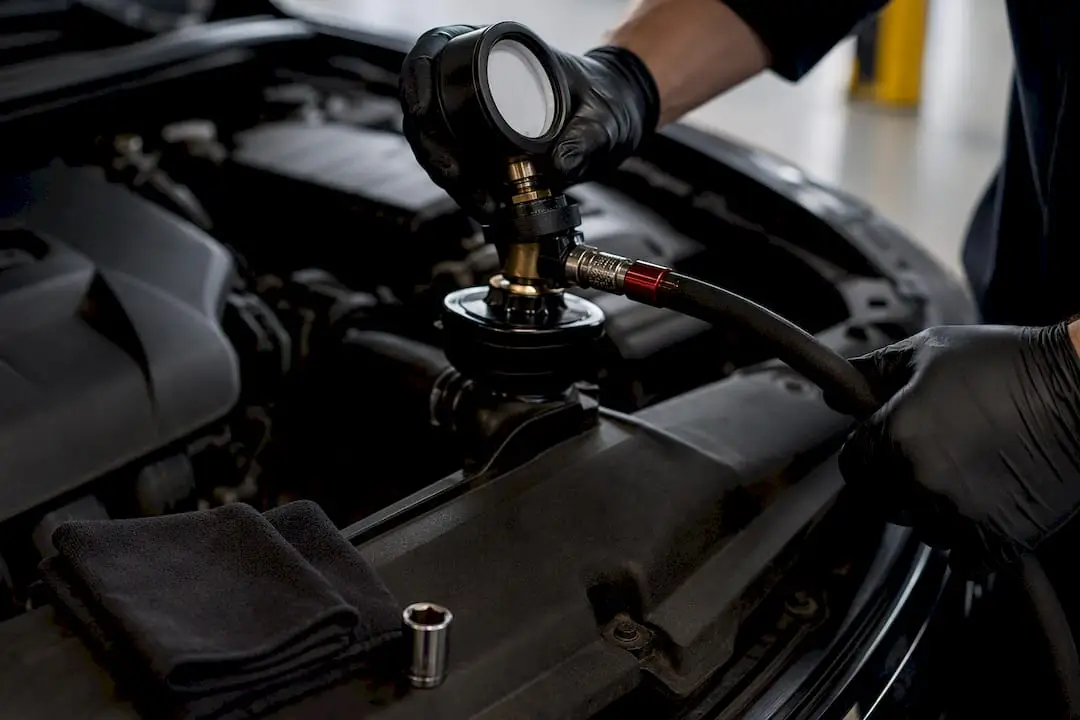
Radiator flow checks and internal leak tests, sometimes chemical or compression-based, help rule out a head gasket issue when there’s no obvious external leak. This matters because topping off coolant without finding the leak usually just delays the same overheating event, often at a worse moment.
Preventing overheating with routine maintenance
Most overheating problems are preventable with a handful of habits.
- Follow your owner’s manual for coolant change intervals and always use the correct coolant-to-water mixture for your climate.
- Have hoses, belts, the radiator cap, and the water pump inspected on a regular schedule, and replace them at the first sign of wear rather than waiting for failure.
- Keep oil at the recommended level and stay current on oil changes, since oil plays a direct role in managing friction heat throughout the engine.
- Do a quick seasonal check before long trips or summer heat, and book a professional cooling-system inspection if you notice any early warning signs.
Pro Tip: A five-minute visual check of your coolant level and hose condition before a road trip can catch small problems while they’re still cheap to fix.
When overheating points to major repair
Sometimes overheating is a symptom of damage that’s already happened rather than something that’s about to happen. Persistent white smoke from the exhaust, or oil that looks milky on the dipstick, usually means coolant and combustion gases or oil are mixing somewhere they shouldn’t. That’s the kind of finding that leads a shop to discuss head gasket replacement or, in more serious cases, an engine rebuild. Either way, this isn’t a call to make yourself. A professional engine diagnosis should confirm what’s actually happening before any major work begins.
How weather, towing, and heavy loads raise your overheating risk
Your cooling system is designed with a margin for normal driving, but that margin shrinks fast under tougher conditions. Hot summer days push ambient air temperature up, which means the radiator has less of a temperature gap to work with when it’s trying to shed heat from the coolant. A cooling system that’s coping fine in spring can struggle in July, especially if it’s already running low on fluid or has a partially clogged radiator core.
Towing and heavy loads add a different kind of stress. The engine has to work harder to move the extra weight, which means it generates more heat, and that heat has to go through the same-sized radiator and fan setup as always. Stop-and-go traffic makes this worse because airflow through the radiator drops at low speeds, right when the engine may need it most.
Long uphill climbs combine both problems: more load and less airflow at low speed, all while ambient heat works against the radiator. None of these conditions cause overheating on their own in a healthy cooling system, but they have a way of exposing a weak thermostat, a worn belt, or a coolant level that was already borderline. If you’re planning a summer trip with a loaded vehicle or a trailer, that’s exactly the moment to have your cooling system checked rather than after you’re already stranded on the shoulder.
The radiator cap’s role in preventing overheating
The radiator cap does more than keep coolant from spilling out. It seals the cooling system so pressure can build as coolant heats up, and that pressure is what raises the boiling point of the coolant well above what it would be in an open container. A properly sealed system lets coolant run hotter without boiling, which is exactly what you want for efficient heat transfer.
When a radiator cap’s seal wears out or its pressure-relief valve fails, the system can’t hold that pressure. Coolant boils at a lower temperature than it’s supposed to, and you get overheating symptoms even though the coolant level might look fine at a glance. A failing cap can also let coolant escape as vapor over time, which explains a slow, mysterious drop in coolant level with no visible puddle anywhere.
This is one of the cheaper parts on the entire cooling system, and one of the easiest to overlook, since it rarely shows obvious wear from the outside. If a shop pressure-tests your system and finds it won’t hold pressure, a bad cap is one of the first things worth ruling out before assuming a bigger leak.
Adding coolant or water safely in an emergency
If you’re stuck somewhere without a spare jug of coolant, plain water can work as a short-term emergency fix to get you to a shop, though it should never replace a proper coolant mixture long-term.
Wait until the engine has fully cooled, ideally 15 to 20 minutes or more after shutting it off, before touching the radiator cap. Even then, place a thick cloth over the cap and turn it slowly to release any remaining pressure gradually rather than all at once, since a fully pressurized hot system can spray scalding coolant.
Add fluid slowly, watching the reservoir or radiator neck, and stop once it reaches the proper fill line rather than the very top. If your vehicle uses a separate coolant reservoir, that’s typically the safer place to add fluid rather than the radiator itself. Once you’re able to reach a shop, have the coolant mixture corrected and the system checked for whatever leak or failure caused the low level in the first place.
Overheating differences between gas and diesel engines
Gasoline and diesel engines share the same basic cooling architecture, coolant, radiator, water pump, thermostat, but they don’t run identical thermal profiles. Diesel engines generally operate at higher compression and can generate substantial heat under load, which puts extra demand on the cooling system, particularly the radiator and any oil cooler working alongside it.
Diesel engines also often rely on more robust cooling components from the factory to handle towing and heavy-duty work, so a failure in one of those larger components (a bigger radiator, heavier-duty water pump) can sometimes take longer to show symptoms, then escalate quickly once it does. Gasoline engines, especially smaller ones, tend to show overheating symptoms a bit sooner since they have less thermal mass to buffer a developing problem.
The core warning signs, though, look the same across both: a rising gauge, steam, coolant smell, and loss of power. Whatever engine you’re driving, the same rule applies. Don’t keep driving once you see those signs.
What technicians look for first when a car comes in overheated
A typical triage starts with a visual leak check, a cooling-system pressure test, and a look at the thermostat and oil level. Acting on the first warning sign, rather than waiting, is usually what keeps a small fix from becoming a major one.
— Express Lube & Car Care
Getting your cooling system checked at Express Lube & Car Care
An overheating scare deserves more than a coolant top-off and a hope it doesn’t happen again. Our ASE-certified technicians can pressure test your cooling system, inspect the radiator, water pump, thermostat, and belts, and get to the actual cause instead of just the symptom.
- Radiator & cooling-system service to find leaks and restore proper flow.
- Engine R&R and diagnostics for cases where overheating has already caused internal damage.
- Routine maintenance to keep coolant, oil, and hoses in good shape before a breakdown happens.
We back qualifying repairs with a 24-month/24,000-mile warranty. If your temperature gauge has been climbing, book a cooling-system inspection with us today.
Sources
- What to do if Your Car is Overheating and How to Prevent it | AAA Oregon/Idaho
- Car Overheating: 8 Causes and Solutions | AAA Automotive
- What to do if Your Car is Overheating and How to Prevent it | Via
FAQ
How do you fix an overheated engine?
The fix depends entirely on the cause: a low coolant level or a small hose leak might mean a repair and refill, while a failed water pump, thermostat, or head gasket requires a proper repair before the vehicle is safe to drive again. A shop typically pressure tests the system first to confirm which part failed rather than guessing.
How do I diagnose what’s making my car overheat?
Technicians usually start with a cooling-system pressure test to find leaks, then check the thermostat, water pump, belts, and hoses for wear or failure. Topping off coolant without this kind of inspection often just delays the same problem instead of solving it.
What is the most common reason for engine overheating?
Low coolant, whether from a slow leak or simple neglect, is one of the most frequent causes, alongside a stuck thermostat, a failing water pump, or a clogged radiator, according to AAA Automotive. Low engine oil can also contribute by letting friction heat climb.
Is it OK to drive if the engine overheats?
No. Continuing to drive with an overheating engine risks warped cylinder heads, a blown head gasket, or a seized engine, and mechanics generally treat the warning as an immediate stop rather than something to push through, per AAA’s guidance. Pull over safely, shut the engine off, and arrange a tow or inspection instead.