
The most common cause of an ABS light is a faulty wheel speed sensor, followed by a dirty or damaged sensor ring, wiring problems, low brake fluid and a failing ABS control module. The light means the anti-lock system has detected a fault and switched itself off. Your regular brakes still work, but you lose the pulsing protection that keeps the wheels from locking on wet or slick pavement. The only way to know which cause is yours is to read the stored trouble codes with a scan tool.
If you’re in Arlington and the light came on during your commute on I-30 or Highway 360, don’t panic. Do read the rest of this guide, because one detail changes the urgency completely: whether the red BRAKE light is on too.
TL;DR
- A wheel speed sensor problem is the most frequent reason the ABS light comes on, but wiring, the hydraulic control unit, low brake fluid and related stability systems can all trigger it.
- If only the ABS light is on, you can usually drive carefully to a shop and avoid hard braking. If the red BRAKE light is also on, treat it as a priority safety problem and get the car inspected right away.
- The light stays on as long as a fault is stored, so it won’t clear itself just because the car feels normal.
- Don’t replace parts by guesswork. A scan for codes and a hands-on check come first.
Table of Contents
- What the ABS light actually tells you
- The most common ABS light causes
- ABS light on vs. brake light on: why the difference matters
- Is it safe to drive with the ABS light on?
- Can you troubleshoot it yourself?
- What a proper ABS diagnosis looks like
- ABS sensor failure symptoms
- Why does the ABS light stay on after starting?
- Our perspective: what we see in the bay
- Getting it checked in Arlington
- FAQ
- Book your ABS check
- Sources
What the ABS light actually tells you
When you turn the key or press the start button, the ABS light should glow for a few seconds and then go out. That’s the system checking itself. Ram’s owner literature describes this as a brief bulb check at start-up, and it adds that if the light stays on while you drive, the anti-lock system isn’t working and the vehicle brakes conventionally, without anti-lock assistance.
Think of it as the system sending up a flare. It isn’t telling you the brakes are gone. It’s telling you the safety net under them has a hole.
AAA makes the same point in its warning light guide: an ABS light doesn’t automatically mean the brakes won’t work, but the anti-lock feature probably has a problem.
Why the light won’t just turn itself off
Many drivers hope the light is a fluke because it flickered or the car feels fine. Federal brake standards are built so that it doesn’t work that way. NHTSA’s interpretation of the rule says the warning lamp has to stay lit as long as a malfunction is stored. So an intermittent fault, such as a sensor that drops out on bumpy pavement, can leave the lamp on even when everything seems to work.
The most common ABS light causes
Here’s the short list, roughly in the order we’d think about them. Order varies by vehicle, which is why diagnosis matters.
1. A failed or contaminated wheel speed sensor
Each wheel has a sensor that reports how fast it’s turning. The ABS computer compares the four signals. If one drops out or reads wrong, the system can’t tell whether a wheel is about to lock, so it shuts the feature down.
Bosch, one of the original ABS suppliers, notes that wheel speed sensors and the hydraulic control unit are common failure points. Sensors sit near the wheel, so they take a beating from road grime, moisture, heat and vibration. That’s why they top nearly every list.
2. A dirty, rusty or damaged tone ring
The sensor reads a toothed ring (sometimes called a tone ring or sensor rotor) that spins with the wheel. If it’s caked with metallic debris, rusted, cracked or missing teeth, the signal gets noisy. A sensor can be perfectly healthy and still throw a code.
Nissan’s service manual for the Versa says that dirt on the rotor can mimic a mechanical failure, and a related manual for the Cube describes removing dust and foreign matter from the sensor rotor before checking readings. Cleaning and inspecting first can keep you from paying for a part you didn’t need.
3. Damaged wiring or a bad connector
The sensor wires run along the suspension and through the wheel well. They flex with every bump, and they can chafe, corrode or get pinched after other work. A broken wire gives the same symptom as a dead sensor.
Wiring can be a bigger deal than a fuse. Many drivers assume a blown fuse is the usual culprit. It can be on some vehicles, but integrated harnesses are more common now, and tracing them takes the right equipment. For example, Ford has issued a safety recall on certain 2021 to 2023 F-150 trucks where the rear axle wiring bundle can rub against the axle housing. If you drive a truck, it’s worth checking your VIN for open recalls.
4. A failing ABS module or hydraulic control unit
The hydraulic control unit (HCU) contains the valves and pump that pulse brake pressure during a stop, and an electronic module that runs them. When the module fails or loses communication with a sensor, the light comes on. This is less common than a sensor problem, and it’s usually the most expensive one, which is exactly why you want a confirmed diagnosis before anyone orders one.
5. Low brake fluid or a hydraulic problem
Low fluid in the reservoir can turn on the ABS light, the red brake light, or both. Fluid doesn’t just disappear. As pads wear, the level drops a little, but a significant drop can point to a leak. A leak is a safety issue on its own and shouldn’t wait.
6. Related systems: traction control and stability control
ABS shares sensors and hardware with traction control and electronic stability control. Bosch points out that problems in related systems can also light up the ABS warning. If you see the ABS light along with a traction or stability light, that’s a clue the shared sensor network is involved.
7. Other causes worth knowing about
- Wheel bearing or hub problems. A loose or worn bearing can change the gap between the sensor and the ring.
- Mismatched or incorrect tire sizes. Wheels that spin at different rates can confuse the system.
- Low battery voltage. A weak battery or charging problem can set odd codes in electronic modules.
- Recent brake work. If a sensor was bumped, a connector wasn’t reseated, or the ring was damaged during a repair, the light can appear right after.
ABS light on vs. brake light on: why the difference matters
This is the single most important distinction in this article.
| What you see | What it generally means | What to do |
|---|---|---|
| ABS light only | Anti-lock function is off, normal braking still works | Drive gently to a shop soon, leave extra following distance, avoid hard braking |
| Red BRAKE light only | Parking brake, low fluid or a hydraulic issue | Check the parking brake, then get it inspected promptly |
| ABS and red BRAKE lights together | Possible loss of hydraulic pressure or a brake force distribution problem | Treat as a priority safety issue and have it inspected right away |
Owner’s manuals back this up. Ram’s guidance is that it’s generally okay to drive to a shop with only the ABS light on, but you should avoid hard braking. Hyundai’s manual for the Ioniq Plug-in Hybrid describes warning lights that tell you when the brake system isn’t working as designed. When both lights are on, normal braking may be compromised, and the chance of wheel lock-up in a sudden stop goes up.
If your pedal feels soft, sinks toward the floor, or the car pulls when you brake, don’t drive it. Have it towed. For more on that red light, see our guide to the brake light on your dashboard.
Is it safe to drive with the ABS light on?
Usually yes, for a short, careful drive to a shop, as long as the red BRAKE light is off and the pedal feels normal. But “safe enough” isn’t the same as “fine for weeks.”
Here’s how to drive in the meantime:
- Leave more space between you and the car ahead, double what you normally would.
- Brake earlier and more gently. Lock-up is most likely in a panic stop.
- Slow down in rain. A lot of Arlington’s worst driving moments are a wet afternoon on I-30 or Division Street, and that’s exactly when anti-lock matters most.
- Skip towing, steep downhill loads and long highway trips until it’s checked.
There’s also a cost reason not to wait. Consumer Reports has long warned that ignoring warning signs can turn small repairs into bigger ones. A sensor problem is usually the cheaper end of the scale. Left alone, it can sit alongside other brake wear you don’t know about.
Can you troubleshoot it yourself?
A few quick checks are reasonable before you call:
- Look at the parking brake. Make sure it’s fully released.
- Check the brake fluid level if you know how, and notice if it’s well below the MIN mark. If so, don’t just top it off and move on. Low fluid is a symptom.
- Restart the car once. If the light goes out and stays out, still get it checked. A stored code may be waiting to return.
- Think about recent work. Did the light appear after new tires, a brake job or a wheel bearing repair?
What you can’t do reliably at home is read the codes. Nissan’s manual notes that a visual check alone may not find the cause and that careful checking of suspicious circuits can prevent replacing good parts. That’s the whole case for a proper diagnosis.
What a proper ABS diagnosis looks like
Here’s the sequence we’d expect any good shop to follow:
- Confirm the complaint. Which lights are on? Did it come on suddenly? Any brake noise or pedal changes?
- Scan for trouble codes. An ABS-capable scan tool reads codes from the ABS module, not just the engine computer. A code usually points to a circuit or a wheel, not directly to a part.
- Check live data. Compare wheel speed readings on all four corners while the wheels turn. A wheel that reads zero or erratic is your suspect.
- Inspect the wheel end. Look at the sensor, its wiring, the tone ring, the bearing and the hub for damage, debris or looseness.
- Check fluid and the hydraulic system. Level, condition and any sign of leaks.
- Test before replacing. Verify the sensor or circuit is actually at fault. Then repair, clear the codes and road test.
One point of honesty: a code is a starting point, not a verdict. A wheel speed sensor code can come from the sensor, the wire, the connector, the tone ring or the bearing. That’s why we recommend diagnostics before replacing parts.
A practical example
Say your ABS light comes on after a rainy week and the code points to the left front wheel speed circuit. A quick look might show a sensor packed with brake dust and road grime, or a wire that has worn through where it flexes. Cleaning the sensor and ring may restore the signal. If the wire is damaged, repairing it can solve it without a new sensor. If the sensor itself reads out of range, you replace that one part. Three different causes, same code, three different repairs. Guessing means paying for the wrong one.
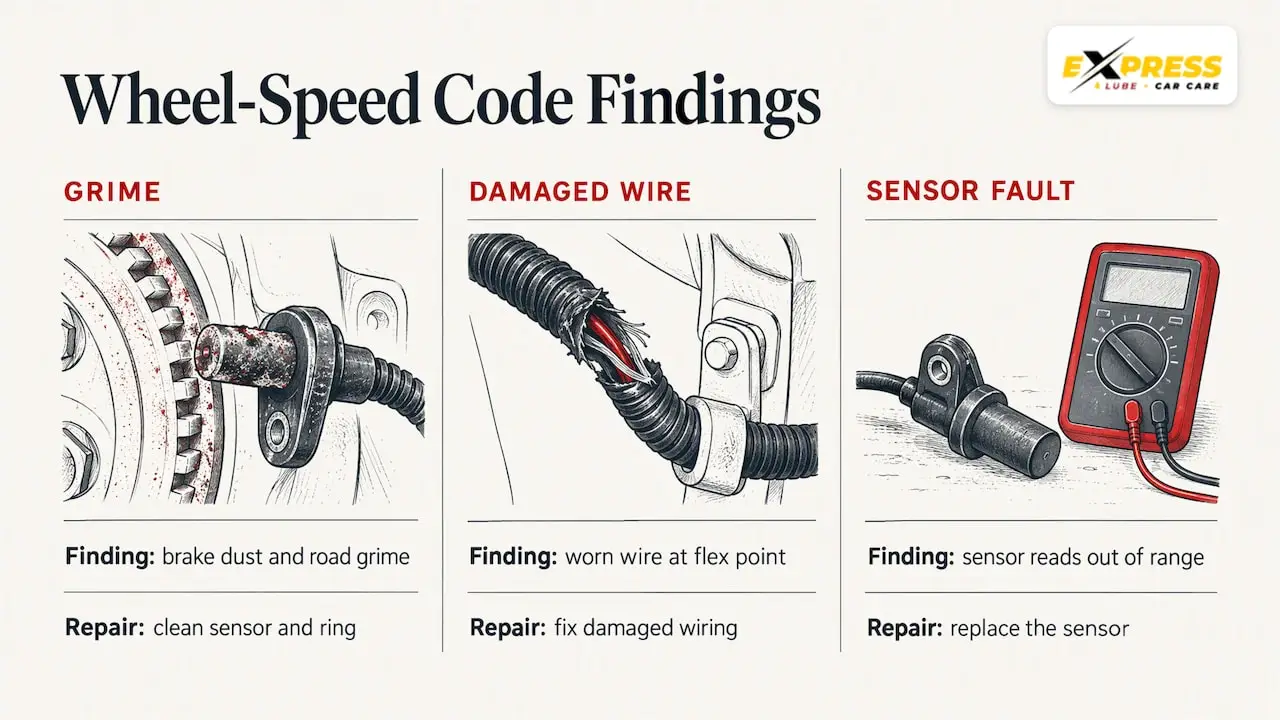
ABS sensor failure symptoms
Besides the dash light, a failing wheel speed sensor or related fault can show up as:
- The ABS light on, sometimes with the traction control or stability light.
- The speedometer acting erratic or dropping to zero on some vehicles, since some use wheel speed signals.
- Traction control or stability control cutting in at odd times, or not working.
- A pedal that pulses unusually or doesn’t pulse in a hard stop on a slippery surface.
- The light flickering on over bumps, which can hint at a wiring or connector issue.
Any of these with a soft pedal, grinding or pulling is a reason to stop driving it and get it checked. Our rundown of brake problem symptoms can help you sort out what you’re feeling.
Why does the ABS light stay on after starting?
If it never goes out after start-up, the self-check found a fault. If it goes out and comes back later, the fault appears only under certain conditions, such as speed, temperature, moisture or a bump. Both cases mean there’s a code stored. Since the lamp is designed to stay lit while a malfunction is stored, as the NHTSA interpretation explains, don’t wait for it to clear.
Occasionally the light comes on right after a battery replacement or a jump start because of a voltage dip. If it persists after a normal drive cycle, get it scanned.
Our perspective: what we see in the bay
We’re a full-service shop, so we look at the whole brake system, not just the lamp on your dash. An ABS light is rarely a one-part story. We start with a scan, then confirm with a hands-on look at the wheel end, because the sensor, the ring, the wiring and the bearing can all produce the same warning.
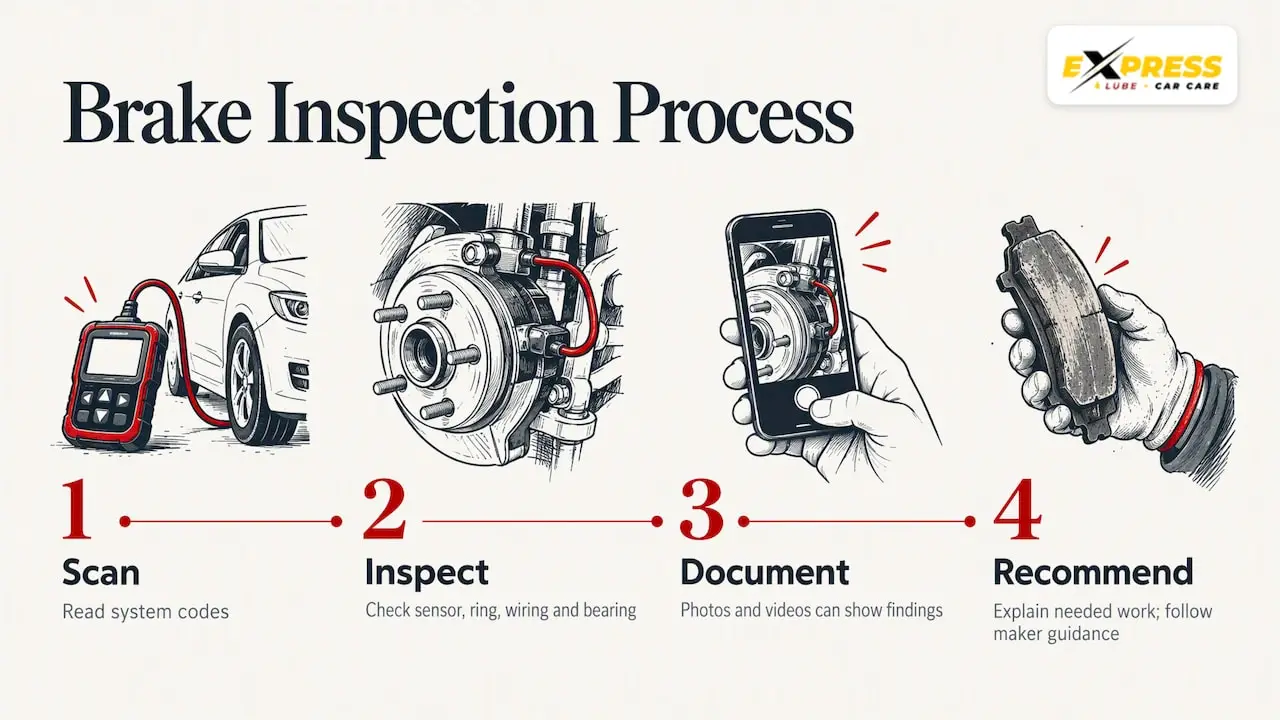
Our technicians are ASE-certified, and every inspection can include photos and videos, so you see what we see before you decide. That matters here more than almost anywhere, since the difference between a cleaned sensor and a control module is a big one, and you shouldn’t have to take anyone’s word for it.
We also don’t think you should be sold more than you need. If the fix is cleaning and a connector, we’ll say so. If the brake pads and rotors are worn too, we’ll show you where they stand and let you decide on timing. Our guidance is to follow your manufacturer’s recommendations rather than a universal schedule.
— Express Lube & Car Care
Getting it checked in Arlington
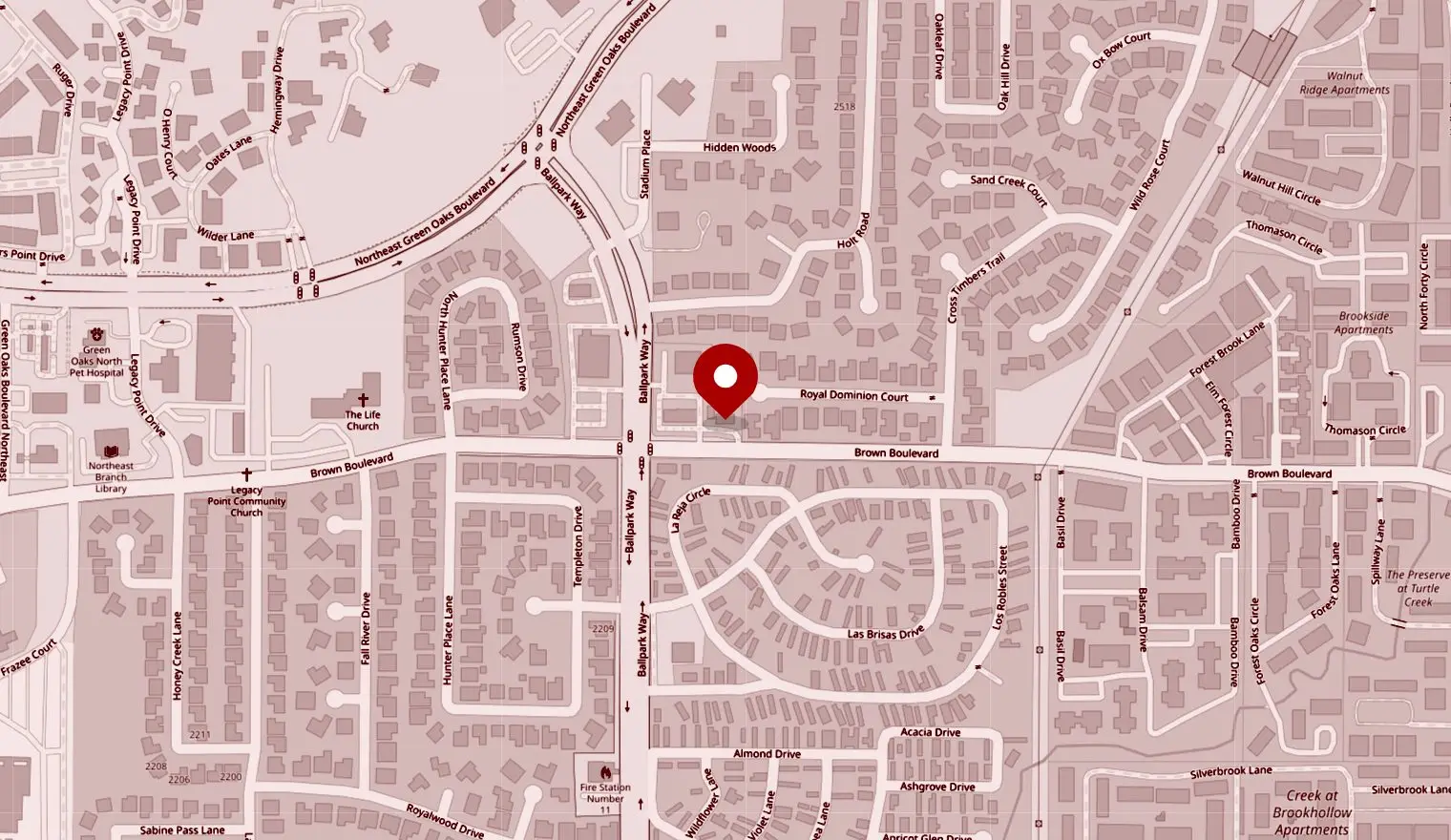
We handle brake repair and diagnostics at our shop on Brown Blvd, close to I-30 and Highway 360, so it’s an easy stop whether you’re coming from North Arlington or from Grand Prairie, Euless, Bedford or Hurst. Repairs that qualify are backed by our 24-month/24,000-mile warranty, and you can see the full list on our services page.
We don’t publish prices for ABS work because it depends on what the diagnosis finds. We’ll give you the findings first, then the estimate.
FAQ
Why is my ABS light on?
The system has detected a fault and turned off anti-lock braking. The usual causes are a wheel speed sensor, a dirty or damaged tone ring, wiring, low brake fluid or the ABS module. A scan for codes tells you which one it is.
Can I pass a Texas inspection with the ABS light on?
Don’t count on it. We can check your vehicle against the current requirements when you bring it in. Diagnosing the light before inspection day saves you a second trip.
Can a bad battery cause the ABS light to come on?
It can. Low voltage can confuse electronic modules and set codes, including in the brake system. If the battery or charging system is weak, we’d test that along with the ABS diagnosis rather than replace brake parts first.
How long can I drive with the ABS light on?
There’s no safe number of days to promise. With only the ABS light on and a normal pedal, a short careful drive to a shop is generally fine, but get it looked at soon. If the red BRAKE light is on too, or the pedal feels soft, stop driving and have it towed.
Will the ABS light go away on its own?
Usually not. The light is designed to stay on while a fault is stored. It may go out if a temporary condition clears, like a low-voltage event, but a returning light means the problem is still there.
Book your ABS check
If your ABS light is on, let’s find out why before it turns into a bigger brake repair. Call us at (682) 248-3416 or schedule an appointment online. You’ll find us at 2105 Brown Blvd, Arlington, TX 76006, and you can see more at Express Lube & Car Care.
Sources
- Ram 1500/2500/3500 owner’s supplement (Mopar)
- Antilock braking system (Bosch Mobility)
- NHTSA interpretation on warning lamp requirements
- Consumer Reports: what your car is telling you
- 2008 Nissan Versa repair manual, Brake Control System
- 2012 Nissan Cube repair manual, Brake Control System
- 2022 Hyundai Ioniq Plug-in Hybrid owner’s manual
- Ford F-150 rear axle wiring harness recall 23S35
- AAA Via: car warning lights explained