
TL;DR:
- Brake inspection frequency helps ensure safe stopping power and prevent costly repairs before issues worsen. Regular inspections catch wear early, improve safety, and save money by avoiding severe damage. The recommended interval depends on driving conditions, with more frequent checks needed for heavy city traffic, towing, or aggressive driving.
Brake inspection frequency is defined as how often your vehicle’s braking system should be professionally checked to maintain safe, reliable stopping power. This is not a minor detail on your maintenance checklist. Skipping or delaying brake checks is one of the most common ways car owners unknowingly put themselves at risk. Routine brake inspections detect minor issues before they become serious safety threats, and the difference between catching a worn pad early and ignoring it can mean the difference between a $150 repair and a $1,000+ brake system overhaul. Understanding why brake inspection frequency matters starts with knowing what your brakes go through every single day.
Why brake inspection frequency matters more than most drivers realize
Your brakes are the single most safety-critical system on your vehicle, yet most car owners treat them as an afterthought until something goes wrong. Brake system issues accounted for 30% of all commercial vehicle out-of-service orders in 2025. That figure reflects a systemic problem: drivers and fleet operators alike delay inspections until a failure forces their hand.

The core issue is that brake wear is gradual. You will not feel your pads thinning out over 500 miles. You will feel it all at once when the metal wear indicator screams at you from a parking lot. By then, you may already owe your mechanic a rotor replacement on top of new pads. Consistent inspection tracking prevents that kind of sudden, expensive surprise and keeps your pedal feel predictable every time you drive.
The importance of brake inspections also goes beyond your wallet. Worn brakes extend stopping distances. Longer stopping distances mean less time to react in an emergency. That chain of consequences starts with one skipped appointment.
How often should you inspect your brakes?
The honest answer is: it depends on how you drive. Brake inspection guidelines are not one-size-fits-all. Your commute, terrain, and load all affect how fast your pads and rotors wear down.
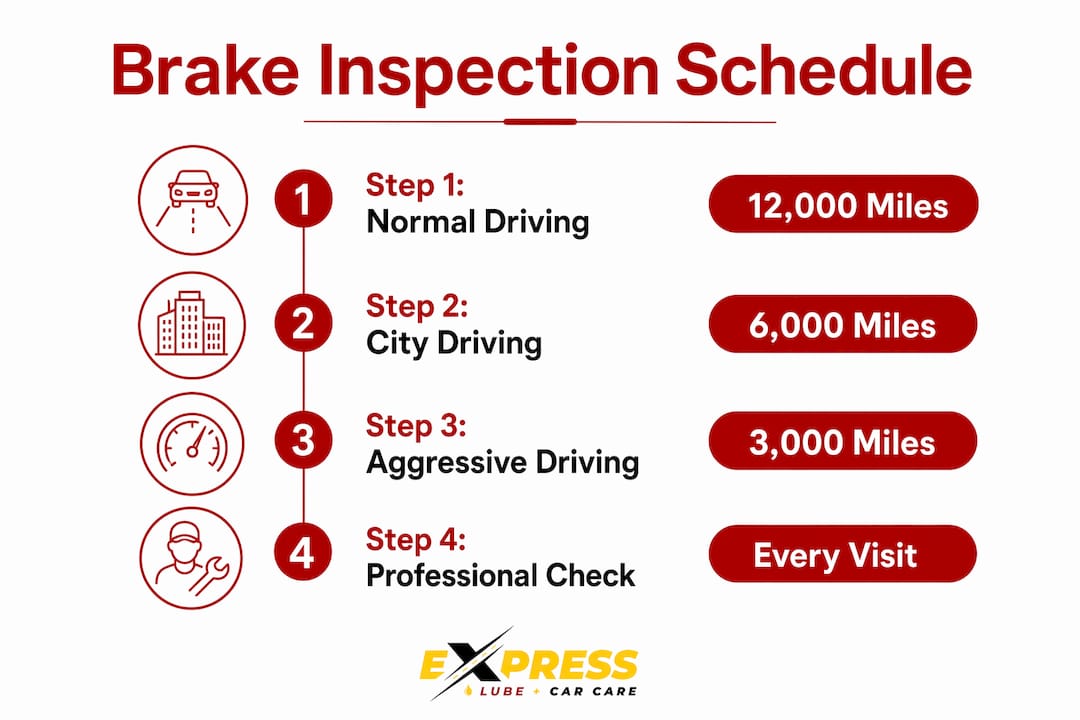
Recommended inspection intervals vary significantly by driving condition, and here is a clear breakdown:
| Driving condition | Recommended interval |
|---|---|
| Normal highway driving | Every 12,000 miles or 12 months |
| Heavy city traffic or hilly terrain | Every 6,000–8,000 miles or 6–8 months |
| Towing or hauling | Every 6,000 miles or 6 months |
| Performance or track driving | Every 5,000 miles |
City drivers who stop and go dozens of times per commute wear their pads far faster than someone who mostly cruises on the highway. If you live in a hilly area like parts of the DFW region with frequent elevation changes, your brakes work harder on every descent. Towing a trailer multiplies braking force demands dramatically, which is why the interval drops to six months regardless of mileage.
Your driving style matters just as much as your route. Aggressive braking from high speeds generates heat that degrades brake fluid and warps rotors over time. If you tend to brake late and hard, move your inspection schedule closer to the shorter end of any range. Regular vehicle checks keep you ahead of that wear curve instead of reacting to it.
What happens during a professional brake inspection?
A brake inspection is not just a quick glance at your wheels. A thorough check covers every component that affects your stopping power. Here is what a qualified technician examines:
- Brake pads: Measured for remaining friction material thickness. Pads below the minimum safe threshold need immediate replacement.
- Rotors: Checked for warping, scoring, and minimum thickness. A warped rotor causes the steering wheel to vibrate when you brake.
- Calipers: Inspected for leaks, seized pistons, and uneven pad wear patterns. A stuck caliper can cause one wheel to drag constantly.
- Brake fluid: Tested for moisture contamination and proper fluid level. Contaminated fluid lowers the boiling point and reduces braking effectiveness under hard use. Learn more about brake fluid maintenance and when it needs changing.
- Brake lines and hoses: Checked for cracks, corrosion, or soft spots that could cause a pressure loss.
- Warning lights: Any active brake system warning codes are scanned and diagnosed.
The inspection process also catches cascading damage early. A worn pad left unchecked will eventually grind metal against your rotor. Once a rotor is scored deeply enough, it cannot be resurfaced and must be replaced entirely. That single oversight turns a $150 pad job into a $400–600 repair. Understanding the role of brake calipers in this system helps you appreciate why every component on that list matters.
Warning signs that mean your brakes need attention now
Your brakes communicate. The trick is knowing which signals are “get it checked soon” and which ones mean “pull over and call a tow truck.” Warning signs carry different urgency levels, and treating them all the same is a mistake.
Stop driving immediately if you notice:
- A grinding or metal-on-metal noise when braking. This means your pads are gone and rotors are being damaged right now.
- A soft or spongy brake pedal that sinks toward the floor. This signals a fluid leak or air in the brake lines, both of which compromise stopping power severely.
- The vehicle pulling hard to one side under braking. This points to a seized caliper or uneven pad wear that affects directional control.
Schedule a service appointment within a week if you notice:
- A high-pitched squealing sound when you apply the brakes. Metal wear indicators in modern brake pads create this noise intentionally as an early warning before the pad reaches a dangerous thickness.
- A burning smell after driving in stop-and-go traffic or down a long hill. Overheated brakes need inspection before the next drive.
- Your brake warning light turning on. Do not assume it is a sensor glitch. Check it promptly.
Ignoring warning signs causes repair costs to double or more as damage spreads from pads to rotors to calipers. Recognizing brake problem symptoms early is one of the most valuable brake maintenance tips you can act on.
Pro Tip: Do a quick brake check every time you wash your car. Look through the wheel spokes at your rotor surface. If you see deep grooves or heavy rust pitting, book an inspection before your next long drive.
The real benefits of sticking to a brake inspection schedule
Consistent brake safety checks deliver three concrete advantages: they protect your safety, protect your money, and protect your vehicle’s long-term value.
On the safety side, routine inspections prevent brake failure by catching wear and damage before it reaches a critical point. A technician who spots a caliper starting to seize can fix it in an hour. A caliper that fully seizes on the highway creates an emergency. The math on that trade-off is obvious.
On the financial side, the numbers are stark. A routine brake inspection costs anywhere from $0 to $100. Waiting until pads are destroyed and rotors are scored can push your repair bill past $1,000. Regular car maintenance is one of the clearest examples of spending a little now to avoid spending a lot later.
“Brakes wear gradually, and that gradual wear is exactly what makes it so easy to ignore. The drivers who stay safe and spend the least on repairs are the ones who treat inspection appointments as non-negotiable, not optional.”
Consistent inspections also maintain predictable pedal feel. When your brake system is in good shape, your foot knows exactly how much pressure to apply in any situation. That muscle memory matters in emergency stops. Drivers who let their brakes degrade slowly often do not realize how much their stopping distance has increased until they need every inch of it.
Key Takeaways
Regular brake inspections are the single most cost-effective safety habit a car owner can build, preventing failures, limiting repair costs, and maintaining consistent stopping performance across all driving conditions.
| Point | Details |
|---|---|
| Inspection interval varies by driving style | Normal driving needs checks every 12 months; city, towing, or performance use requires checks every 5–8 months. |
| Early detection saves significant money | A routine inspection costs $0–100; delayed repairs can exceed $1,000 when rotors and calipers are damaged. |
| Warning signs have different urgency levels | Grinding and soft pedals require stopping immediately; squealing and warning lights need service within a week. |
| Inspections cover six key components | Pads, rotors, calipers, fluid, lines, and warning codes are all checked during a professional brake inspection. |
| Consistent scheduling beats reactive repairs | Tracking wear on a set schedule prevents sudden failures and keeps pedal feel predictable and reliable. |
What I’ve learned from watching drivers delay brake checks
I have seen the same pattern repeat itself more times than I can count. A car owner notices a faint squeal for two weeks, tells themselves it will go away, and shows up three months later with metal-on-metal grinding and a repair bill that wrecked their budget. The squeal was the brake pad wear indicator doing exactly what it was designed to do: sending up a flare before things got serious. They just did not answer it.
The biggest mistake I see is treating brake inspections as something you do when something feels wrong, rather than something you do on a schedule. Brakes do not fail dramatically all at once in most cases. They fail quietly, gradually, and then suddenly. By the time you feel it, you are already past the point where a simple pad swap would have fixed everything.
My advice is to tie your brake check to something you already do consistently. Every oil change is a natural checkpoint. Every tire rotation is another. If you drive aggressively or commute in heavy traffic, do not wait for the annual reminder. Adapt your schedule to how you actually drive, not how you wish you drove.
Building a relationship with a trusted mechanic also changes everything. When a technician knows your vehicle’s history, they can spot trends in wear that a one-time inspection might miss. That context is worth a lot. If you are not sure what to look for in a shop, understanding what ASE certification means is a solid starting point for finding someone you can trust.
— Hassan
Brake inspections at Expresslubearlington: no guesswork, just results
Expresslubearlington is a RepairPal Certified Shop and CarFax Top-Rated Service Center serving drivers across the DFW area. Our ASE-certified technicians perform thorough brake inspections that cover every component in your braking system, from pad thickness and rotor condition to fluid quality and caliper function.
We make it easy to stay on schedule without stress. Whether you are due for a routine check or you heard something that did not sound right on your last drive, our team gives you a straight answer and a fair price. Check out our current maintenance savings offer and book your brake inspection today. Staying ahead of brake wear is one of the smartest things you can do for your safety and your budget, and we are here to help you do exactly that.
FAQ
How often should brakes be inspected for normal driving?
For normal highway driving, brake inspections are recommended every 12,000 miles or once every 12 months, whichever comes first. Drivers in heavy city traffic or hilly terrain should inspect every 6,000–8,000 miles or every 6–8 months.
What are the most urgent signs of brake wear?
Grinding noises, a soft or spongy pedal, and the vehicle pulling to one side under braking are all stop-driving-immediately warning signs. Squealing, a burning smell, or a dashboard brake warning light require a service appointment within a week.
Can I skip a brake inspection if my brakes feel fine?
No. Brake wear is gradual and often undetectable by feel until damage is already significant. Scheduled inspections catch issues like thinning pads, fluid contamination, and caliper wear before they affect performance or cause failure.
How much does a brake inspection cost compared to ignoring it?
A routine brake inspection typically costs $0–100. Delaying until pads are destroyed and rotors are scored can push repair costs past $1,000, making early inspections one of the most cost-effective maintenance habits available.
Does driving style affect how often I need brake checks?
Yes, significantly. Aggressive braking, frequent stop-and-go traffic, towing, and performance driving all accelerate brake wear. Drivers in these categories should follow shorter inspection intervals, as low as every 5,000–6,000 miles, rather than the standard annual schedule.