

TL;DR:
- A car battery is a rechargeable lead-acid pack that provides the initial power to start the engine and supports vehicle electronics. The alternator recharges the battery once the engine runs and supplies electrical power during operation. Proper maintenance, timely testing, and awareness of failure signs extend battery life and ensure reliable vehicle performance.
A car battery is a rechargeable lead-acid pack that converts chemical energy into electrical energy, delivering a powerful burst of current to crank the starter motor and keeping your vehicle’s electronics stable while the engine runs. The alternator takes over once the engine is running, restoring the charge the battery spent on startup.
The short version:
- A standard 12-volt battery contains six lead-acid cells, each producing roughly 2 volts, wired in series.
- During discharge, lead and lead dioxide plates react with sulfuric acid electrolyte to push electrons through the circuit; charging reverses that reaction.
- The three biggest threats to battery life are sulfation (from sitting discharged), high heat, and parasitic drain from accessories or faulty components.
Table of Contents
- How a car battery works: what’s inside the case
- Voltage, current, amp-hours, and CCA: the numbers that actually matter
- The lead-acid chemistry: how your battery makes electricity
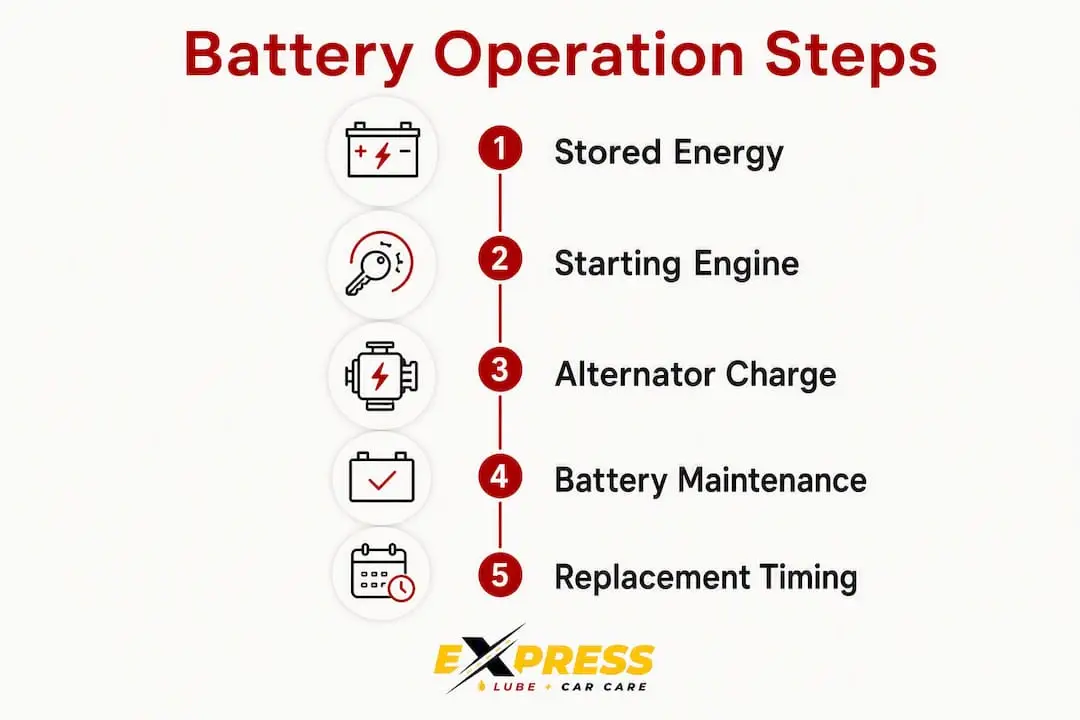
- Step-by-step: how the battery starts your car
- How charging works while the engine runs
- What actually damages batteries: the real failure modes
- How to test a car battery at home with a multimeter
- Maintenance, safety, and recycling: what you can do right now
- When to replace a battery: symptoms and lifespan
- When to see a professional: what a mechanic will check
- Key Takeaways
- What most car owners get wrong about their battery
- Your battery, tested and backed by a warranty
- Useful sources and further reading
- FAQ
How a car battery works: what’s inside the case
Picture six small compartments lined up inside a hard plastic box. Each compartment is a cell, and each cell produces about 2 volts when fully charged. Wire all six in series and you get the ~12.6–12.7 volts a healthy battery shows at rest.
Inside every cell, you’ll find alternating positive and negative plates submerged in electrolyte. The positive plates are lead dioxide (PbO2), the negative plates are sponge lead (Pb), and the electrolyte is dilute sulfuric acid (H2SO4). Thin separators sit between the plates to prevent short circuits while still letting ions pass through freely.
The two external terminals, positive (+) and negative (−), are the connection points for your vehicle’s cables. They’re made of lead alloy and sized differently on purpose so you can’t accidentally connect them backward. The whole assembly is heavy because lead is dense. That weight matters when you’re lifting one out of the engine bay, and it’s one reason proper handling technique and gloves are non-negotiable.
Voltage, current, amp-hours, and CCA: the numbers that actually matter
Before the chemistry makes sense, a few electrical terms are worth pinning down:
- Voltage (V): The electrical “pressure” pushing current through a circuit. A fully charged 12-volt battery reads about 12.6 to 12.8 V at rest; a lower reading indicates a partially or fully discharged battery.
- Current (A): The flow of electrons. Accessories like headlights draw a few amps. The starter motor draws hundreds of amps for a few seconds, which is why battery terminals and cables must be clean and tight.
- Amp-hours (Ah): A measure of capacity, how many amps the battery can deliver over time. Battery capacity, measured in amp-hours, indicates how many amps a battery can supply over time; for example, a 60 Ah battery can supply a moderate current for several hours.
- Cold Cranking Amps (CCA): The number of amps a battery can deliver at 0°F for 30 seconds while staying above 7.2 volts. CCA is the spec that tells you whether a battery can reliably start your engine on a cold morning.
- Internal resistance: Every battery has some resistance inside. Under a heavy starter load, that internal resistance causes the terminal voltage to drop noticeably, sometimes from 12.6 V down to 10 V or lower for a fraction of a second. A battery with high internal resistance (from age or sulfation) drops further and may not crank the engine at all.
Resting voltage, CCA, and Ah together tell the full story of battery health. Resting voltage alone won’t catch a battery that’s fully charged but has lost half its capacity.
The lead-acid chemistry: how your battery makes electricity
Here’s where the real magic happens, and it’s simpler than it sounds.
During discharge (when you’re starting the car or running accessories with the engine off), two reactions happen simultaneously. At the negative plate, lead (Pb) reacts with sulfate ions from the electrolyte to form lead sulfate (PbSO4) and releases electrons. At the positive plate, lead dioxide (PbO2) accepts those electrons and also reacts with sulfate ions to form lead sulfate and water. The net result: electrons flow through your car’s circuit, powering everything from the starter to the radio.

During charging, the alternator or an external charger forces current backward through the battery, reversing both reactions. Lead sulfate breaks back down into lead, lead dioxide, and sulfuric acid. To drive that reversal, the charging voltage must exceed the battery’s resting voltage; vehicle charging systems typically float between 13.7 and 14.8 volts depending on battery type and temperature.
Sulfation is what goes wrong when a battery sits discharged for too long. Lead sulfate crystals harden and become stable, increasing internal resistance and preventing full recovery. A mildly sulfated battery can sometimes be recovered with a slow, controlled charge. A heavily sulfated one is effectively done.
One more thing worth knowing: not all lead-acid batteries are flooded (liquid electrolyte). AGM (Absorbent Glass Mat) batteries immobilize the electrolyte in a fiberglass mat, making them spill-proof and more vibration-resistant. Gel batteries use a silica-thickened electrolyte. Both AGM and gel variants are more sensitive to charging voltage profiles than standard flooded batteries, so matching the charger or charging system to the battery type matters.
Step-by-step: how the battery starts your car
This is the sequence that plays out every time you turn the key or press the start button:
- You send the START signal. Turning the ignition key or pressing the start button sends a low-current signal from the ignition switch to the starter relay.
- The relay closes. The relay (or starter solenoid) acts as a high-current switch, connecting the battery’s positive terminal directly to the starter motor.
- High current flows. Hundreds of amps surge from the battery through the thick positive cable to the starter motor. This is why a weak or corroded connection at the terminal can prevent starting entirely.
- The starter motor spins. The starter’s pinion gear engages the engine’s flywheel ring gear and cranks the engine.
- The engine fires. Once combustion begins, the engine runs on its own and the starter disengages automatically.
- The alternator takes over. With the engine running, the alternator begins generating electricity, powering the vehicle’s systems and recharging the battery.
The CCA rating exists precisely for step 3. A battery rated at 600 CCA can sustain 600 amps at 0°F for 30 seconds without collapsing below 7.2 volts. Loose or corroded terminals add resistance to that high-current path, which is why a car with a perfectly good battery can still fail to start if the terminal connections are dirty.
How charging works while the engine runs
The alternator is a generator driven by the engine’s serpentine belt. It produces alternating current (AC), which an internal rectifier converts to direct current (DC) to charge the battery and run the vehicle’s electrical loads.

A voltage regulator, built into the alternator on most modern vehicles, keeps output in the right range. For a standard flooded battery, that’s typically 13.7–14.4 volts. AGM batteries often charge best at the higher end of that window, while gel batteries prefer a slightly lower ceiling. Overcharging is a real problem: excess voltage electrolyzes water in the electrolyte, producing hydrogen and oxygen gas, degrading the electrode surfaces, and reducing capacity.
Pro Tip: If your car sits in stop-and-go traffic most of the day, the alternator may not fully recharge the battery between starts. Short trips with lots of electrical load (heated seats, defrost, high-beam lights) can slowly drain a battery over weeks. A monthly highway drive or a periodic top-up with a smart charger keeps the battery healthier longer.
An alternator with a failing diode can also mimic a dead battery. The diode failure allows the battery to discharge back through the alternator when the engine is off, draining it overnight. If you replace a battery and it goes dead again within days, the alternator is the first thing to check.
What actually damages batteries: the real failure modes
Most batteries don’t just “wear out” uniformly. They fail for specific, often preventable reasons:
- Sulfation: The dominant failure mode. Stable lead sulfate crystals form when the battery sits discharged or is chronically undercharged, cutting capacity and raising internal resistance.
- Plate corrosion: Positive plates gradually corrode over charge cycles; this is normal aging, but heat and overcharging accelerate it.
- Stratification: In flooded batteries, acid can settle to the bottom of the cell, leaving weaker electrolyte near the top. Periodic equalization charges or driving on the highway helps mix the electrolyte.
- Overcharging: A faulty voltage regulator pushes too much voltage, gassing the battery and physically degrading the plates.
- Thermal degradation: Heat is the silent killer. Battery life in hot climates commonly drops well below the typical 3–5 year range, which is why Texas drivers often see batteries fail earlier than the national average.
- Vibration damage: Loose hold-down brackets let the battery shake, which cracks plates and shakes active material loose from the grids.
- Parasitic drain: Normal parasitic draw for a modern vehicle runs between 25 and 85 milliamps for alarms, keyless entry receivers, and module memory. A stuck relay, a faulty alternator diode, or an aftermarket accessory wired incorrectly can push that draw high enough to drain a battery in days.
Lead-acid batteries also self-discharge on their own at roughly 0.5%–1% per day, faster in heat. A battery left in a hot garage for a month without a trickle charger can sulfate enough to shorten its life noticeably.
How to test a car battery at home with a multimeter
A basic digital multimeter is all you need for a first check. Here’s how to do it safely:
Before you test: Let the car sit for at least two hours after the last drive. Surface charge from the alternator can give a falsely high reading if you test immediately after driving.
Measuring resting voltage:
- Set your multimeter to DC voltage, 20-volt range.
- Connect the red probe to the positive terminal, black probe to the negative terminal.
- Read the display.
| Resting Voltage | State of Charge | Recommended Action |
|---|---|---|
| 12.6–12.8 V | Fully charged | No action needed |
| 12.4 V | partially charged | Charge and retest |
| 12.2 V | about half charged | Charge; consider load test |
| 12.0 V | ~25% charged | Charge; likely needs replacement |
| Below 12.0 V | Discharged / failing | Professional load test or replace |
Resting voltage is a starting point, not a final verdict. A battery can read 12.6 V and still fail a load test because it has lost capacity from sulfation. A proper CCA or load test, which applies a controlled current draw and measures how the voltage holds up, gives a more complete picture. Most auto parts stores offer free load testing, but a shop with a dedicated battery analyzer gives you the most reliable result.
Safety first: Wear safety glasses. Lead-acid batteries can vent hydrogen gas, especially during or after charging. No open flames or sparks near the battery.
Maintenance, safety, and recycling: what you can do right now
Keeping a battery healthy doesn’t take much effort, but the basics matter:
Routine maintenance:
- Keep terminals clean and free of white or blue corrosion buildup. A paste of baking soda and water neutralizes acid deposits; rinse with water and dry thoroughly.
- Check that the hold-down bracket is tight. A loose battery vibrates and damages plates.
- For serviceable flooded batteries only, check the electrolyte level periodically and top up with distilled water (never tap water) if plates are exposed.
- If the car sits for more than two weeks, connect a smart float charger to prevent self-discharge and sulfation.
Safety warnings:
- Always wear safety glasses and chemical-resistant gloves when handling a battery.
- Never lean directly over a battery during charging; hydrogen gas vents from the cells.
- Disconnect the negative cable first when removing a battery, and connect it last when installing one. This prevents accidental short circuits.
- Keep sparks and open flames away from the battery at all times.
Recycling: Lead-acid batteries are classified as hazardous waste and cannot go in the regular trash. The good news is that lead recycling infrastructure is well-established; virtually every auto parts retailer and repair shop accepts old batteries for recycling, often at no charge. Many states require retailers to accept them. When transporting a used battery, keep it upright and in a sealed plastic bag or battery box to contain any acid leaks.
When to replace a battery: symptoms and lifespan
Most car batteries last several years, though heat, vibration, and charging habits can shorten their lifespan significantly. In hot climates like North Texas, start annual load testing after year two rather than waiting until the battery leaves you stranded.
Watch for these warning signs:
- Slow cranking: The engine turns over sluggishly, especially on cold mornings.
- Dim headlights at idle that brighten when you rev the engine.
- Dashboard battery or check-engine warning light illuminated.
- Swollen or bulging case: A sign of overcharging or extreme heat damage.
- Rotten egg smell: Hydrogen sulfide gas from a failing or overcharged battery.
- Frequent jump-starts: Needing a jump more than once in a short period means the battery is not holding charge.
If your resting voltage is below 12.0 V and the battery won’t hold a charge after a full recharge cycle, replace it. Repeated recharging of a deeply sulfated battery rarely recovers meaningful capacity and just delays the inevitable.
Check your shop invoice for the battery’s born-on date code. Most batteries carry a warranty with a free-replacement period followed by a prorated period. Knowing the date helps you claim warranty coverage if the battery fails early.
When to see a professional: what a mechanic will check
Some battery problems are easy to spot at home. Others need shop equipment to diagnose properly. Book a professional battery service when:
- The battery fails a load test or reads below 12.0 V after a full charge.
- A new battery goes dead again within days (possible alternator or parasitic drain issue).
- You see corrosion at the cable ends, not just the terminals.
- The check-engine or battery warning light stays on after a jump-start.
At a shop like Expresslubearlington, an ASE-certified technician will run a full electrical system scan, test alternator output and check for diode failures, perform a calibrated CCA/load test, inspect terminal connections and cable condition, and confirm the hold-down is secure. They’ll also match the replacement battery to your vehicle’s group size, CCA requirement, and whether your car calls for AGM or flooded chemistry. Installing the wrong battery type in a vehicle designed for AGM can shorten the new battery’s life considerably.
Expresslubearlington is a RepairPal Certified Shop and a CarFax Top-Rated Service Center, which means the diagnostic process follows verified standards. If a new battery is installed and the problem recurs, the technician will dig into the charging system and parasitic draw before recommending further parts. Repeated failures after a new battery almost always point to a charging-system fault or an abnormal drain, not another bad battery.
Key Takeaways
A car battery’s job is to deliver a high-current burst to the starter, then step back while the alternator handles everything else, and understanding that split role is what makes testing and maintenance decisions straightforward.
| Point | Details |
|---|---|
| Chemistry drives everything | Lead and lead dioxide plates react with sulfuric acid to produce electricity; charging reverses that reaction. |
| Alternator restores the charge | Once the engine runs, the alternator (at 13.7–14.8 V) recharges the battery and powers vehicle systems. |
| Sulfation is the top killer | Sitting discharged lets lead sulfate crystals harden, permanently cutting capacity; keep the battery near full charge. |
| Test before it fails | A resting voltage below 12.0 V or a failed load test means replace now; in hot climates, test annually after year two. |
| Expresslubearlington handles it all | ASE-certified technicians at Expresslubearlington test, match, and replace batteries with a 24-month/24,000-mile warranty. |
What most car owners get wrong about their battery
Here’s the thing that surprises people when they come into the shop: most drivers treat the battery as a standalone part, something that either works or doesn’t. But the battery is really one node in a system. The alternator feeds it, the voltage regulator controls that feed, and dozens of small electrical consumers are quietly pulling on it even when the car is parked.
The practical consequence of that misunderstanding is that people replace a perfectly good battery when the real problem is a failing alternator diode or a stuck relay draining 300 milliamps overnight. They spend money, feel relieved for a week, and then the new battery dies too. Knowing how the system works, not just the battery in isolation, is what lets you have an informed conversation with a mechanic and avoid that cycle.
The other thing worth saying plainly: resting voltage is not a health check. A battery can sit at 12.6 V and still fail to crank a cold engine because sulfation has gutted its capacity. The only honest test is a load test under real current draw. If a shop or parts store offers a free load test, take it, especially after year two in a warm climate.
Your battery, tested and backed by a warranty
Expresslubearlington offers on-site battery testing, alternator output checks, and full battery replacement for drivers across the DFW area. Every battery service includes a proper match to your vehicle’s group size, CCA rating, and battery chemistry (AGM or flooded), so you’re not just getting a battery off the shelf.

The shop’s 24-month/24,000-mile warranty covers qualifying battery and electrical repairs, giving you real peace of mind after the job is done. ASE-certified technicians handle the old battery disposal and recycling correctly, so you don’t have to worry about hazardous waste. If you’re not sure whether you need a battery or an alternator, the diagnostic process sorts that out before any parts are ordered.
Ready to stop guessing? Check out the battery coupon and book your test at Expresslubearlington today.
Useful sources and further reading
These are the primary sources behind the technical claims in this article. Each one is worth bookmarking if you want to go deeper on a specific topic.
| Source | What it covers |
|---|---|
| Lead-acid battery chemistry tutorial (Ausetute) | Cell voltage, plate chemistry, resting voltage thresholds, and overcharging effects — supports the chemistry and testing sections. |
| Car battery function (VARTA Automotive Batteries) | Component descriptions, AGM vs. flooded differences, and maintenance notes. |
| Lead-acid Battery Handbook (Hioki PDF) | Sulfation mechanics, self-discharge rates, and internal resistance — the most technical source in the list. |
| Know when to replace the car battery (AAA) | Lifespan guidance, warning signs, and replacement timing recommendations. |
| Car battery buying guide (Consumer Reports) | Born-on date codes and regional testing frequency advice for hot climates. |
| Why your car battery dies while parked (The Auto Wire) | Normal parasitic draw ranges and how excessive draw drains a parked battery. |
| How parasitic battery drain happens (UTI blog) | Diagnosis steps for parasitic drain, including fuse-pull isolation technique. |
For vehicle-specific battery group size and CCA recommendations, always check your owner’s manual or the manufacturer’s specification page for your exact make, model, and engine.
FAQ
How does a car battery work step by step?
The battery stores chemical energy in lead and lead dioxide plates submerged in sulfuric acid electrolyte. When you start the car, a chemical reaction pushes electrons through the circuit to the starter motor; once the engine runs, the alternator recharges the battery by reversing those reactions.
Does a car battery charge while the car is running?
Yes. The alternator, driven by the engine’s serpentine belt, generates electricity and sends it back to the battery at roughly 13.7–14.8 volts, which is enough to reverse the discharge reactions and restore charge.
How do I tell if my car needs a new battery?
Slow cranking, dim headlights at idle, a battery warning light, a swollen case, or a resting voltage below 12.0 V after a full charge are all clear signals. AAA recommends replacing batteries that are 3–5 years old and showing any of these symptoms rather than waiting for a no-start.
What drains a car battery when the car is off?
Modern vehicles intentionally maintain a small parasitic draw (25–85 milliamps) for alarms, keyless entry, and module memory. Problems arise when aftermarket accessories, stuck relays, or a faulty alternator diode push that draw well above normal levels, draining the battery within days of parking.
Can Expresslubearlington test my battery without an appointment?
Expresslubearlington’s ASE-certified technicians can run a battery and alternator test as part of a quick service visit. If the test points to a charging-system fault rather than a bad battery, they’ll diagnose the root cause before recommending any replacement.