

Your synthetic oil change interval starts with one source: your vehicle’s owner’s manual. That manual is the authoritative guide for your specific engine, oil spec, and warranty requirements. For most U.S. drivers, the practical rule of thumb looks like this:
- Follow the owner’s manual first. Many automakers publish intervals of 7,500–10,000 miles or a time limit of six to 12 months, whichever comes first.
- Severe driving conditions? Drop to roughly 5,000 miles or every six months. Short trips, towing, stop-and-go traffic, and extreme temperatures all qualify.
- Oil-life monitor on your dash? Trust it as a guide, but never let it push you past 12 months without a change, even if mileage is low.
- Low annual mileage? Change the oil at least once a year regardless of the odometer reading.
Think of these as your baseline. The sections below explain why each rule exists and how to apply it to your specific situation.
Key Takeaways
Following your owner’s manual and treating severe driving conditions as the default for most U.S. drivers gives you the most reliable synthetic oil change interval for your engine.
| Point | Details |
|---|---|
| Owner’s manual is primary | OEM intervals, typically 7,500–10,000 miles or 12 months, are validated for your specific engine and oil spec. |
| Severe conditions shorten the interval | Short trips, towing, or stop-and-go traffic call for ~5,000 miles or six months between changes. |
| Annual minimum always applies | Even low-mileage drivers should change oil at least once a year; time degrades oil regardless of miles. |
| Filter and records matter | Replace the filter every change and keep service receipts to protect warranty coverage. |
| Expresslubearlington for DFW drivers | ASE-certified technicians, OEM-spec oil, and a 24-month/24,000-mile warranty back every service in Arlington. |
Table of Contents
- How manufacturers and oil makers actually set your oil change schedule
- What the numbers actually look like for typical synthetic oil intervals
- Severe driving conditions that should shorten your interval
- Signs your car needs an oil change sooner than scheduled
- Can synthetic oil really last 20,000 miles or two years?
- What happens when you push past the recommended interval
- Practical service tips: oil grade, filters, and what to ask your technician
- A technician’s perspective on setting the right interval
- Get your synthetic oil change done right in Arlington
- Sources
- FAQ
How manufacturers and oil makers actually set your oil change schedule
Your owner’s manual isn’t a suggestion. Consumer Reports calls it the “bible” for oil-change timing, and that framing holds up. OEMs validate their published intervals using real-world duty cycles, specific oil viscosities, and defined operating conditions. Change the oil type or the driving pattern, and you’ve stepped outside the tested envelope.
Oil manufacturers run their own lab and field testing to back up advertised mileage ratings. They measure additive depletion, thermal breakdown, and oxidative stress under controlled conditions. Those ratings assume the oil is used in the right application. As Valvoline’s industry commentary explains, OEM-validated intervals are tied to specific duty cycles and oil specs. Swap in a different oil or drive differently than the test assumed, and confidence in that extended interval drops.
How to verify your oil meets OEM spec:
- Find the API/ILSAC service category on the back of the oil bottle (e.g., API SP, ILSAC GF-6A).
- Cross-reference it with the spec listed in your owner’s manual or on the oil filler cap.
- Look for OEM approvals printed on the bottle (e.g., dexos1 for GM vehicles, BMW LL-01).
- Match the SAE viscosity grade (e.g., 5W-30, 0W-20) exactly to what the manual specifies.
Pro Tip: If your manual calls for 0W-20 with an ILSAC GF-6A rating, don’t substitute a 5W-30 just because it’s on sale. The viscosity and additive chemistry both matter for the interval to hold.
What the numbers actually look like for typical synthetic oil intervals
Car and Driver summarizes common OEM ranges clearly: most modern vehicles land in the 7,500–10,000 mile window, with an annual minimum. Some manufacturers push further. Toyota, for example, lists 10,000 miles or 12 months for certain models using 0W-20 synthetic. A handful of European brands permit 12,000–16,000 miles under specific conditions with OEM-approved oils.
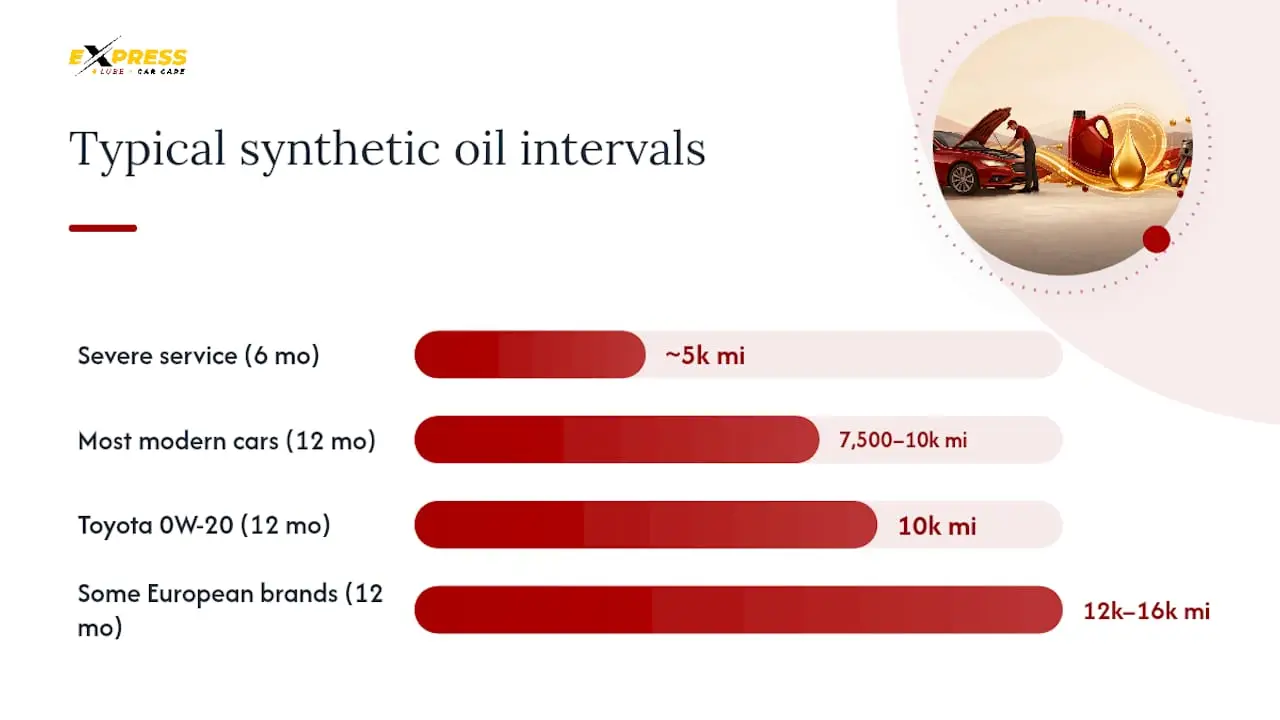
| Driving Type | Typical Interval | Time Limit |
|---|---|---|
| Normal (mostly highway) | 7,500–10,000 miles | 12 months |
| Extended/OEM-permitted | 12,000–16,000 miles | 12 months |
| Severe (short trips, towing, extremes) | ~5,000 miles | 6 months |
A few practical rules for U.S. drivers choosing between these ranges:
- If you do mostly highway miles with minimal idling, the 7,500–10,000 mile range is reasonable.
- If your OEM explicitly permits 12,000+ miles and you’re using the exact specified oil, that interval can be appropriate.
- If any severe-service trigger applies (see the next section), default to 5,000 miles or six months.
- Never skip the annual change just because the odometer hasn’t moved enough. Oil degrades over time even when the car sits.
For a deeper look at how oil type affects these numbers, the synthetic vs. conventional comparison at Expresslubearlington breaks down the trade-offs clearly.
Severe driving conditions that should shorten your interval
Most motorists drive under conditions that owner’s manuals classify as “average” or “severe.” That means most drivers should be defaulting to the shorter schedule, not the extended one.
Severe-service triggers your manual likely lists:
- Frequent short trips under ~4 miles — the engine never fully warms up, so moisture and fuel contamination build up in the oil.
- Towing or hauling heavy loads — higher engine temperatures accelerate additive breakdown.
- Prolonged idling or stop-and-go traffic — low-speed operation generates more soot and heat cycling.
- Dusty or off-road conditions — airborne particles bypass filters and contaminate oil faster.
- Extreme heat or cold — Texas summers and northern winters both stress oil chemistry.
If even one of these describes your regular driving, treat 5,000 miles or six months as your interval. A city commuter making multiple short daily runs fits the severe-service definition more often than not, even if the car never tows a trailer.
Signs your car needs an oil change sooner than scheduled
Your oil-change schedule is a maximum, not a guarantee. Sometimes the oil tells you it’s done before the interval arrives. Watch for these signals:
- Dark, thick, or gritty oil on the dipstick — fresh synthetic is amber and translucent; black and opaque means it’s working overtime.
- Burnt or acrid smell inside the cabin — oil that’s breaking down thermally produces a distinctive odor.
- Oil-change or check-engine warning light — don’t dismiss either one.
- Unusual engine knocking or ticking — low or degraded oil reduces the protective film between metal surfaces.
- Visible oil leaks under the car — a leak means the level is dropping, which compounds the problem.
If the dipstick shows oil that’s low between scheduled changes, top it off with the correct spec, but understand that topping off is not a substitute for a full drain-and-fill. Old oil with fresh oil mixed in is still old oil. Check the common mistakes drivers make skipping oil changes if you want the full picture on what deferred maintenance actually costs.
Can synthetic oil really last 20,000 miles or two years?
Short answer: for most consumer vehicles driven under real-world U.S. conditions, no. The marketing language around synthetic oil’s longevity is technically accurate in controlled lab conditions, but those conditions rarely match daily driving.
SAE driving tests found that service type, specifically freeway versus short-trip duty, influenced oil degradation more than whether the base oil was synthetic or mineral. Short-trip driving introduces moisture, fuel dilution, and soot that no synthetic additive package can fully resist. Once oil becomes saturated with those contaminants, the only fix is a change, regardless of what the bottle claims.
Stat to know: The Filter Manufacturers Council / Auto Care Association reports that roughly 80% of motorists drive under conditions classified as “average” or “severe” — meaning most drivers should not be banking on extended intervals.
Extended intervals can be reasonable when all of these apply:
- Your OEM explicitly validates that interval for your model and oil spec.
- Your driving is predominantly long highway miles with minimal idling.
- You’re using the exact oil the OEM specifies, with the correct API/ILSAC rating.
- You’re willing to use used-oil analysis to verify the oil is still within spec before extending further.
What happens when you push past the recommended interval
Skipping or stretching oil changes isn’t just a minor inconvenience. The mechanical consequences stack up fast.
- Additive depletion — anti-wear, detergent, and antioxidant additives exhaust themselves over time, leaving base oil with reduced protection.
- Sludge formation — oxidized oil thickens into a gel-like deposit that clogs oil passages and starves bearings.
- Varnish and deposits — high-temperature zones (piston rings, valve stems) accumulate hard carbon deposits that reduce engine efficiency.
- Fuel dilution and soot buildup — short-trip driving introduces these contaminants, and a clogged filter can no longer remove them.
- Increased wear — metal-on-metal contact accelerates once the protective film breaks down.
Beyond the mechanical risks, there’s a warranty angle. OEM maintenance schedules are tied to warranty coverage. Ignoring them can complicate or void claims. Keeping service receipts and digital inspection records is your paper trail. The 24-month/24,000-mile warranty at Expresslubearlington is one reason drivers in the DFW area keep their service records on file with the shop.
For a broader look at the repair costs that follow deferred maintenance, common car repair mistakes lays out the financial case clearly.
Practical service tips: oil grade, filters, and what to ask your technician
Every oil change is a chance to verify a few things that most drivers never think to check, including tips on how to properly maintain a clean engine bay: safe steps and ceramic protection.
At every oil change, confirm:
- The oil meets your OEM’s API/ILSAC specification and viscosity grade.
- The oil type matches your engine’s needs: full synthetic, synthetic blend, or high-mileage formula for vehicles over 75,000 miles.
- The filter is being replaced, not just the oil. A contaminated old filter reintroduces dirty oil into fresh oil within minutes of startup.
On filters specifically: insist on an OEM-equivalent quality filter. A cheap filter with a low-capacity media can bypass under cold-start conditions, defeating the purpose of a quality oil change. AAA research confirms that synthetic oils outperform conventional on lab wear metrics, but that advantage disappears if the filtration system isn’t keeping pace.
Keep every service receipt. If you ever need to make a warranty claim, that paper trail is your best defense.
Pro Tip: Before the technician closes out the job, ask them to show you the dipstick condition and confirm the filter part number. A shop that’s confident in its work will do this without hesitation.
A technician’s perspective on setting the right interval
When an ASE-certified technician at a shop like Expresslubearlington looks at an oil-change recommendation, the owner’s manual is the starting point, not the finish line. Visual oil condition, vehicle age, and a quick conversation about driving habits all feed into the final call.
A city commuter making five-mile round trips in Arlington traffic almost always fits the severe-service definition, even if the car is relatively new. A highway sales rep logging 1,500 miles a week on the interstate is a different story. For high-mileage vehicles over 100,000 miles, the conversation shifts toward high-mileage synthetic formulas and slightly shorter intervals to compensate for increased seal wear and blow-by.

Expresslubearlington’s technicians are ASE-certified and RepairPal-verified, which means the interval recommendation you get is grounded in training and real diagnostic data, not a upsell script. The shop’s digital vehicle inspections create a record you can reference at your next service, making it easier to spot trends before they become repairs.
Get your synthetic oil change done right in Arlington
Expresslubearlington is the straightforward answer for DFW drivers who want a synthetic oil change done to OEM spec without the guesswork. Every service uses oil that matches your manufacturer’s API/ILSAC requirements, a quality OEM-equivalent filter, and a digital inspection report you can keep for warranty purposes.
Fast turnaround, transparent pricing, and a 24-month/24,000-mile warranty back every oil change. The shop’s ASE and RepairPal certifications mean you’re getting technician-level expertise, not a quick-lube guess. There’s currently a $45 off mechanical repairs coupon available for qualifying services. Book your oil change service today and leave with a verified interval recommendation you can actually trust.
Sources
- 5 Things to Know About Oil Changes for Your Car – Consumer Reports
- How Often Should You Change Synthetic Oil? – Car and Driver
- Effects of trip length and oil type (synthetic versus mineral oil) on engine damage and engine-oil degradation – SAE Paper
- Automotive Oil Change Intervals Severe vs. Normal Driving – Filter Manufacturers Council / Auto Care Association
- Why do 10,000-mile oil changes exist? Valvoline explains – PickupTruckTalk (Valvoline industry perspective)
- What are the oil change intervals using synthetic oil? – Toyota Support
FAQ
How often do you really need to change synthetic oil?
For most U.S. drivers, every 7,500–10,000 miles or at least once a year is the practical rule, per Car and Driver. If your driving involves frequent short trips, towing, or stop-and-go traffic, shorten that to around 5,000 miles or every six months.
Can you really drive 10,000 miles on synthetic oil?
Yes, if your OEM explicitly validates that interval for your vehicle and you’re using the specified oil. Many modern vehicles, including certain Toyota models using 0W-20, list exactly that interval. The key is matching the oil spec and driving pattern the manufacturer tested against.
Can you go two years without changing synthetic oil?
Generally no. Even if mileage is low, oil degrades over time from moisture, oxidation, and contamination. The standard guidance is a minimum annual change regardless of miles driven, and most OEMs set a 12-month time limit alongside their mileage interval.
Can synthetic oil last 20,000 miles?
For most consumer vehicles under real-world U.S. driving conditions, no. SAE testing shows that short-trip and stop-and-go driving degrades oil faster than base oil chemistry can compensate for. Some specialty or fleet applications with verified long-highway duty cycles and used-oil analysis programs can approach extended intervals, but that’s not the typical car owner’s situation.