
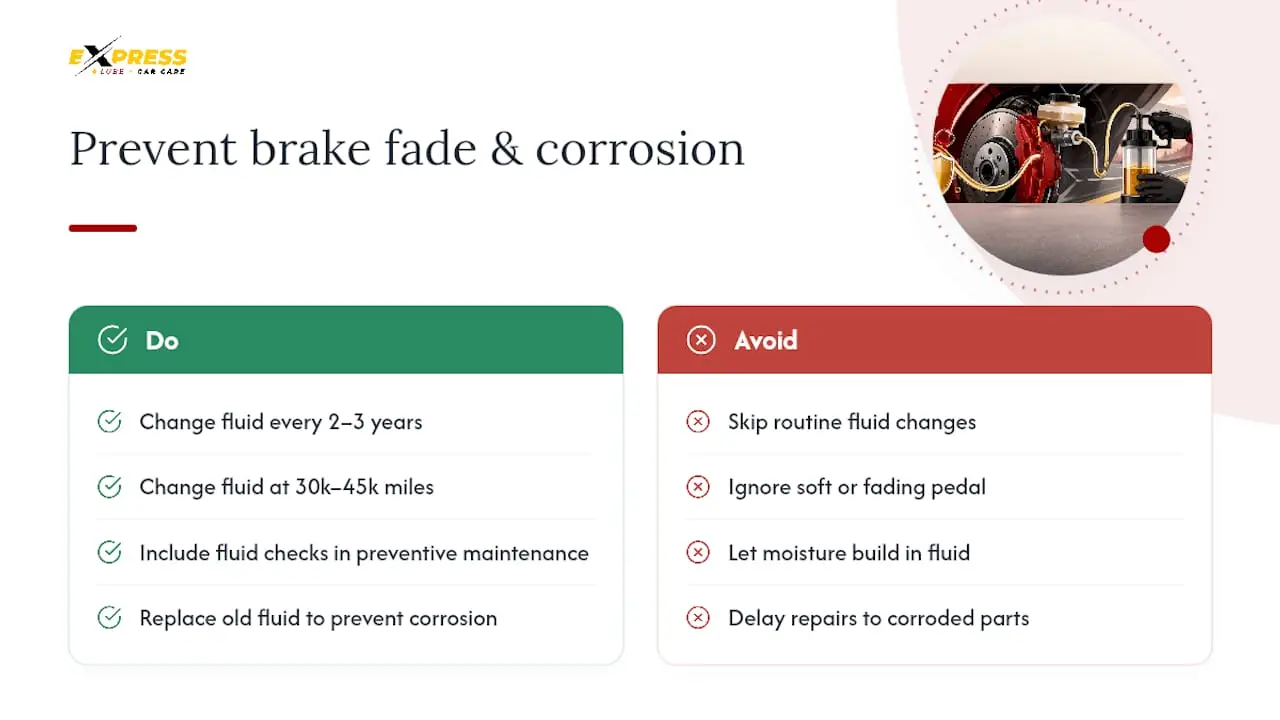
A brake fluid flush is a complete exchange of all hydraulic fluid in your braking system, restoring its boiling point and corrosion protection. Most drivers should schedule one every 2–3 years or roughly 30,000–45,000 miles, though a spongy pedal, dark fluid, or a failed moisture test can move that timeline up fast. Cost typically varies depending on your vehicle and what the shop includes. If you’re in the Arlington area and not sure where your fluid stands, Express Lube & Car Care can test it and tell you straight.
Quick stat: Common guidance recommends replacing brake fluid every 2–3 years for most passenger vehicles — yet many drivers go far longer without ever checking it.
Key Takeaways
A brake fluid flush is one of the most cost-effective safety services you can schedule, and the evidence to justify it is objective and testable.
| Point | Details |
|---|---|
| Flush vs. bleed | A flush replaces all hydraulic fluid; a bleed only removes air. Most modern vehicles need a flush, not just a bleed. |
| Service interval | Most vehicles need a brake fluid change every 2–3 years or 30,000–45,000 miles; moisture testing confirms the actual need. |
| Cost range | Expect $75–$205 for a typical passenger car; full-service shops with testing and documentation sit at the higher end. |
| DOT compatibility | Never mix silicone-based DOT 5 with glycol-based DOT 3, 4, or 5.1 — it can cause seal damage and brake failure. |
| Expresslubearlington | ASE-certified, RepairPal Certified, with powered flush equipment, pre/post testing, and a 24-month/24,000-mile warranty. |
Table of Contents
- What a brake fluid flush is and how it differs from bleeding
- Why a brake fluid flush matters for your safety
- How to tell if your car needs a flush: symptoms and objective tests
- What a professional brake fluid flush looks like step by step
- DOT brake fluid types and why mixing them is dangerous
- When should you schedule a brake fluid flush?
- How much does a brake fluid flush cost?
- Can you do a brake fluid flush yourself?
- Questions to ask before approving a brake fluid flush
- Why choose Express Lube & Car Care for a brake fluid flush
- Primary sources and further reading
- An honest take on brake fluid decisions
- Book a brake fluid flush at Express Lube & Car Care in Arlington
- Sources
- FAQ
What a brake fluid flush is and how it differs from bleeding
These two services get mixed up constantly, and the confusion can cost you. A flush and a bleed are not the same thing, and knowing the difference helps you understand what you’re actually paying for.
A brake fluid flush is a complete hydraulic fluid exchange. Fresh fluid is pushed through the entire system, from the master cylinder down through every caliper and wheel cylinder, until the old fluid is fully displaced. The goal is to replace degraded, moisture-laden fluid with fresh fluid that has a healthy boiling point.
A brake bleed is narrower in scope. Bleeding removes trapped air from the lines, which is what causes a spongy or low pedal after a brake repair. It doesn’t necessarily replace the fluid itself, and it won’t fix chemically degraded fluid that’s absorbed too much moisture.
Here’s a quick way to think about when you need which:
- Bleed only: Air got into the system during a caliper swap, line repair, or pad replacement. Fluid condition is still good.
- Flush only: Fluid is dark, moisture-contaminated, or past its service interval. No air in the system.
- Both: Fluid is degraded AND air was introduced during a recent repair.
Pro Tip: Modern ABS and ESC systems have modulator passages that trap old fluid in dead-end chambers. A simple gravity or manual bleed won’t reach those pockets. That’s why a professional flush using powered equipment — combined with modulator cycling — is the only way to ensure a complete exchange on ABS-equipped vehicles.
Why a brake fluid flush matters for your safety
Brake fluid is hygroscopic, meaning it actively absorbs moisture from the air over time. That sounds like a minor chemistry detail, but the real-world consequence is significant: as moisture content rises, the fluid’s boiling point drops. Under hard braking, overheated fluid can vaporize and create gas bubbles in the lines. Gas compresses; fluid doesn’t. The result is a pedal that suddenly goes soft exactly when you need it most. That’s brake fade, and it’s a documented safety risk that a routine fluid change prevents.
Beyond fade, old fluid corrodes. The internal components of your braking system, including the ABS modulator, master cylinder, and calipers, are made of metals and rubber seals that degrade when exposed to acidic, moisture-laden fluid. Replacing an ABS modulator can run several hundred dollars or more. A brake fluid change costs a fraction of that and protects every one of those components.
Stat to know: Interval guidance commonly points to 2–3 years or 30,000–45,000 miles as the threshold before moisture absorption meaningfully degrades fluid performance.
Pro Tip: Think of brake fluid maintenance as part of your broader preventive car maintenance strategy. Catching degraded fluid early is far cheaper than replacing the components it destroys.
How to tell if your car needs a flush: symptoms and objective tests
Your car usually gives you signals before a brake problem becomes a brake failure. Here’s what to watch for.
Observable symptoms:
- Spongy or soft pedal: The pedal travels further than usual before the brakes engage. Air or vapor in the lines is the likely cause.
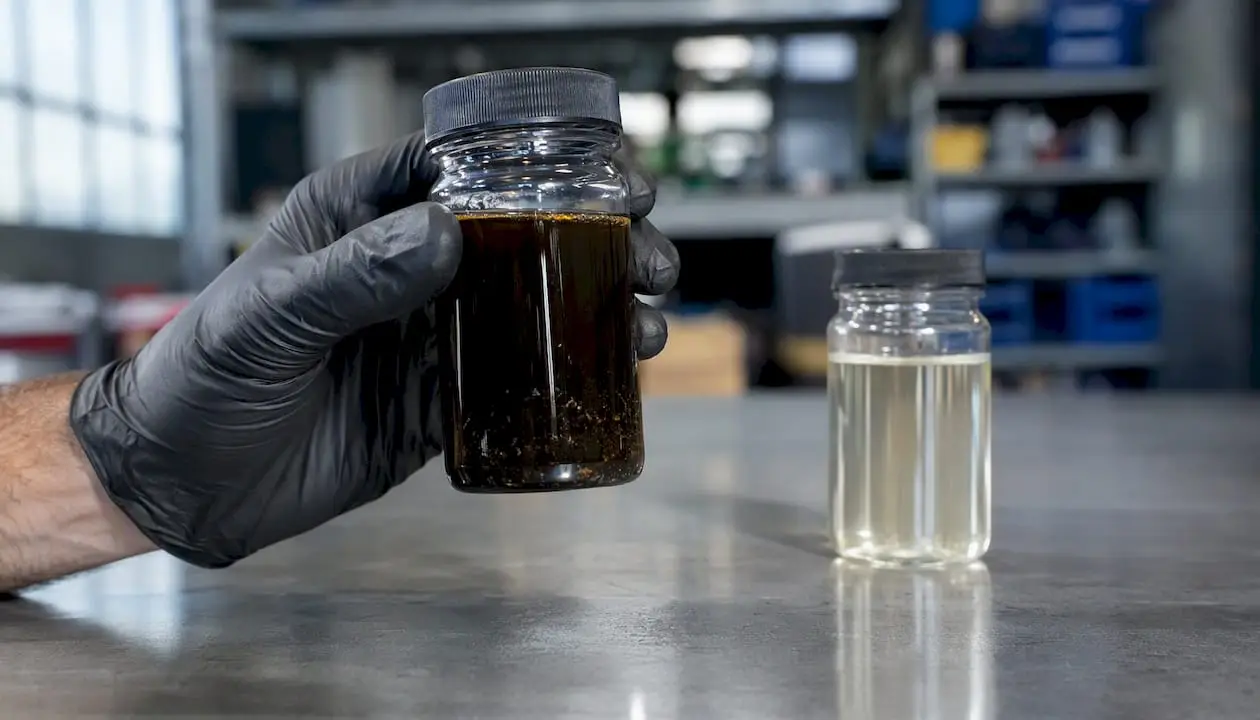
- Dark or murky reservoir fluid: Healthy fluid is clear to light amber. Tea-colored or cola-dark fluid has absorbed significant moisture and contaminants.
- Burnt or chemical odor: A sharp smell near the wheels after driving, especially on hills, can indicate overheated, degraded fluid.
- ABS or ESC warning lights: These systems depend on clean, properly pressurized fluid. Contaminated fluid can trigger fault codes.
- Longer stopping distances: If your car takes noticeably more distance to stop, degraded fluid may be part of the problem.
Objective tests a shop can run:
- BrakeStrip copper test: Copper ions leach into brake fluid as internal components corrode. A BrakeStrip test strip measures copper content and gives an objective, documented result.
- Moisture-content tester: Electronic testers measure the percentage of water in the fluid directly. Above a manufacturer’s threshold, replacement is warranted.
- Visual reservoir documentation: A good shop photographs the reservoir before and after service so you have proof of condition.
At home, you can do a quick visual check through the reservoir cap without opening it. If the fluid looks dark, that’s your signal to get it tested. Avoid removing the reservoir cap unnecessarily, though. Every time it comes off, moisture-laden air gets in.
Pro Tip: Ask the shop to show you the BrakeStrip result or moisture-test reading before approving any service. A shop that can’t produce a test result for a brake inspection recommendation is asking you to take their word for it.
| Symptom | What it suggests |
|---|---|
| Spongy pedal | Air or vapor in lines; possible degraded fluid |
| Dark/murky fluid | Moisture contamination; flush likely needed |
| Burnt odor after braking | Fluid overheating; boiling point compromised |
| ABS/ESC warning light | System fault; fluid condition may be a factor |
| Longer stopping distance | Reduced hydraulic performance |
What a professional brake fluid flush looks like step by step
Knowing what happens during a professional service helps you read the invoice and ask the right questions. Here’s the typical workflow at a competent shop.
The professional flush sequence:
- Pre-service fluid test: The technician tests the existing fluid with a BrakeStrip or moisture tester and photographs the reservoir. This is the baseline.
- Reservoir drain: Old fluid is removed from the master cylinder reservoir.
- Powered flush or pressure exchange: A powered flushing machine or pressure-bleeding system forces fresh fluid through the hydraulic circuit. This is what separates a professional flush from a DIY top-off.
- Corner sequence: Each wheel is bled in the manufacturer’s recommended sequence (typically starting farthest from the master cylinder) until clean fluid runs through.
- ABS/modulator cycling: For ABS-equipped vehicles, the technician cycles the modulator to push fluid through dead-end passages that gravity bleeding can’t reach. Reverse Fluid Injection is one method that improves displacement in complex modulator geometries.
- Reservoir monitoring: Throughout the process, the reservoir is kept topped up so the system never runs dry. Running it dry introduces air and can require master-cylinder bench-bleeding.
- Post-service fluid test: A second BrakeStrip or moisture test confirms the new fluid is clean.
- Pedal firmness check: The technician verifies pedal feel before the vehicle moves.
- Road test: A short drive confirms brake response under real conditions.
Equipment that makes the difference:
- Powered flushing machines (pressure or vacuum exchange)
- Reverse Fluid Injection tools for ABS modulator passages
- BrakeStrip test strips or electronic moisture testers
- Documented pre/post photos
Pro Tip: If a shop skips the pre-service test and the post-service road test, ask why. Both are standard practice at shops following SAE J1707 maintenance guidance for brake fluid service.
DOT brake fluid types and why mixing them is dangerous
Not all brake fluid is the same, and using the wrong type, or mixing types, can damage seals and cause brake failure. Here’s what the DOT ratings actually mean.
The critical rule: DOT 3, DOT 4, and DOT 5.1 are all glycol-based and are generally compatible with each other (though you should always use the grade your manufacturer specifies or higher). DOT 5 is silicone-based and is chemically incompatible with all three.
Key rules to follow:
- Check your reservoir cap or owner’s manual for the required DOT rating before any service.
- Never mix DOT 5 with DOT 3, DOT 4, or DOT 5.1. The two chemistries don’t play well together.
- Using a lower-rated fluid than specified reduces your system’s boiling point protection.
- Some AWD and specialized drivetrain systems have additional fluid considerations. Owners of Haldex-equipped vehicles, for example, should review Haldex-specific flushing guidance before service.
Warning: Mixing silicone-based DOT 5 with any glycol-based fluid (DOT 3, 4, or 5.1) can cause seal swelling, fluid separation, and brake system failure. Using the correct DOT-rated fluid is not optional — it’s a safety requirement.
When should you schedule a brake fluid flush?
The short answer: follow your manufacturer’s schedule, and let a moisture or copper test make the final call.
Most manufacturers and service advisors recommend a brake fluid change every 2–3 years or roughly 30,000–45,000 miles, whichever comes first. But driving conditions matter as much as the calendar. Humidity accelerates moisture absorption. Hard, repeated braking heats the fluid faster. Mountain driving and track use push fluid to its limits in ways that normal commuting never does.
Special-case triggers that should move up your timeline:
- Heavy towing or trailer hauling (repeated high-heat braking cycles)
- Mountain or canyon driving (sustained downhill braking)
- Track days or performance driving events
- Unknown service history on a used vehicle
- Visually dark or murky fluid in the reservoir
- A failed BrakeStrip copper test or moisture reading above threshold
- ABS or ESC warning lights with no other obvious cause
Pro Tip: Don’t just accept a flush recommendation based on mileage alone. Ask the shop to show you a fluid condition test result. If the fluid tests clean and you’re not in a special-case category, you may have more time. If it fails, you have documented proof the service is warranted.
How much does a brake fluid flush cost?
Pricing varies more than most drivers expect. Kelley Blue Book reports that brake fluid flush costs commonly vary widely for a typical passenger car, with the spread driven by several factors.
What drives the price up or down:
- DOT fluid grade: DOT 5.1 costs more than DOT 3. Performance vehicles requiring specific fluids add to material cost.
- ABS/modulator complexity: Cycling the modulator and using powered equipment takes more time.
- Vehicle type: Luxury and performance vehicles often have more complex hydraulic systems.
- Labor rates: Vary by region and shop certification level.
- Repairs discovered: If the tech finds a leaking caliper or corroded line during the flush, that’s a separate repair cost.
- Documentation and testing: Shops that include pre/post BrakeStrip tests and photos may charge slightly more, but that documentation is worth it.
What to ask for on the invoice: fluid type and DOT rating used, quantity, pre/post test results or photos, labor time, warranty coverage, and confirmation of a road test. If any of those are missing, ask before you sign.
Can you do a brake fluid flush yourself?
Technically, yes. Practically, it depends on your vehicle and your comfort level with brake system work.
What a competent DIYer needs:
- Correct DOT fluid (match your reservoir cap or owner’s manual exactly)
- A vacuum bleeder kit or a helper to pump the pedal
- Clear tubing, a catch bottle, and a wrench for bleeder screws
- Patience to follow the correct corner sequence
- A plan for proper fluid disposal (more on that below)
Numbered steps for a basic DIY corner bleed:
- Confirm the correct DOT fluid for your vehicle.
- Clean around the reservoir cap before opening it to avoid contaminating the system.
- Remove old fluid from the reservoir with a turkey baster or fluid pump.
- Refill with fresh fluid and keep it topped up throughout the process.
- Starting at the wheel farthest from the master cylinder, attach tubing to the bleeder screw and open it.
- Have a helper press the pedal slowly (or use a vacuum bleeder) until clean fluid runs through.
- Close the bleeder screw before the pedal is released to avoid drawing air back in.
- Repeat at each wheel in sequence, checking the reservoir level constantly.
- Verify pedal firmness before driving.
Where DIY gets risky:
- Running the reservoir dry introduces air and can require master-cylinder bench-bleeding, a much bigger job.
- ABS modulator passages are not reachable with a basic gravity or manual bleed. Without powered equipment and modulator cycling, old fluid stays trapped.
- Choosing the wrong DOT fluid or accidentally mixing types can damage seals.
- Contamination from dirty tools or an open reservoir can introduce moisture immediately.
DIY makes reasonable sense for a simple corner bleed after a caliper swap on a non-ABS vehicle where the fluid is otherwise in good shape. For a full system flush on a modern ABS-equipped car, or any vehicle with an unknown fluid history, a professional with powered equipment is the safer call.
Pro Tip: Used brake fluid is hazardous waste. Never pour it down a drain or into the trash. Most auto parts stores and municipal recycling centers accept it for free. Wear nitrile gloves, and keep fluid off painted surfaces — it strips paint fast.
Questions to ask before approving a brake fluid flush
A shop recommending a flush should be able to back it up with evidence. Here’s your checklist.
Essential questions to ask:
- Was the fluid tested? With what tool?
- What was the test result that justifies the flush?
- Which DOT fluid will you use, and does it match my manufacturer’s spec?
- Do you cycle the ABS modulator during the flush?
- Can I see the pre-service test result and a photo of the reservoir?
- Will you provide a post-service test result to confirm the new fluid is clean?
- Is this service covered by a warranty?
Red flags to watch for:
- No test result, just “it’s been a while” as the justification
- Vague answers about which fluid they’ll use
- No mention of ABS modulator cycling on a modern vehicle
- High-pressure upsell without any documentation
- Invoice that lists “brake flush” with no fluid type, quantity, or test data
What a good invoice looks like:
- DOT fluid type and quantity used
- Pre/post test values or photos
- Labor time
- Warranty wording (look for at least 12 months or 12,000 miles)
- Road-test confirmation
Pro Tip: Industry guidance is clear: a flush recommendation should be based on a scheduled interval, a moisture or copper test result, or a documented drivability issue. Ask for that evidence before approving the service. A trustworthy shop will have it ready.
Why choose Express Lube & Car Care for a brake fluid flush
If you want the service done right, the credentials matter. Expresslubearlington’s ASE-certified technicians follow a test-first approach: they check your fluid condition with a BrakeStrip or moisture tester before recommending a flush, document the result, and give you a clear reason for every service they suggest.
What you get at Express Lube & Car Care:
- ASE-certified technicians on every job
- RepairPal Certified Shop status and CarFax Top-Rated Service Center recognition
- Powered flush equipment with ABS modulator cycling capability
- Pre/post fluid testing with documented results
- Road-test verification before your vehicle leaves the bay
- 24-month/24,000-mile warranty on covered services
Expresslubearlington serves drivers across the DFW area and treats every brake service as a safety job, not a line item. The benefits of working with a trusted local mechanic go beyond the service itself: you get transparency, documentation, and a shop that stands behind its work.
Pro Tip: Bring your vehicle in for a fluid condition check even if you’re not sure a flush is needed yet. A quick BrakeStrip test takes minutes and gives you a data-backed answer rather than a guess.
Primary sources and further reading
These are the sources used to build this article’s recommendations. Your owner’s manual remains the final authority on fluid type and service intervals for your specific vehicle.
- RepairPal: Brake Bleed vs. Brake Flush — Explains the distinction between bleeding and flushing, and what professional equipment accomplishes.
- Phoenix Systems: Brake Bleeding vs. Brake Flushing — Covers Reverse Fluid Injection and why ABS modulator passages require more than a manual bleed.
- How-To Geek: Brake Fluid Flush Isn’t Just an Upsell — Consumer-focused explanation of hygroscopic fluid properties, brake fade, and when flushing is genuinely necessary.
- SAE J1707: Brake Fluid Service and Maintenance — The industry standard covering safe handling, dispensing, and maintenance procedures for SAE J1703/J1704 brake fluids.
- Kelley Blue Book: Brake Fluid Flush Costs — Consumer cost reference for evaluating shop quotes.
- AutoMedic Mobile: Brake Fluid Change Interval — Practical interval guidance and rationale for the 2–3 year/30,000–45,000-mile recommendation.
An honest take on brake fluid decisions
Most drivers skip the brake fluid flush because it’s invisible. The pedal still works, the car still stops, and nothing is obviously wrong. That’s exactly what makes it easy to defer, and exactly why it’s worth paying attention to.
The shops that earn long-term trust are the ones that test first and recommend second. A BrakeStrip result or moisture reading takes two minutes and turns a vague “your fluid looks old” into a documented, defensible reason to act. That’s the standard Expresslubearlington holds itself to: no flush without evidence, no invoice without documentation, and no vehicle leaving the bay without a road test confirming the pedal is firm.
If your fluid hasn’t been checked in two or more years, or you just bought a used vehicle and have no service history, that’s the moment to get it looked at. Not because something is wrong, but because you deserve to know either way.
Book a brake fluid flush at Express Lube & Car Care in Arlington
Expresslubearlington gives Arlington-area drivers something most shops don’t: a documented, test-backed brake fluid service with a warranty that actually means something. You’ll know your fluid’s condition before the service starts, and you’ll have proof it’s clean when you leave.
Right now, you can save with a $45 off mechanical repair coupon toward your brake fluid flush or any qualifying repair. Every service includes pre/post fluid testing, powered flush equipment, ABS modulator cycling, and a 24-month/24,000-mile warranty. Our ASE-certified technicians will walk you through the test results and answer every question before touching your vehicle. Stop by or schedule your appointment online today.
Sources
- Brake Bleed vs. Brake Flush: Which Is the Right Choice? — RepairPal
- Brake Bleed vs. Brake Flush: Which Is the Right Choice? — Phoenix Systems
- Brake fluid flush isn’t just an upsell — How-To Geek
- SAE J1707: Service and maintenance of SAE J1703 and J1704 brake fluids — SAE
- Brake Fluid Change Interval: When to Flush Your Brake Fluid — AutoMedic Mobile
FAQ
Is a brake fluid flush really necessary?
Yes, for most vehicles. Brake fluid absorbs moisture over time, which lowers its boiling point and increases corrosion risk inside the hydraulic system. Skipping the service can lead to brake fade and expensive component failures.
How often should brake fluid be flushed?
Most vehicles benefit from a brake fluid change every 2–3 years or roughly 30,000–45,000 miles, though your owner’s manual and a moisture or copper test are the most reliable guides for your specific car.
Can I do a brake fluid flush myself?
A basic corner bleed after a simple repair is manageable for a confident DIYer with the right tools and the correct DOT fluid. A full system flush on an ABS-equipped vehicle is harder to complete properly without powered equipment and modulator cycling, so a professional is usually the better choice.
What are the signs I need a brake fluid flush?
Watch for a spongy or soft pedal, dark or murky fluid in the reservoir, a burnt odor after braking, ABS or ESC warning lights, or noticeably longer stopping distances. Any of these symptoms warrants a brake problem check and a fluid condition test.