

When your AC clutch not engaging leaves you sweating through Texas heat, the culprit is usually one of a few cheap fixes: a blown fuse, a bad relay, low refrigerant tripping the pressure cutout, or a weak coil. Check the fuse first, listen for a click when you flip the AC on, then confirm 12 volts at the clutch connector. If refrigerant handling comes up, that’s your cue to stop and call a shop.
TL;DR:
- Checking and replacing the fuse and relay are quick, inexpensive first steps, especially if the relay click or fuse filament is visibly damaged.
- Electrical faults, such as low voltage, bad coils, or wiring issues, cause most clutch engagement problems and are the easiest to diagnose with multimeters.
- Low refrigerant levels activate pressure switches that prevent clutch engagement, making leak detection and proper charging critical before attempting repairs.
- Mechanical issues like excessive air gap between the clutch plate and pulley, worn friction surfaces, or internal bearing wear often require more advanced checks and possible component replacement.
- Serious faults like a seized compressor or internal damage warrant professional diagnosis, especially when electrical and refrigerant tests show no issues.
Table of Contents
- Why Is My AC Clutch Not Working? Start Here
- How Do You Test the AC Clutch Relay and Electrical Circuit?
- Could Low Refrigerant Be Blocking Engagement?
- Is It a Mechanical Clutch Problem, Not Electrical?
- Step-by-Step DIY Fixes You Can Try Safely
- When Should You Stop DIY and Call a Shop?
- A Technician’s Take on Smart AC Diagnostics
- Book Your AC Diagnostic With Express Lube & Car Care
- Sources
- FAQ
Why Is My AC Clutch Not Working? Start Here
Before you grab a wrench, understand what the clutch is actually doing. It’s an electromagnetic switch bolted to the front of your compressor. When the AC controls send power to the clutch coil, it creates a magnetic field that pulls the clutch plate against the spinning pulley, locking the compressor shaft to the engine’s belt system. No power, no magnetism, no engagement, no cold air. Simple in theory, but the chain of components that has to work correctly before that coil ever sees voltage is longer than most drivers realize: fuse, relay, low pressure switch, sometimes a high pressure switch, the ECM or HVAC control module, and the wiring connecting all of them.
That’s why an AC compressor won’t engage for reasons that have nothing to do with the compressor itself most of the time. The fix is almost never “replace the compressor” as a first move. It’s a process of elimination, cheapest and easiest checks first.
- Pull the AC compressor clutch fuse and inspect it for a broken filament, then swap in an identical relay from another circuit to rule out a sticking or dead relay.
- Turn the AC on max and listen closely near the compressor. A healthy clutch makes an audible click and the center plate should visibly stop spinning freely against the pulley.
- With the AC still on, backprobe the clutch connector with a multimeter set to DC volts. You want to see power reaching the plug.
- If you’ve got 12 volts at the connector but nothing happens, move to a resistance check on the coil itself.
- No voltage at all means the problem is upstream. Trace back through the relay, the pressure switches, and the wiring harness.
- If everything electrical checks out but you suspect low charge, that’s when a manifold gauge set (or a trip to the shop) tells the real story.
Pro Tip: Keep a notepad or your phone handy while you test. Jot down every reading (voltage, resistance, whether the relay clicked) so you’re not repeating tests later or, worse, walking into a shop unable to answer the technician’s first question.
How Do You Test the AC Clutch Relay and Electrical Circuit?
Electrical faults cause the majority of AC compressor engagement issues, and they’re the fastest, cheapest things to rule out. Start with the fuse box diagram under your hood or in your owner’s manual to find the AC compressor clutch fuse. A fuse that’s visibly blown (broken metal strip, discolored glass) is often the whole story. If it blows again immediately after replacement, you’ve got a short somewhere in the circuit, and that’s a wiring problem, not a fuse problem.
Relay problems are the next most common cause. Automotive relays fail internally in ways you can’t always see. The fix is a straightforward swap test:
- Find another relay in the fuse box with the identical part number and amperage rating.
- Swap it into the AC clutch relay socket.
- Turn the AC on and listen for the compressor click.
- If it engages now, your original relay was bad.
Diagnostics like this, working outward from the simplest components toward the compressor itself, is the approach Dorman’s technical diagnostic guide recommends, and it’s also why a systematic fuse to coil test sequence tends to isolate the fault fast rather than sending you chasing the compressor first.
Once fuse and relay are cleared, check voltage at the clutch connector. With the AC on and the connector backprobed, you should read roughly 11 to 14 volts. Anything meaningfully lower points to a weak battery, a corroded ground, or voltage drop somewhere in the harness.
If voltage is present but the clutch still won’t engage, kill the engine and measure coil resistance across the connector terminals with your multimeter set to ohms. Most clutch coils read within a small resistance range typical for the model. A reading of infinite resistance means an open coil. A very low reading suggests an internal short. Either result means the coil needs replacement.
Don’t skip ground checks. A corroded or loose ground strap can starve the coil of current even when your voltmeter shows decent voltage under no load. Voltage-drop testing (measuring the difference between battery negative and the clutch’s ground point while the circuit is energized) catches this. Anything over roughly half a volt of drop signals a bad connection worth cleaning or replacing.
Pro Tip: If you want to bench-test the clutch coil directly, use a fused jumper lead, never a bare wire or paperclip, and limit the test to a few seconds. Unprotected direct-power tests can fry sensitive electronics if something downstream shorts, and the coil draws enough current that an unfused connection is asking for trouble.
Could Low Refrigerant Be Blocking Engagement?
Low refrigerant is one of the most common reasons an AC clutch won’t engage, and it’s mechanical, not electrical. Every AC system has a low pressure cutout switch wired into the clutch circuit specifically to prevent the compressor from running dry. If refrigerant has leaked out, that switch opens the circuit and cuts power to the clutch before you ever hear a click.
This is exactly why low refrigerant preventing clutch engagement shows up so often in real-world diagnostics, and it also explains a symptom that confuses a lot of DIYers: intermittent engagement that seems to track the weather. Static refrigerant pressure rises and falls with ambient temperature, so a system that’s borderline low might trip the cutout on a hot afternoon but engage fine in the morning.
A manifold gauge set tells you where you stand. With the engine off, static pressure on both the high and low side should roughly match ambient temperature charts for your refrigerant type. With the engine running and AC on, you’re looking for pressures within the system’s normal operating range, not a full charging procedure, just enough to confirm whether you’re low.
- Static pressure reading well below spec for the ambient temperature usually means a leak, not just normal loss over time.
- UV dye (added during a prior service) glowing under a blacklight pinpoints the leak location.
- An electronic refrigerant sniffer detects leaks without dye, useful if the system wasn’t dyed beforehand.
- Bubbles or oily residue at fittings and hose connections are visual leak clues worth checking before you reach for gauges at all.
Here’s the part that trips up a lot of otherwise careful DIYers: topping off refrigerant without finding and fixing the leak first only buys you a few weeks of cold air before you’re back to square one, and running a system low for extended periods risks compressor damage from inadequate lubrication. Refrigerant is also federally regulated. It should never be vented to the atmosphere, and recovery, evacuation, and recharging are best left to a certified shop with the right recovery equipment. If your AC isn’t blowing cold and gauges confirm a low charge, that’s your signal to book a leak inspection rather than DIY a recharge.
Is It a Mechanical Clutch Problem, Not Electrical?
If your electrical tests all check out (fuse good, relay good, 12 volts at the connector, coil resistance in range) but the clutch still won’t grab, you’re likely looking at a mechanical issue: the air gap.
The air gap is the small space between the clutch plate and the pulley face when the system is off. When the coil energizes, magnetism pulls that plate across the gap to lock onto the pulley. If the gap is too wide, either from worn friction material or age, the magnetic pull isn’t strong enough to close it, even with perfect electrical signal.
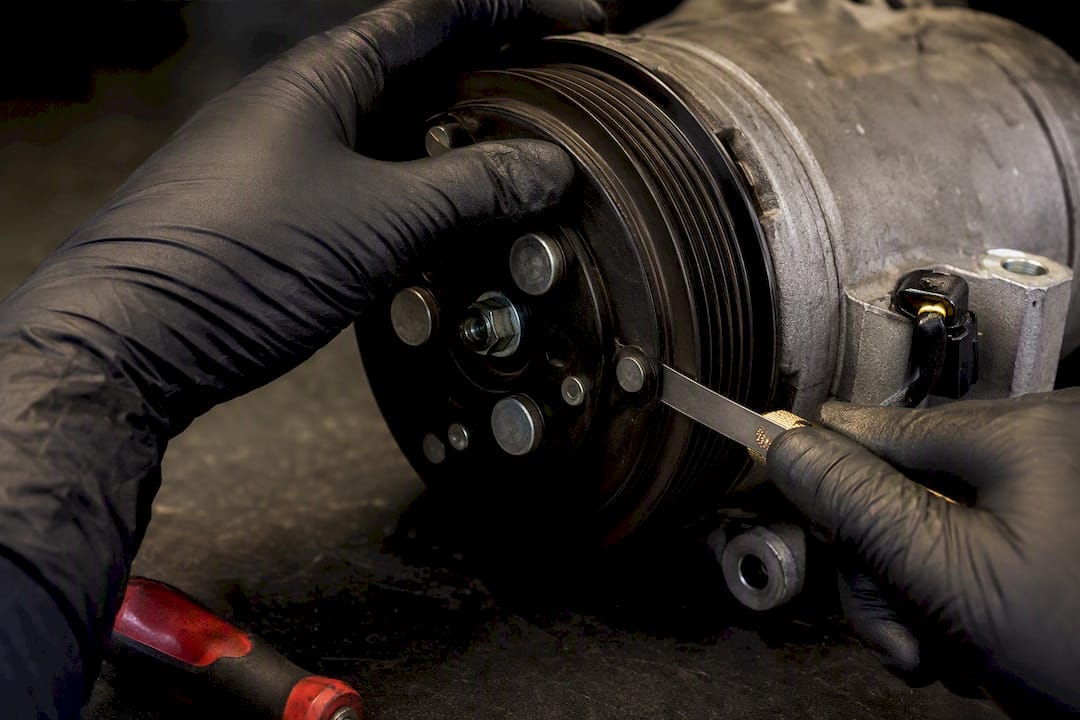
The tap test is the standard way to confirm this. With the AC on and the coil energized, gently tap the center of the clutch plate with a screwdriver handle or similar tool. If you hear a distinct click or feel the plate shift when you tap it, the coil is energized but the gap is too wide to close on its own, meaning a shim adjustment might solve the problem.
While you’re in there, check the surrounding hardware:
- Spin the pulley by hand (engine off, belt removed if needed) and feel for roughness, grinding, or play in the pulley bearing.
- Inspect the serpentine belt for glazing, cracking, or fraying, since a worn belt can slip under compressor load even when the clutch itself is fine.
- Look at the clutch plate’s friction surface for scoring, glazing, or a blackened, burnt appearance, which points to slippage damage from repeated partial engagement.
- Wiggle the compressor shaft slightly to check for excess play, a sign of internal bearing wear that goes beyond a simple clutch fix.
Measuring the actual air gap with a feeler gauge and removing a shim to correct it is a job within reach of a patient DIYer with the right tools. But a worn pulley bearing, a scored friction surface, or damaged bearing surfaces inside the compressor itself aren’t shim adjustments. That’s clutch assembly or full compressor replacement territory, and it’s worth reading up on signs your AC compressor is failing before you decide how far to take the repair yourself.
Step-by-Step DIY Fixes You Can Try Safely
Once you’ve narrowed the fault down, several fixes are genuinely within reach of a home garage.
- Replace the fuse. Pull the old one, drop in an exact-amperage replacement, and run the AC. If it blows again right away, stop. That’s a short in the wiring, not a fuse issue, and it needs tracing before you burn through more fuses.
- Swap the relay. Match part number and amp rating exactly. Using a relay rated for a different circuit can cause erratic behavior or fail to protect the wiring properly.
- Test and replace the coil. If resistance readings show an open or shorted coil, replacement doesn’t require evacuating the refrigerant system on most vehicles since the coil sits outside the sealed system. You’ll need a socket set, possibly a clutch holding tool, and the correct replacement coil for your compressor model.
- Adjust the air gap with a shim. After confirming a wide gap with the tap test, removing a shim from behind the clutch plate is an effective minor repair, but it demands the right tools: a clutch holding tool to keep the pulley from spinning, sometimes a puller to remove the center hub, and careful attention when reinstalling the snap ring. A snap ring seated wrong can lead to catastrophic pulley failure down the road.
Pro Tip: Before disconnecting anything electrical, disconnect the negative battery terminal. It’s a thirty-second step that prevents accidental shorts, protects the ECM from voltage spikes, and it’s standard practice on any pre-repair safety checklist.
When Should You Stop DIY and Call a Shop?
There’s a hard line between smart troubleshooting and risky improvisation, and it’s worth knowing where it sits. Bypassing the low pressure switch to “force” the clutch to engage might seem like a shortcut, but running a compressor with insufficient refrigerant starves it of the oil that circulates with the refrigerant for lubrication. That’s how a low-charge problem turns into a seized compressor, a far more expensive repair than the leak you were avoiding.
A few situations call for professional diagnosis rather than another round of testing:
- You’ve confirmed low pressure but can’t locate the leak with basic tools.
- Coil resistance is out of range and the replacement part isn’t straightforward to source or install on your compressor model.
- The pulley bearing feels rough or the compressor shaft has noticeable play.
- You’ve done every electrical check and still can’t isolate the fault.
Repair costs for AC clutch issues vary widely by vehicle and by what’s actually wrong, from a simple relay or fuse swap on the low end to full compressor and clutch assembly replacement on the high end. Get a local quote once you know what’s failed rather than guessing at a number, since parts availability and labor time swing the total significantly.
When you do bring it in, bring your notes. Voltage readings at the connector, coil resistance numbers, whether the relay swap changed anything, and static gauge pressure if you checked it all help our ASE-certified technicians skip straight to confirmation testing instead of starting from zero. Combined with a digital vehicle inspection, that prior legwork often shaves real time off the diagnostic process.
A Technician’s Take on Smart AC Diagnostics
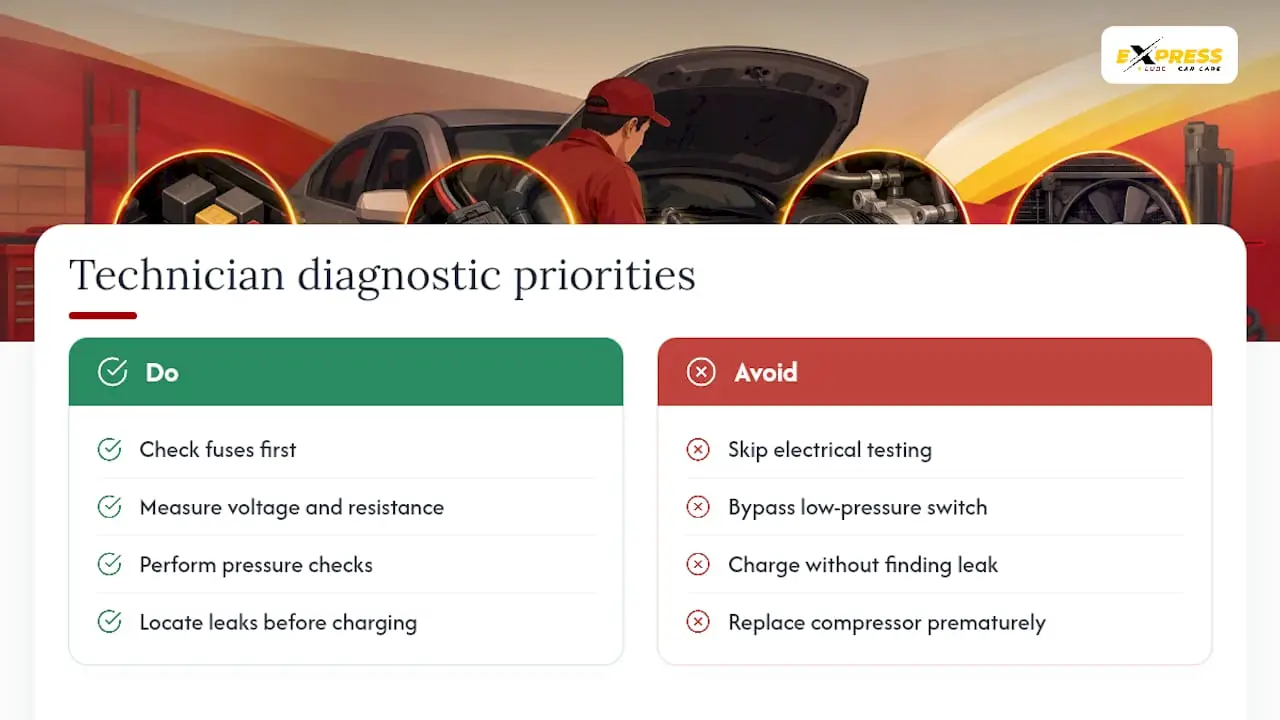
Working electrical-first isn’t just cheaper for you, it’s how a shop avoids replacing parts that were never broken. A fuse costs pennies. A compressor doesn’t. Skipping straight to “replace the compressor” without confirming voltage and resistance first is how good money gets spent on the wrong fix.
Pressure checks exist to protect the compressor from itself. Bypassing a low pressure switch to force engagement, or charging a system without finding the leak, treats a symptom while the real problem keeps getting worse underneath.
Book Your AC Diagnostic With Express Lube & Car Care
If you’ve worked through the fuse, the relay, and the voltage checks and you’re still stuck, it’s time for a professional look. Express Lube & Car Care’s ASE-certified technicians run a full digital vehicle inspection alongside AC diagnostics, so you get a documented, photo-backed picture of exactly what’s happening under the hood instead of a guess.

Bring whatever readings you gathered. Fuse and relay results, voltage at the connector, coil resistance, gauge pressures if you checked them. That information lets our team confirm the fault fast instead of repeating tests you’ve already run. Whether it turns out to be a simple relay or a leak that needs proper detection equipment, our A/C repair service covers the diagnosis and the fix. Right now you can also put a $45 off mechanical repair coupon toward the job. Schedule your AC diagnostic appointment today and get your cold air back before the next Texas heat wave hits.
Sources
For readers who want to go deeper on procedure: Dorman’s AC compressor fault guide covers electrical test sequencing and safe jumper use, while R & Y A/C Compressors’ troubleshooting breakdown details the relay-swap method in more depth.
- AC compressor fault — Shop Press (Dorman) — ‘AC compressor fault’ technical diagnostic
- AC Compressor Clutch Not Engaging: 6 Causes and How to Fix Them – R & Y A/C Compressors®
- Why won’t my car’s AC clutch engage and how to fix it? – MR.FAST
FAQ
How Do You Force an AC Clutch to Engage?
Using a fused jumper lead to briefly apply 12 volts directly to the clutch connector can confirm the coil works, but this is a diagnostic-only test lasting a few seconds, never a permanent fix, and it should never be done by bypassing a low pressure switch.
What Stops an AC Clutch From Engaging?
The most common causes are a blown fuse, a failed relay, low refrigerant tripping the low pressure cutout switch, a bad clutch coil, or an air gap that’s too wide for the magnetic field to close.
How Can You Tell if Your AC Clutch Is Bad?
A bad clutch typically won’t click when the AC is switched on, the pulley spins freely without the center plate locking to it, or the tap test shows the coil energizing without the plate actually grabbing.
How Much Does It Cost to Fix an AC Clutch?
Costs vary widely depending on whether the fix is a fuse, relay, coil, or full clutch assembly, so getting a local quote after diagnosis at a shop like Express Lube & Car Care gives you the most accurate number for your vehicle.