
A loud clunk over bumps, loose or wandering steering, and uneven edge wear on your front tires are the clearest ball joint failure symptoms a driver can catch early. If you notice severe play, a tilted wheel, or a heavy clunk under load, stop driving and get the vehicle towed. Anything milder still calls for a professional inspection soon.
TL;DR:
- Severe wheel play, tilted tires, or loud clunks under load require immediate towing and professional inspection to prevent wheel collapse or loss of control.
- Early symptoms like clunking noises over bumps and uneven tire wear often indicate a worn ball joint, especially if accompanied by steering looseness or vibrations at highway speeds.
- Visual signs such as torn dust boots, grease leaks, or rust around the joint, along with manual checks like wheel-rock and pry tests, help confirm ball joint failure before driving becomes unsafe.
- Most modern ball joints are sealed and non-serviceable, making replacement necessary once they wear out, with a four-wheel alignment vital to avoid uneven tire wear afterward.
- DIY checks are possible but risky; professional inspection, especially for severe symptoms, ensures safety and proper repair, including pairing ball joint replacement with an alignment.
Table of Contents
- Recognizing Ball Joint Failure Symptoms: Sounds, Feel, and Tires
- How Do You Check for a Bad Ball Joint at Home?
- What Causes Ball Joints to Wear Out and Fail?
- Is It Safe to Drive With a Bad Ball Joint?
- What Does Ball Joint Replacement and Alignment Involve?
- What Should You Tell Your Mechanic About the Symptoms?
- What Technicians Check First
- Get Your Suspension Inspected
- Sources
- FAQ
Recognizing Ball Joint Failure Symptoms: Sounds, Feel, and Tires
Your car talks to you before a ball joint actually lets go. The trick is learning which noise or feeling points to this specific part instead of your brakes, tie rods, or a bad alignment.
Audible noises are usually the first tip-off. A clunk or pop over bumps, potholes, or during low-speed turns is a textbook sign of bad ball joint symptoms, especially when it’s paired with a faint squeak from a dry, worn socket. That noise happens because a loose joint lets suspension parts shift and knock against each other under load, something a healthy joint simply won’t allow.
Steering problems show up differently than a clunk. Wandering, a pull to one side, or a spongy, loose feel in the wheel points to play building up inside the joint. That’s a useful clue for telling this apart from tie rod trouble, since clunking over bumps is the more common ball joint signature, while tie rod wear tends to cause vague, wandering steering with less of an early clunk.
Vibration or shimmy in the steering wheel or through the floor, especially one that intensifies at highway speeds or during braking, often means a joint has enough wear to let the wheel move where it shouldn’t.
Worn ball joints also throw off the wheel’s camber angle under load, which chews up tires unevenly:
- Feathering or scalloping across the tread
- Excess wear on the inside or outside edge of one tire compared to its pair
- Cupping patterns that weren’t there a few months ago
Pro Tip: Run your hand across the tire tread, inside edge to outside. If one side feels noticeably more worn than the other on the same tire, that’s often suspension wear talking, not just an old alignment.
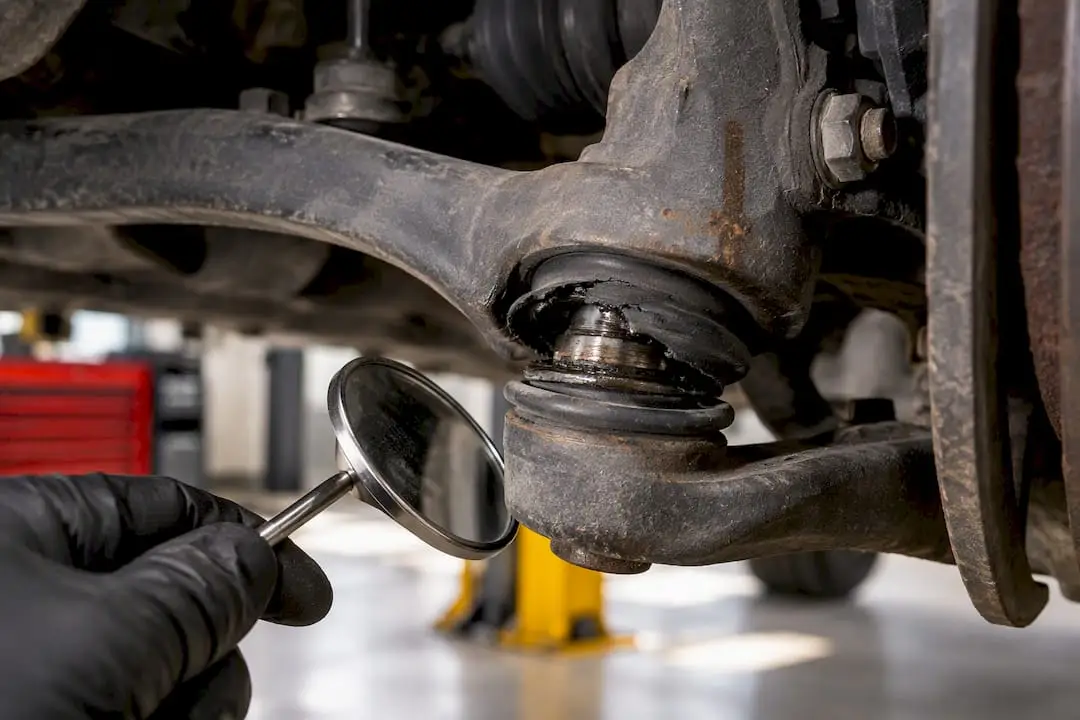
Pop the wheel off or peer through the wheel opening and look at the dust boot. A torn boot, grease slung around the wheel well, or rust streaking down from the joint housing are visible confessions that the part is failing from the inside out.
How Do You Check for a Bad Ball Joint at Home?
You don’t need a lift to get a solid read on ball joint condition. A few careful checks, done in the right order, will usually confirm what your ears and steering wheel are already telling you.
- Drive test first. At low speed in an empty lot, turn the wheel gently side to side and listen for clunks. Note whether the noise happens over bumps, during turns, or under braking.
- Chock and jack safely. Chock the wheels that stay on the ground, then raise the vehicle and support it on jack stands rated for the job. Never rely on a jack alone.
- Wheel-rock test. Grip the tire at the top and bottom (12 and 6 o’clock) and rock it in and out. Excess movement points to worn upper or lower ball joints, depending on your suspension type.
- Screwdriver pry test. With the wheel off the ground, wedge a screwdriver between the control arm and the steering knuckle near the joint and pry gently. Movement you can see or feel here confirms play in the joint.
- Visual boot check. Look for a torn or missing dust boot, grease residue, or rust around the socket housing.
These same wheel-rock and pry checks are standard screening tests mechanics use, but they only work safely with the car properly supported.
Pro Tip: If you don’t have jack stands rated for your vehicle’s weight, or you’re not confident doing this under the car, skip the DIY route entirely and have it towed in. A ball joint failure while you’re underneath is not a risk worth taking.
What Causes Ball Joints to Wear Out and Fail?
Most ball joint failures trace back to one root problem: loss of lubrication. Once the protective boot fails, the joint starts to die from the inside.
- A torn or cracked dust boot lets grease escape and dirt get in, and that grease loss quickly leads to contamination and metal-on-metal wear inside the joint.
- Road salt, moisture, and years of grit accelerate corrosion at the socket, especially on higher-mileage vehicles.
- Hard impacts, potholes, curb hits, and consistently heavy loads put extra stress on the joint and shorten its life.
- Serviceable joints with grease fittings can be maintained with regular lubrication, but most modern ball joints are sealed, non-serviceable units that simply get replaced once they wear out.
Is It Safe to Drive With a Bad Ball Joint?
A ball joint that fails completely can let the wheel collapse outward or detach entirely, causing sudden loss of steering control. If you notice severe play, a wheel that looks tilted, or a heavy clunk under load, stop driving and arrange a tow rather than risk it. Mild, occasional noise with no looseness might get you to a shop at a slow, careful pace, but that’s a judgment call best made with a technician’s input, not a guess.
What Does Ball Joint Replacement and Alignment Involve?
Replacement scope depends on your vehicle. Some cars use a press-in joint that a shop presses out of the control arm and replaces on its own. Others are built with the ball joint integrated into the control arm, so the whole assembly gets swapped. Older or heavy-duty trucks sometimes still use a serviceable joint with a grease fitting, though that’s increasingly rare.
Whatever the method, a few things stay consistent:
- A four-wheel alignment afterward isn’t optional. Skipping it after a ball joint replacement often causes rapid, uneven tire wear and unsettled handling, even when the mechanical repair itself was done correctly.
- Shops often recommend replacing joints in pairs to keep wear and alignment balanced across the front end.
- DIY replacement gets tricky fast. Pressing a joint in or out calls for specialized tools and precise torque specs, and getting either wrong can undo the repair or create a new safety issue.
What Should You Tell Your Mechanic About the Symptoms?
The more specific you can be, the faster a shop can confirm what’s wrong. Before you go in, gather a few details:
- Exactly what you hear or feel, and when it happens (over bumps, during turns, at certain speeds).
- Any recent pothole hits, curb strikes, or off-road driving that might have caused impact damage.
- A short video or audio clip of the noise, if you can safely capture one while someone else drives.
Once you’re at the shop, ask the technician to check both sides of the front end, not just the side making noise, and to document findings with photos or video before starting work. If a joint gets replaced, confirm a four-wheel alignment is included, and ask for a clear, itemized estimate along with any written warranty information on the repair.
What Technicians Check First
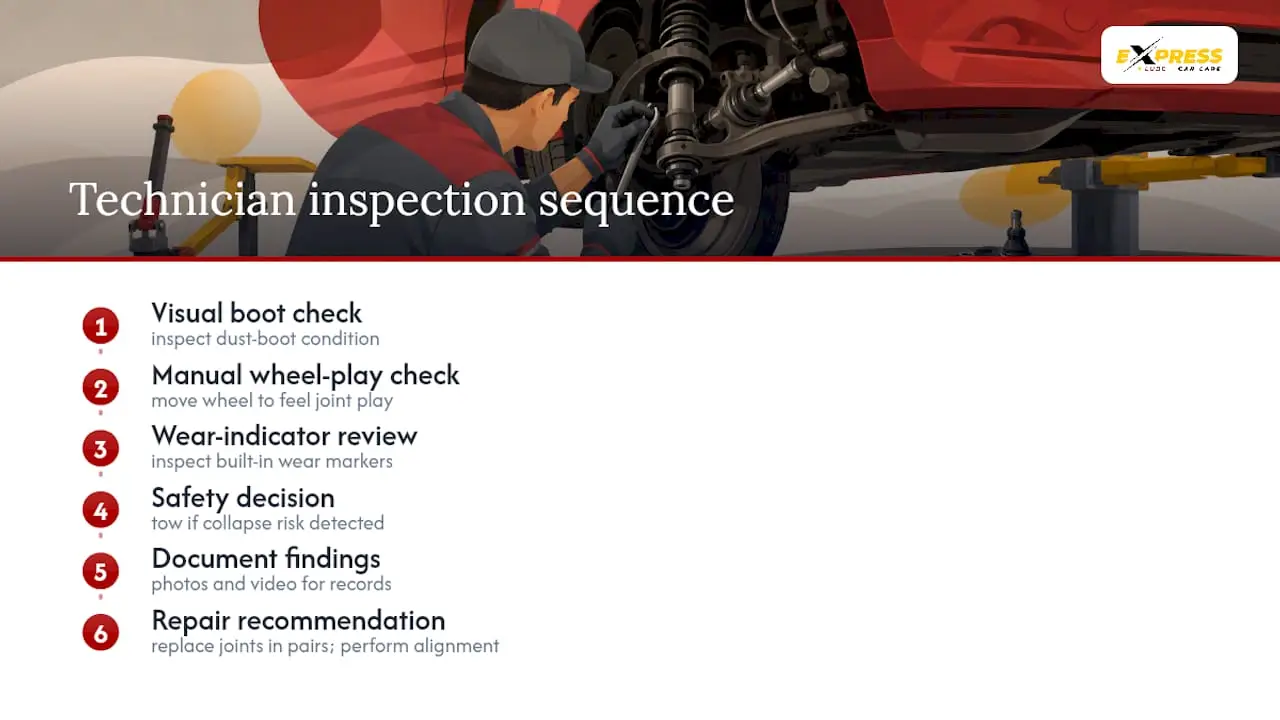
When a suspension complaint comes in, the approach starts simple: visual boot check, manual play checks at the wheel, and a look at wear indicators before anything else. If there’s any hint of collapse risk, towing takes priority over driving it in. Every finding is documented with photos and video, and it is typical to recommend replacing worn joints in pairs along with a proper alignment.
Get Your Suspension Inspected
If any of the symptoms above sound familiar, waiting it out isn’t the move. Suspension inspections and ball joint replacement by certified technicians, backed by digital vehicle inspections that include photos and video, can help you see exactly what’s worn before you approve any work.

Every inspection gets documented clearly, and if a joint needs replacing, the repair is paired with the alignment work it requires to keep tires wearing evenly and steering settled. That kind of transparency helps avoid prolonged guessing about noises. Head to the services page to see the full range of suspension and repair work handled, and book an appointment as soon as you notice clunking, steering play, or uneven tire wear. Catching it early usually means a simpler, less expensive fix.
Sources
- Carparts
- Here’s Why Your Ball Joint Failed – The Drive
- Symptoms of Bad Ball Joints – MOOG Technical
- Loose Steering or Clunking Noises? Tie Rod and Ball Joint Problems Explained | Snell Automotive
FAQ
Can I Still Drive With a Bad Ball Joint?
It depends on severity. Mild noise without looseness might allow a slow, careful drive to the nearest shop, but severe play, wheel tilt, or a loud clunk under load means you should stop driving and arrange a tow instead of risking sudden wheel collapse.
What Can Be Mistaken for a Bad Ball Joint?
Worn tie rods, sway bar links, or strut mounts can all produce similar clunks or steering looseness. The distinguishing clue is that ball joint problems tend to clunk over bumps first, while tie rod wear usually shows up as vague, wandering steering with less of an early knock.
Is Replacing Ball Joints a Big Job?
It’s a moderate repair that varies by vehicle. Some cars need only the joint pressed out and replaced, while others require swapping the entire control arm assembly, and a four-wheel alignment afterward is required to prevent rapid tire wear.
How Expensive Is It to Replace Ball Joints?
Costs vary by vehicle, parts needed, and whether an alignment is included, so there’s no single fair number to quote here. Express Lube & Car Care can provide a specific, itemized estimate once a technician has inspected your vehicle, which you can request through the services page.
Does a Noisy Suspension Always Mean a Ball Joint Problem?
Not always. Squeaks and clunks can also come from worn brake hardware or loose components elsewhere in the suspension, so it helps to rule out related issues like the ones covered in this brake noise diagnostic guide before assuming it’s the ball joint.