

Short answer: if your vehicle came from the factory with Dex-Cool, the safest choice is a coolant that meets the same specification your owner’s manual lists. A bottle labeled “universal” may work in some cars, but nobody has proven it works in all of them, and the carmakers who have spoken on it say so plainly. Mixing it into a system that holds Dex-Cool is where the real trouble starts.
That’s the quick version. Below we walk through what the labels mean, why color won’t settle the question, what happens when coolants get mixed, and how to find the right one for your car. If you’re in Arlington and would rather have a technician handle it, we’ll get to that too.
TL;DR
- GM advises using Dex-Cool only in vehicles that were factory-equipped with it, and not switching those vehicles to conventional green coolant.
- “Universal” is a marketing label, not a guarantee. Ford states that no single universal coolant has been verified as safe for all applications.
- Color is a dye, not a standard. Read the specification on the label and match it to your owner’s manual.
- Mixing coolant types can shorten coolant life and reduce corrosion protection. A proper drain, rinse and refill is the fix.
- When in doubt, have the cooling system tested before you add anything. A guess can cost far more than the jug.
Table of Contents
- What is Dex-Cool, and what makes a coolant “universal”?
- Orange vs. green coolant: does color tell you anything?
- OAT, HOAT and IAT: what the letters mean
- Can you use universal coolant in a car that calls for Dex-Cool?
- What happens if you mix them or use the wrong one?
- How to choose the right antifreeze for your car
- Our perspective: match the spec, then test before you replace
- Flush and fill: when to hand it to a pro
- Cooling system service in Arlington
- Schedule your coolant check in North Arlington
- FAQ
- Sources
What is Dex-Cool, and what makes a coolant “universal”?
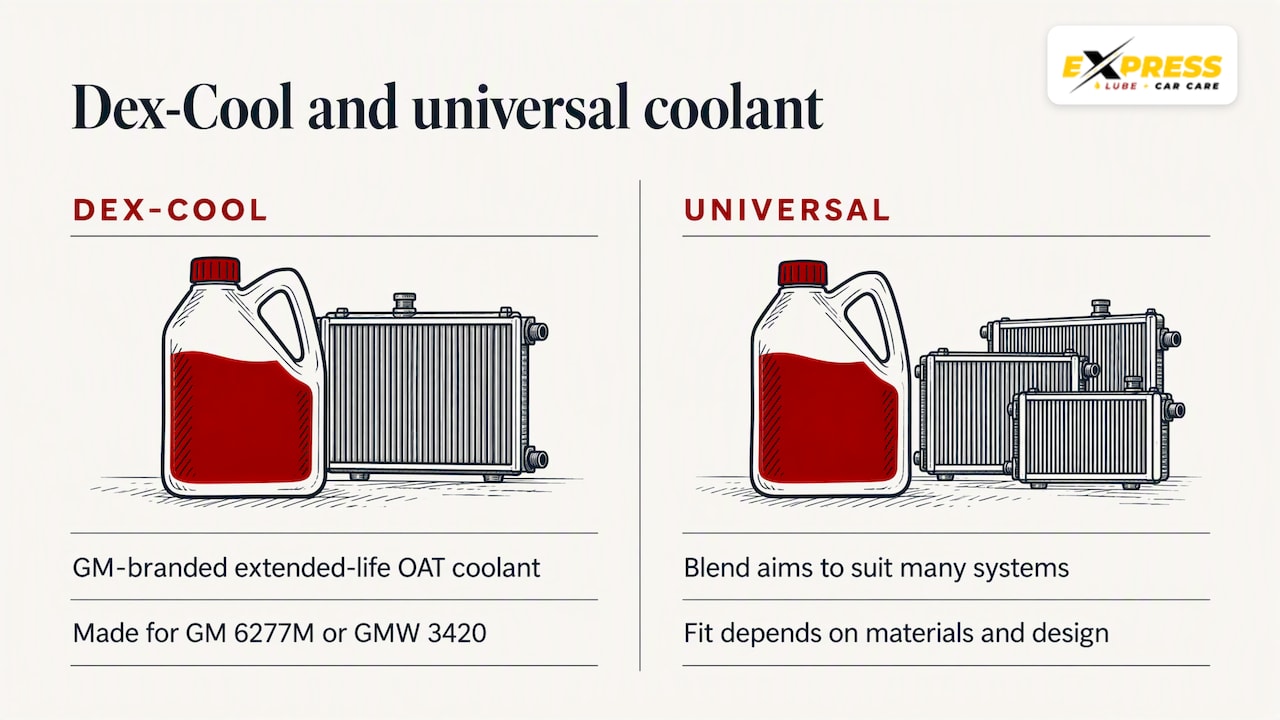
Dex-Cool is General Motors’ branded extended-life coolant. It is an OAT coolant, short for Organic Acid Technology. A manufacturer’s product data sheet describes a Dex-Cool-compatible formula as a full OAT coolant made for vehicles requiring GM 6277M or GMW 3420. Those numbers are GM specifications, and they matter more than the word “orange” on the jug.
A “universal” or “all makes, all models” coolant is a blend that aims to be acceptable across many systems. The idea is convenient: one jug on the shelf, one answer for every driver. The catch is that cooling systems are not all alike. Gates, a company that makes cooling system components, explains that compatibility depends on the materials inside the cooling system and the additive technology the vehicle was designed around. A coolant that suits one engine’s gaskets, metals and water pump seals isn’t automatically right for another.
You’ll see plenty of forum threads where someone says they switched to universal years ago and never had a problem. That can be true. It’s also one car, one driver, and no way of knowing what the inside of the engine looks like. The carmaker’s engineers tested the specified coolant against the materials in that exact system. That’s the difference between “it worked for me” and “it was designed for this.”
Orange vs. green coolant: does color tell you anything?
This is the question most drivers type in, and the honest answer is: a little, but not enough to trust.
Green is the classic. The Petroleum Quality Institute of America notes that green coolant is commonly used for IAT formulas, but there are no industry standards defining the color for each type. Manufacturers use different dyes for different chemistries, and one brand’s yellow can be another brand’s something else entirely. The same source says to check the product label and make sure it meets your vehicle manufacturer’s recommendation.
Think of coolant color like the color of a pill. It might hint at what’s inside, but you wouldn’t take it on that basis alone. Here’s how it plays out in real garages:
- Orange in the reservoir often means Dex-Cool or a similar OAT coolant, but not always. Someone may have topped it off with whatever was on sale.
- Green in a GM car that originally had Dex-Cool suggests someone swapped types at some point, which is worth checking before you add more fluid.
- A muddy brown or rusty look means something has gone wrong, regardless of the original color. That’s a job for a technician, not another jug.
So don’t buy by color. Buy by specification, and confirm it against your manual.
OAT, HOAT and IAT: what the letters mean
The acronyms look intimidating, but the idea is simple. Each describes the type of corrosion inhibitors in the coolant. Gates lays it out this way: IAT uses inorganic additives such as silicates, OAT uses organic acids and is silicate-free, and HOAT combines organic acids with inorganic additives. Gates also says manufacturers choose a coolant technology for the specific materials and design of each cooling system.
| Type | What it means | Typical use |
|---|---|---|
| IAT | Inorganic Acid Technology, the traditional green antifreeze | Older vehicles designed around it |
| OAT | Organic Acid Technology, silicate-free, longer-lasting | Many newer engines with more aluminum, including Dex-Cool applications |
| HOAT | Hybrid: organic acids plus some inorganic additives | Vehicles whose maker specifies a hybrid formula |
AutoZone’s consumer guide describes IAT as the traditional green antifreeze, with OAT developed as a longer-lasting option for engines that use more aluminum. That fits the broad picture: as engines changed, coolant chemistry changed with them.
Here’s the part that trips people up. Both OAT and HOAT can be called “long life,” and both can be dyed several colors. So “OAT vs. HOAT” isn’t a question of which is better. It’s a question of which one your engine was designed for. GM advises against switching a Dex-Cool vehicle to conventional green coolant or a hybrid OAT coolant containing silicates. A Ford, a Honda or a Volkswagen may call for something else entirely.
Can you use universal coolant in a car that calls for Dex-Cool?
Here’s the straight answer, with the reasoning behind it.
If your manual calls for Dex-Cool or a GM 6277M/GMW 3420 coolant, use a coolant that states it meets that specification. GM’s guidance, as reported by Brake & Front End, is to use Dex-Cool only if the vehicle was originally equipped with it, and not to move those vehicles to a conventional green or silicate-containing hybrid. The same report notes that GM has said coolants labeled “Dex-Cool compatible” may put the cooling system warranty at risk if GM has not officially licensed them. That’s a 2006 report, so check current GM guidance for your model year, but it shows how seriously the maker takes the distinction.
Ford takes an even firmer line. In its position statement, Ford says it does not recommend universal coolants, because they haven’t been proven to work in all vehicles and may not meet Ford’s requirements for silicates and nitrites. Because of the diversity of cooling system technologies, Ford says no single universal coolant has been verified as safe for every application.
What about those forum posts saying it’s fine in a pinch? Two honest points:
- Topping off in an emergency is not the same as a long-term plan. If you’re stranded with a low reservoir, adding the right 50/50 mix, or even clean water to get to a shop, is better than overheating. Just have the system corrected soon after.
- Older vehicles are a different story. A 1990s car designed for traditional green coolant isn’t a Dex-Cool question at all. The rule is the same, though: match the original specification.
The rule of thumb we give customers: the cheapest coolant is the one you only buy once. If a universal jug saves you a few dollars now and shortens the life of the coolant or the water pump, you haven’t saved anything.

What happens if you mix them or use the wrong one?
Mixing is the real risk, and it’s more common than you’d think. A previous owner tops off with green. A quick-lube bay adds whatever is on the shelf. A DIY flush leaves old fluid in the block.
The chemistry issue is straightforward. Arteco Coolants explains that mixing coolants can upset the balance of the additive package, which can cause instability, pH changes and reduced corrosion protection. Arteco also points out that additives deplete at different rates depending on the technology, so even mixing within the same class can cause unintended reactions. AutoZone’s guide adds that mixing OAT antifreeze with other coolant types is generally not recommended by vehicle manufacturers.
The numbers GM has put on it
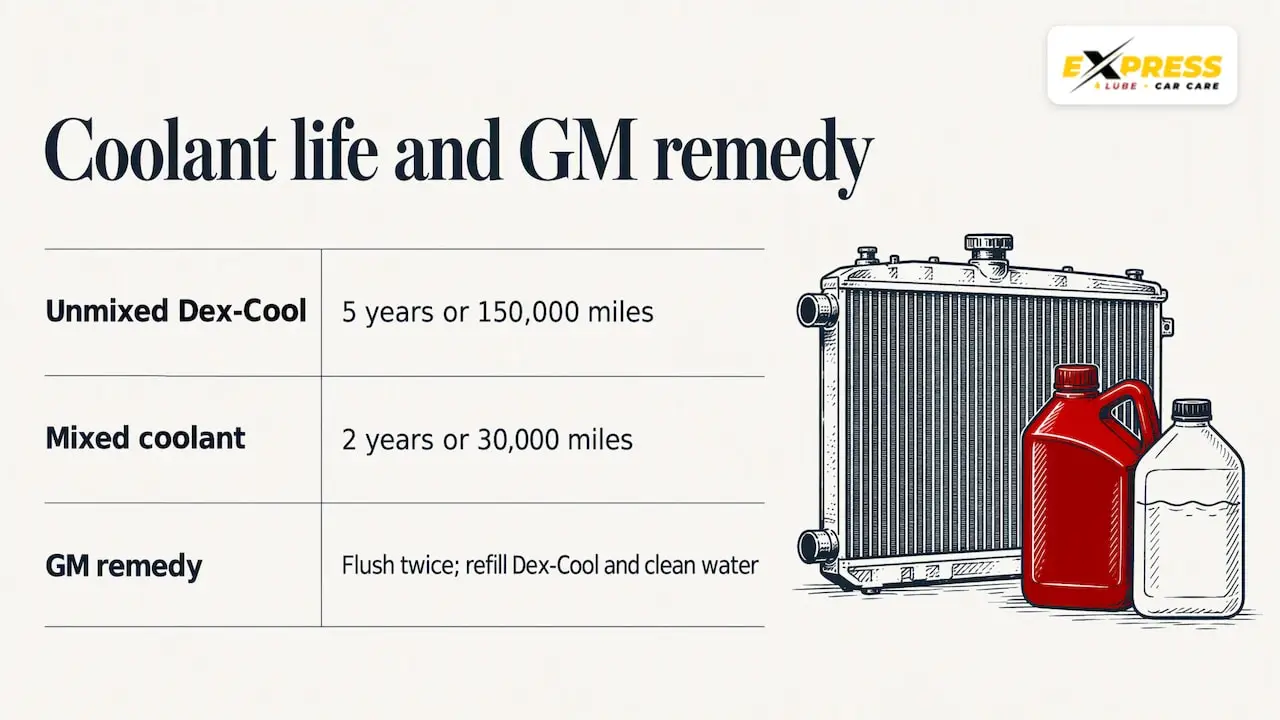
Brake & Front End reports that mixing conventional green coolant into Dex-Cool cuts coolant life from five years or 150,000 miles down to two years or 30,000 miles, unless the contaminated coolant is removed. GM’s stated fix is to flush the system twice and refill with Dex-Cool and clean water.
What the damage looks like
Ford’s position statement warns that non-approved universal coolants may lead to long-term engine damage such as corrosion, cylinder wall cavitation or plugged coolant passages. Ford also notes that using non-approved coolant doesn’t automatically void a new vehicle limited warranty, but damage that results from it isn’t covered.
In practical terms, here’s what you might notice before things get serious:
- Coolant that looks cloudy, gelled, sludgy or rusty
- A temperature gauge that creeps up in traffic on I-30 or Highway 360
- A heater that blows lukewarm
- A coolant smell, drips under the car, or a reservoir that keeps dropping
None of these automatically means you used the wrong coolant. A failing radiator cap, a leaking hose or a weak water pump can look the same. That’s why we recommend a proper pressure test and inspection before replacing parts. If your temperature gauge is climbing, our guide on what to do about engine overheating walks through the triage.
If you’ve already mixed them
Don’t panic, and don’t keep topping off. Arteco’s guidance for contamination or switching is to fully drain the system and rinse it several times with inhibited water. A simple drain-and-fill from the radiator petcock leaves a lot of old fluid in the engine block, heater core and hoses, which is why a thorough exchange is the better route.
How to choose the right antifreeze for your car
People search for the “best antifreeze for my car,” but there’s no single best. There’s the correct one for your vehicle. Here’s how to find it, in order of reliability:
- Check the owner’s manual. The coolant type and specification are listed in the maintenance or fluids section. AutoZone’s guide says to choose the coolant recommended in your owner’s manual or use a lookup by make and model.
- Use the carmaker’s own reference. Ford’s U.S. support page tells owners to use the Chemical and Lubricants Quick Reference Charts, find the vehicle year and model, and read the chart notes. Other makers publish similar guidance.
- Match the specification on the bottle. Look for the exact standard, such as GM 6277M or GMW 3420 for Dex-Cool applications, or the Ford, Honda, Toyota or European specification named in your manual. Ignore front-label claims like “fits all.”
- Check the mix. Ask for a 50/50 blend with clean water unless the product is sold pre-mixed. Strength matters, and GM recommends a coolant refractometer rather than a simple hydrometer to accurately check the strength of coolant mixtures.
How often should coolant be replaced?
Don’t rely on a universal number. AutoZone’s guide says manufacturers generally recommend full replacement every three to five years or 100,000 to 150,000 miles, depending on the model. That’s a wide range, which is exactly why your manual’s schedule beats any rule of thumb. We break down how coolant fits into the bigger picture in our fluid replacement schedule and our page on coolant flush intervals.
Texas heat is hard on cooling systems. Stop-and-go traffic on Brown Boulevard in July is a better stress test than any lab. Good coolant at the right strength, along with sound hoses, a good cap and a working fan, is what keeps the gauge steady.
Our perspective: match the spec, then test before you replace
We see this question at the counter more than you’d expect, and it usually starts the same way. A driver topped off with what was handy, or a previous shop used a different jug, and now they’re not sure what’s in there.
Our view is simple. First, the manual is the boss. If it says Dex-Cool or a GM-specified OAT coolant, we treat that as the requirement, not a suggestion. Second, “universal” isn’t a dirty word, but it isn’t a free pass either. We’d rather confirm that a product states the specification your vehicle calls for than rely on a front-label promise. Third, coolant problems rarely stand alone. A temperature spike might be the coolant, or a thermostat, a water pump, a radiator cap or a leak. Our ASE-certified technicians recommend proper diagnostics before parts get replaced, and our digital vehicle inspections include photos and videos so you can see what we see.
We also don’t believe in selling a flush you don’t need. If your coolant is the right type, at the right strength, and in good condition, the answer may be “leave it alone for now.”
— Express Lube & Car Care
Flush and fill: when to hand it to a pro
A coolant swap looks easy on video. In practice, the details are where it goes wrong: air pockets that cause overheating, old fluid left in the block, a hot system under pressure, and disposal. Used coolant is toxic to pets and wildlife, so it can’t just go down a driveway drain.
DIY is reasonable if you have the right specification, distilled or properly inhibited water, a cold engine and a plan for the old fluid. A pro makes more sense when:
- You don’t know what’s currently in the system, or suspect it’s mixed
- The coolant looks rusty, oily or sludgy
- You’re also replacing a water pump, thermostat or radiator
- The car has overheated before
One tip that helps either way: keep the engine bay reasonably clean. It’s much easier to spot a seep or a crusty coolant trail on clean hoses and fittings, and here are some safe engine bay cleaning steps that won’t soak electrical connectors. Then check the reservoir level when the engine is cold, not hot.
Cooling system service in Arlington
At Express Lube & Car Care, we’re a full-service shop, not just an oil change stop. Our radiator and cooling system service covers inspection, fluid exchange and repairs, and our fluid exchange services page explains how we handle coolant along with other vehicle fluids. Every job is done by ASE-certified technicians, and most services are completed the same day. Qualifying repairs are backed by a 24-month/24,000-mile warranty. You can see the full list on our services page or start at our home page.
Schedule your coolant check in North Arlington
Not sure whether you have Dex-Cool, green coolant or a mix of both? Bring the car in and we’ll check the coolant condition and type, test the system, and tell you what it needs, including if that’s nothing. Whether you commute along I-30, run Highway 360 every day, or drive Brown Boulevard to work, a cooling problem is the last thing you want on the road.
Schedule service online or call us at (682) 248-3416. You’ll find us at 2105 Brown Blvd, Arlington, TX 76006.
FAQ
Is universal coolant OK for Dex-Cool?
Not as a default. GM advises using Dex-Cool only in vehicles that came with it, and Ford says no universal coolant has been verified as safe in every application. If you’re unsure, match the specification in your owner’s manual rather than the word “universal.”
What happens if you use universal coolant?
In the right system, it may work fine. In the wrong one, a mismatch in additives can reduce corrosion protection and shorten coolant life. Ford warns that non-approved coolants can lead to long-term engine damage, including corrosion and plugged coolant passages.
Is Dex-Cool really necessary?
If your vehicle was factory-equipped with it, yes, you should use Dex-Cool or a coolant that meets the same GM specification (GMW 3420 or 6277M). The chemistry was matched to your engine’s materials. For vehicles designed around other coolant types, Dex-Cool isn’t the answer, so check the manual.
Can you replace Dex-Cool with regular coolant?
GM advises against switching a Dex-Cool vehicle to conventional green coolant. If it has already been mixed, the fix is a thorough drain, rinse and refill with the correct coolant, not more topping off. Our technicians can check what’s in the system first.
Does orange coolant always mean Dex-Cool?
No. Coolant color is a dye, and there’s no industry standard that ties a color to a chemistry. Always read the specification on the label and compare it to your vehicle’s requirement.
Sources
- Ford Motor Company Position Statement on Universal Antifreeze Coolants
- Dex-Cool-compatible antifreeze product data sheet
- Under Pressure, Brake & Front End
- Understanding Coolant Technology, Gates
- Antifreeze: What’s the Difference?, Petroleum Quality Institute of America
- Antifreeze and Coolant For Your Car, AutoZone
- Coolant compatibility, Arteco Coolants
- What engine coolant should I use in my vehicle?, Ford