

TL;DR:
- The age of a vehicle significantly impacts repair frequency, complexity, and costs for owners. Regular maintenance and timely repairs can help manage expenses and prolong vehicle lifespan.
Vehicle age is the single biggest driver of rising repair frequency, complexity, and cost for car owners. The average U.S. light vehicle is now 12.8 years old, meaning most drivers are already deep in the territory where repair bills stop being predictable. Understanding how vehicle age affects repair needs is not just reassuring. It is the foundation for smarter budgeting, better maintenance decisions, and knowing when to fix versus when to move on. Whether your car just crossed 75,000 miles or is pushing 150,000, this guide gives you the full picture.
How vehicle age affects repair needs and costs
Repair costs do not rise in a straight line as your car gets older. They creep up slowly, then spike hard. Annual maintenance costs rise from about $610 at 50,000–75,000 miles to over $2,400 at 175,000+ miles. That is a nearly fourfold increase, and it does not happen gradually. It tends to hit all at once.
The pattern breaks into two distinct phases. In the first phase, roughly the first 75,000 miles, your car mostly needs scheduled maintenance: oil changes, tire rotations, brake pads, and filters. These are predictable, budgetable, and rarely surprising. After that threshold, repairs become event-driven rather than scheduled. A timing belt fails. A water pump gives out. A suspension component cracks. These repairs are larger, less predictable, and often arrive in clusters.
Here is a practical look at how costs typically shift by mileage stage:
| Mileage range | Typical monthly budget | Repair character |
|---|---|---|
| Under 75,000 miles | $50–$80/month | Scheduled, predictable |
| 75,000–150,000 miles | $100–$160/month | Mixed scheduled and event-driven |
| 150,000+ miles | $200+/month | Mostly event-driven, unpredictable |
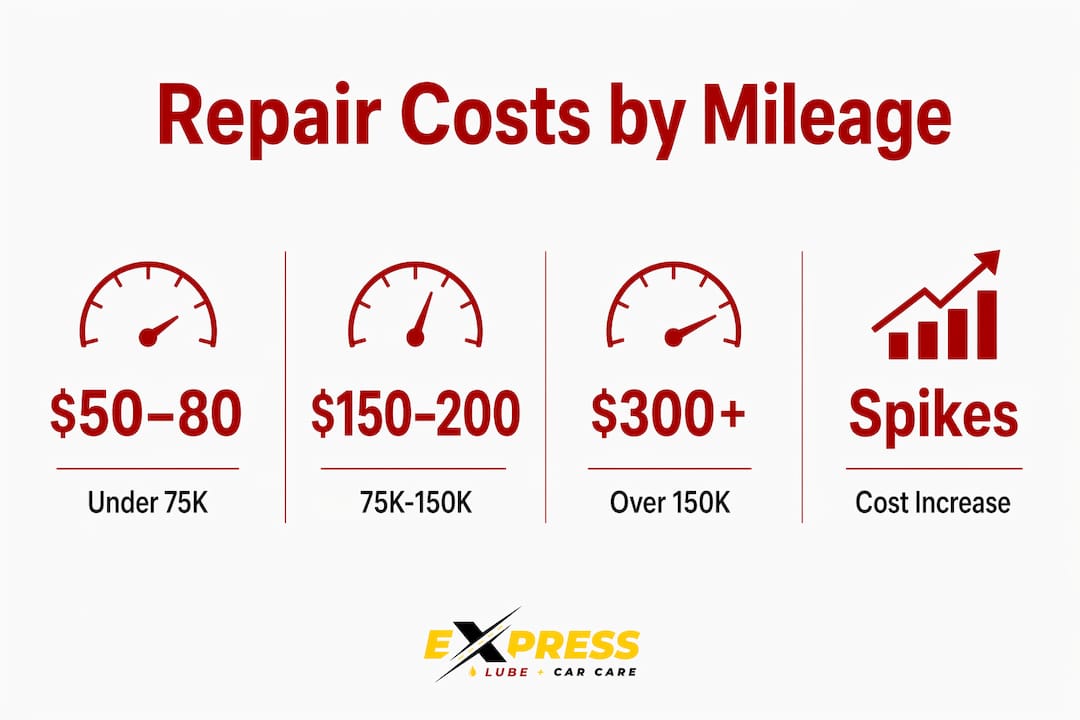
The jump from the first bracket to the last is not just about money. It is about mental energy. You stop planning for maintenance and start bracing for surprises.
Key cost milestones to watch for include:
- 75,000 miles: Timing belt replacement, spark plugs, and coolant flush become urgent.
- 100,000 miles: Transmission service, water pump, and suspension components often need attention.
- 150,000+ miles: Seals, gaskets, sensors, and electronic modules begin failing in sequence.
Skipping manufacturer-specified maintenance, like a timing belt at 90,000 miles, triples eventual repair costs. That one skipped service can turn a $400 belt replacement into a $1,500 engine repair.
What parts fail first as your car ages?
Mechanical wear follows a predictable order. The components that move the most fail the fastest. Brakes, suspension bushings, CV joints, and drive belts all degrade with mileage. By the time a car reaches 10 years old, most of these systems have been repaired or replaced at least once. The second round of failures is often more expensive because surrounding parts are also worn.

Cooling systems are a quiet threat. Hoses, thermostats, and radiators harden and crack with age. A blown radiator hose on a 12-year-old car rarely comes alone. It often signals that the entire cooling system needs a closer look.
Electronic systems add a new layer of complexity to age-related auto repair issues. Modern vehicles rely on dozens of sensors, control modules, and wiring harnesses. Older vehicle electronics become prone to faults that require multi-part diagnosis and repair. A single failing oxygen sensor can trigger a cascade of check engine codes that takes hours to sort out.
Common age-related failures by system:
- Brakes and suspension: Rotors, calipers, control arm bushings, and struts wear down with every mile.
- Engine seals and gaskets: Valve cover gaskets and oil pan seals dry out and crack, leading to leaks.
- Cooling system: Hoses, water pumps, and thermostats degrade after 8–10 years.
- Electronics: Oxygen sensors, mass airflow sensors, and ABS modules fail with age and heat exposure.
- Body and frame: Corrosion and body panel fatigue increase repair costs and make sourcing replacement sheet metal difficult.
Pro Tip: Follow your high mileage vehicle care routine closely. Catching a small oil leak early costs far less than an engine replacement after months of low oil pressure.
Why repairs get harder and more expensive over time
One repair rarely stays one repair on an older car. Cascading failures are the norm, not the exception. When a technician removes a corroded exhaust manifold to fix a leak, they often find cracked heat shields, stripped bolts, and damaged oxygen sensor threads underneath. What started as a $300 job becomes a $700 job before the first part is even installed.
Labor costs climb with vehicle age for three specific reasons:
- Corrosion locks fasteners. Removing a rusted bolt on a 15-year-old car can take 30 minutes. On a new car, it takes 30 seconds.
- Diagnosis takes longer. Interconnected electronic systems mean one symptom can have five possible causes. Complex electronic faults require specialized scan tools and experienced technicians to untangle.
- Parts sourcing gets harder. Discontinued components may only be available as aftermarket alternatives, which vary in quality and fitment.
The financial impact goes beyond the repair bill. Frequent repairs create a reliability tax that hits your wallet in ways that never show up on an invoice. Lost work time, rental car costs, and the stress of an unreliable vehicle all add up. Owners often underestimate this hidden cost until it becomes impossible to ignore.
Pro Tip: Keep a simple repair log in your glove box. Write down every repair, the date, and the cost. After 12 months, you will have a clear picture of your car’s true annual cost, not just what you remember.
When should you repair versus replace an aging vehicle?
The 50% Rule is the most practical guideline for this decision. If a single repair costs more than 50% of the vehicle’s current resale value, replacement is the better financial choice. This rule cuts through the emotional attachment most owners feel toward their cars and grounds the decision in real numbers.
But the 50% Rule only tells part of the story. You also need to factor in reliability risk. A car that has needed three major repairs in 12 months is sending a clear signal. Each repair you make on a high-mileage vehicle is a bet that nothing else will fail soon. That bet gets riskier with every passing mile.
Fuel economy is another factor worth calculating. A 2014 vehicle averages 24 MPG, while a 2024 model with mild hybrid tech reaches 38 MPG. That gap can translate to up to $900 in annual fuel savings. Over five years, that is $4,500 back in your pocket.
A practical replacement checklist looks like this:
| Factor | Keep | Replace |
|---|---|---|
| Repair cost vs. resale value | Under 50% | Over 50% |
| Repair frequency | One major repair per year | Multiple major repairs per year |
| Fuel economy gap | Under $500/year savings | Over $900/year savings |
| Safety features | Adequate for your needs | Significant upgrade available |
Track your cumulative repair costs over 12 months. If they approach or exceed what a newer car payment would cost, the math has already made the decision for you.
Practical strategies to manage repairs as your car ages
Sticking to your manufacturer’s maintenance schedule is the single most effective way to slow the cost curve. Scheduled maintenance keeps small problems from becoming expensive ones. It also gives a trusted technician regular opportunities to spot developing issues before they fail on the road.
Budgeting for repairs is just as important as doing them. Set aside a dedicated monthly amount based on your mileage bracket. If your car has 100,000 miles, budget $100–$160 per month into a repair fund. When a big repair hits, you will have the cash ready instead of reaching for a credit card.
Here are the strategies that make the biggest difference:
- Follow the manufacturer’s schedule. Every skipped service is a future repair waiting to happen.
- Find an ASE-certified mechanic you trust. A good technician catches problems early and gives you honest repair-versus-replace advice.
- Get a pre-repair inspection. Before approving a major repair, ask for a full vehicle inspection. Knowing what else is wearing out helps you make smarter decisions.
- Consider an extended warranty carefully. Extended warranties can be cost-effective for older vehicles with high failure risk, but they typically exclude routine maintenance costs. Read the fine print.
- Plan for preventive car maintenance. Scheduling services proactively, rather than waiting for a warning light, is the most reliable way to avoid costly surprises.
Pro Tip: Use a fleet maintenance checklist as a personal vehicle inspection template. Fleet managers track every service interval precisely, and you can apply the same discipline to your own car.
Key Takeaways
Vehicle age directly increases repair frequency, cost, and complexity, making proactive maintenance the most reliable way to control what you spend.
| Point | Details |
|---|---|
| Costs spike after 75,000 miles | Annual repair costs can rise from $610 to over $2,400 as mileage climbs. |
| Cascading failures are common | One repair on an older car often reveals adjacent failures, raising the final bill. |
| The 50% Rule guides replacement | If a repair exceeds 50% of resale value, replacing the vehicle is the smarter financial move. |
| Skipping maintenance triples costs | Missing scheduled services like timing belt replacement multiplies eventual repair bills. |
| Budget by mileage bracket | Set aside $100–$160/month at 75,000–150,000 miles to avoid financial surprises. |
What I have learned from watching owners manage aging cars
I have seen the same pattern play out hundreds of times. An owner ignores a small oil leak for six months because the car “runs fine.” Then the engine overheats, and a $150 fix becomes a $2,800 repair. The car did not fail them. The maintenance gap did.
The owners who spend the least on repairs over time are not the ones with the newest cars. They are the ones who treat maintenance like a bill that comes due every few months, not a crisis to handle when something breaks. They keep records. They ask questions. They do not wait for a warning light to tell them something is wrong.
There is also an emotional side to this that does not get talked about enough. Older cars carry memories, and that makes it hard to let go. But I have watched people pour $6,000 into a car worth $4,000 because they could not face the decision. The 50% Rule exists for exactly that moment. Use it.
My honest advice: treat your car like a business asset, not a sentimental object. Track what you spend. Know what it is worth. And when the math says replace, trust the math.
— Hassan
Keep your aging vehicle running with Expresslubearlington
Regular oil changes are not glamorous, but they are the cheapest insurance you can buy for an older engine. At Expresslubearlington, our ASE-certified technicians do more than swap oil. They inspect your vehicle at every visit, catching the small issues that turn into big bills.

As a RepairPal Certified Shop and CarFax Top-Rated Service Center, Expresslubearlington serves drivers across the DFW area with honest, fast, and thorough service. Check out our oil change tips to protect your engine between visits. If a bigger repair comes up, our auto repair financing and 24-month repair warranty mean you are never left without options. Stop by today and let us help you get more miles out of the car you already own.
FAQ
How does vehicle age affect repair costs?
Repair costs rise sharply after a vehicle passes 10 years or 75,000 miles, shifting from predictable scheduled maintenance to costly, unpredictable event-driven repairs. Annual costs can climb from around $610 to over $2,400 as mileage accumulates.
Do older vehicles need more repairs than newer ones?
Yes. Older vehicles are twice as likely to require roadside assistance and four times more likely to need a tow compared to newer models. Worn mechanical components and aging electronics both contribute to higher repair frequency.
What is the 50% Rule for vehicle repair decisions?
The 50% Rule states that if a single repair costs more than half the vehicle’s current resale value, replacing the car is the better financial decision. This guideline helps owners cut through emotional attachment and make decisions based on real numbers.
What systems fail most often in high-mileage vehicles?
Brakes, suspension components, cooling system parts, engine seals, and electronic sensors are the most common failure points in high-mileage vehicles. Electronic faults are especially costly because they require extended diagnostic time and specialized equipment.
How can I slow down repair cost increases on my aging car?
Following your manufacturer’s maintenance schedule is the most effective way to slow rising repair costs. Skipping scheduled services like timing belt replacement can triple your eventual repair bill.