
If your car slips, shudders between 25 and 50 MPH, runs hot, or hums at idle but quiets down in gear, you’re likely looking at torque converter symptoms rather than a random transmission glitch. Check your fluid level and condition first, write down exactly when the symptom happens, and get a diagnostic scheduled if it sticks around or the transmission runs hot.
TL;DR:
- A low speed lurch can indicate a TCC stuck on; weak takeoff that improves while moving points toward a stator or one way clutch.
- A road test showing low TCC slip under light pedal pressure can confirm shudder; solenoid data helps distinguish electrical, hydraulic, and clutch faults.
- If slipping becomes severe or the transmission overheats, stop driving and arrange a tow; continued use can turn converter damage into broader transmission failure.
- Common professional replacements can cost around $1,000, with labor typically taking 4 to 10 hours; complex or performance vehicles may cost more.
Table of Contents
- Common Torque Converter Symptoms: What to Feel, Hear, and See
- What Each Torque Converter Symptom Usually Points To
- Diagnosing Torque Converter Problems: Checks You Can Do Today
- Professional Diagnostics and Repair Options for a Bad Torque Converter
- Short-Term Safety Steps Before Your Shop Visit
- Why an ASE-Certified Diagnostic Matters
- Our Diagnostic Priorities When Torque Converter Complaints Come In
- Book a Torque Converter Diagnostic in Arlington
- FAQ
- Sources
Common Torque Converter Symptoms: What to Feel, Hear, and See
A failing torque converter rarely announces itself with one dramatic event. It tends to nag at you through small, repeatable sensations that get worse over weeks or months. Here’s what drivers usually notice first:
- Slipping: the engine revs climb, but your speed doesn’t catch up, like the transmission briefly lets go of the wheels.
- Shudder at light throttle: a vibration that feels like driving over rumble strips, most common between 25 and 50 MPH according to AutoZone’s diagnostic guide.
- Overheating: a transmission temperature warning, a burnt smell, or fluid that’s gone dark brown instead of its normal pink or red.
- Noise at idle: a whine or rattle that shows up in park or neutral and fades once you shift into gear.
- High cruise RPM: your engine seems to work harder than it should at highway speed, often paired with a drop in fuel economy.
None of these symptoms is exclusive to the torque converter. That’s exactly why a proper road test with live data matters more than guesswork.
What Each Torque Converter Symptom Usually Points To
Different symptoms trace back to different parts of the converter or the hydraulic system around it. Knowing the pattern helps you understand what a technician is actually checking for.
- No lockup at cruise: points to the torque converter clutch (TCC) not engaging, which drives up RPM and hurts fuel economy.
- Buck or lurch at low speed: suggests the TCC is stuck on when it shouldn’t be, applying lockup too early.
- Weak takeoff from a stop, fine once moving: often a stator or one-way clutch problem rather than the converter body itself.
- Solenoid commanded on but slip persists: a strong clue that the leak is downstream in the hydraulic circuit, not the solenoid itself, according to the ASE A2 automatic transmission study guide.
- Whine or rattle at idle: usually a pump drive or converter pilot bearing issue, which reads differently on a scan tool than clutch-material shudder does.
Pro Tip: Note whether a noise or vibration changes the instant you shift from park into drive. That single detail helps a technician separate a converter issue from an engine or accessory noise in minutes.
Diagnosing Torque Converter Problems: Checks You Can Do Today
You don’t need a lift to gather useful information. A few careful checks at home can shave real time off a shop visit and keep you from paying for parts you don’t need.
- Check the fluid first. Look at the level, color, and smell. Fresh fluid is pink to red; dark or burnt-smelling fluid signals heat damage, and you shouldn’t keep driving if the transmission has recently overheated.
- Road-test and take notes. Record your speed, gear, throttle position, and approximate RPM at the exact moment the slip or shudder happens, and whether it occurs under load (accelerating uphill) or coasting.
- Understand the stall test, but leave it to a shop. A stall test holds the brake and briefly revs the engine in gear to check how the converter couples power. Low stall speed suggests the engine or TCC is dragging early; high stall speed suggests the converter can’t couple power at all, per the ASE A2 study guide. This test should never run longer than five seconds, since heat builds fast.
- Ask for scan-tool live data. TCC slip values and commanded solenoid state tell a technician whether you’re dealing with a solenoid, a hydraulic leak, or worn clutch material inside the converter.
Shudder is often confirmed when TCC slip measures low during a road test with light pedal pressure, per AutoZone’s repair guide. That’s a narrow enough window that guessing rarely gets you there. For more on what slipping itself can mean beyond the converter, our guide to transmission slipping causes and fixes breaks down related failure points.
Professional Diagnostics and Repair Options for a Bad Torque Converter
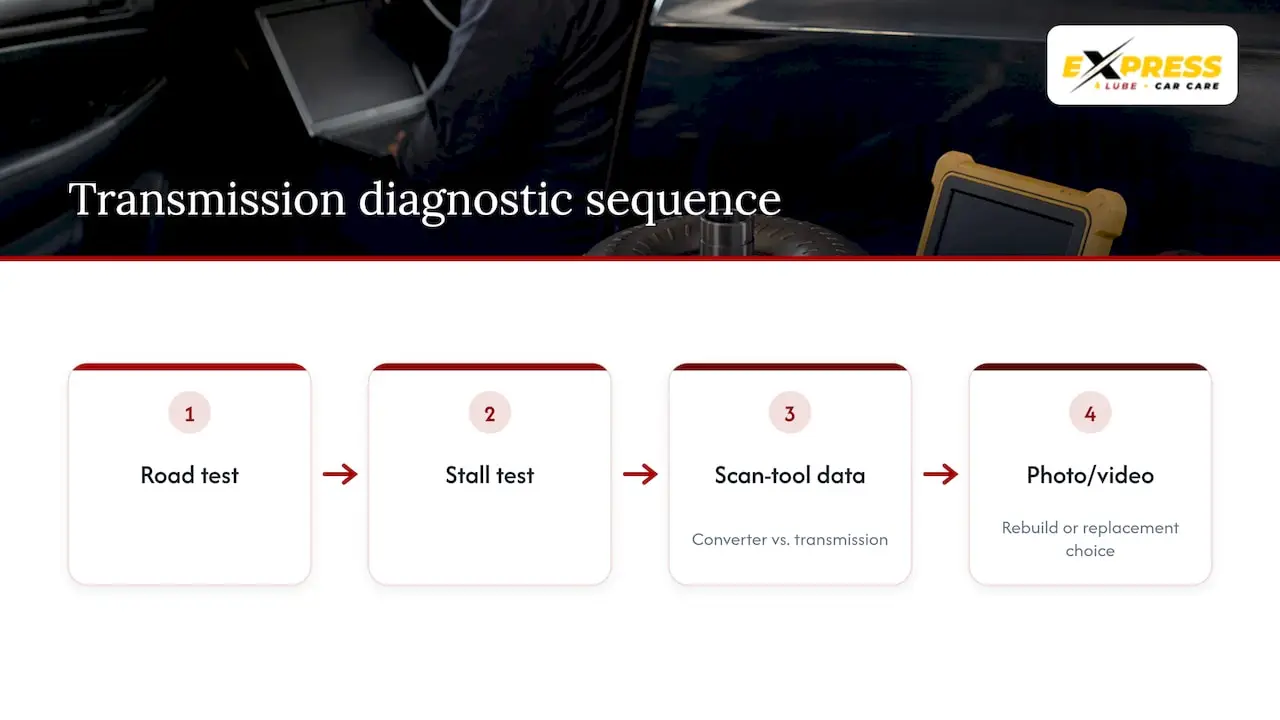
Once you bring the car in, a shop should run a structured sequence rather than jumping straight to parts. A thorough diagnostic typically includes a lift inspection for leaks, hydraulic pressure tests, a stall test, scan-tool live data capture, and a road test built around the exact conditions you documented.
From there, repair paths generally fall into three camps:
- Internal converter repair, when the issue is isolated to a single component like the TCC apply circuit.
- Remanufactured converter replacement, the more common route when clutch material or the stator has failed.
- Broader transmission work, when converter symptoms turn out to be masking a separate internal transmission fault.
Cost varies by parts and labor. Pricing guidance from JEGS puts typical replacement costs from a few hundred dollars for a basic rebuild up to around $1,000 for common professional replacements, with labor typically running 4 to 10 hours depending on vehicle accessibility and transmission design. Complex or high-performance applications can run higher. A documented diagnosis, gear-specific versus non-gear-specific symptoms, stall results, and live TCC data, is what keeps a repair focused on the converter instead of escalating into an unnecessary full transmission replacement. If you’re weighing your options, our breakdown of transmission rebuild versus replacement walks through the tradeoffs in more detail.
Short-Term Safety Steps Before Your Shop Visit
If your transmission is overheating or slipping severely, stop driving and arrange a tow instead of pushing on to a shop. Continued driving under those conditions risks turning a converter repair into a full transmission replacement.
- Dark or burnt-smelling fluid means it’s time to book a fluid inspection, not a long road trip.
- Stick to your manufacturer’s fluid-change interval and avoid repeated hard launches or prolonged stall-speed revving, both of which accelerate converter wear.
- A fresh fluid service won’t undo existing damage, but it protects whatever life the converter has left.
Pro Tip: If you’re not sure whether fluid discoloration means trouble, our guide on transmission fluid change benefits explains what healthy fluid should look and smell like.
Why an ASE-Certified Diagnostic Matters
We rely on ASE-certified technicians who run structured road tests, stall tests, and scan-tool data captures to separate converter faults from broader transmission issues, rather than swapping parts on a hunch. Every inspection includes photos and video documentation, so you see exactly what we found before deciding between a rebuild and a replacement. We back that process with recognition for dependable workmanship and fast turnaround.
Our Diagnostic Priorities When Torque Converter Complaints Come In
We rule out engine and driveline issues before touching the converter, since a rough idle or a worn CV joint can mimic converter shudder and lead to a wasted repair. Documenting exact conditions, speed, gear, throttle, and pulling scan-tool live data up front consistently shortens diagnosis time and avoids guesswork. If your transmission is overheating or slipping hard, our honest advice is simple: stop driving and get it looked at before the damage spreads.
— Express Lube & Car Care
Book a Torque Converter Diagnostic in Arlington
Catching torque converter symptoms early costs less than waiting for a slip to turn into a full transmission failure. Our transmission diagnostic combines inspection, scan-tool data capture, and a structured road test, then we hand you a documented repair estimate before any work begins.

- We capture the same live data points covered above: TCC slip, commanded solenoid state, and stall behavior.
- You get a clear rebuild-versus-replace recommendation backed by photos and video, not guesswork.
- If you’re overheating or slipping severely right now, stop driving and call us to arrange a tow instead of risking further damage.
Visit our transmission repair and service page to schedule your diagnostic today.
FAQ
Can a bad torque converter damage the transmission?
Yes. A failing converter can send metal particles or overheated fluid through the transmission, and continued driving while slipping or overheating raises the risk of damaging clutches, seals, and other internal components. Addressing symptoms early, rather than continuing to drive, limits how far that damage spreads.
What are signs of a slipping transmission?
The clearest sign is the engine revving higher without a matching increase in speed, especially when accelerating from a stop or merging onto a highway. You may also notice delayed engagement when shifting from park to drive, or a brief flare in RPM between gear changes.
What is the average cost of replacing a torque converter?
Replacement costs vary by vehicle and labor time, but general pricing guidance places common professional replacements up to around $1,000, with basic rebuilds running lower and labor typically taking 4 to 10 hours. Complex or performance applications can cost more. For an exact figure, our shop provides a documented estimate after diagnosis.
Can you fix a torque converter without replacing the whole transmission?
Often, yes. Many converter issues, like a failed TCC solenoid circuit or worn clutch material, can be resolved by repairing or replacing the converter itself without touching the rest of the transmission. A proper diagnostic with stall testing and live scan data is what confirms whether the problem is isolated to the converter.
How do technicians diagnose torque converter problems?
Technicians combine a stall test, a structured road test with recorded speed and throttle conditions, and scan-tool live data showing TCC slip and commanded solenoid state. This combination, outlined in the ASE A2 study guide, separates converter faults from transmission or engine issues that can cause similar symptoms.
Sources
- How to Know If Your Torque Converter Is Bad – AutoZone Repair Guide
- ASE A2 automatic transmission study guide — APEX Tech
- Pricing guide: torque converter replacements — JEGS Tech Articles