

A transmission rebuild is usually the right call when the transmission case and hard parts are structurally sound but internal wear, soft-part failure, or clutch pack damage has made the unit unreliable. For most automatic transmissions, expect to pay $2,500–$4,500 installed.
Here’s the quick-decision snapshot:
- Automatic transmission rebuild (most common vehicles): $2,500–$4,500 installed, depending on damage found during teardown
- Manual, CVT, or dual-clutch (DCT) units: costs vary more widely. CVTs and DCTs often push toward the higher end or make a remanufactured replacement more attractive
The single biggest deciding factor is the condition of the hard parts — the case, planetary gear sets, and output shaft. If those are intact, a rebuild makes financial sense on a vehicle you plan to keep for several more years. If hard parts are cracked or scored, the math shifts fast toward a remanufactured or new unit.
Start with a proper diagnosis before committing to anything. Many symptoms that look like internal failure turn out to be fluid- or sensor-related issues that cost a fraction of a rebuild.
Key Takeaways
A transmission rebuild makes financial sense when hard parts are sound, the vehicle has lasting value, and a qualified shop backs the work with a written warranty.
| Point | Details |
|---|---|
| Diagnose before deciding | Many symptoms are fluid- or sensor-related; a proper diagnosis prevents overspending on a rebuild you may not need. |
| Rebuild cost range | Most automatic transmission rebuilds run $2,500–$4,500 installed; CVTs and DCTs typically cost more. |
| Rebuild vs. reman tradeoff | Remanufactured units cost $3,500–$6,000 but often carry longer warranties (commonly 3 years/100k miles) and more consistent quality. |
| Timeline expectation | Plan for 3–5 business days total; bench hours alone don’t account for parts sourcing and adaptation cycles. |
| Expresslubearlington warranty | ASE-certified technicians, written estimates, and a 24-month/24,000-mile warranty make Expresslubearlington a strong choice for DFW-area drivers. |
Table of Contents
- What symptoms actually point to a transmission problem?
- What a full transmission rebuild actually involves
- Rebuild vs. remanufactured vs. used vs. new: which option fits your situation?
- Why transmission rebuild costs vary so much
- What the rebuild timeline actually looks like
- How to pick the right shop for a transmission rebuild
- Why Expresslubearlington’s approach to transmission work stands out
- The conventional wisdom on transmission rebuilds gets one thing consistently wrong
- Expresslubearlington handles the hard calls so you don’t have to guess
- Sources
- FAQ
What symptoms actually point to a transmission problem?
Not every shudder or hesitation means your transmission is dying. Kelley Blue Book notes that accurate diagnosis is what separates a $150 fluid service from a $3,500 rebuild — and skipping that step is one of the most expensive mistakes a car owner can make.
AutoZone’s symptom guide lists the most common warning signs:
- Slipping gears: The engine revs but the car doesn’t accelerate — feels like driving on ice
- Delayed engagement: A pause between shifting into Drive or Reverse and actually moving
- Grinding or clunking noises: Often a sign of worn gear synchronizers (manual) or clutch pack damage (automatic)
- Burning smell: Overheated fluid, usually from low fluid level or a slipping clutch
- Fluid leaks: Reddish fluid under the car; low fluid accelerates internal wear fast
- Limp mode / warning light: The transmission control module detected a fault and locked into a safe gear
- Poor acceleration: The engine pulls but the vehicle barely responds
- Difficulty staying in gear: The unit hunts between gears or drops out unexpectedly
Matching symptoms to repair scope
Not all of these mean a full teardown. Here’s a rough triage:
- Fluid service only: Delayed engagement with clean fluid, minor shudder, no codes — check fluid level and condition first; a transmission fluid change at $150–$200 may solve it
- Minor parts (solenoid, sensor, seal): Specific fault codes, single-gear issues, small external leak — solenoid replacement runs $200–$500; a seal repair is often less
- Full rebuild territory: Multiple slipping gears, grinding under load, metal debris in the pan, or limp mode with internal fault codes — these point to clutch pack or valve body damage that requires a bench teardown
Pro Tip: Before scheduling a teardown, check the fluid level and color yourself (dark brown or burnt-smelling fluid is a red flag), pull any stored codes with an OBD-II scanner, and ask the shop to do a pan-drop inspection. Metal shavings in the pan confirm internal damage; a clean pan with a code pointing to a solenoid is a much cheaper fix. You can find more on transmission slipping symptoms to help you play detective before the shop visit.
What a full transmission rebuild actually involves
A rebuild is not a patch job. It’s a complete bench teardown of the entire unit, a hard-part inspection, replacement of every soft component, and a full reassembly — essentially giving the transmission a new internal life while keeping the original case and gear sets (assuming they’re sound).
The bench workflow follows this sequence:
- Removal from the vehicle (typically 3–6 hours of labor on its own)
- Disassembly on the bench — every component separated and laid out
- Cleaning of all hard parts in a solvent tank or parts washer
- Hard-part inspection — measuring wear on planetary gears, checking the case for cracks, inspecting the output shaft and drum
- Soft-part replacement — everything worn or consumable goes in the trash
- Reassembly with new soft parts, torqued to spec
- Fluid fill with the correct fluid type and quantity
- Testing and adaptation cycles — especially critical on late-model automatics that require a computer relearn
Parts replaced in a standard rebuild
A quality overhaul kit covers the soft parts. Mopar’s overhaul kit bill of materials gives a clear picture of what’s typically included:
- Seals and accumulator seals
- Clutch discs and friction plates
- Valve body filter and gaskets
- Multiple O-rings throughout the unit
- Check balls
- Regulator valve screen
- Bands (where applicable)
The torque converter gets inspected during teardown. If it shows heat damage, scoring, or bearing wear, it needs replacement — that alone can add $150–$400 to the parts bill.
Hard parts — planetary gear sets, the case itself, drums, and the output shaft — are inspected but not automatically replaced. When one of those is damaged, the cost picture changes significantly. A cracked case or scored planetary set can push total costs past what a remanufactured unit would cost, which is exactly when the rebuild-vs-replace decision flips.
Rebuild vs. remanufactured vs. used vs. new: which option fits your situation?
Here’s how the four main options stack up on cost, warranty, and risk:
| Option | Total installed cost | Typical warranty | Risk / reliability | Best for |
|---|---|---|---|---|
| Rebuild (local shop) | $2,500–$4,500 | 1–2 years / 12k–24k miles | Medium — depends heavily on shop quality | Vehicles with sound hard parts; owners keeping the car 3+ years |
| Remanufactured | $3,500–$6,000 | Commonly 3 years / 100k miles | Lower — factory-controlled process | Higher-value vehicles; owners wanting longer warranty coverage |
| Used (pull-out) | $800–$2,500 | Minimal or none | Higher — unknown internal condition | Lower-value vehicles; short-term ownership; tight budget |
| New OEM | $4,500–$8,000+ | Manufacturer warranty | Lowest risk | High-value or newer vehicles where cost is secondary |
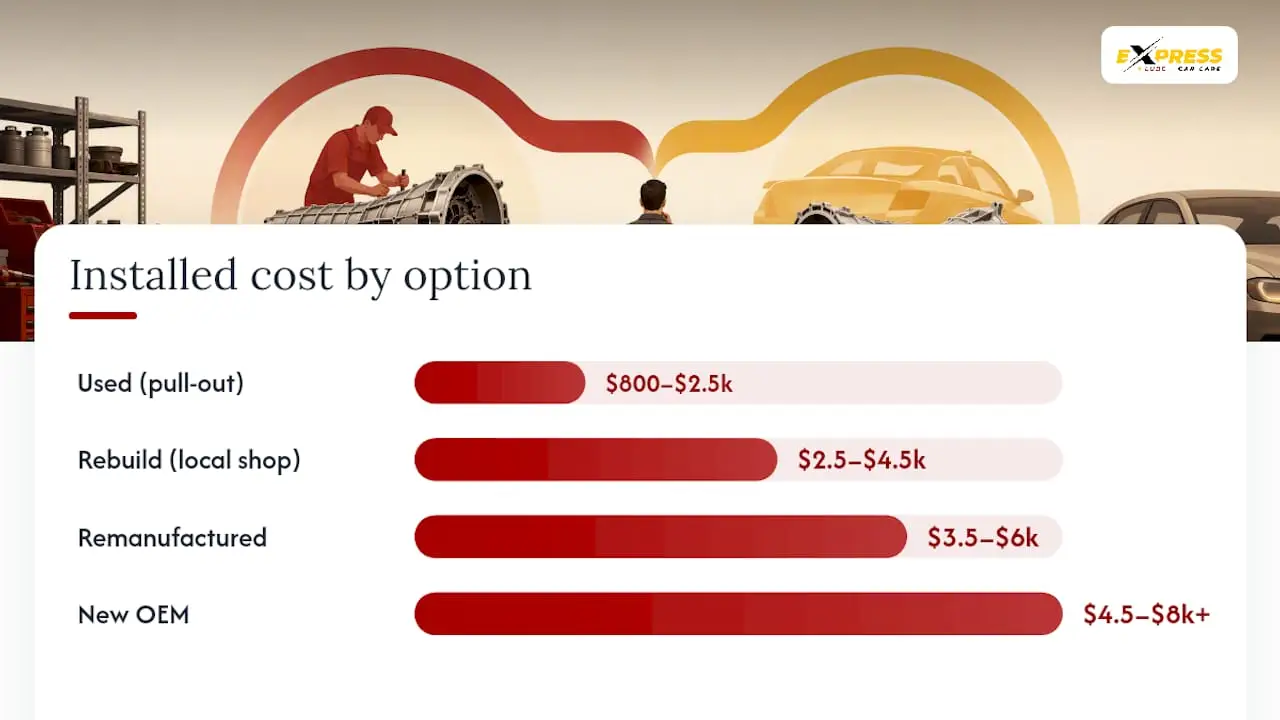
Factory remanufactured units tend to offer more consistent quality control than a local rebuild because the process is standardized and measured — but you pay for that consistency, and wait times can be longer. A used unit is the cheapest entry point but carries real risk: you’re buying someone else’s unknown wear history. For most owners keeping a mid-value vehicle for several more years, a rebuild from a qualified shop hits the best balance of cost and warranty coverage.
Quick decision checklist:
- Is your vehicle worth more than $8,000–$10,000? A rebuild or reman makes financial sense.
- Do you plan to keep the car for 3+ more years? Prioritize warranty length — lean toward rebuild or reman.
- Can you tolerate 3–5 business days of downtime? A local rebuild is realistic. Need it faster? A reman drop-in may be quicker once the unit arrives.
For a broader look at the repair-vs-replace question, the repair vs. replace guide walks through the vehicle-value math in plain terms.
Why transmission rebuild costs vary so much
Parts and labor are the two big line items, but several variables push the final number up or down significantly.
Typical cost components:
- Parts kit (soft parts): $800–$1,500 depending on the transmission make and model
- Torque converter: $150–$400 if replacement is needed
- Labor: 8–15 hours at shop rates that typically run $100–$150/hour in most markets
- Diagnostic fee: $100–$200 (often credited toward the repair)
- Core deposit (reman only): $200–$500, refunded when the old unit is returned
Understanding how labor rates work helps you read a quote intelligently. A shop charging $85/hour isn’t automatically a deal — it may mean fewer experienced technicians or a higher risk of shortcuts.
How transmission type changes the price
| Transmission type | Typical rebuild range |
|---|---|
| Standard 4–6 speed automatic | $2,500–$4,000 |
| Manual (simple/older) | $1,500–$3,000 |
| CVT (continuously variable) | $2,500–$4,500 |
| Dual-clutch (DCT) | $2,500–$4,500 |
| Luxury European (ZF, Aisin) | $4,000–$6,000+ |
CVTs and DCTs are more complex, have tighter tolerances, and require specialized tooling — which is why many shops recommend a remanufactured replacement over a local rebuild for those units. Routine fluid service every 30,000–60,000 miles at $150–$200 is the cheapest insurance against ever reaching this point.
Red flags on a quote:
- Price is below the typical parts cost alone (under ~$1,500 total is a warning sign)
- No itemized parts list — you can’t verify what’s actually being replaced
- No written warranty offered
- Shop can’t explain what diagnostic method they used
Ask for a written estimate that breaks out parts, labor hours, and any core deposit terms. A shop that won’t provide that in writing is telling you something important.
What the rebuild timeline actually looks like
Bench time and total turnaround time are not the same thing. Active labor on the transmission may total 8–12 hours, but plan for 3–5 business days at a dedicated shop once you factor in parts sourcing, inspection outcomes, and post-rebuild testing.
Here’s the typical sequence:
- Diagnosis (Day 1): Road test, code scan, pan-drop inspection — 1–2 hours
- Removal (Day 1–2): Dropping the transmission from the vehicle — 3–6 hours depending on the platform
- Teardown and inspection (Day 2): Full disassembly, cleaning, hard-part measurement — 3–5 hours
- Parts ordering (Day 2–3): If the kit isn’t in stock, add 1–2 days for delivery
- Rebuild bench work (Day 3–4): Reassembly with new soft parts — 4–6 hours
- Reinstallation (Day 4): Bolting the unit back in, reconnecting all lines and electronics — 3–5 hours
- Fluid fill and adaptation cycles (Day 4–5): Late-model automatics need a computer relearn sequence after installation
- Road test (Day 5): Verified under load across multiple gear changes
Parts sourcing is the most common source of delays. If teardown reveals hard-part damage that wasn’t visible on the outside, that discovery can add another day or two while the shop sources replacement gears or drums.
Post-rebuild verification checklist — ask your shop for these:
- Cleared fault codes confirmed by a final scan
- Road-test notes documenting shift quality across all gears
- Written parts list showing every component replaced
- Warranty paperwork with specific mileage and time terms
- Core deposit receipt (if applicable)
How to pick the right shop for a transmission rebuild
The shop you choose matters more than almost any other variable. A quality rebuild depends on the technician’s experience and inspection discipline — shops that skip careful measurement or reuse borderline hard parts are the main reason rebuilt transmissions fail prematurely.
Trust signals to look for:
- ASE certification (look for the blue seal — it means technicians passed standardized competency tests)
- Transmission specialty or strong transmission track record
- Written estimate with itemized parts list before work begins
- Clear warranty terms in writing (length, mileage, what’s covered)
- Willingness to show you the old parts after teardown
- Documented road test as part of delivery
Questions to ask before you commit:
- What diagnostic method did you use, and what specifically did you find?
- Which parts will be replaced, and can I see the kit list?
- Do you rebuild the torque converter in-house, or replace it?
- What’s the warranty — exact time and mileage, and what does it exclude?
- What’s the turnaround time, and what causes delays?
- Can I see photos or documentation of prior rebuild work?
Understanding how to read a repair invoice before you sign anything is worth 10 minutes of your time — it helps you spot vague line items that hide what’s actually being done.
Red flags:
- “Full rebuild” quoted at suspiciously low prices with no parts breakdown
- No warranty offered, or warranty is verbal only
- Shop can’t name the diagnostic method used
- Pressure to decide same-day without a written estimate
DIY vs. professional: when does it make sense?
A simple older manual transmission on a vehicle you’re comfortable working on is a realistic DIY project if you have the tools, a service manual, and patience. Modern automatics, CVTs, and DCTs are a different story. The valve body tolerances, adaptation cycles, and specialized tooling required make a professional rebuild the far safer choice for anything built in the last 15 years. The cost savings of DIY evaporate quickly if an adaptation cycle isn’t completed correctly or a torque spec is missed. Shops like Barry Fleet Services and Manley Tire & Oil illustrate the kind of specialized transmission experience worth looking for when you’re evaluating local options.
Why Expresslubearlington’s approach to transmission work stands out
When you’re trusting a shop with a $3,000+ repair, credentials and process matter. Expresslubearlington’s ASE-certified technicians bring that documented competency to every transmission job, backed by a 24-month/24,000-mile warranty that covers the work in writing — not just a verbal promise.
Here’s what the shop provides on every transmission service:
- Digital vehicle inspection with documented findings before work begins
- Written estimate with itemized parts list — no surprises on the final invoice
- Core deposit handling explained upfront for any remanufactured unit
- Post-rebuild scan to confirm cleared codes and adaptation completion
- Road-test documentation included with delivery
Expresslubearlington is also a RepairPal Certified Shop and a CarFax Top-Rated Service Center, which means the quality standard is verified by third parties, not just self-reported.
Pro Tip: Keep every piece of paperwork from a transmission rebuild — the parts list, the warranty document, the road-test notes, and the invoice. If you sell the vehicle, that documentation adds real value. If a warranty claim comes up, you’ll have everything you need to support it.
For owners weighing the cost of a rebuild, auto repair financing options are available to spread the expense without delaying a repair that only gets more expensive the longer it runs.
The conventional wisdom on transmission rebuilds gets one thing consistently wrong
Most guides lead with cost tables. That’s useful, but it buries the decision that actually matters: whether the vehicle is worth the repair at all. A $3,000 rebuild on a car worth $4,500 is rarely the right call, no matter how clean the hard parts are. Yet owners get talked into it regularly because the rebuild conversation starts with “what’s wrong with the transmission” rather than “what’s the vehicle worth and how long are you keeping it.”
The second thing most guides underplay is the shop-quality variable. The cost ranges for a rebuild are real, but they assume competent execution. A rebuild done by a shop that skips careful measurement, reuses borderline clutch packs, or doesn’t run proper adaptation cycles on a late-model automatic can fail within 20,000 miles. The warranty is your protection against that — but only if it’s in writing, covers parts and labor, and comes from a shop with the credentials to back it up.
DIY rebuilds are worth a mention here too. For a simple older manual, the savings are real and the risk is manageable with the right service manual and patience. For anything with a CVT, DCT, or a modern electronically controlled automatic, the adaptation cycles alone make professional service the only realistic path. The tooling cost and the learning curve on a modern 8- or 10-speed automatic would eat the savings before you finished the teardown.
The practical takeaway: get the diagnosis first, check the vehicle’s value against the repair cost, and then evaluate shops on warranty terms and credentials — not just price.
Expresslubearlington handles the hard calls so you don’t have to guess
Facing a transmission repair is stressful enough without wondering whether the shop you picked actually knows what they’re doing. At Expresslubearlington, ASE-certified technicians handle every transmission job with a documented process: digital inspection before work starts, a written estimate with a full parts breakdown, and a 24-month/24,000-mile warranty that covers the repair in writing.
DFW drivers trust Expresslubearlington because the credentials are real — RepairPal Certified, CarFax Top-Rated — and the process is transparent from diagnosis to road test. If you’re weighing a rebuild against other options and want a straight answer on what your vehicle actually needs, schedule a transmission inspection and get a written estimate before committing to anything. For drivers concerned about the upfront cost, repair financing is available to make a quality repair accessible without delay.
Sources
These are the primary sources behind the cost ranges, symptom guidance, and parts lists in this article:
- Signs of a Bad Transmission — AutoZone
- Mopar Trans Rebuild Kits with Build List Links — Mopar Repair Connect (PDF)
- Do I Need a New Transmission? — Kelley Blue Book
- Thehowmuch
- How Much Does a Transmission Rebuild Cost? — Continental Transmission (blog)
FAQ
What’s the average cost to rebuild a transmission?
Most automatic transmission rebuilds run $2,500–$4,500 installed. CVTs, dual-clutch units, and luxury European transmissions typically push toward $4,000–$6,000 depending on parts availability and labor hours.
Is it worth it to rebuild a transmission?
A rebuild makes sense when the vehicle is worth more than the repair cost and you plan to keep it for several more years. If the car’s market value is close to or below the rebuild cost, a used unit or selling the vehicle may be the smarter financial move.
What are the first signs of transmission failure?
Slipping gears, delayed engagement when shifting into Drive or Reverse, grinding noises, a burning smell, and a dashboard warning light are the most common early signals. Catching these early often means the difference between a fluid service and a full rebuild.
Is it hard to rebuild a transmission yourself?
A simple older manual transmission is a realistic DIY project with the right tools and a service manual. Modern automatics, CVTs, and DCTs require specialized tooling and computer adaptation cycles after reassembly, making professional service the practical choice for most drivers.