
For routine maintenance and most out-of-warranty repairs, a trusted local mechanic usually delivers better value. For active manufacturer warranties, recalls, and complex software or ADAS calibration work, your dealership is the right call. That’s the short version. Here’s how to apply it to your situation.
Three quick scenarios:
- New car under warranty (0–3 years / under 36,000 miles): Use the dealership for covered repairs and recalls. You’re paying for it in the purchase price anyway, and warranty documentation protects resale value.
- Older car (5+ years or 60,000+ miles): A reputable local shop with ASE-certified technicians almost always costs less and schedules faster for brakes, fluids, and general repairs.
- Recall or ECU/software issue: Go to the dealer. Manufacturer-specific diagnostic tools and Technical Service Bulletin (TSB) access aren’t something most independent shops can replicate for late-model vehicles.
One thing many car owners don’t realize: the Magnuson-Moss Warranty Act means a manufacturer cannot automatically void your warranty just because you used an independent shop. They must prove the independent work caused the failure. That changes the math considerably for owners who’ve been paying dealer prices out of fear.
Table of Contents
- What dealerships genuinely do well (and where they fall short)
- What local mechanics do best (and the risks to watch for)
- Warranty, recalls, and parts: what U.S. law actually says
- How to choose today: a practical checklist
- Why Express Lube & Car Care belongs on your shortlist
- Key Takeaways
- The view from the bay
- Express Lube & Car Care is your local alternative to dealer pricing in Arlington
- Sources and further reading
- FAQ
What dealerships genuinely do well (and where they fall short)
Dealerships bring factory-trained technicians, OEM parts, and manufacturer diagnostic tools to every job. For a car still under the manufacturer’s bumper-to-bumper or powertrain warranty, that combination is hard to argue against. Recall repairs are performed at no charge, and the service records feed directly into the manufacturer’s system; this matters when you sell or trade the vehicle.
Where dealers earn their premium:
- Active manufacturer warranty repairs (covered at no cost to you)
- Official recall work and safety campaigns
- ADAS calibration (lane-keep assist, automatic emergency braking, camera alignment)
- ECU flashes and brand-specific software updates
- Certified Pre-Owned (CPO) inspection and reconditioning
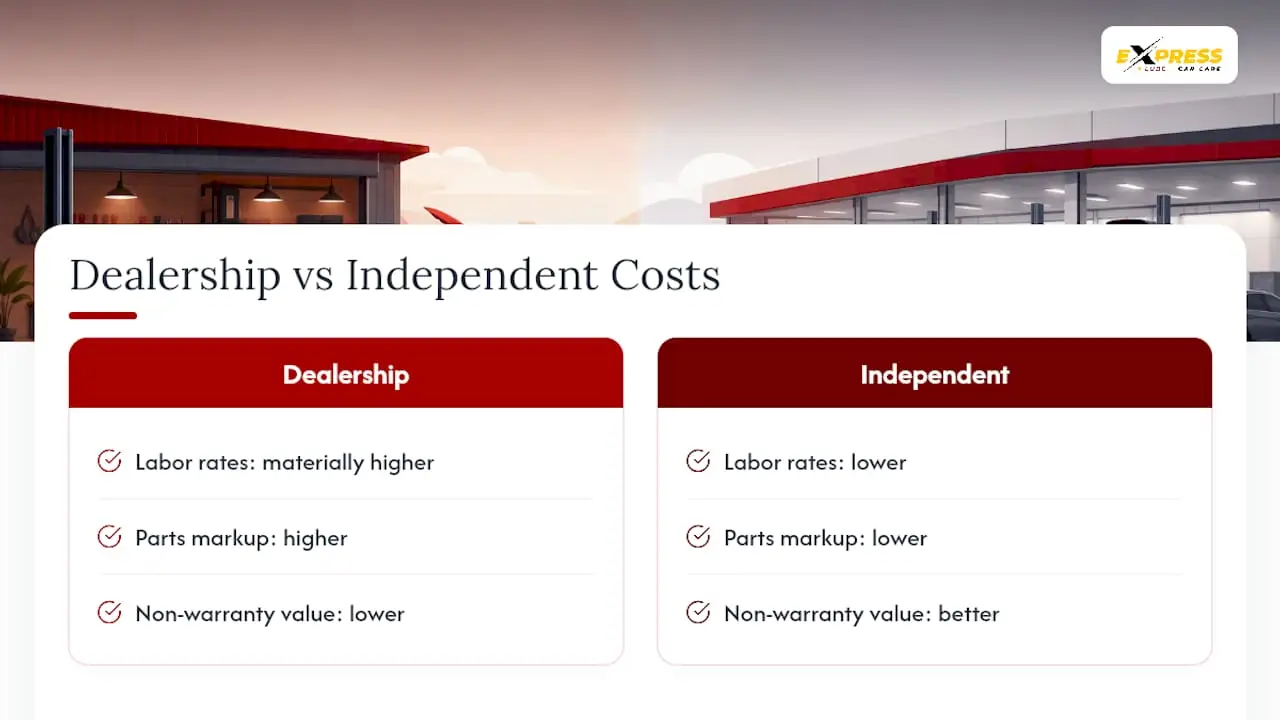
The downsides are real, though. Dealer labor rates run 25% or more above independent shops in many markets, and parts markup follows the same pattern. High-volume service bays mean your car sometimes sits in a queue for hours before a technician touches it. Upselling is also common — a routine oil change appointment can turn into a $600 conversation if you’re not prepared.
Pro Tip: Before you approve any dealer service, ask for a written estimate itemizing labor hours and parts cost separately. If the service advisor adds items not on your original request, ask to see the inspection photos or a digital vehicle inspection (DVI) report before you say yes.
What local mechanics do best (and the risks to watch for)
Independent shops typically cost less and offer more personalized service than dealerships, and that’s not a small thing. When you bring your car to the same shop repeatedly, the technician who worked on it last time already knows its history. That continuity catches patterns a high-volume dealer bay never would.
Surveys show many owners migrate to independent shops after the first two years of ownership, and independents consistently score well for value and timeliness. Once a vehicle passes roughly five years or 60,000 miles, the dealership premium rarely returns proportional value for most owners.
Where a good local shop wins:
- Routine maintenance: oil changes, brake service, fluid flushes, filters, tire rotations
- Out-of-warranty repairs on vehicles 5+ years old
- Owners watching their total cost of ownership
- Jobs where scheduling flexibility and faster turnaround matter
- Shops that can source OEM parts on request while saving you on labor
Risks to know before you hand over the keys:
- Quality varies widely between shops. Certifications and reviews are your filter.
- Some newer vehicles require manufacturer-specific software that not every independent carries.
- A shop without a written repair warranty is a shop worth skipping.
Pro Tip: When vetting a new shop, ask three things: Are your technicians ASE-certified? Do you offer a written warranty on parts and labor? Can I see the old parts after the job? A shop confident in its work will answer all three without hesitation.
Warranty, recalls, and parts: what U.S. law actually says
This is where a lot of car owners get tripped up, so let’s clear it up directly.
The Magnuson-Moss Warranty Act (enacted 1975) protects you from automatic warranty denial when you use an independent shop or aftermarket parts. A manufacturer must demonstrate that the independent service or the specific part caused the failure to deny a warranty claim. They can’t simply point to a non-dealer oil change and call it a day. That’s a meaningful protection, and it’s one reason the benefits of local mechanic shops are often undersold to new car owners.
Recall and warranty repairs are different. Those are performed at manufacturer expense, which means they must go through an authorized dealer. No independent shop can process a manufacturer-paid recall. If you’re called in for a safety recall, the dealer is your only option for getting it done at no charge.
On parts: well-run independent shops can and do source OEM parts when you request them, often saving you on labor while matching dealer parts quality. Aftermarket parts from reputable suppliers (meeting or exceeding OEM specs) generally don’t threaten your warranty under Magnuson-Moss, but it’s smart to keep receipts and confirm the parts meet manufacturer specifications.
Checklist to protect your warranty rights:
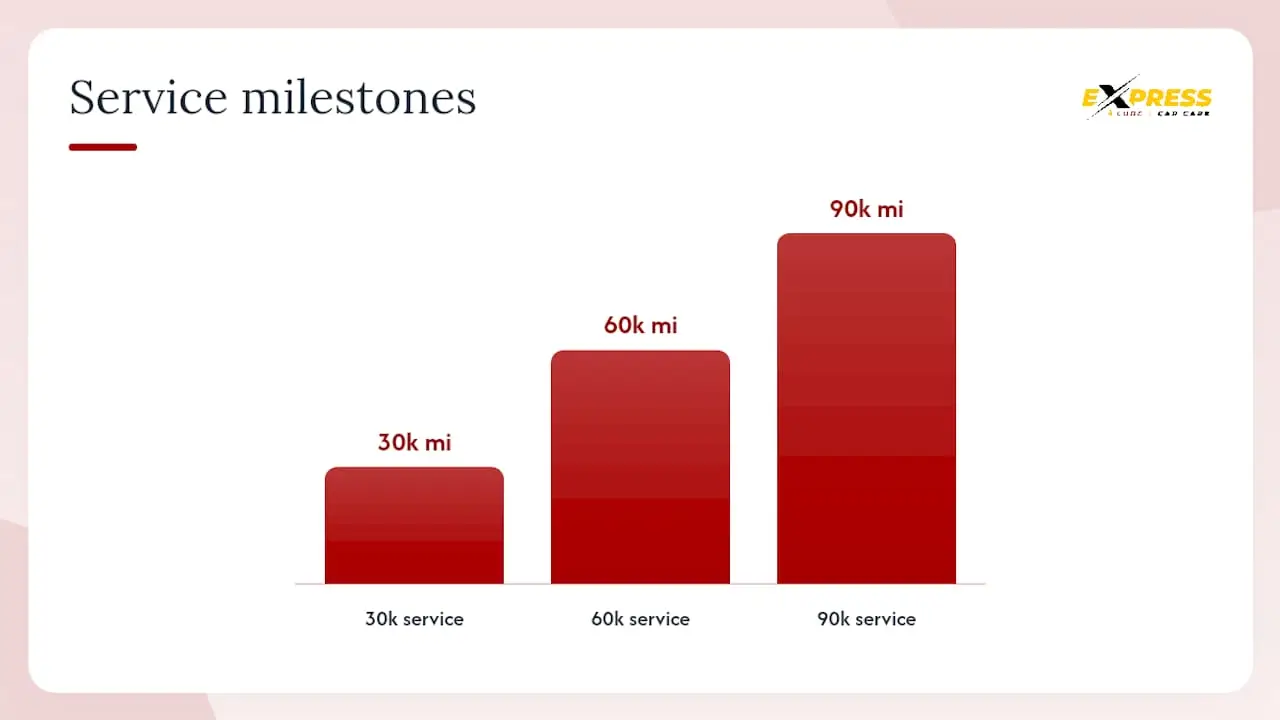
- Follow the manufacturer’s recommended service intervals (see the 30-60-90 rule as a planning anchor for 30k, 60k, and 90k milestones)
- Keep every receipt and service record, whether dealer or independent
- Request OEM or spec-equivalent parts and note them on the invoice
- Use a shop that provides a written repair warranty and a DVI report
- Track vehicle maintenance records carefully — they’re your proof if a warranty dispute arises
How to choose today: a practical checklist
Run through these five questions before you book any service appointment.
- Is the repair covered by an active manufacturer warranty or recall? If yes, go to the dealer. Full stop.
- Is the job software-dependent? ECU programming, ADAS calibration, or brand-specific diagnostics belong at the dealer for late-model vehicles.
- How old is the vehicle and what’s the mileage? Past five years or 60,000 miles, a trusted independent shop almost always makes more financial sense for most repairs.
- How cost-sensitive is this repair? For anything outside warranty coverage, get quotes from both. Independent shops routinely run 20–40% cheaper on routine maintenance.
- Can the shop document the work? Written estimates, DVI reports, and a shop warranty are non-negotiables. Learn how to evaluate an ASE-certified mechanic before you commit.
Questions to ask any service provider:
- Are your technicians ASE-certified or factory-trained for my vehicle?
- What warranty do you offer on parts and labor?
- Will you source OEM parts if I request them?
- Can you show me the estimated labor hours broken out from parts cost?
- Do you provide a digital vehicle inspection with photos?
Red flags that should make you pause:
- Vague verbal estimates with no written follow-up
- Reluctance to show old parts after a job
- Pressure to approve additional work without inspection photos
- No proof of certifications when asked
- No shop warranty offered on repairs
A shop that checks all five positive boxes and raises none of the red flags is worth building a relationship with. That kind of continuity pays dividends over the life of your vehicle.
Why Express Lube & Car Care belongs on your shortlist
For Arlington and DFW drivers weighing the local mechanic vs. dealership question, Expresslubearlington checks the boxes that matter most for routine and out-of-warranty work.
Verifiable trust signals:
- ASE-certified technicians on every job
- RepairPal Certified Shop status
- CarFax Top-Rated Service Center recognition
- 24-month/24,000-mile repair warranty on covered work
- Digital vehicle inspections with photos provided on every service
The shop handles far more than oil changes. Expresslubearlington covers brakes, diagnostics, A/C service, engine repairs, electrical work, transmission and suspension, state inspections, tire services, and fleet accounts. That scope means most out-of-warranty repairs you’d otherwise send to a dealer can be handled locally, faster, and at a lower cost.
Expresslubearlington fits the decision checklist above squarely: certified technicians, written warranty, DVI on every visit, and the ability to source OEM parts on request. For DFW drivers, it’s a practical first call before defaulting to the dealer for anything outside active warranty or recall work.
Key Takeaways
For most U.S. car owners, the right answer is simple: use the dealer while the warranty is active and for recalls, then switch to a trusted local shop for everything else.
| Point | Details |
|---|---|
| Warranty and recall work | Always use an authorized dealer for manufacturer-paid recalls and active warranty repairs. |
| Cost advantage of independents | Independent shops are commonly 20–40% cheaper on routine maintenance than dealerships. |
| Magnuson-Moss protection | Manufacturers cannot void your warranty solely for using an independent shop; they must prove causation. |
| Vetting a local shop | Confirm ASE certification, a written shop warranty, and DVI reports before committing to any independent. |
| Expresslubearlington for DFW drivers | ASE-certified, RepairPal Certified, CarFax Top-Rated, with a 24-month/24,000-mile warranty for routine and out-of-warranty repairs in Arlington, TX. |
The view from the bay
Most of the car owners we see at Expresslubearlington follow a predictable pattern: they stick with the dealer for the first couple of years, then start asking questions once the warranty expires and the bills climb. That’s not a coincidence. It’s the moment when the dealer premium stops being invisible.
What surprises people most is how often the work they assumed required a dealer doesn’t. Brake jobs, fluid services, diagnostics on common fault codes, A/C recharges — these are bread-and-butter repairs for any well-equipped independent shop. The cases where we genuinely tell someone to go to the dealer are narrow: active recall campaigns, brand-specific ECU programming, and certain ADAS calibrations that require manufacturer-only tools.
The other thing worth saying plainly: a digital vehicle inspection changes the dynamic entirely. When a technician can show you photos of worn brake pads or a leaking seal before asking for approval, the trust equation shifts. You’re not taking anyone’s word for it. That transparency is something every shop, dealer or independent, should offer as standard practice.
If you want to dig deeper into what a shop warranty actually covers and how it protects you, the warranty details page lays it out clearly.
Express Lube & Car Care is your local alternative to dealer pricing in Arlington
Dealer prices for out-of-warranty work add up fast, and most of those repairs don’t require a factory badge to fix correctly. Expresslubearlington gives Arlington and DFW drivers a full-service alternative: ASE-certified technicians, a 24-month/24,000-mile warranty, and transparent digital vehicle inspections on every visit.
Whether you’re due for an oil change, need brakes looked at, or want a full diagnostic before a long trip, the team handles it without the dealer wait times or the markup. Repair financing is also available for larger jobs through auto repair financing options if cost is a concern. Ready to book? Call or stop by the shop at 2840 in Arlington, TX, and let’s take a look at what your car actually needs.
Sources and further reading
- Should a Car Be Serviced at a Mechanic or Dealership?
- Corner Garage vs. Dealer Service Department
- Dealer vs Independent Mechanic: Cost, Quality, and When to Choose Each
- Average mechanic labor rate and repair costs in your state — AAA
- Should you service your car at a mechanic or a dealership?
- Dealership service center vs independent mechanic: what to know
- Why Choose An Independent Local Auto Repair Shop | Pacific Automotive
- What Is the 30‑60‑90 Rule for Cars? – Kwik Kar Craig Ranch
FAQ
Should I go to a dealership or a local mechanic?
Use the dealership for active warranty repairs, recalls, and brand-specific software work. For routine maintenance and out-of-warranty repairs, a reputable local mechanic with ASE certification typically costs less and schedules faster.
Do dealerships charge more than independent mechanics?
Yes. Dealer labor rates commonly run materially higher than independent shops in many U.S. markets, and parts markup follows a similar pattern, making independents the better value for most non-warranty work.
Will using a local mechanic void my car’s warranty?
Not automatically. The Magnuson-Moss Warranty Act requires the manufacturer to prove that the independent service or part caused the failure before denying a warranty claim. Keep your receipts and follow the manufacturer’s service schedule.
What is the 30-60-90 rule for cars?
The 30-60-90 rule refers to preventive maintenance milestones, including the 60,000-mile checkpoint, covering items like spark plugs, transmission fluid, belts, and coolant. These intervals are useful checkpoints when deciding where to schedule your next service.
Is it better to get work done at the dealership?
For warranty-covered repairs and recalls, yes. For everything else, independent shops are commonly significantly cheaper on routine maintenance, and a certified shop like Expresslubearlington offers a written warranty and DVI on every visit.