

TL;DR:
- Maintaining detailed vehicle records increases resale value, speeds up repairs, and protects warranty claims. Owners should keep organized logs, including dates, mileage, work details, and parts used, for at least three to five years. Digital backups and systematic tracking methods most effectively safeguard proof and streamline vehicle history management.
Vehicle maintenance records are the documented history of every service, repair, and inspection performed on your car. Knowing how vehicle maintenance records help is not just useful trivia. It directly affects your wallet, your warranty, and your safety on the road. A complete service log tells the full story of your car’s life, from the first oil change to the most recent brake inspection. Buyers trust it. Mechanics rely on it. Warranty providers require it. If you have ever sold a car and left money on the table, or had a warranty claim denied, missing records were likely the reason.
How vehicle maintenance records help your car run longer

A service log is your car’s memory. Without it, every mechanic who touches your vehicle starts from scratch, guessing what was done and when. With it, they can pinpoint issues quickly by seeing exactly what was replaced, what fluids were used, and how many miles ago the last service happened. That saves you time and money on every visit.
Tracking service intervals is the most direct way records prevent premature wear. When you know your last transmission fluid change was at 45,000 miles, you can schedule the next one before damage sets in. Skipping that step because you “can’t remember” is how small neglect turns into a $3,000 repair.
Records also reveal patterns that no single visit can show. If your brake pads are wearing out every 15,000 miles instead of the expected 30,000–50,000, your log will surface that trend. A mechanic with that context can check for a sticking caliper or driving habit issues before the next set of pads fails early.
- Date and mileage of every service visit
- Description of work performed, including part brands and fluid types
- Name and contact info of the shop or technician
- Cost of each service for budget tracking
- Any diagnostic codes pulled and their resolution
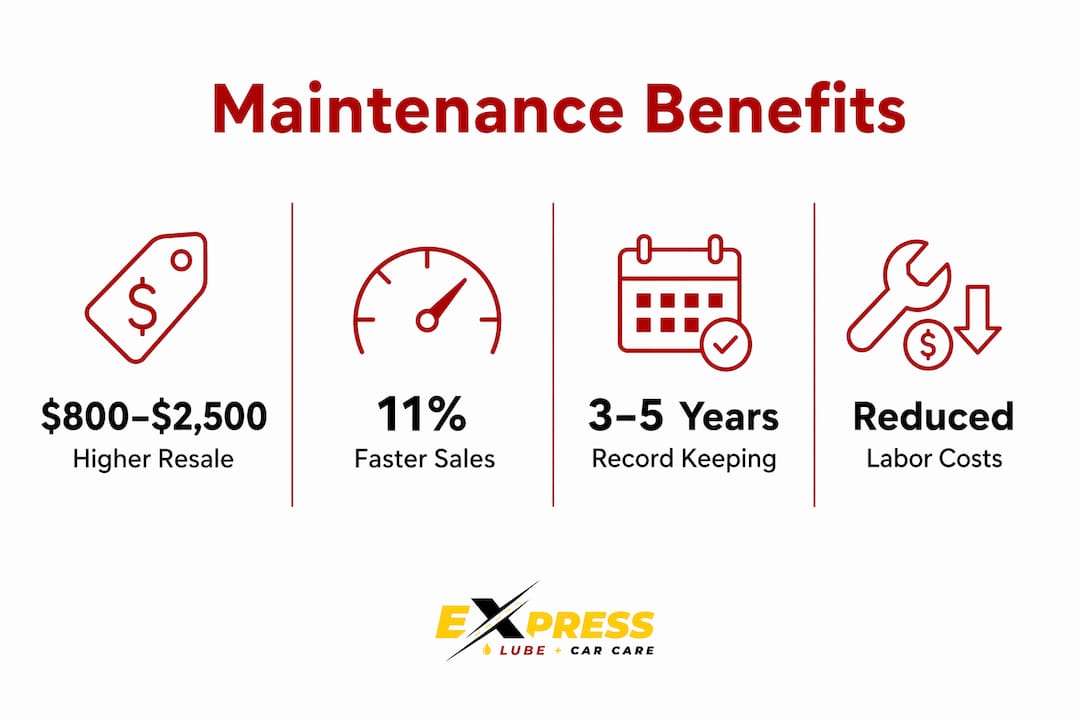
A detailed maintenance log also reduces mechanic labor costs by giving technicians a clear service timeline. Mechanics use part brands and service specifics to fine-tune diagnostics and avoid unnecessary repeat work.
Pro Tip: Update your log the same day as each service visit. Memory fades fast, and a one-week delay often means missing details like the specific oil grade or the mileage reading at drop-off.
Do maintenance records really increase resale value?
Yes, and the numbers are specific. A vehicle with a complete, documented service history sells for $800–$2,500 more in the US market, with luxury vehicles seeing the highest gains. That premium more than offsets the cost of dealer servicing over the life of the car.
Speed matters too. Vehicles with full, verifiable service records sell 11% faster than comparable vehicles with no documentation. At the wholesale and trade-in level, the price negotiation gap favors documented vehicles by 3–7%. That is real money left on the table when records are missing.
The psychology behind this is worth understanding. Maintenance records act as a proxy for the owner’s character, signaling care and responsibility to a buyer who has never met you. A buyer looking at two identical vehicles will pay more for the one with a folder of organized receipts. The records reduce their fear of hidden mechanical problems. That reduced fear translates directly into a higher offer and less negotiation pressure on you.
Think of it this way: a car without records is a mystery box. A car with records is an open book. Buyers pay a premium for certainty, and your service log is the proof they need.
For practical tips on boosting your car’s resale value, consistent documentation is one of the highest-return habits you can build from day one of ownership.
| Scenario | Typical outcome |
|---|---|
| Full service records, documented at every interval | Higher sale price, faster sale, stronger negotiating position |
| Partial records with gaps in service history | Moderate buyer confidence, price negotiation likely |
| No records, verbal claims of maintenance | Lowest offers, highest buyer skepticism, slowest sale |
How records protect you in warranty claims and legal disputes
Warranty providers deny claims far more often than most car owners realize. The most common reason is not a bad part. It is bad paperwork. Maintaining an organized folder of invoices and work orders is a critical requirement for warranty claim eligibility, and providers frequently deny claims without proof of factory-recommended maintenance at correct intervals.
Many owners assume their dealership keeps complete records on their behalf. That assumption is dangerous. Administrative gaps are frequent in dealership and manufacturer records, and the owner must keep personal copies for warranty or legal protection. Relying solely on dealer digital records risks denial during a dispute.
2026 consumer legal guidance recommends keeping warranty records for at least three to five years to protect coverage and dispute eligibility. Regular record reviews reduce the risk of claim denials. That is a minimum, not a ceiling. Keeping records for the full life of the vehicle costs nothing and protects everything.
Here is what to record for effective warranty defense:
- Date of service with the exact calendar date, not just the month or year
- Mileage in and out so the interval between services is clear and verifiable
- Description of work performed including diagnostic verification codes
- Parts used with brand names and part numbers where available
- Shop name, address, and technician signature as proof of professional service
For a deeper look at how auto warranties interact with repair documentation, the 2026 warranty guide covers the specific requirements that protect your coverage.
Pro Tip: Store digital photos of every receipt in a dedicated cloud folder. Paper fades, gets lost in moves, and survives neither floods nor fires. A digital backup costs nothing and keeps your proof intact for years.
Best practices for keeping accurate vehicle maintenance records
The best system is the one you will actually use. A consolidated service log that chronologically links records to mileage milestones creates a strong evidence base for both warranty claims and resale. Simple receipts alone are not enough. A service diary or organized log is far more effective than a glove box stuffed with loose paper.
You have several format options, and the right one depends on how you naturally organize information:
- Physical folder: A labeled accordion folder with sections by year works well for owners who prefer paper. File receipts immediately after each visit.
- Spreadsheet: A basic Google Sheets or Excel file with columns for date, mileage, service type, cost, and shop name is easy to search and share with buyers.
- Maintenance apps: Several apps designed for vehicle tracking let you log services, set reminders, and store receipt photos in one place.
- Photos of receipts: At minimum, photograph every receipt and store it in a dated folder on your phone or cloud storage.
If your records have gaps, you can reconstruct partial history using your VIN. Dealers and service chains often retain digital records of past visits. A VIN-based history report can fill in documented service events, though it will not capture work done at independent shops that did not report to national databases.
| Record format | Best for | Key advantage |
|---|---|---|
| Physical folder | Owners who prefer paper | Easy to hand over at point of sale |
| Spreadsheet | Detail-oriented owners | Searchable, shareable, free |
| Maintenance app | Busy owners on the go | Reminders and photo storage built in |
| Cloud photo archive | Minimal-effort owners | Fast to set up, hard to lose |
A complete car upkeep guide can help you build a tracking template that covers every service category your vehicle needs, from oil changes to tire rotations to timing belt replacements.
Key Takeaways
Accurate vehicle maintenance records protect your investment by increasing resale value, supporting warranty claims, and giving mechanics the history they need to diagnose problems efficiently.
| Point | Details |
|---|---|
| Records increase resale price | Documented vehicles sell for $800–$2,500 more and close 11% faster than undocumented ones. |
| Warranty protection requires proof | Providers deny claims without organized invoices showing factory-recommended service at correct intervals. |
| Logs reduce repair costs | A clear service timeline helps mechanics avoid unnecessary work and diagnose problems faster. |
| Digital backups prevent loss | Cloud photos of receipts protect your proof against fading, loss, or physical damage. |
| Keep records for 3–5 years minimum | 2026 consumer legal guidance sets this as the baseline for warranty and dispute coverage. |
Why I think most car owners are sitting on a costly blind spot
After years of watching car owners navigate repairs, resale negotiations, and warranty disputes, one pattern stands out clearly. The owners who treat their maintenance log as a living document almost always come out ahead. The ones who treat it as optional almost always pay for that choice later.
I have seen sellers lose $1,500 or more on a trade-in simply because they could not produce receipts for oil changes they genuinely performed. The work was done. The proof was gone. The dealer assumed the worst and priced accordingly. That is not a mechanical problem. It is a paperwork problem, and it is entirely preventable.
What surprises most people is how much a complete log changes the dynamic with mechanics too. When you walk in with a clear service history, a good technician can diagnose problems faster and skip the guesswork. You build a relationship based on shared knowledge of your car rather than starting from zero every visit. That relationship, built on documented trust, is one of the most underrated benefits of keeping vehicle records.
Start today, even if your records have gaps. Reconstruct what you can, photograph what you have, and log every service from this point forward. The habit takes five minutes per visit and pays back in hundreds or thousands of dollars over the life of your car.
— Hassan
Professional service that makes record-keeping easy
Every visit to Expresslubearlington comes with documented service records you can add directly to your maintenance log. Our ASE-certified technicians record the date, mileage, work performed, and parts used on every job, giving you exactly the paper trail that warranty providers and buyers want to see.
Expresslubearlington is a RepairPal Certified Shop and a CarFax Top-Rated Service Center, serving drivers across the DFW area. Whether you are due for an oil change or a more complex repair, our team keeps your vehicle and your records in top shape. Stop by today and let us help you build the service history your car deserves.
FAQ
What should vehicle maintenance records include?
Records should include the date of service, mileage in and out, a description of work performed, parts used with brand names, and the shop’s name and contact information. Diagnostic verification codes add further protection for warranty claims.
How long should I keep my car’s maintenance records?
2026 consumer legal guidance recommends keeping warranty-related records for at least three to five years. Keeping records for the full life of the vehicle offers the strongest protection for resale and legal disputes.
Do maintenance records really affect resale value?
Yes. A vehicle with complete service documentation sells for $800–$2,500 more in the US market and closes 11% faster than comparable vehicles without records. Buyers pay a premium for documented proof of care.
Can I rely on my dealership to keep my records?
No. Administrative gaps are frequent in dealership records, and owners must keep personal copies. Relying solely on dealer digital records risks denial during warranty disputes or resale negotiations.
What is the easiest way to track vehicle maintenance records?
A cloud folder of dated receipt photos is the lowest-effort system that still protects you. For more detail, a spreadsheet or dedicated maintenance app lets you log mileage, costs, and service types in a searchable format you can share with buyers or mechanics.