
Most of the time, a car that pulls to one side comes down to uneven tire pressure, wheel alignment, uneven tire wear, a dragging brake from a stuck caliper, or worn suspension and steering parts. NHTSA, Tire Rack, and our own technicians at Express Lube & Car Care all start with the simple stuff first. If the pull is sudden, severe, or comes with noise, smoke, or any loss of control, stop driving and call for service.
TL;DR:
- Use a gauge on all four tires when cold, after the car has sat three hours, and compare readings with the door placard.
- If the car drifts only on grooved roads or in certain lanes but tracks straight on smooth pavement, suspect tramlining before a mechanical fault.
- A pull that changes during braking, especially with a pulsing pedal, steering shimmy, hot wheel, or burning smell, calls for brake inspection before alignment.
- When a pull starts after tire replacement, check for mismatched models or tread depths, and replace tires in pairs or match models on each axle.
- Stop driving and call for service if the pull is sudden or severe, or comes with smoke, grinding noise, burning smell, or loss of control.
Table of Contents
- What can make your car pull to one side?
- How do you check why your car pulls?
- What repairs usually fix a car that pulls?
- How do brake problems other than a stuck caliper cause pulling?
- Can tire type or quality differences make a car pull?
- Can unbalanced tires make a car pull?
- Can power steering problems cause a car to pull?
- How can you keep your car from pulling again?
- How we approach a car that pulls
- Ready to get your car driving straight again?
- FAQ
- Sources
What can make your car pull to one side?
Think of a pull as your car telling you that something on one side is working differently than the other. The trick is figuring out which side, and why. Here are the usual suspects, with the clues that point to each.
- Uneven tire pressure: One low tire creates more rolling resistance on that side, so the car drifts toward it. NHTSA says to check tire pressure at least once a month when the tires are cold, and a quick glance won’t catch underinflation.
- Wheel alignment: Toe, camber, and thrust angle describe where each tire points compared to the vehicle’s centerline. If one side is off, the car tracks away from center, and Tire Rack notes that incorrect toe settings can push or pull a vehicle, especially on wet roads.
- Tire wear: Diagonal scuffing across the tread can point to a toe problem, because the tire is being dragged along a path offset from the centerline. Tire Rack explains that diagonal tread wear leads to uneven grip and a pull.
- Dragging brake: A stuck caliper keeps the pads pressed against the rotor even when your foot is off the pedal. You may notice the pull while coasting, a hot wheel after a drive, or a burning smell. Our guide to brake problem symptoms covers the warning signs in more detail.
- Worn suspension and steering parts: Tie rods, ball joints, and control arm bushings hold your wheels in position. When they wear, they add play, and the wheel can shift its angle under load, which shows up as a wandering or pulling car. Our rundown of tie rod end warning signs is a good place to start.
- Wheel bearings: A bearing that’s failing creates drag on one hub. You’ll often hear a hum or growl that changes with speed or when you turn.
- Tramlining: Sometimes there’s no mechanical pull at all. The car follows ruts or grooves worn into the road, which feels like a tug.
That last one trips up a lot of drivers, so it’s worth a closer look.
Tire Rack points out that tramlining is commonly mistaken for a mechanical pull, and it’s tied to tire responsiveness and alignment settings. If your car only drifts in certain lanes and tracks straight on smooth pavement, suspect the road and the tires before you suspect a repair.
Here’s a handy way to separate the two. A true mechanical pull follows you everywhere, on any road surface. Tramlining comes and goes with the pavement, and it tends to show up more with high-performance tires or worn suspension parts.
How do you check why your car pulls?
You don’t need a lift to gather useful clues. A few safe checks can narrow things down, and they give your technician a head start. Our car inspection checklist is a good companion if you want to go further.
- Check tire pressure cold. NHTSA defines cold tires as a vehicle that hasn’t been driven for at least three hours. Use a reliable gauge on all four tires and compare each one to the pressure on your door-jamb placard.
- Look at the tread. Run your eyes and fingers across each tire. Wear on one edge, scuffing at an angle, or a tire that looks different from its partner all point to an alignment or suspension issue.
- Check around the wheels. Look for brake fluid leaks, and feel (carefully, and only after the car has cooled) for a wheel that’s much hotter than the others, a sign of a dragging brake.
- Look for loose or damaged parts. With the car parked, grab the top and bottom of each front tire and see if there’s any play. A clunk or wobble means a worn part.
- Take a careful test drive. On a safe, quiet, straight road with no traffic, hold the wheel lightly at a steady speed and note which way the car drifts. Then see whether the pull changes when you brake, whether it’s constant or intermittent, and whether you hear or feel anything unusual.
Pro Tip: Write down what you notice (which direction, what speed, braking or coasting) and bring it with you. A detailed description can save a technician real diagnostic time.
A few red flags mean you should stop driving and get help right away: smoke, a grinding noise, a strong burning smell, or a drag so heavy that you’re fighting the wheel. Don’t try to push through any of those.
What repairs usually fix a car that pulls?
The good news is that many pulls have straightforward fixes. What you’ll need depends on what the checks turned up, and here’s what to expect from a technician.
- Pressure and rotation: If one tire was low, adjusting pressure may end the pull on the spot. Rotating tires can also help if wear is irregular, though a tire that’s already badly worn won’t straighten out from rotation alone.
- Brake service: For a dragging caliper, a technician inspects the pads and rotors, then frees or replaces the caliper and takes the car on a test drive to confirm the drag is gone. Our brake repair and pad replacement page explains what that visit includes.
- Suspension and steering parts: Worn tie rods, ball joints, or control arm bushings need replacing, because play in those parts keeps causing a pull no matter how well the tires are inflated.
- Wheel bearings: A noisy hub or one that feels rough when spun is the cue to replace the bearing.
- Follow-up checks: After suspension work or new tires, a technician will recheck how the car tracks, because new parts can change the angles the wheels sit at.
A typical visit follows a simple flow: inspection, estimate, repair, and a post-repair test drive. You see what’s wrong before anything gets approved.
How do brake problems other than a stuck caliper cause pulling?
A stuck caliper gets most of the attention, but it isn’t the only brake issue that can steer you off course. Uneven brake pad wear is one. If the pads on one side have worn down faster than the other, the two wheels grip differently when you press the pedal, and the car tugs toward the side that’s grabbing harder.
A collapsed brake hose is another sneaky culprit. From the outside, the hose looks fine, but the inside can swell or break down so that fluid gets in but doesn’t flow back out. The result is a brake that doesn’t fully release, so the wheel drags just like it would with a stuck caliper. You may notice the pull is worse after a long drive, or that one wheel runs noticeably hotter.
Rotors matter too. A rotor with uneven wear or a glazed surface can change how a wheel grips from one side to the other. If you notice a pulsing pedal, a steering wheel that shimmies when you brake, or a pull that appears only when you slow down, tell your technician. Those details help separate a brake problem from an alignment or tire issue.
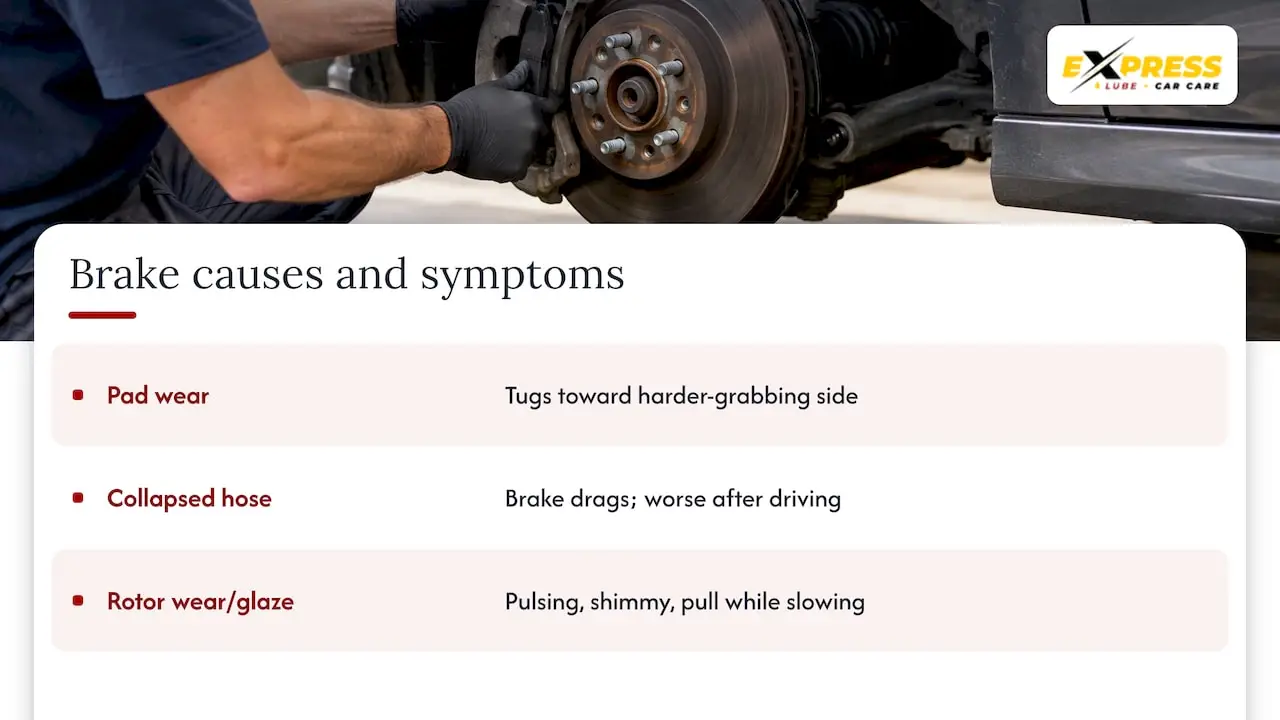
The takeaway is simple: if the pull shows up or changes when you touch the brakes, the brake system deserves a close look before anyone touches the alignment. And because brakes are a safety system, don’t wait on this one. Our post on why brake inspection frequency matters explains how regular checks catch these problems early.
Can tire type or quality differences make a car pull?
Absolutely, and it’s one of the easiest causes to overlook. Your car expects each side to behave the same way. If you’ve got two different tire models on the same axle, or tires with very different tread depth or construction, the sides grip and roll differently, and the car can drift toward the tire with more drag.
Mismatched tires are a common issue after a single tire replacement. If you swap in one new tire next to three worn ones, the new tire has more tread and a slightly larger rolling diameter. That small difference can be enough to nudge the car off line.
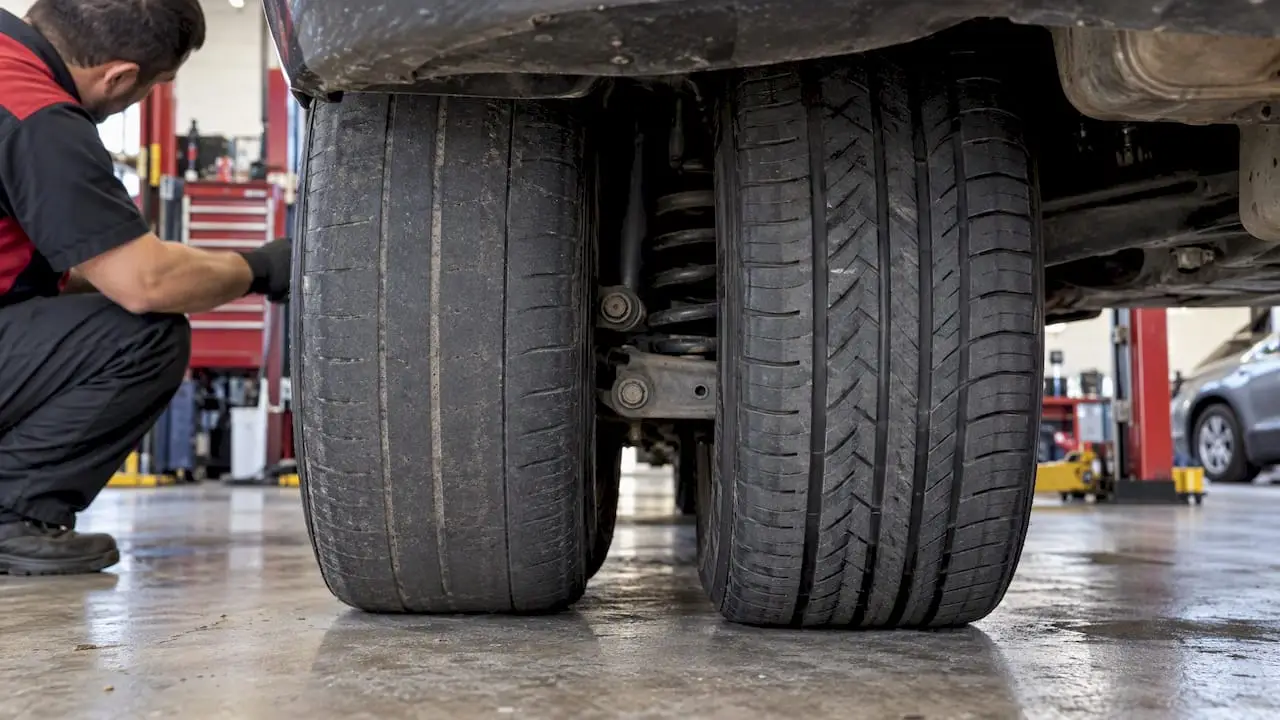
Tire design plays a role as well. Some tires have an asymmetric tread or a directional pattern, and mounting them wrong can affect how the car tracks. High-performance tires, with their sharper response, can also make a car more sensitive to road grooves, which circles back to the tramlining we covered above.
A few habits keep this problem away:
- Replace tires in pairs or full sets whenever you can, and match the model on each axle.
- Rotate on schedule so wear stays even. NHTSA notes that rotating tires reduces irregular wear, and your owner’s manual lists the interval and pattern for your car.
- Keep an eye on tread depth on all four tires, not just the front pair.
If your pull started right after new tires went on, mention that when you call. It’s a useful clue.
Can unbalanced tires make a car pull?
Balancing and pulling are different problems, but they get lumped together a lot. A tire that’s out of balance has a heavy spot, and that spot causes a vibration, usually felt in the steering wheel at highway speeds. Strictly speaking, imbalance doesn’t point the car left or right.
Where balance matters is in what it does over time. A wheel with a heavy spot hops and bounces as it spins, and that can wear the tire unevenly and put extra stress on bearings, bushings, and other suspension parts. Uneven wear then shows up as a car that feels unsettled or starts to wander, which can feel like a pull.
So if you feel a shake along with the drifting, balance is worth checking alongside the other causes. A vibration that changes with speed is the classic sign. If it comes with a pull, the two problems may be related, or you may have two separate issues stacked on top of each other.
Balancing is quick and inexpensive compared with replacing a prematurely worn tire. It’s smart to have it checked whenever new tires go on, after a flat repair, or any time you feel a new vibration. A technician can sort out which symptom comes from which cause, so you only pay to fix what’s actually wrong.
Can power steering problems cause a car to pull?
They can, though it usually feels a little different from a classic pull. Power steering helps you turn the wheel with less effort. When the system has trouble, the assist can become uneven, and the steering may feel heavier in one direction or seem to wander on its own.
Start with the basics. Low power steering fluid is a common culprit. If the level has dropped, there’s probably a leak somewhere, and the system can lose its ability to assist evenly. You might also hear a whine or groan when you turn the wheel, which is a hint that the pump is working harder than it should.
A struggling pump is the other thing to watch. When it can’t maintain pressure, you’ll often notice steering that feels stiff, jerky, or inconsistent. That uneven feel can make the car seem like it’s wandering or tugging, especially at low speeds or during turns.
Cars with electric power steering work differently, with a motor instead of a pump and fluid, but the symptoms can still include a heavy or uneven feel. Either way, a warning light on the dash is a sign to get the system looked at.
If your steering feels off and the tires and brakes check out, mention it to your technician. Steering faults affect control, so they’re worth taking seriously, and a proper diagnosis will tell you whether it’s the fluid, the pump, or something else.
How can you keep your car from pulling again?
A little routine care goes a long way, and none of it is complicated. Here’s a simple plan.
- Check pressure monthly, cold. Follow NHTSA’s guidance and use a good gauge. The vehicle placard lists your target numbers, and tire makers like Pirelli also publish guidance on reading recommended tire pressure.
- Rotate tires on schedule. Even wear keeps the car tracking straight. Our guide to the tire rotation interval explains how often to do it.
- Get an alignment check after an impact or change. Hitting a pothole or curb, installing new tires, or changing ride height can all shift your wheel angles. Even lowering springs can push camber out of spec, and Tire Rack notes that an alignment kit may be needed after those changes.
- Inspect the suspension now and then. Have a technician look at tie rods, ball joints, and bushings so small wear doesn’t become a big pull.
Pro Tip: Ask for a digital vehicle inspection with photos and videos at each visit. Looking back at those images over time shows you how your tires and parts are wearing, so you can fix problems before they grow.
Our maintenance services cover many of these routine checks in a single visit. If your car has air suspension, there are extra steps too, and this article on air suspension maintenance walks through monthly tank drains.
How we approach a car that pulls
When you bring a pulling car to us, a technician doesn’t guess. Our ASE-certified team starts with the same basics you’ve just read about: a visual inspection, a tire pressure check, and a road test to feel the problem for themselves. Then we document what we find with a digital vehicle inspection that includes photos and videos, so you can see exactly what we see.
We’re a RepairPal Certified Shop and a Top-Rated Service Center according to CARFAX, and we stand behind qualifying repairs with a 24-month/24,000-mile warranty. That transparency matters most when the fix involves safety systems like brakes and steering.
— Express Lube & Car Care
Ready to get your car driving straight again?
If your car drifts and you can’t pin down why, we’ll find out. Book a diagnostic with our ASE-certified technicians in Arlington, and we’ll check the likely culprits, show you the results, and recommend next steps.

- Start on our services page, where you’ll find brakes, steering and suspension work, check engine diagnostics, and more.
- Look at our brake repair and pad replacement page if you suspect a dragging brake.
- Use our maintenance page to schedule tire rotation and other preventive care.
Call us or book online, and bring your notes from the checks above. The more you can tell us about when and how your car pulls, the faster we can get to the answer.
FAQ
Why does my car pull to the right when I let go of the wheel?
Usually something is different from one side to the other, such as a low tire, an alignment problem, a dragging brake, or worn steering parts. Check your cold tire pressure first, since that’s the simplest cause. If the tires are fine, a technician can inspect the brakes, suspension, and alignment.
Will my car flip if I drift to one side?
A gentle drift on its own isn’t likely to flip a car, but it can put you out of your lane and make it harder to react in an emergency. If the pull is severe or comes on suddenly, slow down safely and get the car checked right away. Don’t keep driving on a car that fights you.
What does a messed up alignment feel like?
Common signs include the car drifting off center, a steering wheel that sits crooked when you’re driving straight, and tires wearing unevenly. Tire Rack notes that incorrect toe and other settings can push or pull a vehicle. Wear on one edge of a tire is another clue.
How do I figure out if my car pulls because of the road or the car?
Drive on a few different safe, smooth roads. If the pull follows you everywhere, it’s likely mechanical. If it only happens in certain lanes or on grooved pavement, it may be tramlining, which Tire Rack describes as commonly mistaken for a pull.
Is it safe to drive a car that pulls to one side?
A mild pull from low tire pressure is usually fine to drive on while you fix it, but anything sudden, severe, or paired with noise, smoke, or a burning smell is not. In those cases, stop and call for service. When in doubt, have it inspected before you take a longer trip.