

Most drivers should rotate their tires every 5,000 to 8,000 miles, according to NHTSA’s tire safety guidance, but your owner’s manual always has the final word. If you drive a lot of short trips, tow, or notice vibration or pulling, rotate sooner. While you’re at it, check your tire pressure and tread depth too.
TL;DR:
- Most drivers should rotate their tires every 5,000 to 8,000 miles, but always follow your vehicle manufacturer’s specific recommendations.
- Short trips, towing, or noticing vibration can require earlier rotations, while steady highway driving allows for longer intervals within the recommended range.
- Different drivetrain types require specific rotation patterns: front-wheel drive typically uses a forward cross, rear-wheel and four-wheel drive use a rearward cross, and all-wheel drive often employs an X-pattern.
- The first tire rotation is critically important for catching uneven wear early and should occur sooner if you observe signs like uneven tread, vibration, or vehicle pulling.
- Keep records of each rotation to support warranty claims, improve vehicle handling, and maximize tire lifespan through consistent maintenance practices.
Table of Contents
- What’s the recommended tire rotation interval?
- Which rotation pattern fits your drivetrain?
- Signs you need a rotation sooner than scheduled
- How rotation fits into your overall maintenance routine
- Special cases: directional, staggered, and spare tires
- Why ASE-certified service and documentation matter
- What actually matters most with tire rotation
- Schedule your tire rotation with Express Lube & Car Care
- FAQ
- Sources
What’s the recommended tire rotation interval?
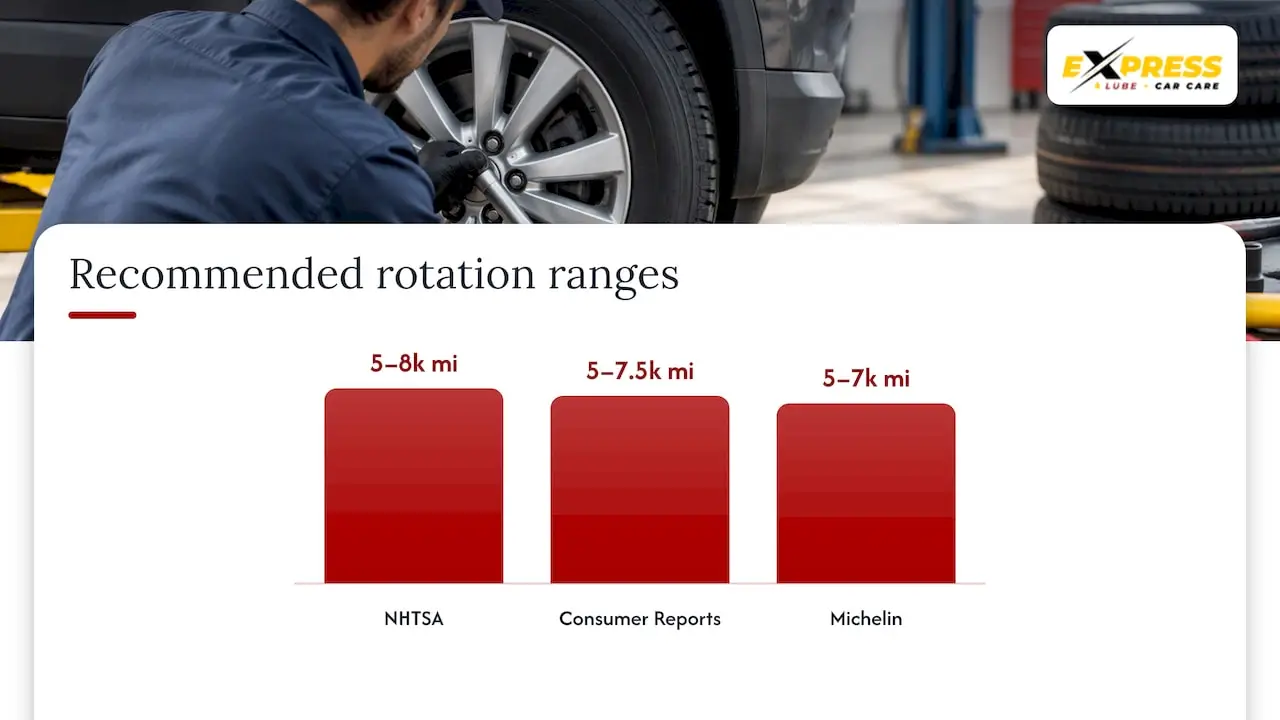
Here’s the thing about tire rotation intervals: there’s no single magic number, but there is a solid range to work with. NHTSA points to 5,000 to 8,000 miles when your vehicle manufacturer hasn’t specified something different. Consumer Reports narrows that slightly, recommending 5,000 to 7,500 miles. Michelin lands in a similar zone at 5,000 to 7,000 miles, or every other oil change, whichever feels easier to remember.
Why the range instead of one hard number? Because your driving habits matter as much as the mileage on your odometer. Frequent short trips, stop-and-go traffic, heavy braking, or regularly hauling cargo all accelerate uneven tread wear, which pushes you toward the shorter end of that range. Steady highway commuters with lighter loads can often stretch toward the longer end.
One important note on warranty coverage: skipping rotations can jeopardize your tire mileage warranty, since many manufacturers require documented rotation history as proof of proper maintenance.
Two schedules work well for most drivers:
- Every 5,000 miles, paired with your oil change: simple to remember and keeps wear consistent, especially for daily commuters.
- Every 7,500 miles: a reasonable stretch for drivers with lighter mileage or less demanding routes.
Michelin’s own guidance backs up both approaches: rotating every 5,000 to 7,000 miles, or every other oil change, keeps tread wear even and extends the life of your tires. Whatever schedule you pick, your owner’s manual is the final authority, since manufacturers sometimes set tighter intervals based on your specific tire and suspension setup.
Which rotation pattern fits your drivetrain?
Not every tire rotation pattern works for every vehicle, and using the wrong one can actually create uneven wear instead of preventing it. Your drivetrain determines which pattern makes sense.
- Front-wheel drive (FWD): typically uses a forward cross pattern, moving rear tires diagonally to the front.
- Rear-wheel drive (RWD) and four-wheel drive (4WD): usually call for a rearward cross, sending front tires diagonally to the rear.
- All-wheel drive (AWD): often uses an X-pattern, crossing all four tires diagonally.
- Directional or staggered tires: limited to a front-to-back, same-side swap, since the tread design or tire size restricts crossing sides.
If your vehicle has a full-size matching spare, you can work it into the rotation to spread wear across five tires instead of four, which stretches the life of the whole set. After any rotation, double check inflation pressure for each tire’s new position, since front and rear axles often call for different PSI.
Directional and asymmetrical tires are the exception that trips up a lot of people. These tires are built to roll in one direction only, so crossing them side to side can hurt performance and even create a safety issue. When in doubt, your owner’s manual or a quick conversation with a technician will tell you exactly which pattern applies to your setup.
Signs you need a rotation sooner than scheduled
Your first rotation matters more than people realize. According to USTMA’s Tire Care and Safety Guide, the first rotation is the most important one, because catching uneven wear early prevents it from becoming a permanent pattern baked into the tread. Wait too long, and that early wear can shorten the life of the tire no matter how faithfully you rotate afterward.
Watch for these warning signs between scheduled rotations:
- Uneven tread wear you can see or feel across the tire’s surface.
- Cupping or scalloped wear patterns, often a sign of suspension issues combined with delayed rotation.
- Vibration at highway speeds, which can point to an imbalance made worse by uneven wear.
- Your vehicle pulling to one side, suggesting pressure or wear differences between tires.
If you spot any of these, don’t wait for your next scheduled mileage mark. Keep a record of each rotation, too. Not only does it support tire mileage warranty claims, it also adds value if you sell the vehicle down the road.
How rotation fits into your overall maintenance routine
Rotation rarely happens in isolation at a good shop. It’s really part of a short checklist that keeps your tires, and your whole vehicle, running safely.
- Tire pressure check and adjustment to each axle’s specified PSI.
- Tread depth measurement across all four tires, which also flags when replacement is approaching.
- Wheel balance check, especially if you’ve felt vibration.
- Visual inspection for cuts, bulges, or embedded debris.
- Valve stem condition, since a cracked or brittle stem can cause slow leaks.
If your technician notices pulling or uneven wear patterns, that’s a signal to address the underlying cause first, since rotating tires without fixing the root issue just delays the inevitable.
Pro Tip: Bring a quick mental checklist to your next visit, tires, pressure, tread, and any noise or pull you’ve noticed, so your technician can address everything in one visit.
For a broader view of what your vehicle needs at each mileage marker, our car maintenance schedule by mileage walks through the other checks worth bundling with your rotation.
Special cases: directional, staggered, and spare tires
A few setups don’t follow the standard rotation rules, and treating them like a normal tire can cause problems.
- Directional tires have tread designed to roll one way only, so they can only move front to back on the same side, never crossed.
- Staggered setups, where front and rear tires are different sizes, usually can’t be cross-rotated at all, since the sizes won’t fit the opposite axle.
- Full-size spares that match your other tires can often join the rotation.
- Temporary spares (“donuts”) should never be included in a rotation, since they’re built for short-distance, low-speed use only.
If your vehicle sits unused for long stretches, flat spots can develop on tires left in one position too long. Our partners at Asphalt Lots cover practical ways to prevent that during storage.
Why ASE-certified service and documentation matter
The mileage ranges we’ve covered aren’t guesswork. NHTSA and USTMA both back the 5,000 to 8,000 mile window, and that guidance shapes how we approach every rotation we perform.
USTMA’s guide confirms that rotation’s main job is equalizing tread wear, which prevents early tire failure and keeps handling and fuel economy consistent. That’s the whole point of staying on schedule.
Our ASE-certified technicians document every rotation with digital, vehicle-linked records, the kind of paperwork that makes tire mileage warranty claims far less of a headache if you ever need one.
Pro Tip: Bring your tire purchase receipt or warranty paperwork to your rotation appointment so we can log it alongside your service record.
What actually matters most with tire rotation
Here’s where a lot of advice online gets it backward: people fixate on hitting an exact mileage number, as if rotating at 5,412 miles instead of 5,000 makes a meaningful difference. It doesn’t. What actually matters is consistency and catching problems early, not precision to the mile.
The first rotation deserves more attention than it usually gets. We see plenty of vehicles that developed a wear pattern in the first few thousand miles simply because nobody rotated the tires early, and that pattern never fully goes away. If you only remember one piece of advice from this guide, make it that one.
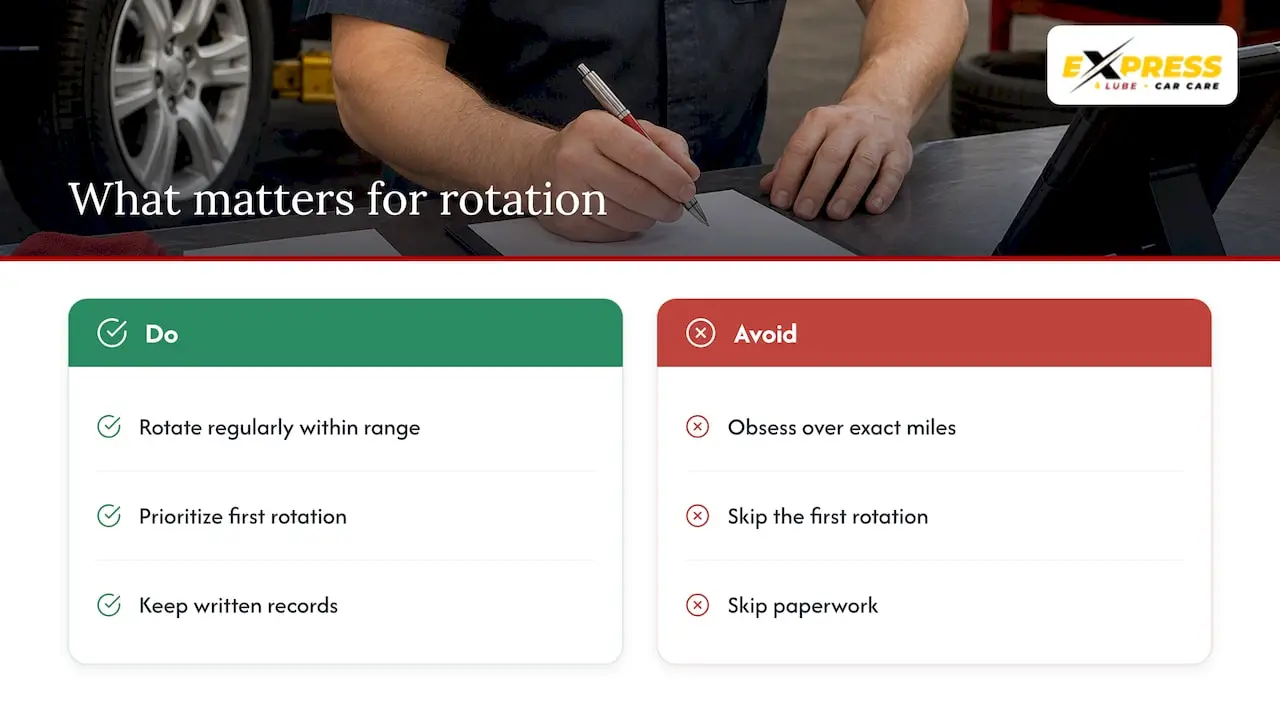
The other overlooked piece is recordkeeping. Drivers treat rotation like a quick, forgettable task, but a documented history protects your tire warranty and adds real value when you sell the car. Skip the paperwork and you’re leaving money on the table for no good reason.
Prioritize the first rotation, keep records, and let the exact mileage flex within the recommended range based on how you actually drive.
— Express Lube & Car Care
Schedule your tire rotation with Express Lube & Car Care
We make tire rotation simple: book it alongside your next oil change, and our technicians will check pressure, tread depth, and balance while they’re at it, all documented in your digital vehicle record for easy warranty reference later.

If you’re not sure which rotation pattern fits your vehicle, or you’ve noticed vibration, pulling, or uneven wear, bring it in and we’ll sort it out. Our maintenance services cover rotation alongside the pressure, tread, and inspection checks that keep small issues from turning into expensive ones. For fleet vehicles, our fleet services keep every vehicle on a consistent rotation schedule without you having to track it yourself.
Ready to get started? Schedule your appointment and we’ll take it from there.
FAQ
Do I really need to rotate my tires every 5,000 miles?
Not exactly every 5,000 miles on the dot, but it’s a solid benchmark. NHTSA and Consumer Reports both point to the 5,000 to 8,000 mile range, so pairing rotation with every oil change keeps you well within that window.
Is it okay to rotate tires every 7,500 miles?
Yes, 7,500 miles falls within the range Consumer Reports recommends, and it’s a reasonable interval for drivers with lighter mileage or mostly highway commutes. Just check your owner’s manual first, since some manufacturers set tighter requirements.
Can you rotate tires every 3,000 miles?
Rotating that often won’t hurt your tires, but it’s more frequent than the guidance from NHTSA or Michelin calls for. It makes more sense to match rotation with your oil change schedule instead, which usually lands closer to the recommended range anyway.
What are signs I need a tire rotation?
Uneven tread wear, cupping, vibration at highway speeds, and your vehicle pulling to one side are all signs worth addressing sooner rather than later. If you notice any of these between scheduled rotations, it’s worth having a technician take a look before your next planned visit.
Sources
- Tire Safety Ratings and Awareness | TireWise | NHTSA
- Tire care and safety guide (USTMA/USTires)
- How often should you rotate your tires? – Consumer Reports
- Tire rotation: why it matters and how to do it – Michelin