

A modern tune-up means inspecting and servicing ignition parts, filters, fluids, belts and hoses, the battery and charging system, and running basic diagnostics. It’s not the old carburetor and points adjustments your dad used to do in the driveway. Today’s version is inspection-driven and tied to your owner’s manual, catching small problems before they become expensive ones.
TL;DR:
- Modern tune-ups focus on inspection and maintenance based on your vehicle’s manual, not automatic part replacements or yearly intervals.
- Spark plugs, filters, belts, hoses, the battery, and fluids are checked or replaced according to vehicle-specific mileage recommendations, often between 12,000 and 120,000 miles.
- Many tune-up tasks like filter changes and basic diagnostics are DIY-friendly, but complex repairs such as timing belt replacement should be left to professionals.
- Unusual symptoms like a burning smell or flashing check engine light demand immediate attention rather than waiting for the next scheduled service.
- Accurate inspection-driven maintenance prevents unnecessary costs and ensures safety, with digital records helping track what your vehicle actually needs.
Table of Contents
- What Tune Up Components Actually Cover
- Why Tune-Ups Look Different Than They Used To
- How Often Tune Up Components Need Replacing
- Which Tune Up Tasks Can You Do Yourself?
- Your Step-by-Step Tune-Up Checklist
- How Much Time and Money Should You Expect to Spend?
- How a Certified Shop Documents Tune-Up Work
- Why We Trust Inspections Over Automatic Part Swaps
- Book a Tune-Up Backed by Real Documentation
- Where to Verify Tune-Up Specs Yourself
- Sources
- FAQ
What Tune Up Components Actually Cover
Here’s the thing about “tune-up” as a phrase: it’s a little outdated, and shops know it. There’s no single universal checklist, but a handful of systems show up in nearly every professional inspection. Let’s break down what each part does and why a technician cares about it.
- Spark plugs and ignition coils/wires fire the air-fuel mixture in each cylinder. Modern platinum and iridium plugs can last well past 100,000 miles, so swapping them early rarely helps. Using the wrong heat range or thread reach, though, can cause pre-ignition or fouling, so the manufacturer’s exact spec matters.
- Engine and cabin air filters keep debris and dust out of your engine and cabin air system. A clogged engine filter can choke performance and hurt fuel economy; a dirty cabin air filter usually announces itself with a musty smell or weak airflow from the vents.
- Fuel filter and fuel-system checks matter more on older or higher-mileage vehicles, since many newer cars integrate the filter into the fuel pump assembly.
- Belts and hoses (serpentine belts, and timing belts where applicable) keep your accessories and, in some engines, your valves and pistons synced. Timing belt work is not a DIY job. It requires precise alignment and often gets paired with a new water pump and tensioners while the engine is already apart, since labor access overlaps.
- Battery and charging system get a voltage test, a look at terminal corrosion, and an alternator output check. A slow crank or dimming headlights at idle are early warning signs worth catching during a tune-up rather than on the side of the road.
- Fluids cover engine oil, coolant, brake fluid, and transmission fluid. An oil change is routine; a fluid flush is a bigger job reserved for fluids showing contamination or age.
- Brakes, suspension, and exhaust get a visual check, not a repair, unless something’s clearly worn. Technicians look here because these systems affect safety directly.
- OBD-II diagnostics and sensor checks pull any stored or pending codes. A code doesn’t automatically mean a part needs replacing; a qualified technician correlates it with live data and symptoms first.
Why Tune-Ups Look Different Than They Used To
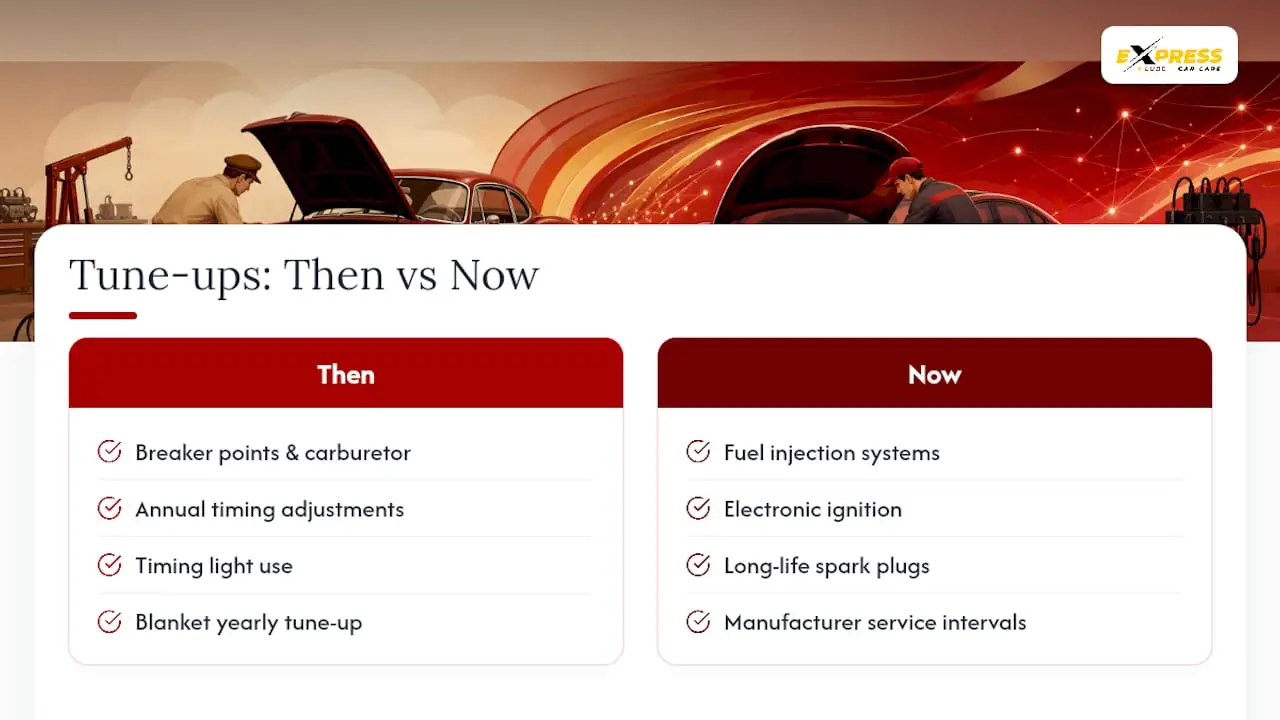
If you remember tune-ups meaning new points, a carburetor adjustment, and a timing light every spring, you’re not imagining things. That era is gone for good reason. Fuel injection replaced carburetors decades ago, and electronic ignition replaced breaker points, eliminating the annual adjustments those older systems demanded.
Long-life spark plugs and manufacturer-based service intervals have replaced the blanket yearly tune-up. Consumer Reports has been blunt about this: many modern vehicles simply don’t need the periodic tune-up in the old sense, and swapping parts that aren’t worn just adds cost. Your best defense against an unnecessary upsell is your owner’s manual and the shop’s actual inspection findings, not a generic “it’s been a year” schedule.
How Often Tune Up Components Need Replacing
Intervals vary by part, vehicle, and how you drive. As a general guide:
- Spark plugs: often 60,000 to 120,000 miles, depending on plug material and engine design.
- Air filters (engine and cabin): roughly 12,000 to 30,000 miles.
- Timing belts, where the engine uses one: typically 60,000 to 100,000 miles.
Severe driving conditions push those numbers earlier. Towing, dusty roads, and extreme heat or cold all shorten component life and call for more frequent inspection. Your owner’s manual lists the manufacturer’s actual intervals for your specific engine, and that number always beats a generic rule of thumb.
Which Tune Up Tasks Can You Do Yourself?
Some of this is genuinely approachable weekend work. Others need a lift, a scan tool, and training you probably don’t have, and shouldn’t try to improvise.
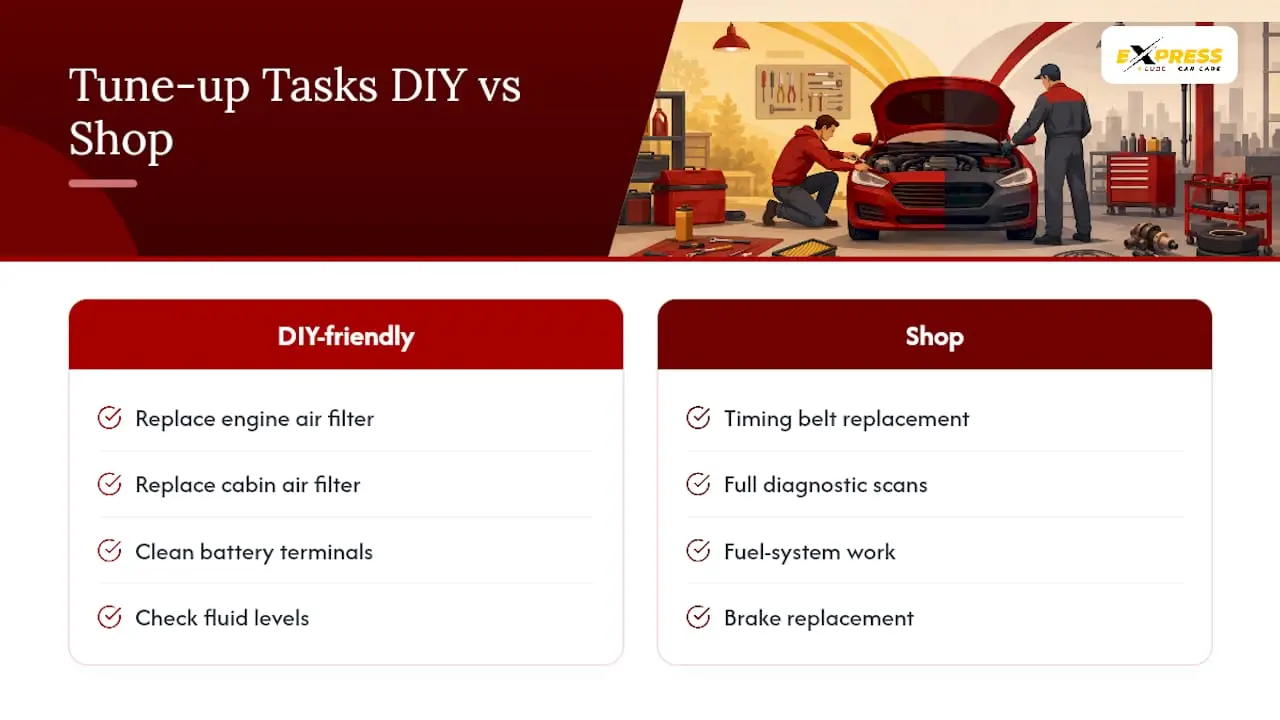
DIY-friendly: swapping engine and cabin air filters, cleaning battery terminals, checking fluid levels, and replacing spark plugs on engines with easy access.
Leave it to a shop: timing belt replacement, full diagnostic scans, fuel-system work, brake replacement, and suspension repairs. These carry real safety stakes and often require torque specs and procedures that are easy to get wrong without the right tools.
Pro Tip: Always torque spark plugs to the manufacturer’s spec. Over-tightening can crack the cylinder head; under-tightening can cause a misfire or even let a plug work loose while driving.
Your Step-by-Step Tune-Up Checklist
Whether you’re doing this yourself or handing your keys to a shop, this order keeps you from missing anything:
- Walk-around visual check — look for fluid leaks, worn tires, and warning lights on the dash.
- Pop the hood — inspect belts for cracking, hoses for soft spots or bulges, and check fluid levels.
- Check the battery — clean terminals, test voltage, confirm the alternator is charging properly.
- Replace or inspect filters — engine air filter, cabin air filter, fuel filter if accessible.
- Inspect or replace spark plugs — following manufacturer type and gap specs exactly.
- Run an OBD-II scan — record any stored or pending codes for follow-up.
- Visually inspect brakes, suspension, and exhaust — flag anything showing wear.
- Document everything — parts replaced, mileage, and the next recommended service date.
Smoke, a strong burning smell, a check-engine light that’s flashing rather than steady, or fluid pooling under the car all mean stop and get it looked at now, not after your next paycheck.
How Much Time and Money Should You Expect to Spend?
Time and cost swing a lot depending on what your vehicle actually needs. An oil and filter change usually runs 30 to 60 minutes. Spark plug replacement takes anywhere from one to three hours, depending on how buried the plugs are in your particular engine. Timing belt jobs can eat up several hours because of the disassembly involved.
Cost depends on parts quality, local labor rates, your vehicle’s make and model, and whether the inspection turns up anything beyond the basics. The smartest move is to request an itemized estimate before work starts, and prioritize whatever the inspection actually flags over anything a shop suggests just because it’s “been a while.”
How a Certified Shop Documents Tune-Up Work
At Express Lube & Car Care, tune-up work starts with a digital multipoint inspection, complete with photos and video, so you can see exactly what an ASE-certified technician found. Findings get matched against your owner’s manual’s schedule, then you receive an itemized report with clear next-interval recommendations. Nothing gets replaced on a guess.
Why We Trust Inspections Over Automatic Part Swaps
Here’s our honest take: a tune-up should function as a diagnostic checkpoint, not an automatic parts-replacement ritual. Swapping components that show no wear wastes your money and doesn’t make your car run better. The stronger approach is inspection-first, repair-second, backed by records you can actually reference at your next visit.
— Express Lube & Car Care
Book a Tune-Up Backed by Real Documentation
Some shops offer digital multipoint inspections with photos and video for tune-ups, performed by ASE-certified technicians who match findings to your owner’s manual. Most tune-up work gets same-day turnaround.

If your check-engine light has been on, your idle feels rough, or it’s simply been a while since anyone looked under your hood, book a tune-up and get a documented, itemized report on exactly what your vehicle needs next. While you’re at it, pair it with a look at your routine maintenance schedule so you’re not chasing repairs one at a time.
Where to Verify Tune-Up Specs Yourself
Your owner’s manual remains the single best source for your vehicle’s exact intervals and parts specs. Beyond that, a few trusted resources are worth bookmarking:
- AAA’s mechanic guidance on what a tune-up actually covers
- Consumer Reports on when you do and don’t need a tune-up
- Kelley Blue Book’s breakdown of tune-up components and timing
- EPA fuel-saving tips tied to proper maintenance
Sources
- Ask a Mechanic: What Is a Tuneup? — AAA network magazine
- You probably don’t need a tune-up — Consumer Reports
- Car Tuneup: What They Mean and When You Need One — KBB
- Fuel-saving tips — EPA
FAQ
What should a full tune-up consist of?
A full tune-up typically covers ignition components like spark plugs and coils, engine and cabin air filters, belts and hoses, battery and charging system checks, fluid levels, and a visual inspection of brakes, suspension, and exhaust. Most shops also run an OBD-II diagnostic scan to catch stored or pending codes before recommending any repairs.
What is the average cost for a full tune-up?
Cost depends heavily on your vehicle’s make, model, and what the inspection finds, so there’s no single fixed number. Express Lube & Car Care’s current tune-up pricing is available on the services page, and we recommend requesting an itemized estimate before any work begins.
What else needs to be replaced when replacing spark plugs?
Spark plugs alone don’t automatically require other parts, but a technician will often check ignition coils and wires at the same time since they wear together. If you’re also having timing belt work done, it’s often efficient to replace the water pump and tensioners simultaneously since the labor access overlaps.
What does an engine tune-up kit typically include?
A basic tune-up kit generally includes spark plugs, an air filter, and sometimes a fuel filter, though the exact contents vary by engine. Ignition coils or wires are often bundled in for engines where those parts are due for inspection or replacement.
Does my car need a tune-up if the check-engine light isn’t on?
Yes. Plenty of tune-up items, like a dirty air filter or worn accessory belt, don’t trigger a warning light but still affect performance and fuel economy. A scheduled inspection catches these before they become dashboard warnings.