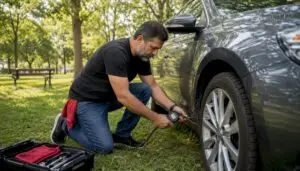

The legal minimum tire tread depth is 2/32 of an inch on passenger vehicles, and driving below that line is against the law in every state. But “legal” and “safe” are not the same thing. Most technicians recommend replacing tires once tread hits 4/32" for wet roads and 5/32" if you drive in snow or ice, well before you’d ever get a citation for it.
TL;DR:
- Replacing tires at 4/32" or above is advisable for wet conditions, as wet braking and hydroplaning resistance decline before reaching the legal 2/32" limit.
- Commercial steer tires should be replaced proactively at 4/32", measured in the deepest groove, to prevent safety risks and avoid roadside violations.
- Checking tread depth with a quarter or gauge at multiple points on each tire provides a more accurate assessment than using coins alone or waiting for the wear bars.
- Waiting until tires reach 2/32" poses significant safety hazards, especially during rain or snow, due to sharply reduced traction.
- Regular inspections and early replacements help avoid dangerous driving conditions and costly roadside interventions.
Table of Contents
- What Is the Minimum Tire Tread Depth Allowed by Law?
- How Does Tread Depth Affect Wet Braking and Hydroplaning?
- What Are the FMCSA Tread Depth Rules for Commercial Vehicles?
- How Do You Measure Tire Tread Depth Yourself?
- When Should You Actually Replace Your Tires?
- Why Do Tires Wear Unevenly, and What Can You Do About It?
- What Does a Technician Check During a Tire Inspection?
- Why Proactive Tire Replacement Beats Waiting for the Legal Line
- Get Your Tread Checked Before It Becomes a Problem
- Sources
- FAQ
What Is the Minimum Tire Tread Depth Allowed by Law?
The federal baseline is 2/32 of an inch, and it applies to passenger vehicle tires nationwide. This comes straight from 49 CFR § 570.9, which spells out that passenger tire tread “shall not project less than 2/32 of an inch” and describes how inspectors are supposed to check it. Research backing this threshold shows traction drops off sharply once tires wear down that far, which is exactly why the number exists in the first place.
Every tire made for sale in the U.S. has built-in wear bars, small raised rubber ridges hiding in the tread grooves. They’re invisible when your tread is healthy. Once the tread wears down enough that the bars sit flush with the surrounding rubber, you’ve hit 2/32" and the tire is legally done.
A few things worth knowing about how this plays out on the road:
- Some states add their own inspection quirks on top of the federal floor, so check your local rules if you’re near a state line or driving for work.
- The federal number is a floor, not a target. Nobody engineered 2/32" to be a good place to stop.
- If a wear bar is flush with the tread anywhere around the tire, that tire needs to come off the vehicle now, not “on the next paycheck.”
Think of 2/32" as the point where the state says you’re breaking the law. It’s not the point where your tires are still doing their job well.
How Does Tread Depth Affect Wet Braking and Hydroplaning?
Tread grooves exist to push water out from under the tire so rubber can actually touch the road. As those grooves shrink, water has nowhere to go, and your tires start riding on a thin film of water instead of pavement. That’s hydroplaning, and it gets more likely with every 32nd of an inch you lose.
Statistic Callout: Industry and fleet guidance shows wet stopping distances and hydroplaning resistance both decline noticeably before tires reach the legal 2/32" limit, which is why the recommended replacement point sits well above the compliance floor.
Here’s what that means for your driving habits:
- If you drive in rain regularly, plan to replace tires at 4/32", not 2/32".
- Heavy vehicles, loaded trucks, and trailers need more margin because stopping distance grows with weight.
- High-speed driving (highway commutes, road trips) shrinks your reaction window when hydroplaning starts, so don’t wait until tread is legally illegal to act.
Michelin’s guidance on tread depth echoes the same point: tires perform worse in wet conditions well before they cross the legal line. Waiting for the wear bars to show up is waiting too long if you drive in rain more than occasionally.
What Are the FMCSA Tread Depth Rules for Commercial Vehicles?
Commercial trucking runs on a stricter standard than passenger vehicles, and it’s split by tire position. Under 49 CFR § 393.75, steer tires must keep at least 4/32" of tread measured in a major tread groove. Drive and trailer tires get the same 2/32" minimum as passenger tires.
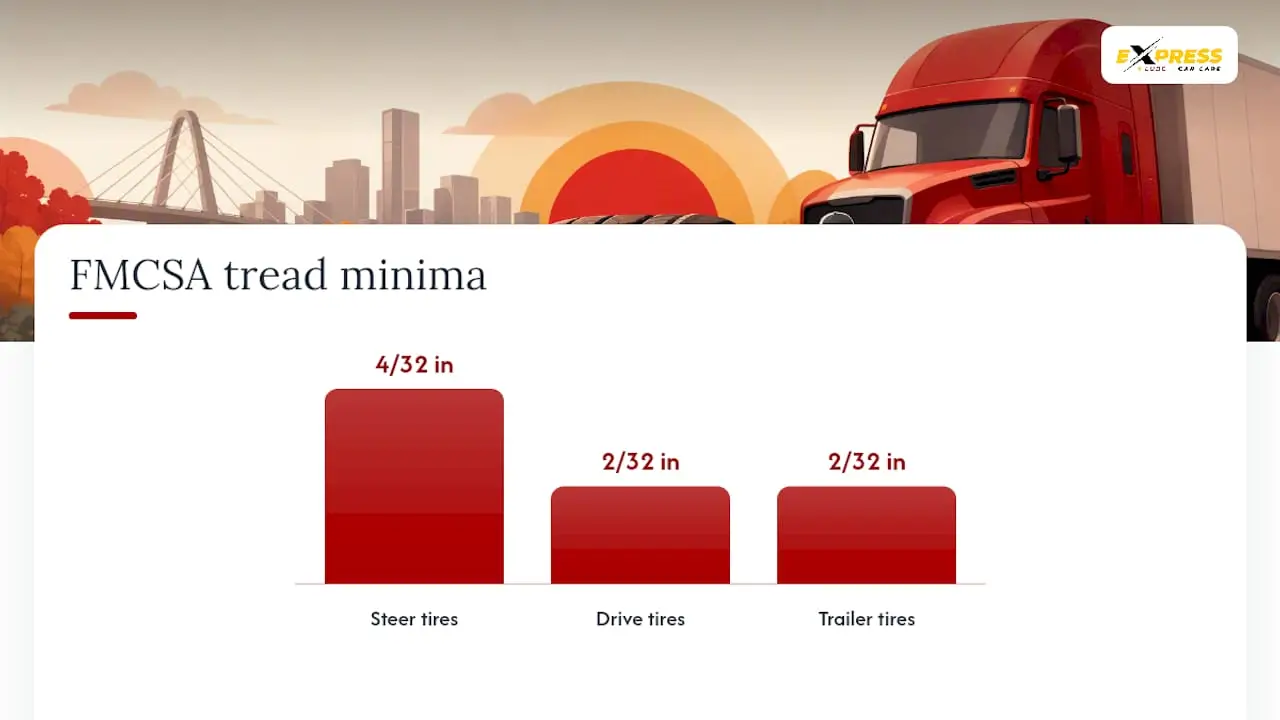
The reasoning is simple: steer tires do the steering. A blowout or loss of traction up front is a much bigger control problem than the same issue on a trailer axle.
There’s also a gap between FMCSA’s citation threshold and how roadside inspectors actually apply the rule. The Commercial Vehicle Safety Alliance (CVSA) can place a truck out of service under criteria that are effectively stricter in practice than a simple FMCSA citation, meaning a tire that technically passes federal minimums can still get a rig parked at a weigh station.
That’s why smart fleets don’t wait for either agency to make the call:
- Replace steer tires proactively at 4/32" rather than riding them down to the legal line.
- Measure in the major tread groove, the deepest channel running around the tire, not a shallow decorative groove.
- Build tread checks into routine fleet maintenance inspections instead of waiting for a roadside surprise.
How Do You Measure Tire Tread Depth Yourself?
You don’t need a shop visit to get a rough read on your tires. A few low-effort checks will tell you whether it’s time to worry, though a technician’s gauge will always be the most reliable answer.
- The penny test. Insert a penny into the tread groove with Lincoln’s head facing down. If you can see all of his head, tread is at or below 2/32", the legal minimum.
- The quarter test. Same idea, but with a quarter and Washington’s head. If his head is fully visible, tread is around 4/32" or less, the point where wet-weather performance starts to suffer.
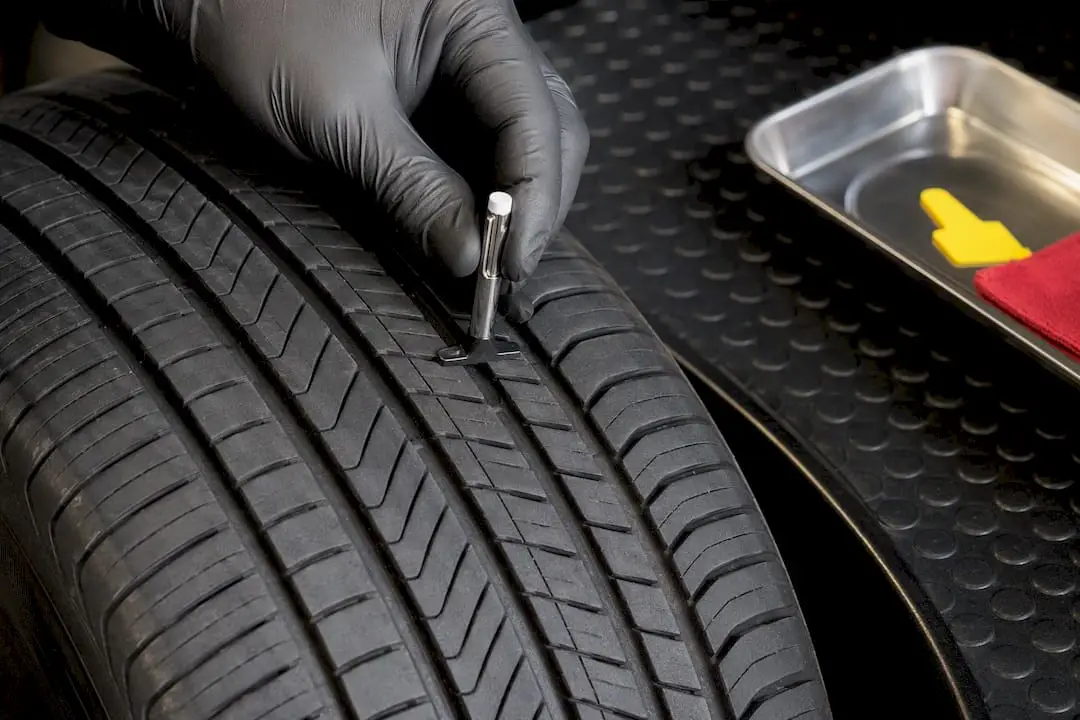
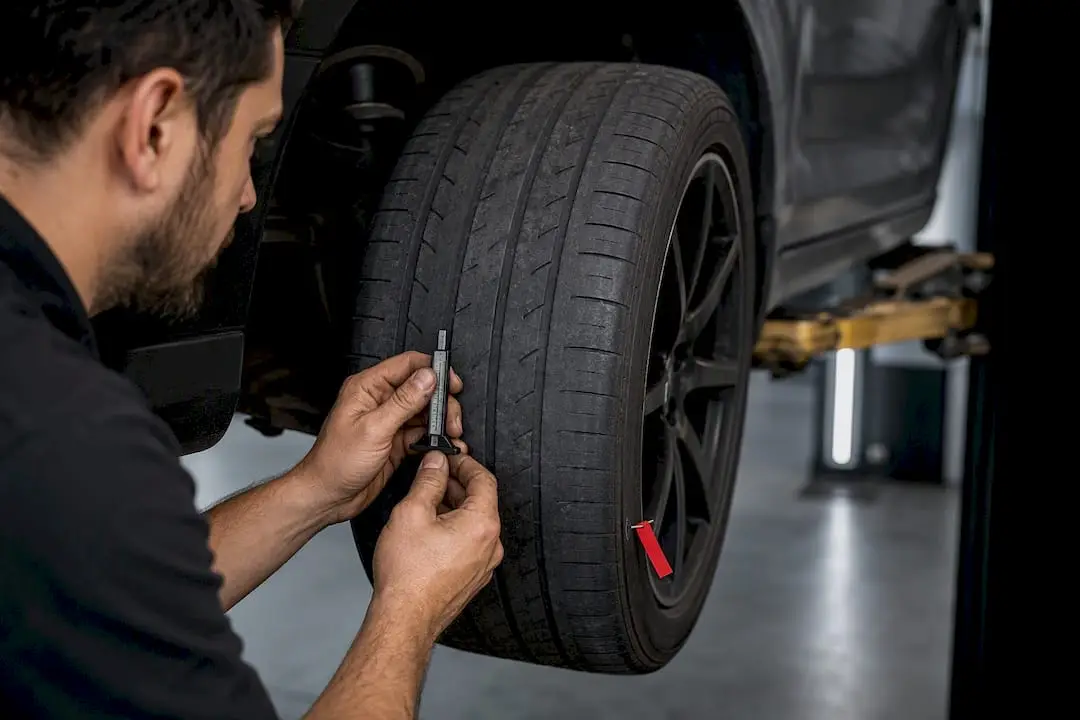
- The tread depth gauge. A cheap gauge from any auto parts store gives you an actual number instead of a pass/fail guess, and it’s the method a technician will use during an inspection.
- Check three spots per tire. Measure the inner, center, and outer grooves, since tires rarely wear evenly. Use the lowest reading you find, not the average.
Wear indicator bars back up whatever your gauge tells you. If the rubber is level with those raised bars anywhere on the tire, you’ve hit 2/32" regardless of what the rest of the tire looks like.
Pro Tip: Coins are a fast gut check, but they only tell you “above” or “below” a single number. If your reading is anywhere close to a threshold, a gauge or a quick stop at a shop for a real measurement beats guessing.
When Should You Actually Replace Your Tires?
There’s a legal answer and a smarter answer, and they’re not the same number.
- 2/32" or below: legally required, no exceptions. The tire comes off the vehicle.
- 4/32": the recommended replacement point if you drive in rain with any regularity. Wet braking distance and hydroplaning resistance both start slipping noticeably above this line.
- 5/32": the safer cutoff for winter and snow driving, since snow and slush need deeper grooves to grip and clear than rain does.
Timing matters, too. Check tread before long road trips, before winter weather rolls in, and as part of routine seasonal upkeep rather than only when something feels off. A quick look during an oil change or a scheduled maintenance visit catches wear before it becomes a wet-road emergency.
Why Do Tires Wear Unevenly, and What Can You Do About It?
Uneven wear is your tires sending you a message, and the pattern tells you what’s wrong.
- Wear concentrated in the center: usually overinflation. The tire is bulging in the middle, so that’s the part touching the road.
- Wear along both edges: usually underinflation, the opposite problem, with the tire sagging and running on its shoulders.
- Wear on one edge only: often a sign of alignment trouble or worn suspension components, not a tire pressure issue at all.
- Cupping or scalloped patches: frequently points to worn shocks or struts rather than the tires themselves.
Most of this is preventable with basic habits: check pressure monthly, rotate tires at the intervals your owner’s manual recommends, and get an alignment check if you notice one-sided wear. Our car inspection checklist walks through what to look for between shop visits.
Pro Tip: Run your palm across the tread instead of just glancing at it. Uneven wear often shows up as a texture difference before it’s obvious to the eye.
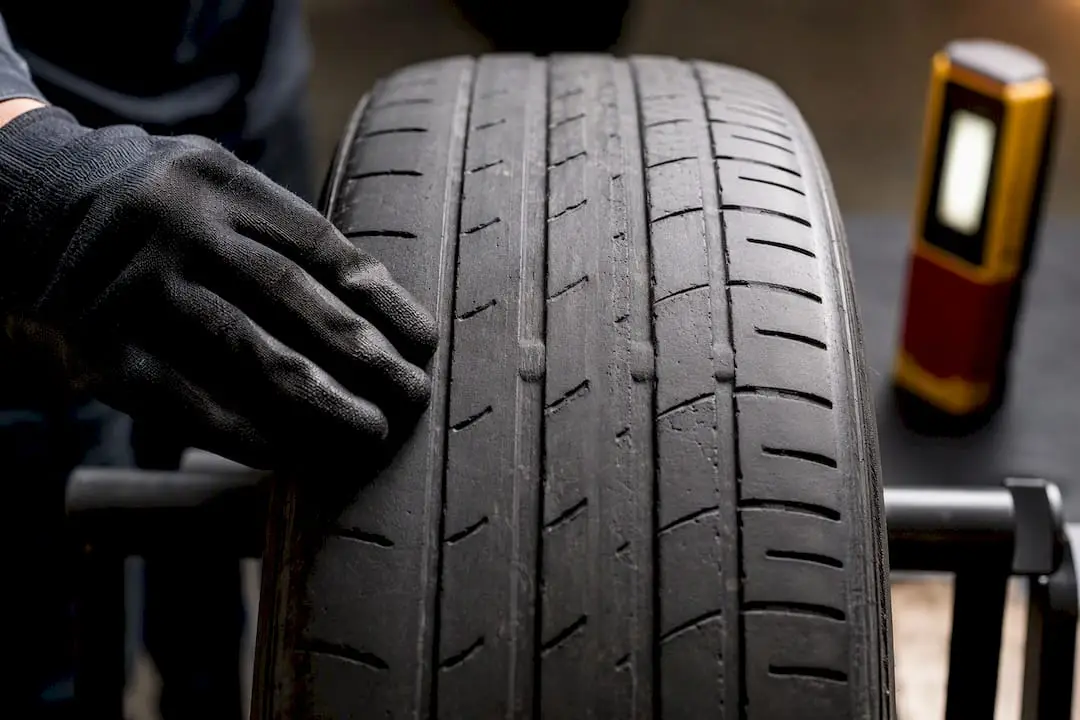
If the pattern doesn’t match a simple pressure fix, or if it keeps coming back after a rotation, that’s a signal for a professional alignment or suspension check rather than a DIY guess.
What Does a Technician Check During a Tire Inspection?
A proper inspection goes well beyond eyeballing the tread. Here’s what an ASE-certified technician is actually looking for:
- Tread depth measured at the inner, center, and outer grooves on all four tires, using the lowest reading as the deciding number.
- Any exposed steel belts or cords, which mean a tire is beyond replacement, not just close to it.
- Spare tire condition and pressure, since a flat spare defeats the purpose of carrying one.
- Wear patterns that point to alignment, suspension, or inflation issues rather than tire quality.
At Express Lube & Car Care, that inspection is paired with digital reporting so you can see exactly what the technician saw, not just take their word for it. If replacement is needed, the same visit covers mounting, balancing, and proper disposal of the old tires, so you’re not making three separate trips for one job.
Why Proactive Tire Replacement Beats Waiting for the Legal Line
Waiting until tires hit 2/32" is playing the odds with wet roads, and the odds get worse every time it rains. We’d rather see a driver replace tires a little early than find out the hard way what 3/32" feels like on a highway during a downpour.
The math is straightforward: a tire costs money either way, but a wet-weather incident costs more than money. For fleets, proactive replacement at 4/32" also means fewer roadside surprises and less downtime than getting flagged during an inspection. Use the checklist above, and if you’re unsure where your tires stand, that’s exactly what an inspection is for.
Get Your Tread Checked Before It Becomes a Problem
Guessing at tread depth with a coin is a fine start, but it won’t catch uneven wear hiding in the inner groove or tell you if your alignment is quietly eating your tires from one edge. Express Lube & Car Care gives Arlington drivers a real measurement, not a guess, with digital inspection reports that show you exactly where each tire stands before it becomes a wet-road hazard.

Our ASE-certified technicians check tread depth, inflation, and wear patterns as part of every visit, and we’ll walk you through what your numbers mean instead of just handing you an invoice. If your tires are due for a look, use our vehicle maintenance schedule to see where tire checks fit into your routine, and book an inspection before your next rainy drive or road trip.
Sources
- PubMed — Tire safety / tread depth research
- 49 CFR § 570.9 – Tires
- e-CFR — 49 CFR § 393.75 (commercial vehicle tire requirements)
- Geotab — Minimum tire tread depth
FAQ
Should Tires Be Replaced at 4/32"?
Replacing at 4/32" is widely recommended for drivers who regularly deal with wet roads, since braking distance and hydroplaning resistance both start declining before tires reach the legal 2/32" minimum.
Is 5/32" Tire Tread Safe?
5/32" is generally considered a solid safety margin, and it’s the recommended threshold for winter and snow driving, since snow and slush need deeper grooves to channel away than rain does.
Is It Safe to Drive on 2/32" Tread?
No. 2/32" is the legal minimum, not a safety target, and tires at that depth have significantly reduced grip in wet conditions and should be replaced immediately.
Is 7/32" a Good Tire Tread Depth?
Yes, this is well above every replacement threshold discussed here and represents healthy tread with plenty of life left for wet and dry driving alike.
What’s the Difference Between the Legal Minimum and the Safe Minimum?
The legal minimum is 2/32", the compliance floor that applies everywhere in the U.S. The safe minimum is higher, generally 4/32" for wet roads and 5/32" for winter conditions, based on how tire performance actually degrades before hitting the legal line.