

There is no single number that works for every fleet. Federal rules don’t set one, and your vehicles’ manufacturers set different ones for different models. The best service interval for your fleet starts with each vehicle’s manufacturer schedule, gets tightened for the way you really drive, and then gets adjusted using your own records. This guide shows you how to build that schedule, what to track, and where a local shop fits in if your vehicles run around Arlington and the rest of DFW.
TL;DR
- Start with the manufacturer’s maintenance schedule for each vehicle, then move to the “severe” version if your duty cycle matches it: stop-and-go delivery, long idling, short trips, DFW summer heat.
- Federal law requires commercial motor carriers to run a systematic inspection, repair and maintenance program, but it leaves the actual intervals up to you.
- Commercial vehicles also need a formal periodic inspection at least every 12 months.
- Track mileage, engine hours and fuel use, not just the calendar, and keep a record of every service.
- We handle fleet accounts in Arlington and can build the schedule with you. See our fleet services.
Table of Contents
- What a service interval actually is
- What federal rules do and don’t say
- Step 1: Start with the manufacturer’s schedule
- Step 2: Decide whether your fleet is “severe service”
- Step 3: Map the service items to a calendar
- Step 4: Count more than miles
- Step 5: Put drivers in the loop
- How often should fleet oil be changed?
- Condition-based checks: let the vehicle tell you
- Don’t forget Texas inspection rules
- Our perspective: what we see on fleet vehicles
- Setting up fleet service with us
- FAQ
- Sources
What a service interval actually is
A service interval is the gap between one scheduled service or inspection and the next. It can be measured in miles, engine hours, or time, and a good fleet plan uses whichever limit arrives first.
That sounds simple. The trouble is that a delivery van and a sedan with the same odometer reading have lived very different lives. One has spent thousands of hours at idle and in stop-and-go traffic. The other has cruised on the highway. Same miles, different wear.
So think of an interval as a starting point you refine, not a rule carved in stone.
What federal rules do and don’t say
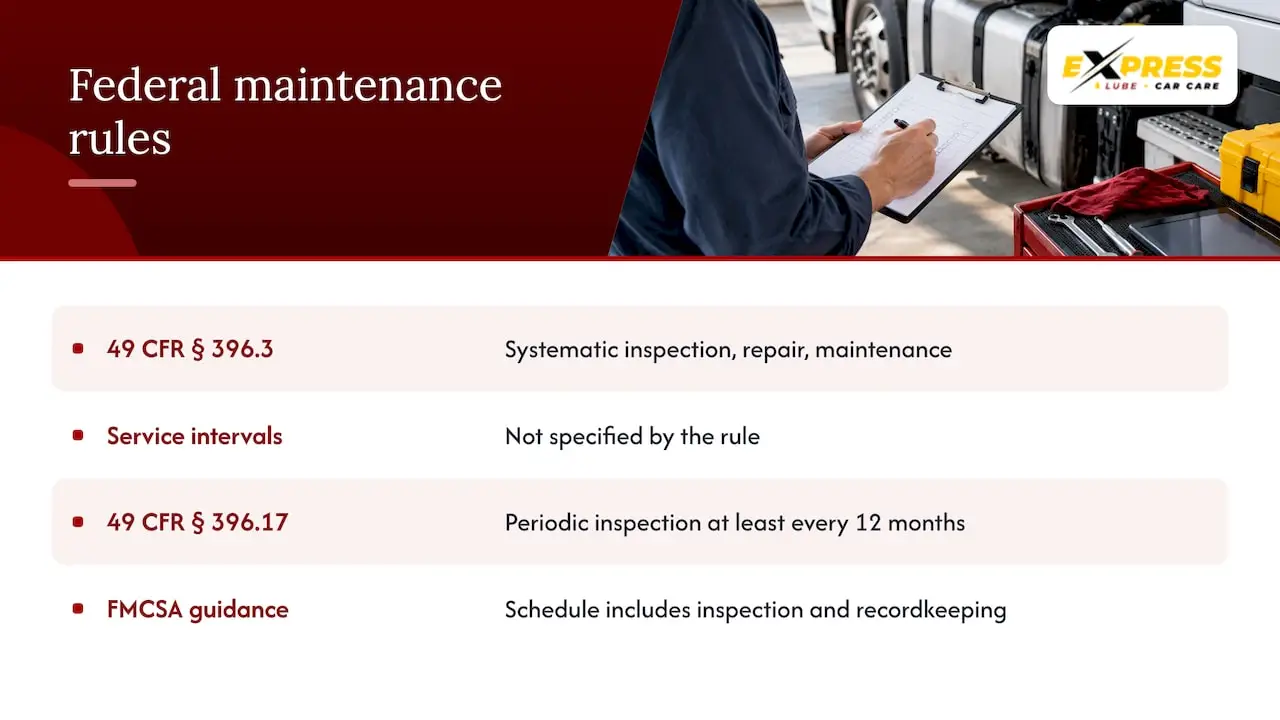
If any of your vehicles are commercial motor vehicles, the Federal Motor Carrier Safety Administration’s rule at 49 CFR § 396.3 applies. It says every motor carrier must systematically inspect, repair and maintain the vehicles it controls. The agency’s own guidance explains that “systematic” generally means a regular or scheduled program, and the rule does not spell out specific intervals. You decide them, based on each vehicle’s needs and use.
There is one hard number to know. Under 49 CFR § 396.17, every commercial vehicle must have a periodic inspection at least once every 12 months. Treat that as the floor for the safety side, not the whole program.
FMCSA’s own training material on the vehicle maintenance category describes the goal as a preventive maintenance system with a schedule for periodic maintenance, inspection and recordkeeping. In other words, the schedule and the paperwork go together.
Not sure whether your vehicles count as commercial motor vehicles? That depends on weight, passenger and cargo rules, and how you operate. Ask your compliance advisor or check with FMCSA before assuming. Many small business fleets of cars, vans and pickups fall outside those definitions but still benefit from the same discipline.
Step 1: Start with the manufacturer’s schedule
Every vehicle in your fleet comes with a maintenance schedule in the owner’s manual. One state fleet maintenance plan puts it plainly: manufacturer manuals define the specific maintenance intervals for the vehicle and its components. That is your baseline.
Many manuals list two schedules: normal and severe. Pull both for each model in your fleet and put them in one spreadsheet. Then note, for each vehicle:
- Year, make, model and engine
- Oil type and capacity
- Mileage or time interval for each service item
- Any hour-based items for equipment such as lift gates or auxiliary units
This is dull work, but it only has to be done once per model, and it pays off every time a vehicle is added.
Step 2: Decide whether your fleet is “severe service”
This is where most fleets get it wrong. They follow the normal schedule because it feels reasonable, then wonder why brakes, batteries and fluids wear faster than expected.
Industry guidance on severe duty points to stop-and-go delivery, long periods of idling and short trips as typical examples. In DFW, add summer heat to that list. For vehicles like these, the standard schedule is often not enough and tighter mileage or hour-based intervals help prevent premature wear.
A quick test. If a vehicle does any of these most days, use the severe schedule:
- Makes many short stops, such as parcel, food or service-call routes
- Idles for long stretches, like job-site trucks or vehicles used as mobile offices
- Makes short trips where the engine rarely reaches full operating temperature
- Tows or hauls near its rated capacity
- Runs through Texas summers with the A/C working hard
If you’re on the fence, ask your service advisor to look at the vehicle’s real use. A technician who sees your vans every few months will notice patterns the manual can’t.
Step 3: Map the service items to a calendar
Here is a framework for what goes on a fleet schedule. The exact mileage or timing for each line comes from your manufacturer’s schedule, not from us, so the right column is where you write your own numbers.
| Service item | What to watch for | How to set the interval |
|---|---|---|
| Engine oil and filter | Oil life, leaks, level between services | Manufacturer normal or severe schedule, whichever applies |
| Other fluids (coolant, brake, transmission, power steering) | Color, level, age | Manufacturer schedule, checked at every visit |
| Brakes | Pad thickness, noise, pulling, pedal feel | Inspect at every service visit; replace on condition |
| Tires | Tread depth, pressure, uneven wear, damage | Check pressure and condition often; rotate per manual |
| Battery and charging | Slow starts, age, corrosion | Test at regular service visits |
| Filters (engine air, cabin, fuel) | Restriction, dirt | Manufacturer schedule |
| Belts and hoses | Cracks, glazing, squeal | Inspect each visit; timing belt on the manual’s schedule |
| Suspension and steering | Clunks, wander, uneven wear | Inspect each visit |
| A/C and heating | Weak cooling, odd smells | Check before summer and winter |
| Annual inspection | Safety and compliance items | At least every 12 months for commercial vehicles |
We want to be clear about one thing: a table like this is only useful when you fill in real numbers per model. A generic “every 5,000 miles” you find online may be too frequent for one engine and not frequent enough for another.
A worked example
Suppose your manual lists oil service at one distance on the normal schedule and a shorter one on the severe schedule. (These are made-up numbers just to show the logic.) You run a delivery van that spends most of its day in town traffic. You choose the severe schedule and record it. Now the van’s service reminder triggers on the shorter interval, or on engine hours if you track them, whichever arrives first.
At the first visit, the technician notices the brake pads are wearing faster than the oil interval would suggest. You add a brake inspection to every oil service for that van. Nothing fancy, just a schedule that reflects what the vehicle really does.
Step 4: Count more than miles
Miles are the easiest thing to measure, and they miss a lot. A van idling at a job site racks up engine wear without moving.
Federal guidance on equipment maintenance suggests the better approach: use data rather than guesswork. Monitoring fuel usage and engine hours alongside mileage lets operators move from fixing things after they break to servicing them before they do.
You don’t need expensive software to start. A shared spreadsheet with these columns works for a small fleet:
- Vehicle ID and VIN
- Current odometer and, where available, engine hours
- Date and mileage of last service for each item
- Next due (by miles, hours or date, whichever comes first)
- Open issues reported by drivers
Larger fleets often move to telematics, which can report diagnostic trouble codes and trigger service based on actual use. The same EPA document notes that paper tracking across many vehicles is error-prone and leads to overlooked maintenance. If you’re past a couple dozen vehicles, it’s worth a serious look.
Step 5: Put drivers in the loop
The cheapest inspection you will ever get is a driver who looks at the vehicle before and after a shift. The state fleet plan we mentioned names pre- and post-trip inspections by drivers as one of the pillars of an effective program, along with following manufacturer recommendations and documenting repairs.
Keep the driver check short and consistent:
- Walk around: tires, lights, body damage, leaks under the vehicle
- Check fluid levels where your policy allows
- Listen for new noises on startup and during the first minutes of driving
- Watch the dash for warning lights
- Report anything odd the same day, in writing
If your fleet includes refrigerated or specialty equipment, the same idea applies to that gear. For a sense of how a structured driver check looks on cold-chain units, see this pre-trip inspection checklist for refrigerated units. Your vehicles may differ, but the habit of catching defects early is the same.
When a driver reports a symptom, don’t wait for the next scheduled service. A brake squeal, a pull to one side or a warm-smelling engine bay is the vehicle sending up a flare. Book it in.
How often should fleet oil be changed?
This is the question we hear most, and the honest answer is: as often as that vehicle’s manufacturer schedule says for your kind of driving, and sooner if your records or a technician’s inspection say so.
Why it matters beyond the engine itself: EPA’s guidance on equipment maintenance notes that the wrong oil grade or overextended changes can cost power, with tests showing losses of up to 18%. That document is aimed at diesel equipment, so don’t read those figures as a promise for your pickup. The takeaway is the direction: poor oil practice shows up in performance and fuel use.
The same source says clean air filters and well-functioning fuel injectors can improve fuel economy by 2 to 3%. For a fleet that burns a lot of fuel, even small percentages add up, and filters are among the cheapest items on the schedule.
For more on what actually happens during the service, see our guides on what an oil change involves and oil change tips.
Condition-based checks: let the vehicle tell you
Calendar and mileage intervals are the backbone. Condition-based monitoring is the upgrade.
Oil analysis is one example. Sending a sample to a lab can reveal internal wear long before it becomes a breakdown, according to the EPA material. That tends to make sense for higher-value or heavier-duty units rather than every compact car.
For most Arlington fleets, practical condition checks are simpler:
- Digital inspections. Photos and videos of worn parts let a fleet manager approve work without standing in the shop.
- Check engine light history. A light that comes and goes is worth a scan, not a shrug. Our check engine light diagnostics page explains what we do.
- Brake wear logs. Writing down pad measurements each visit turns guesswork into a trend line. Our piece on why brake inspection frequency matters shows why.
Don’t forget Texas inspection rules
Texas changed its rules recently. According to the state, safety inspections for noncommercial vehicles are no longer required as of January 1, 2025, but emissions inspections still apply in certain counties. Tarrant County, where Arlington sits, is one of them, so vehicles registered there need an emissions test to renew.
Commercial vehicles are a separate matter. They still need to meet the federal periodic inspection requirement mentioned earlier. If you run a mix of personal-use and commercial vehicles, your schedule should track both sets of deadlines.
For the details, read our Texas vehicle inspection checklist or the page on state inspections in Arlington. A pre-check can also save you a failed test; here’s why a professional pre-check still matters.
Our perspective: what we see on fleet vehicles
We work on vehicles of every kind in Arlington, and fleet vehicles tell a consistent story. The ones that cause trouble are rarely the ones with a complicated schedule. They’re the ones with no schedule at all, or a schedule that lives in one person’s head.
Here is how we’d approach it with you:
- Start with the manual, then be honest about duty cycle. If your vehicles work hard in DFW traffic and heat, plan on severe-service timing.
- Inspect at every visit. An oil service is also a chance to look at brakes, tires, belts, hoses, the battery and fluids. Our technicians are ASE-certified, and our digital vehicle inspections include photos and videos so you can see what we see.
- Fix small things early. A worn filter or a weak battery is cheap compared with a roadside call, a lost shift or a major repair to the engine or transmission.
- Keep records. Whatever you use to track service, make sure each visit ends up in it.
- Let the data adjust the plan. If a vehicle needs brakes twice as often as its siblings, change its schedule.
We can’t tell you a universal number, and we’d be wary of anyone who does. What we can do is look at your vehicles, read the manual with you and help turn it into a calendar you’ll actually follow.
— Express Lube & Car Care
Setting up fleet service with us
If you manage vehicles in Arlington and want one shop to help with scheduling, routine maintenance and repairs, start with our fleet services page. We cover everything from oil changes and filters to brakes, diagnostics, A/C, electrical, suspension, transmission and engine work. Details on routine work are on our maintenance page, and you can see the full list on our services page.
Ready to get started? Contact Express Lube & Car Care to book an appointment and bring your fleet’s manuals or last service records. We’ll go from there.
FAQ
How often should fleet vehicles be serviced?
As often as each vehicle’s manufacturer schedule says, using the severe schedule if the vehicle does stop-and-go work, idles a lot or makes short trips. Federal rules don’t set a general interval, so the carrier decides. Commercial vehicles must also have a formal inspection at least every 12 months.
What is the best fleet maintenance schedule?
The best one is the one built on your manuals, adjusted for how your vehicles are really used, and updated using your own service records. Track miles, engine hours and dates, and service when the first limit is reached. Write it down and assign someone to own it.
How often should fleet vehicles get an oil change?
Follow the manufacturer’s interval for that engine and your type of driving. Many fleet vehicles qualify as severe service, which means shorter intervals than the normal schedule. If you’re unsure which applies, a technician can review the vehicle’s use with you.
Does Texas require inspections for fleet vehicles?
Noncommercial vehicles in Texas no longer need a safety inspection, but emissions testing is still required in counties including Tarrant. Commercial vehicles must still meet federal periodic inspection rules. Check which category each of your vehicles falls into.
Sources
- FMCSA: What is meant by systematic inspection, repair and maintenance?
- FMCSA Motor Carrier Safety Planner: Periodic Inspection
- FMCSA: Safety Management Cycle for the Vehicle Maintenance BASIC
- Sample Vehicle Fleet Maintenance Plan (Tennessee DOT)
- Preventive Maintenance Guidelines (Automotive Services)
- Cleaner Diesels: Low Cost Ways to Reduce Emissions (US EPA archive)
- Texas DMV emissions inspection calendar