
TL;DR:
- A dealership alternative shop is a qualified independent repair facility that offers factory-level maintenance at lower prices. Federal law protects warranty rights when using such shops, provided repairs meet manufacturer standards and are documented properly. These shops typically provide comprehensive services, use certified technicians, source quality parts, and often deliver better transparency and savings than dealerships.
A dealership alternative shop is an independent, qualified repair facility that performs factory-scheduled maintenance and complex diagnostics to dealership-level standards, without the dealership price tag. For most car owners, especially those past the factory warranty period, it’s the smarter call for routine maintenance, brake work, diagnostics, and everything in between. One thing worth knowing right away: federal law already has your back. The Magnuson-Moss Warranty Act, enforced by the FTC, makes it illegal for a manufacturer to void your warranty simply because you chose an independent shop over a dealer.
Table of Contents
- What services does a dealership alternative shop perform?
- What certifications and training should you look for?
- How do independent shops source parts, and does it matter?
- Does using an independent shop void your manufacturer warranty?
- How do costs compare between dealerships and independent shops?
- Do independent shops have the diagnostic tools to handle complex repairs?
- How do you find and choose a trustworthy dealership alternative shop?
- When should you still go to the authorized dealership?
- Why Expresslubearlington is a shop you can trust
- Key Takeaways
- The case for knowing your options
- Expresslubearlington: full-service care without the dealership markup
- Useful sources
- FAQ
What services does a dealership alternative shop perform?
The short answer: most of what your dealer does, at a fraction of the overhead. A well-equipped independent shop handles the full range of auto repair services your vehicle needs across its lifetime.
Routine maintenance services typically include:
- Oil and filter changes, fluid top-offs, and full fluid replacements
- Tire rotation, balancing, and multi-point inspections
- Air filter, cabin filter, and fuel filter replacement
- Scheduled services at the 30k, 60k, and 90k maintenance milestones most manufacturers recommend
Repairs and diagnostics include:
- Brake inspections, pad/rotor replacement, and caliper work
- Suspension, steering, and alignment service
- Engine diagnostics, electrical troubleshooting, and transmission service
- A/C service, state inspections, and fleet maintenance programs
One area where dealerships still hold the edge: active recalls and manufacturer safety campaigns. Those require an authorized dealer to document and cover the cost. For everything else on your maintenance calendar, a qualified independent shop is fully capable.
What certifications and training should you look for?
Not every shop hanging an “independent mechanic” sign is created equal. The credentials are what separate a shop you can trust from one you’ll regret.
ASE certification is the industry benchmark. The National Institute for Automotive Service Excellence issues these credentials after technicians pass standardized exams across specific repair categories. A shop with ASE-certified technicians on staff has cleared a real bar, not just printed a sign. Many of the best independent technicians started their careers at dealerships, which means they bring brand-specific training plus the broader diagnostic experience that comes from working across multiple makes and models.
Beyond individual technician credentials, look for shop-level trust signals. RepairPal certification and CarFax recognition are third-party verifications that a shop meets documented standards for quality, pricing, and customer service. A written repair warranty, such as a 24-month/24,000-mile guarantee, tells you the shop stands behind its work after you drive away.
Pro Tip: Ask to see the shop’s ASE certificates before you authorize any work. Reputable shops display them openly or will pull them up without hesitation. If a shop gets defensive about showing credentials, that’s a signal worth taking seriously.
Digital vehicle inspections with photos are another strong indicator. A shop that sends you timestamped photos of your brake pads or battery terminals before recommending a repair is operating at a transparency level that many dealerships don’t match. The perception of a technology gap between independents and dealers has been shrinking fast, and the best independents now deliver a more personalized, documented experience than a busy dealer service lane often can.
How do independent shops source parts, and does it matter?
Parts sourcing is one of the most practical questions to ask any shop, and the answer tells you a lot about how they operate.
Independent shops typically have access to three categories of parts:
| Part Type | What It Means | Best For |
|---|---|---|
| OEM (Original Equipment Manufacturer) | Identical to what the dealer installs; sourced through manufacturer channels | Safety systems, warranty-adjacent repairs, newer vehicles |
| OE-equivalent aftermarket | Meets or matches OEM specs; made by reputable suppliers | Most routine repairs and maintenance |
| Budget aftermarket | Lower cost; quality varies by brand and application | Non-critical components where fit is confirmed |
For safety-critical systems like brakes, steering components, and airbag sensors, OEM or OE-equivalent parts are the right call. For a cabin air filter or wiper blades, a quality aftermarket option works just as well and costs less. A transparent shop will walk you through the tradeoff in writing before you sign anything.
Pro Tip: Before authorizing any repair, ask the service advisor to write the part brand, part number, and part warranty directly on your estimate. That documentation protects you if a warranty question comes up later.
Does using an independent shop void your manufacturer warranty?
This is the question that keeps a lot of car owners tethered to the dealership longer than they need to be. The legal answer is clear.
The Magnuson-Moss Warranty Act makes it illegal for a manufacturer to void your warranty solely because you used an independent shop or an aftermarket part. The FTC has taken enforcement action against companies that told customers otherwise. If a manufacturer wants to deny a warranty claim, they must prove that the specific independent service or aftermarket part caused the failure, not just that it existed.
To keep your coverage intact, document everything:
- Keep itemized receipts from every service visit, including part brand and part number
- Request digital inspection reports or photos before and after major work
- Ask the shop to note on the invoice that work was performed to manufacturer specifications
- Store all records in one place, physical or digital, tied to your vehicle’s VIN
Maintaining thorough service records does double duty: it protects your warranty rights and adds documented service history that buyers look for when you eventually sell.
Pro Tip: If a dealer ever tries to deny a warranty claim because you used an independent shop, you can report that to the FTC at ReportFraud.ftc.gov. The law is on your side.
The one scenario where caution applies: if a part is installed incorrectly and that specific installation causes a failure, the manufacturer can deny coverage for that failure. The rest of your warranty stays intact. Understanding your warranty coverage types helps you know exactly where those lines are.
How do costs compare between dealerships and independent shops?
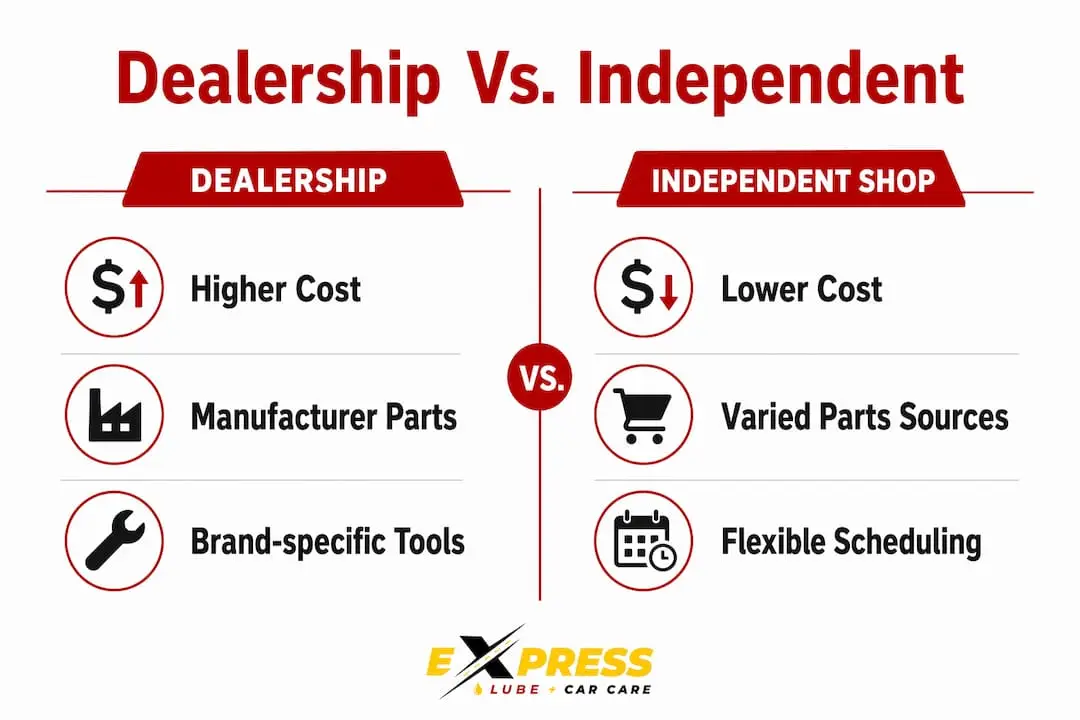
The price difference is real, and it compounds over time. Independent shops typically charge 25–50% less than dealerships for the same work, driven by lower overhead, more flexible parts sourcing, and the absence of manufacturer-mandated pricing structures.
The main cost drivers to understand:
- Labor rate: Dealer labor rates reflect facility costs, brand training programs, and manufacturer overhead. Independent shops run leaner.
- Parts choices: Independents can offer OEM, OE-equivalent, or quality aftermarket options. Dealers almost exclusively use OEM, which carries a premium.
- Unnecessary services: Dealers are more likely to recommend services not listed in your owner’s manual. A good independent shop sticks to what your vehicle actually needs.
- Repair warranty: A shop offering a 24-month/24,000-mile warranty on its work adds real value that offsets any price comparison.
| Factor | Dealership | Independent Alternative Shop |
|---|---|---|
| Typical labor cost | Higher (manufacturer overhead built in) | Often considerably lower |
| Parts options | OEM only | OEM, OE-equivalent, or quality aftermarket |
| Unnecessary service risk | Higher | Lower at reputable shops |
| Repair warranty | Varies by dealer | Up to 24 mo/24,000 mi at certified shops |
| Market scale | — | ~280,000 independent shops in North America |
Regular preventive maintenance at a qualified independent shop is one of the most straightforward ways to keep long-term repair costs down.
Do independent shops have the diagnostic tools to handle complex repairs?
The short answer is yes, for the vast majority of vehicles and repair types. Modern independent shops frequently use OEM-equivalent diagnostic software and scan tools that run the same brand-specific diagnostic flows a dealer would use. Right-to-repair advocacy and open-data efforts have broadened access to technical service information that was once restricted to dealer networks.
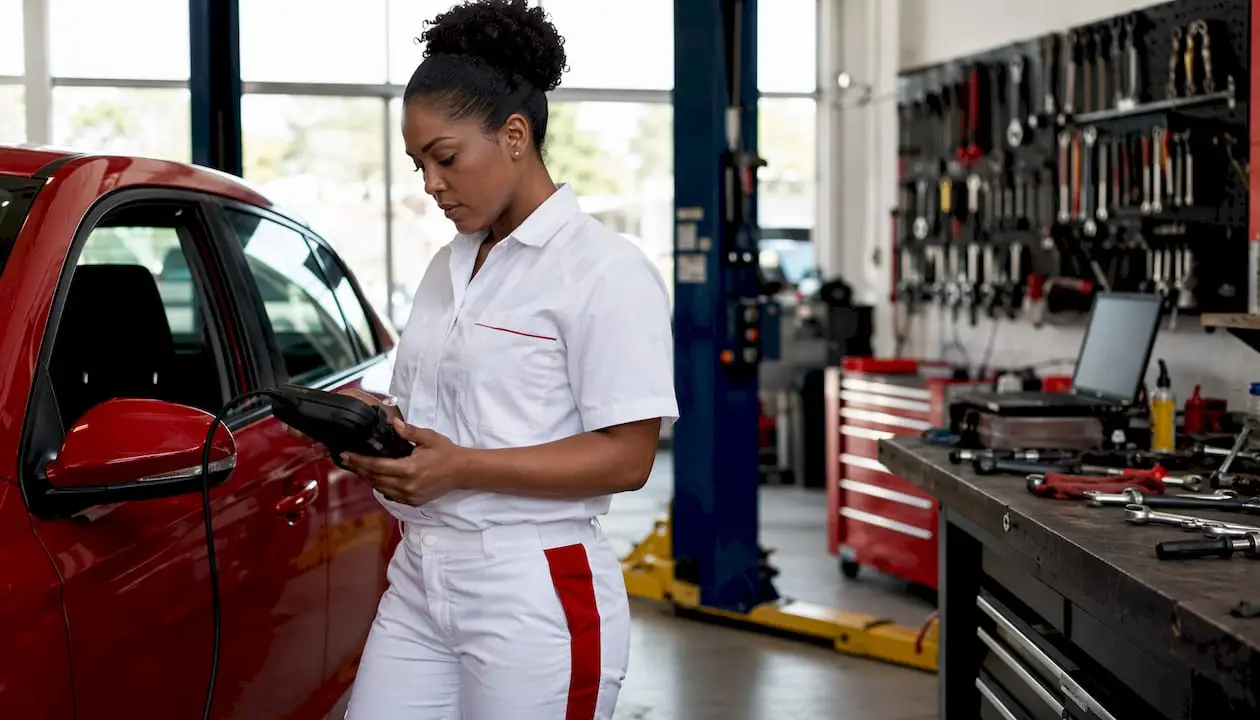
There are real limits worth knowing. Some proprietary modules on very new vehicles, and software tied specifically to active recall campaigns, may still require dealer-level access. If you’re driving a model that’s less than a year old and experiencing a system failure tied to a brand-new feature, calling the dealer first is reasonable.
For everything else, asking a shop directly is the best filter. “Do you have a brand-specific scan tool for my vehicle?” and “Can you walk me through a recent diagnostic you completed on a similar car?” are questions a capable shop will answer without hesitation.
How do you find and choose a trustworthy dealership alternative shop?
Here’s a practical checklist you can run through on a phone call or a quick visit:
- Verify ASE certifications. Ask which technicians are ASE-certified and in which categories. A shop with multiple certified techs is a stronger bet than one with a single certificate on the wall.
- Ask about the repair warranty. A written warranty of at least 12 months or 12,000 miles is a baseline. Shops offering 24 months/24,000 miles are signaling real confidence in their work.
- Request a sample digital vehicle inspection. Shops that use photo-based DVIs will show you one readily. This tells you they document their findings rather than just describing them verbally.
- Check online reviews and third-party badges. RepairPal certification and CarFax recognition are independently verified. Google and Yelp reviews are useful, but look for patterns across many reviews rather than reacting to a single outlier.
- Ask about parts policy. “What parts do you plan to use, and can you put the brand and part number on the estimate?” is a completely reasonable question. A shop that resists it is a red flag.
- Get a written estimate before authorizing anything. Verbal quotes are not enough. A written estimate with line-item pricing protects you if the final bill looks different.
Red flags to watch for: vague or verbal-only estimates, pressure to approve work immediately, unwillingness to show credentials, and a parts policy that’s described as “whatever we have in stock.” Knowing how to evaluate an ASE-certified mechanic before you hand over your keys saves a lot of headaches.
When should you still go to the authorized dealership?
There are specific situations where the dealer is genuinely the right call, and knowing them saves you money and frustration.
Go to the dealership when:
- Your vehicle has an active recall or safety campaign. Recall work is covered by the manufacturer and must be performed by an authorized dealer to be documented and paid for correctly.
- The repair is covered under your factory warranty. Warranty-covered work requires dealer documentation to be reimbursed by the manufacturer.
- You’re dealing with a highly specialized new-system failure tied to proprietary software or hardware that hasn’t been released to independent channels yet.
Dealership technicians are trained on specific brands and have access to the latest manufacturer documentation, which matters most in those three scenarios. Convenience perks like loaner cars and factory-backed scheduling are real, too, though they come at a price.
For out-of-warranty vehicles and routine maintenance, the calculus almost always favors a qualified independent shop.
Why Expresslubearlington is a shop you can trust
Expresslubearlington checks every box this article describes. The shop’s ASE-certified technicians bring hands-on expertise across a full range of makes and models, and every service comes backed by a 24-month/24,000-mile repair warranty. That’s not a marketing line; it’s a documented commitment you can hold them to.
Expresslubearlington is a RepairPal Certified Shop and a CarFax Top-Rated Service Center, two third-party recognitions that reflect consistent quality, fair pricing, and customer satisfaction. Digital vehicle inspections with photos are standard, so you see exactly what the technicians see before any work is authorized. Drivers across the DFW area have made Expresslubearlington their go-to for oil changes, brake service, diagnostics, A/C work, state inspections, transmission service, and fleet maintenance because the shop delivers dealership-level results without the dealership markup.
Key Takeaways
A qualified dealership alternative shop delivers dealership-level service at significantly lower cost, with federal warranty protections already in your corner under the Magnuson-Moss Warranty Act.
| Point | Details |
|---|---|
| Definition and best use case | An independent shop qualified for factory-scheduled maintenance and complex repairs; best for out-of-warranty and routine service. |
| Three checks before you commit | Verify ASE certifications, confirm a written repair warranty, and ask for a parts policy in writing. |
| Warranty rights under federal law | The Magnuson-Moss Warranty Act bars manufacturers from voiding your warranty solely for using an independent shop or aftermarket parts. |
| Cost advantage | Independent shops typically charge 25–50% less than dealerships for the same work. |
| Expresslubearlington | ASE-certified, RepairPal Certified, CarFax Top-Rated, with a 24-month/24,000-mile warranty on repairs in the DFW area. |
The case for knowing your options
Most car owners hand their keys to a dealership out of habit, not because they’ve weighed the options. That habit costs real money over time, and it’s built on a misconception that independent shops are somehow less capable or legally riskier. Neither is true for the vast majority of repairs.
What actually matters is the shop’s credentials, its transparency about parts and pricing, and whether it documents its work. A certified independent shop that sends you inspection photos, puts the part number on your estimate, and backs its labor with a written warranty is operating at a higher standard of accountability than many dealer service lanes. The technology gap that once justified dealer loyalty has largely closed. The price gap has not.
The one thing worth being honest about: not every independent shop is good. The same due diligence you’d apply to any service provider applies here. Check the credentials, read the reviews, ask the direct questions. A shop that earns your trust is worth more than a brand logo above the door.
Expresslubearlington: full-service care without the dealership markup
Skip the dealership wait and the inflated labor rates. Expresslubearlington is a RepairPal Certified, CarFax Top-Rated shop serving drivers across the DFW area with the full range of services your vehicle needs: oil changes, brake repairs, engine diagnostics, A/C service, transmission work, state inspections, and fleet maintenance, all performed by ASE-certified technicians.
Every repair comes with a 24-month/24,000-mile warranty, and digital vehicle inspections mean you see exactly what’s happening with your car before you approve a single dollar of work. Bring your maintenance records and any existing estimate; the team will give you a written, line-item quote you can compare with confidence. Ready to book? Check out current service specials and schedule your visit today.
Useful sources
These primary sources back the legal, industry, and consumer guidance in this article. If you want to dig deeper or verify a specific claim, start here.
- FTC: Auto Warranties, Routine Maintenance, and Repairs — The official government publication explaining your warranty rights when using independent shops; the primary source for Magnuson-Moss guidance.
- FTC Consumer Alert: Warranty Restrictions Were Illegal — Explains specific enforcement actions the FTC took against companies that illegally voided warranties; useful if you’ve been told your warranty is void.
- FTC: Auto Warranties and Auto Service Contracts — Broader consumer guidance on what warranties and service contracts actually cover and how to evaluate them.
- Car Talk: Trusted Local Repair Shops vs. Dealerships — Consumer-facing comparison of cost, convenience, and service quality tradeoffs between independent shops and dealers.
- J.D. Power: Should You Service Your Car at a Mechanic or Dealership? — Industry perspective on when dealer service is the right call versus an independent shop.
- Shop Commander: Independent Auto Repair Shop vs. Dealership — Detailed breakdown of cost differences, diagnostic capability, and parts sourcing at independent shops.
- Jalopnik: Dealership Service Center vs. Independent Mechanic — Practical, reader-friendly comparison of both options with honest takes on the tradeoffs.
One last reminder: keep every service receipt, digital inspection report, and parts invoice in a single folder tied to your VIN. That file is your warranty protection and your strongest asset when it’s time to sell.
FAQ
What does “dealership alternative” mean for car service?
A dealership alternative is a qualified independent repair shop that performs the same maintenance and repairs as a dealer, typically at lower cost, without being affiliated with a specific car brand.
Is a dealership alternative shop cheaper for repairs?
Yes, in most cases. Independent shops typically charge 25–50% less than dealerships for the same work, largely because of lower overhead and more flexible parts sourcing.
Will using an independent shop void my car warranty?
No. The Magnuson-Moss Warranty Act makes it illegal for a manufacturer to void your warranty solely because you used an independent shop or aftermarket parts; the manufacturer must prove a specific part or service caused the failure.
What is the 30-60-90 rule for cars?
It’s a common framework for planning preventive maintenance at recommended mileage intervals, covering services like fluid replacements, filter changes, and inspections that keep larger repairs from sneaking up on you.
What are red flags when choosing a repair shop?
Watch for vague or verbal-only estimates, pressure to approve work immediately, unwillingness to show ASE credentials, and no written parts or warranty policy. Any of those is a reason to keep looking.