
When you get a repair bill, run these five checks before you hand over your card: confirm vehicle identifiers, verify itemized labor, review parts with their condition listed, compare totals to your written estimate, and check for written authorizations and warranty terms. If all five pass, you’re good to pay. If any one fails, you have grounds to question or dispute the charge.
Three standards back this checklist up. ASE-certified technicians are trained to document work to a professional standard, so their invoices should be detailed by default. State consumer-protection laws — including guidance from attorneys general across the U.S. — set the legal floor for what shops must disclose. And because a repair invoice doubles as a tax and warranty record, the IRS recommends keeping vehicle expense documentation for as long as you own the vehicle.
- Vehicle identifiers: VIN, year/make/model, odometer reading, and invoice date
- Itemized labor: each job listed separately with hours and rate
- Parts with condition: new, used, rebuilt, or aftermarket noted for every part
- Estimate comparison: final total within the authorized amount (typically no more than 10% over)
- Authorizations and warranties: your signature or documented phone approval, plus written warranty terms
Key Takeaways
A repair invoice is your legal record of what was authorized, performed, and warranted — treat it that way before you sign.
| Point | Details |
|---|---|
| Five-item checklist | Confirm VIN, itemized labor, parts with condition, estimate comparison, and written authorizations before paying. |
| 10% overage rule | Shops must get your approval before exceeding the written estimate by more than 10% in most U.S. states. |
| Red flags to catch | Watch for vague labor descriptions, duplicated diagnostic fees, and shop-supplies charges that scale with the total. |
| Records to keep | Save the estimate, work order, final invoice, replaced-parts receipt, warranty document, and payment proof. |
| Expresslubearlington | Offers written estimates, documented authorizations, and a 24-month/24,000-mile warranty on every repair in Arlington, TX. |
Table of Contents
- How to read a mechanic repair invoice line by line
- How does the final invoice compare to your written estimate?
- What red flags on an invoice suggest overcharging?
- What should you do if the invoice has errors?
- How do warranties and recordkeeping protect you after the repair?
- What does an annotated sample invoice look like?
- What trustworthy shops do differently
- Expresslubearlington makes invoice transparency the standard
- Sources
- FAQ
How to read a mechanic repair invoice line by line
Every auto repair invoice follows a predictable structure. Knowing what each field means lets you decode the invoice in minutes rather than stare at it in confusion.
Header fields
The top of the invoice should carry the shop’s name, address, and license number; your name and contact info; the vehicle’s VIN and odometer reading; the invoice number; and the date. According to best-practice invoice templates, these identifiers are non-negotiable because they tie the bill to your specific car on a specific day. If the VIN is missing or wrong, that’s a problem worth flagging before you leave the lot.
Labor lines
Each labor entry should read something like: Replace front brake pads — 1.5 hrs @ $120/hr = $180. You can check the math yourself. Multiply hours by rate; if the line total doesn’t match, ask why. Shops typically bill using a flat-rate labor guide (Mitchell or Alldata are common industry references), which means they charge a set number of hours for a job regardless of how long it actually took. That’s standard practice, not padding, as long as the hours are reasonable for the job described. For a deeper look at how labor rates are set, the math is straightforward once you know the system.
Parts lines
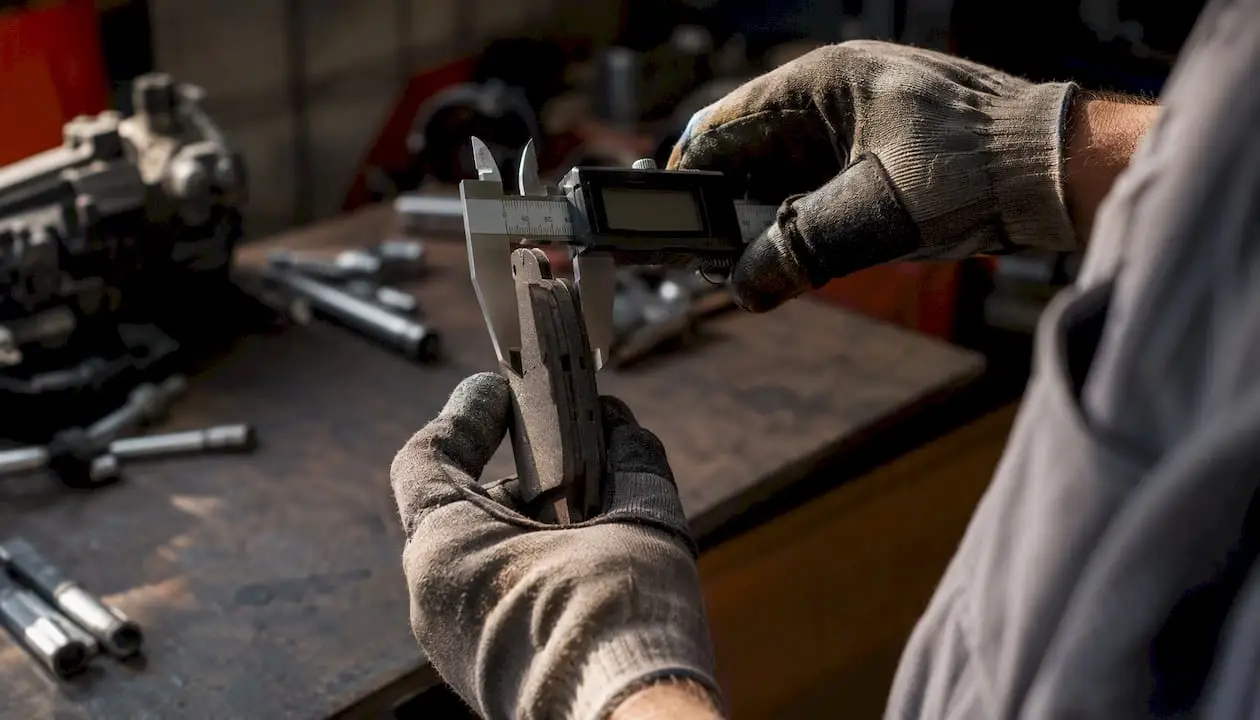
Every part should show a part number, quantity, unit price, and condition. Per LegalClarity’s repair-bill guidance, the invoice must indicate whether each part is new, used, rebuilt, or aftermarket. OEM (original equipment manufacturer) parts cost more than aftermarket; rebuilt parts cost less than new. You’re entitled to know which you’re getting.
Additional charges
| Line Item | What It Covers | What to Watch For |
|---|---|---|
| Diagnostic fee | Time to identify the problem | Should be credited toward repair cost or disclosed upfront |
| Shop supplies | Rags, fluids, small hardware | Reasonable as a small flat fee; suspicious as a percentage of total |
| Environmental/disposal fee | Fluid and parts disposal | Should be a fixed, disclosed amount |
| Sublet services | Work sent to a specialist | Should name the subcontractor |
| Core charge | Deposit on a rebuildable old part | Should be refunded when old part is returned |
| Tax | State/local sales tax on parts | Applies to parts, not always to labor — varies by state |
How does the final invoice compare to your written estimate?
The most common source of billing disputes isn’t fraud — it’s a gap between what was quoted and what was charged, with no clear explanation in between.
Washington State’s Attorney General auto-repair guidance spells out the baseline that most U.S. states mirror: if your repair will cost more than $100 and you dealt with the shop in person, you’re entitled to a written estimate.
Your rights in plain terms: A shop that exceeds your authorized estimate by more than 10% without calling you first has violated consumer-protection rules in most states. You are not required to pay the unauthorized overage, and the shop cannot legally hold your car for that amount alone.
When you receive the final invoice, compare it to your estimate line by line:
- Do the labor descriptions match what was quoted?
- Are the part numbers and conditions the same?
- Is there an estimate number or authorization note on the invoice?
- Did any new work get added? If so, is there a dated note showing you approved it?
If the shop added work without your approval, ask for a corrected invoice before paying. Texas-specific estimate rules follow a similar framework, so Arlington drivers have clear local standing.
Pro Tip: Before you leave the shop for any repair, ask the service advisor to write your estimate number directly on the work order. That one step makes the comparison trivial when you pick up the car.
What red flags on an invoice suggest overcharging?
Most padding hides in plain sight. Consumer guides on hidden auto-repair fees point to the same recurring patterns:
- Vague labor descriptions: “Misc. labor — 2 hrs” with no job name is a red flag. Every labor line should name the specific task.
- Duplicated diagnostic charges: One diagnostic fee per visit is standard. Two or three separate diagnostic line items for the same visit need explanation.
- Shop supplies as a percentage: A flat shop-supplies fee is reasonable. A shop-supplies line that scales with your total bill is a padding signal.
- Flat environmental fees with no disclosure: You should have been told about this fee upfront. If it appears only on the final invoice, ask for the shop’s posted fee schedule.
- Unauthorized “recommended” items: If a service appears on the invoice that wasn’t on your estimate and you never approved it, it shouldn’t be there.
Pro Tip: Ask the service advisor to show you the replaced parts before you pay. A reputable shop will hand them over without hesitation. If they can’t produce them, that’s worth a direct question about what was actually replaced.
What should you do if the invoice has errors?
Start at the counter, not with a complaint hotline. Most billing errors resolve faster with a calm, specific question than with an escalation.
- Point to the specific line. Say: “This labor line shows 3 hours, but the estimate said 2. Can you show me where the additional hour was authorized?”
- Request the replaced parts. You have the right to inspect or keep them. Ask before you leave.
- Ask for a corrected invoice in writing. Don’t accept a verbal promise to “sort it out later.”
- If unresolved, send a written dispute. Mail a certified letter to the shop owner stating the specific discrepancy, the amount in question, and the resolution you’re requesting. Keep a copy.
- Escalate if needed. File a complaint with your state attorney general’s consumer-protection office or the Better Business Bureau. Both accept auto-repair billing complaints and can prompt a response from the shop.
Per Torque Notes’ repair-bill guide, your original estimate, signed work order, and any approval notes are primary evidence. Keep all of them.
Pro Tip: At the counter, use this phrasing: “I’d like to review this line before I sign. Can you walk me through the authorization for this charge?” It’s polite, specific, and puts the burden of explanation where it belongs.
How do warranties and recordkeeping protect you after the repair?
Always ask before the work starts: does the shop offer a written warranty on labor, and will it honor the parts manufacturer’s warranty if a part fails? Get both answers in writing on the work order.
According to Washington State AG guidance, shops should state whether they’ll honor parts warranties and provide a written workmanship warranty for their own labor. Look for duration (months) and mileage limits in the warranty language. A warranty that covers “30 days or 1,000 miles” is very different from one that covers 24 months or 24,000 miles. For a full breakdown of how parts and labor warranties interact, the details matter more than most car owners realize.
Keep these records in one folder after every repair:
- Written estimate (signed copy)
- Work order with your authorization notes
- Final invoice
- Photos of the vehicle before and after, if relevant
- Replaced-parts receipt or notation on the work order
- Warranty document (separate from the invoice if the shop provides one)
- Payment confirmation
Pro Tip: Ask the service advisor to note “customer requests return of replaced parts” directly on the work order before repairs begin. Once the job is done, that notation is your documented right to inspect what was removed.
What does an annotated sample invoice look like?
A well-structured repair invoice gives you everything you need to verify accuracy at a glance. Here’s a field-by-field walkthrough of what a clean invoice contains versus one with red flags.
The red-flag invoice above has three compounding problems: vague descriptions that prevent math-checking, a duplicated diagnostic charge, and a total that exceeds the estimate without documented approval. Any one of those warrants a conversation before payment.
What trustworthy shops do differently
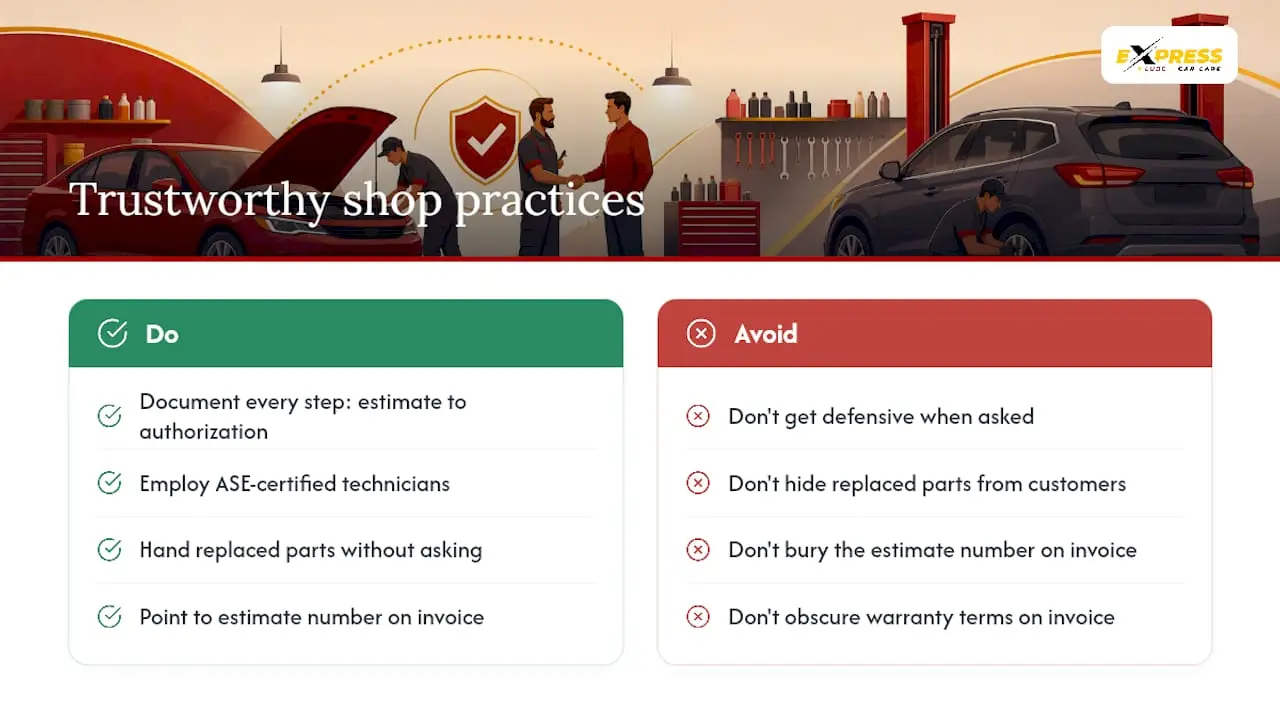
Transparent invoices aren’t an accident. They’re the result of shops that train their advisors to document every step, from the written estimate to the final authorization note. At a shop where technicians hold ASE certification, the documentation standard is built into the workflow, not added as an afterthought.
The shops that generate the fewest disputes are the ones that hand you the replaced parts without being asked, point to the estimate number on the invoice before you even look for it, and have warranty terms printed clearly at the bottom of every bill. When a customer asks to review a line item, a trustworthy shop welcomes the question. If a shop gets defensive when you ask for clarification, that reaction tells you something worth knowing.
A second opinion is always reasonable. Any shop worth its reputation will tell you the same.
Expresslubearlington makes invoice transparency the standard
Sorting out a confusing repair bill is stressful enough without wondering whether the shop will back up its work. At Expresslubearlington in Arlington, TX, every repair comes with a written estimate, documented authorizations, and a 24-month/24,000-mile warranty on parts and labor. Our ASE-certified technicians and RepairPal Certified status mean the invoice you receive reflects real work, real parts, and real accountability.
If you’ve received a bill that doesn’t add up, or you want a second opinion before authorizing a major repair, stop by or call us. We’re happy to walk through an invoice with you, recheck completed work, or run a fresh diagnostic. Need help managing a larger bill? Financing options are available. Book your appointment at expresslubearlington.com and let’s get you some answers.
Sources
These resources cover your legal rights, invoice standards, and where to file complaints:
- Washington State Attorney General — Auto repair
- Repair Bills: Your Rights and How to Dispute Them – LegalClarity
- Receipt and Car Repair Bill Guide for Customers – Torque Notes
- Hidden Fees on Auto Repair Invoices. Overquoted
- How to Read a Car Repair Estimate or Invoice – Great Car Care Center
FAQ
What should a repair order invoice list?
A complete auto repair invoice should include the shop’s identity, your name and vehicle identifiers (VIN and odometer), an itemized list of services with labor hours and rate, parts with condition noted (new/used/rebuilt/aftermarket), diagnostic fees, any additional charges, and the total. It should also reference the original estimate and include authorization notes and warranty terms.
How do you read your invoice?
Start at the header to confirm the vehicle and shop details match, then check each labor line (hours × rate = line total), each parts line (part number, condition, unit price), and any additional fees. Compare the final total to your written estimate, and verify that any work added after the estimate carries a dated authorization note.
What is the $3,000 rule for car repairs?
There is no universal “$3,000 rule” in U.S. consumer-protection law. The standard legal threshold that triggers written-estimate rights in most states is $100 in repair costs.
What does a repair receipt look like?
A repair receipt combines the work order, itemized bill, and payment confirmation in one document. It shows what was authorized, what was done, what parts were used and in what condition, and what you paid. Keep it along with your original estimate — together they are your primary evidence for any future warranty claim or billing dispute.