

Check and clean your battery terminals monthly. That single habit prevents most of the corrosion-related failures we see roll into our bay every week.
- Do this now: Pop the hood, look at the terminals, and clean off any white or blue crust with a baking soda solution.
- Effectiveness: Monthly terminal checks catch the majority of early corrosion before it causes a no-start.
- Call a pro if: Your resting voltage reads below 12.4 volts, the check-engine or battery light stays on, or your engine cranks slowly more than once.
Key Takeaways
Consistent battery maintenance, monthly terminal checks, twice-yearly professional testing, and correct charging, prevents most avoidable failures and extends battery life toward the five-year mark.
| Point | Details |
|---|---|
| Clean terminals monthly | Baking soda solution removes corrosion before it disrupts electrical flow. |
| Test voltage regularly | 12.6V means healthy, 12.4V signals the start of sulfation. |
| Use the right charger | Smart chargers and maintainers prevent overcharging damage that trickle chargers can cause. |
| Watch the 3–5 year window | Test proactively as your battery approaches typical end-of-life. |
| Book professional testing twice a year | Express Lube & Car Care runs load/CCA testing alongside routine service visits. |
Table of Contents
- Why Battery Maintenance Matters for Reliability and Cost
- What Are the Warning Signs of a Failing Battery?
- What Should Be on Your Monthly Battery Inspection Checklist?
- How Do You Clean Battery Terminals Safely?
- How Do You Test Battery Health at Home?
- Smart Chargers vs. Trickle Chargers vs. Maintainers: Which One Do You Need?
- How Do You Maintain a Battery in a Car That Sits for Weeks?
- Which Daily Driving Habits Extend Battery Life?
- When Should You Replace Your Battery, and How Do You Choose the Right One?
- How Often Should a Professional Test Your Battery?
- What Do ASE-Certified Technicians Recommend for Battery Care?
- What Technicians See Most Often in the Shop
- How We Can Help With Battery Testing and Replacement
- Sources
- FAQ
Why Battery Maintenance Matters for Reliability and Cost
Your battery is the heartbeat of the whole electrical system. It fires the starter, feeds the computer modules, and steadies voltage while the alternator catches up. Skip maintenance and you’re not just risking a dead battery. You’re risking a cascade of electrical gremlins that get expensive fast.
A healthy battery typically lasts three to five years, and routine care is what gets you to the far end of that range instead of the near end. AAA recommends professional testing at least twice a year precisely because batteries fail quietly, then all at once.
What Are the Warning Signs of a Failing Battery?
A battery rarely dies without warning. It usually sends up a flare first. Here’s what to watch for:
- Slow or labored engine crank, especially on cold mornings
- Dim headlights or interior lights that brighten when you rev the engine
- Dashboard battery warning light illuminated or flickering
- Visible corrosion (white, blue, or greenish crust) around the terminals
- A swollen or misshapen battery case, which signals internal damage from heat or overcharging
- A rotten-egg smell near the engine bay, which can mean a leak
Slow cranking and dim lights mean it’s time to test, not panic. A swollen case, a persistent smell, or a battery already past the three-to-five-year mark means it’s time to get it checked professionally, soon. Keep in mind a weak starter can mimic these same symptoms, so if replacing the battery doesn’t fix a slow crank, the starter itself might be the actual culprit.
What Should Be on Your Monthly Battery Inspection Checklist?
Think of this as a five-minute habit, not a project. Do it once a month and you’ll catch almost every problem while it’s still cheap to fix.
- Check the case. Look for cracks, bulging, or leaks around the seams.
- Inspect the terminals and cable ends. Look for corrosion, looseness, or fraying insulation.
- Test the hold-down clamp. Give the battery a gentle wiggle. It shouldn’t move.
- Look underneath and around the tray for signs of acid seepage or rust.
- Snap a quick photo each month. Comparing images side by side makes it easy to spot creeping corrosion you might otherwise miss.
A little dust is normal. Heavy crust buildup, a loose clamp, or any bulge in the case is not, and any of those means it’s time for a closer look.
Pro Tip: Set a phone reminder for the first of every month, and pair professional load testing with your semi-annual oil change so it never slips your mind.
How Do You Clean Battery Terminals Safely?
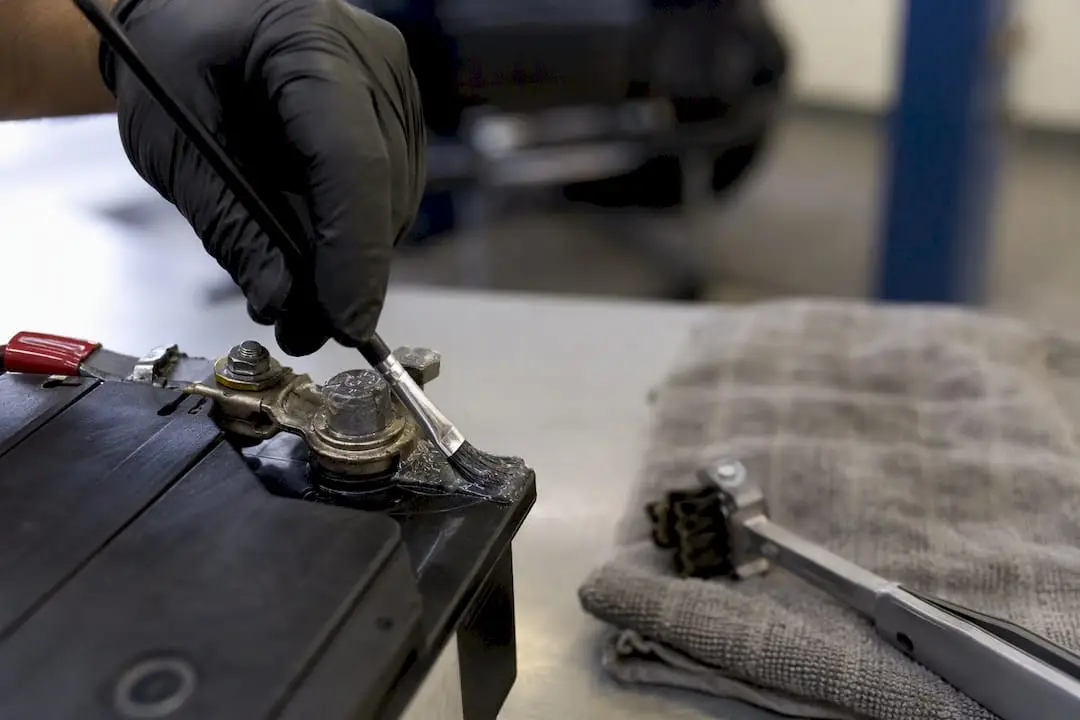
Corrosion buildup slows the flow of current before it stops it completely, which is why cleaning terminals is one of the highest-value five-minute jobs you can do yourself.
What you’ll need:
- Rubber gloves and safety goggles
- A baking soda and water paste (roughly three tablespoons to one cup of water)
- An old toothbrush or wire terminal brush
- A clean rag and a bottle of water for rinsing
- Petroleum jelly or dielectric grease
Steps to follow:
- Turn off the engine and remove the key.
- Disconnect the negative (black) cable first, then the positive.
- Apply the baking soda paste to the terminals and let it fizz on the corrosion for a minute.
- Scrub gently with the brush until the buildup lifts.
- Rinse with a small splash of water and dry thoroughly with the rag.
- Reconnect the positive cable first, then the negative, and tighten both securely.
How-to reporting confirms this negative-first, positive-last order as the standard safety sequence for both disconnecting and reconnecting.
Pro Tip: Coat the clean terminals with a thin layer of petroleum jelly. It’s a cheap trick that keeps moisture and acid vapor from starting the corrosion cycle all over again.
How Do You Test Battery Health at Home?

A basic voltage check tells you a lot in under a minute, and a digital multimeter costs less than a tank of gas.
Resting-voltage check:
- Let the car sit off for at least an hour (overnight is better).
- Set the multimeter to DC volts and touch the probes to the terminals, red to positive, black to negative.
- 12.6 volts or higher means a fully charged, healthy battery.
- 12.4 volts is the point where capacity loss starts to become permanent, a process called sulfation.
- Below 12.2 volts means the battery needs charging immediately and testing for underlying issues.
A voltage reading is a snapshot, though, not the full picture. AAA notes that load testing measures how the battery performs under real starting demand, which a resting-voltage check simply can’t reveal. That’s why a battery can read “fine” on a multimeter and still fail to start your engine on a cold morning. If your voltage reads borderline, or your battery is more than three years old, a shop-grade CCA (cold cranking amps) test is the next step.
Safety first: wear eye protection, keep the multimeter probes away from metal jewelry, and never test near an open flame.
Pro Tip: Test twice a year, once before summer heat and once before winter cold, since both extremes are when batteries fail most often.
Smart Chargers vs. Trickle Chargers vs. Maintainers: Which One Do You Need?
Not all chargers do the same job, and using the wrong one is one of the fastest ways to shorten a battery’s life — for a detailed overview, see Golf cart battery types: maximize performance and longevity.
- Trickle chargers deliver a slow, steady charge but usually lack automatic shutoff, so they need to be monitored closely.
- Smart chargers sense the battery’s state of charge and adjust output automatically, cutting off or trickling down once full.
- Battery maintainers are built specifically for long-term connection, cycling on and off to hold a steady charge without overdoing it.
For anything longer than a weekend of parking, reach for a smart charger or maintainer over a basic trickle charger.
Experts warn that leaving a battery connected to a non-smart charger past full capacity can cause overheating and internal damage. Automatic shutoff isn’t a luxury feature. It’s the difference between maintaining a battery and slowly cooking it.
Delkor’s maintenance guidance lists overcharging alongside overdischarging as one of the most common, and most avoidable, mistakes drivers make. A maintainer that starts around $30 is cheap insurance against that mistake.
How Do You Maintain a Battery in a Car That Sits for Weeks?
Cars that sit, whether it’s a project car, a seasonal vehicle, or one parked during a long trip, are where batteries quietly die of neglect.
- Connect a smart maintainer if the car will sit longer than two weeks.
- Disconnect the negative cable if a maintainer isn’t an option, which stops parasitic drains from slowly bleeding the battery dry.
- Take the car for a 20-minute drive roughly every two weeks if you’re not using a maintainer, since that’s enough to recharge a battery used only occasionally.
- Store spare keys away from the vehicle so it doesn’t get accidentally “woken up” by a remote fob draining the system.
Pro Tip: Keep resting voltage above 12.4 volts throughout storage. Below that threshold, sulfation starts hardening lead crystals on the plates, and that damage doesn’t reverse.
Which Daily Driving Habits Extend Battery Life?
Small habits compound. Here’s what separates drivers who replace a battery every three years from those who stretch it past five:
- Avoid long stretches in accessory mode (radio, AC, or lights on with the engine off).
- Unplug aftermarket dash cams, chargers, and amplifiers when you park for the day.
- Combine short errands into one trip. A string of five-minute drives never lets the alternator fully recharge the battery.
- Park in shade during summer, since heat degrades battery chemistry faster than cold does.
A simple weekly routine works: glance at the terminals when you check tire pressure, and once a month, run through the full inspection checklist above. Once your battery crosses the three-year mark, add a voltage test to that routine every time you’re under the hood.
When Should You Replace Your Battery, and How Do You Choose the Right One?
Replace the battery when it has reached the typical lifespan and testing shows declining CCA, when you’ve needed more than one jump-start in a month, or when the case shows visible swelling or leaks.
Picking the replacement isn’t a grab-any-battery-off-the-shelf decision. Get these specs right:
- Group size, which determines physical fit in your tray and terminal orientation
- Cold cranking amps (CCA) matched to your climate and engine size
- Reserve capacity, which matters more if you run a lot of accessories or short trips
- Manufacture date code, stamped on the case, since a battery sitting on a shelf for a year is already partway through its life
- Warranty length and terms, including whether it’s prorated after the first year
Once installed, the old battery needs proper recycling, not the trash. Nearly every auto parts store and shop will take it for free since lead-acid batteries are almost entirely recyclable. If you’re doing the swap yourself, our step-by-step battery replacement guide walks through it safely.
| Replacement Trigger | What It Means |
|---|---|
| Battery age 3–5 years | Test proactively rather than waiting for failure. |
| Multiple jump-starts needed | Indicates declining capacity, not a one-time fluke. |
| Visible case damage | Swelling or leaks mean immediate replacement, no waiting. |
| Failed load/CCA test | A shop-confirmed sign the battery can’t meet starting demand. |
How Often Should a Professional Test Your Battery?
Bring your car in for professional testing at least twice a year, ideally before summer heat and before winter cold, since AAA identifies those seasonal extremes as when battery failures spike.
During a shop visit, expect the technician to:
- Take a resting-voltage reading as a baseline
- Run a load or CCA test to measure real cranking performance under demand
- Check the alternator output and screen for parasitic draws that drain the battery overnight
- Inspect and, if needed, replace corroded cables or clamps
You should walk away with documented results and, for any battery installed at the shop, warranty paperwork you can produce if a problem crops up later.
What Do ASE-Certified Technicians Recommend for Battery Care?
Shop-level battery diagnostics go beyond a five-dollar tester from the parts store. ASE-certified technicians follow a structured workflow every time, which is why the results are more trustworthy than a quick voltage check in your driveway.
A resting-voltage reading only tells part of the story. Load testing under real starting conditions is what actually predicts whether a battery will leave you stranded next week or next winter.
Here’s what that workflow typically looks like:
- Check resting voltage first, then move to a load/CCA test for anything borderline
- Inspect terminals, cables, and the hold-down clamp as a standard part of every oil change or inspection
- Log battery age and test results in your vehicle file so trends show up over time, not just a single snapshot
- Document every result and back replacements with clear warranty terms you can reference later
What Technicians See Most Often in the Shop
The problems that stall out a Tuesday morning commute are almost never exotic. It’s corroded terminals nobody cleaned in two years, a hold-down clamp that vibrated loose on rough roads, or a phone charger left plugged in that quietly drained the battery overnight. The fix for most of these takes well under an hour and costs far less than a tow truck.
The mistake we see most is drivers waiting for a full no-start before checking anything. A five-minute terminal check, caught early, almost always beats an emergency jump on the side of the road.
How We Can Help With Battery Testing and Replacement
If reading through all of this makes you want someone else to just handle it, that’s exactly the point of stopping by. Express Lube & Car Care runs full battery diagnostics, including load and CCA testing, at the same visit as your oil change or inspection, so you’re not making a separate trip just for a battery check.

Our ASE-certified technicians can test your current battery, walk you through what the numbers mean, and if replacement is the right call, install a properly matched battery backed by our 24-month, 24,000-mile warranty. Bring your vehicle’s make and model along with any prior battery paperwork you have, and we’ll take it from there. Ready to get your battery checked before it strands you? Schedule a battery replacement or testing appointment at our Arlington shop.
Sources
These are the sources behind the testing thresholds, charging guidance, and safety steps in this guide:
- How to Make Your Car Battery Last Longer – Consumer Reports
- Car Battery Maintenance: A Comprehensive Guide
- How to maintain your car battery to avoid getting stranded
- 5 common mistakes to avoid when maintaining your car battery
- How long do car batteries last
FAQ
How do I maintain 100% battery health?
What is the best way to maintain a car battery?
The most reliable approach combines a monthly visual and terminal inspection with professional load testing twice a year, plus a maintainer during any extended storage.
How do I service my car battery myself?
At home, you can safely clean terminals with a baking soda solution, check resting voltage with a multimeter, and verify the hold-down clamp is tight. Anything beyond that, like load testing, belongs at a shop.
What are the basic steps involved in battery maintenance?
A solid routine covers five things: visual inspection, terminal cleaning, voltage testing, secure mounting, and charging with the correct tool for how long the car will sit.
How long does a car battery typically last?
Most car batteries last three to five years with regular maintenance, though extreme heat, frequent short trips, and neglected corrosion can shorten that window significantly.