

Most modern vehicles need an oil change according to the owner’s manual, which often specifies intervals within a broad range depending on the vehicle. That range is not a typo. If you drive under “severe” conditions, short trips, heavy idling, towing, extreme heat, cut that interval closer to half. Start with your owner’s manual, watch your oil-life monitor, and when in doubt, let Express Lube & Car Care check your specific vehicle’s needs.
TL;DR:
- Most drivers operate under severe conditions at least half the time, which cuts recommended oil change intervals roughly in half from normal schedules.
- Using full synthetic oil can extend oil change intervals up to 15,000 miles, but conventional oils typically require changes every 3,000 to 5,000 miles.
- Trust your vehicle’s oil-life monitor and owner’s manual over outdated rules and typical windshield stickers for more accurate timing.
- Waiting several thousand miles past the recommended interval risks sludge buildup, engine wear, and costly repairs, while changing too early wastes money.
- Proper service includes oil and filter replacement, monitor reset, leak check, and recording the mileage and date for precise scheduling.
Table of Contents
- Manufacturer-Recommended Oil Change Intervals Explained
- Does Your Driving Count as “Severe”?
- Reading Your Oil-Life Monitor and Dipstick Correctly
- How Oil Type Changes Your Change Schedule
- Building a Schedule That Actually Fits Your Car
- What Happens When You Wait Too Long
- When to Trust a Professional With Your Oil Change
- Why the 3,000-Mile Rule Refuses to Die
- Get Your Oil Change Timing Right at Express Lube & Car Care
- Sources
- FAQ
Manufacturer-Recommended Oil Change Intervals Explained
Forget everything you learned about the 3,000-mile rule for a second. Your owner’s manual, not your uncle’s garage wisdom, is the real authority here. Manufacturers now list intervals ranging from about 7,500 to 15,000 miles for many vehicles running full synthetic oil, according to Mobil’s vehicle maintenance guidance. That is not a marketing gimmick. It reflects real advances in both engine design and oil chemistry.
Two things changed to make this possible. Engines got tighter tolerances and better filtration, so contaminants build up slower. And synthetic oils hold their molecular structure under heat and stress far longer than the conventional oils your parents used. Additives like detergents and antioxidants used to break down fast; better formulations now resist that breakdown for thousands of additional miles, a shift AAA’s research on synthetic versus conventional oils lays out clearly.
So when does the old 3,000-mile guideline still make sense? A few specific situations:
- You drive an older vehicle designed before synthetic blends became standard.
- You use conventional oil rather than a synthetic or synthetic blend.
- You regularly drive under severe conditions (more on that below).
- Your owner’s manual explicitly calls for a shorter interval, which some performance and diesel engines still do.
Beyond those cases, sticking to an aggressive 3,000-mile schedule mostly just drains your wallet. Analysis from CarSavr on the 3,000-mile myth estimates that unnecessary early changes can cost drivers between $180 and $600 a year they didn’t need to spend. Your recommended oil change frequency should come from your vehicle’s specific maintenance schedule, not a number that got frozen in time decades ago.
Does Your Driving Count as “Severe”?
Here’s an uncomfortable truth: most drivers think severe driving means off-roading or towing a boat. It usually means something far more boring, like your daily commute.
Roughly 80% of motorists operate under conditions that qualify as severe service, according to an Auto Care Association bulletin on oil change intervals. That’s not a niche category. That’s most of us.
Check whether any of these describe your typical week:
- Frequent trips under five miles, where the engine never fully warms up.
- Stop-and-go traffic or lots of idling, like sitting in school pickup lines.
- Towing a trailer or hauling heavy loads regularly.
- Driving in extreme heat or extreme cold for extended stretches.
- Regular dusty, gravel, or unpaved-road driving.
Why does this matter so much? Short, cold trips let condensation and unburned fuel mix into the oil before it ever reaches full operating temperature. Combine that with constant idling and dust infiltration, and you get faster additive depletion and contamination, the exact mechanism that erodes an oil change interval, per the Auto Care Association’s severe-service bulletin. That’s why manufacturers commonly cut the normal interval roughly in half for severe use.
Pro Tip: Open your owner’s manual to the maintenance table and look for two columns, “Normal Schedule” and “Severe Schedule.” If you’re honestly unsure which one applies to you, default to severe. It’s the safer bet for your engine, and it costs you far less than a repair bill down the road.
Reading Your Oil-Life Monitor and Dipstick Correctly
Your dashboard is talking to you, but only if you know what it’s saying. Most oil-life monitors calculate remaining oil life using an algorithm that tracks your driving history, temperature exposure, and engine load, not just raw mileage. Manufacturers like Kia document exactly how their oil-life management systems predict service needs based on how the car has actually been driven. That system only stays accurate, though, if you’re using the oil grade your manufacturer specifies.
Here’s how to read the signals:
- A percentage above 40% usually means you have time; keep driving normally.
- Once you dip below 15%, schedule service soon, according to Toyota’s guide on oil-change warning signs.
- A solid warning light demands immediate attention, not a “next week” mental note.
- Any flickering oil pressure light paired with unusual engine noise means pull over and get it checked now.
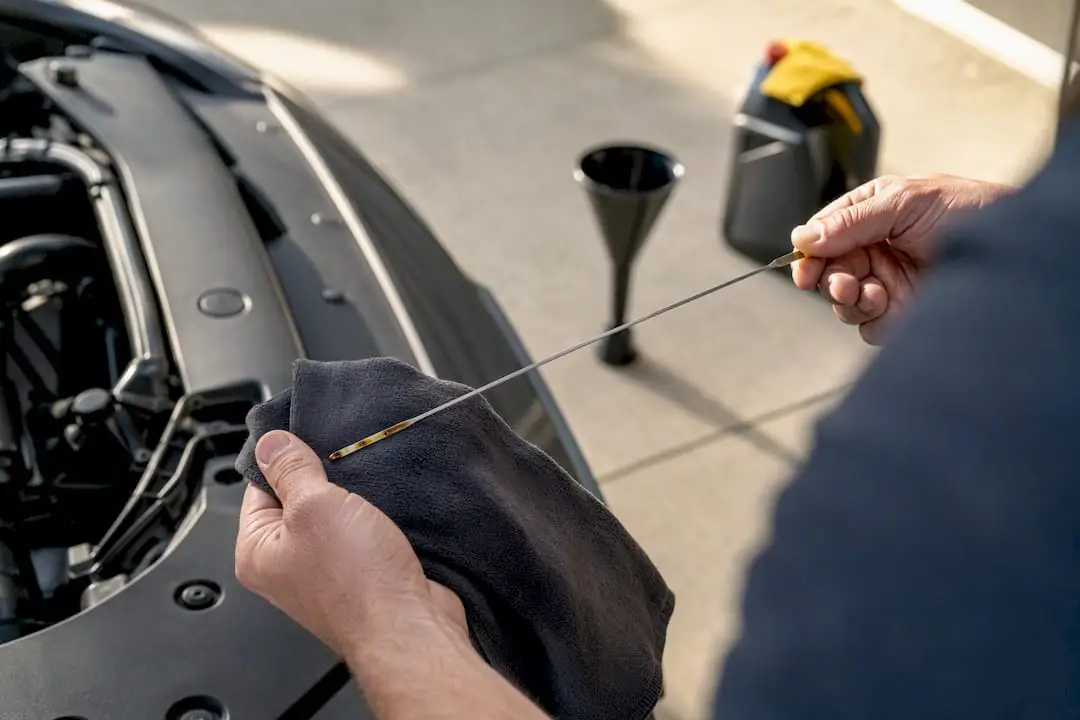
The dipstick tells its own story. Pull it, wipe it clean, reinsert fully, then pull it again. Oil that’s honey colored and between the fill lines is healthy. Oil that’s gritty, sludgy, or nearly black often signals it’s overdue, and low levels on the stick mean you need a top-off at minimum. If you’ve never physically checked your dipstick, you’re not alone. Most oil is nearly black by the time drivers finally look, one of the more common signs cited in Toyota’s own maintenance tips.
How Oil Type Changes Your Change Schedule
Not all oil ages the same way, and that difference should shape your calendar. Conventional oil, synthetic blend, and full synthetic behave like three different products because, chemically, they are.
- Conventional oil breaks down faster under heat and typically supports a 3,000 to 5,000-mile interval.
- Synthetic blend splits the difference, often stretching safely toward 5,000 to 7,500 miles.
- Full synthetic resists oxidation and viscosity breakdown well enough to support intervals from 7,500 up to 15,000 miles in many vehicles.
Following your manufacturer’s exact oil specification matters more than people realize. Oil-life monitors are calibrated assuming you’re using the specified oil type; put in a cheaper conventional oil when your car expects full synthetic, and that monitor’s prediction becomes inaccurate. If you’re not sure what your engine wants, Express Lube & Car Care’s oil change service can confirm the correct spec and get you on the right schedule from that point forward.
Building a Schedule That Actually Fits Your Car
A single universal number never fit every driver, and pretending otherwise is how the 3,000-mile myth survived so long. Here are four realistic templates:
- Normal daily driver, full synthetic: Change every 7,500 to 10,000 miles or per the manual’s normal schedule.
- Severe-duty driver (short trips, towing, extreme heat): Follow the severe schedule, often 3,000 to 5,000 miles.
- Older vehicle on conventional oil: Stick closer to 3,000 to 5,000 miles.
- Low-mileage or seasonal vehicle: Use the time-based rule, typically once a year, since oil degrades from age and moisture even without many miles.
Manufacturer tables often build both a mileage rule and a time rule directly into the schedule, exactly what you’ll find in Mazda’s published maintenance schedules, which list severe intervals alongside annual time-based reminders for lighter use.
Whichever template fits, run through this short checklist at every service:
- Replace the oil and filter together, never one without the other.
- Reset the oil-life monitor immediately after service so it starts tracking fresh.
- Do a quick visual check for leaks around the pan and filter housing; also consider following safe steps and ceramic protection for cleaning your engine bay to keep it in top condition.
- Log the date and mileage somewhere you’ll actually find it again.
- Note your next expected service window on your phone or calendar.
If your car sits most of the season, the time-based rule matters more than the odometer. Our detailed oil change tips walk through exactly how to adjust for low-mileage driving patterns.
What Happens When You Wait Too Long
Skipping oil changes doesn’t fail your engine gradually and gently. It fails it through a specific chain reaction. Additives deplete first, then contaminants build up, then the oil thickens into sludge that can’t circulate properly, and eventually you risk oil starvation in critical engine areas, per AAA’s breakdown of additive depletion.
Here’s the honest cost math: changing too early wastes $180 to $600 a year, per CarSavr’s analysis. Waiting too long risks a repair bill measured in thousands, not hundreds, if sludge causes real engine wear.
- A few hundred miles past your interval? Not urgent, just schedule it soon.
- Several thousand miles overdue, or any warning light plus knocking or burnt smells? That’s an immediate-service situation, not a “get to it eventually” one.
When to Trust a Professional With Your Oil Change
Borderline cases, an unclear monitor reading, unfamiliar prior service history, unusual noises, deserve a professional look rather than a guess. A proper service includes the correct oil grade, a fresh filter, a leak inspection, an oil-life monitor reset, and a documented service record you can reference later.
Express Lube & Car Care is staffed by ASE-certified technicians and holds RepairPal Certified Shop status, along with recognition as a Top-Rated Service Center by CarFax. If your dashboard alert won’t clear, your oil looks or smells off, or you want a paper trail on your maintenance, visiting a shop is advisable rather than guessing on your own.
Why the 3,000-Mile Rule Refuses to Die
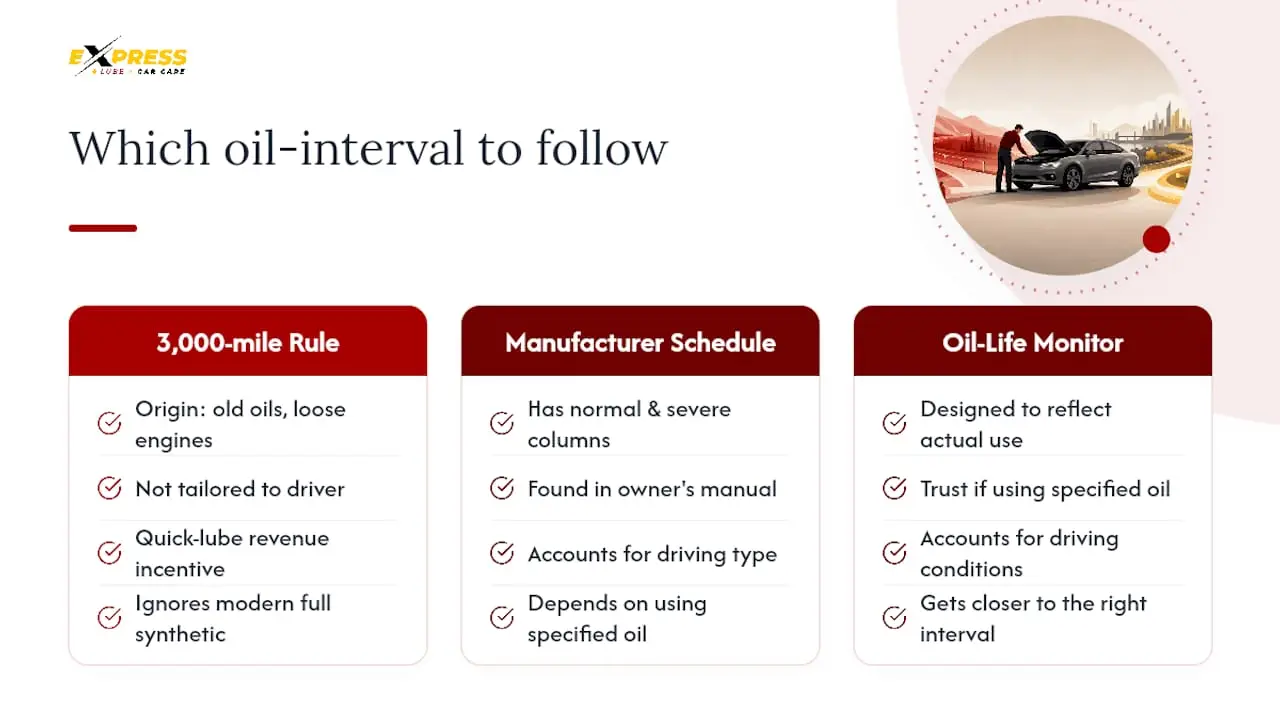
Habits outlive the reasons behind them, and the 3,000-mile oil change is the clearest example in car care. It made sense decades ago when conventional oils broke down fast and engines had looser tolerances. It doesn’t make sense for a modern engine running full synthetic, yet quick-lube stickers keep recommending it anyway, partly because more frequent visits mean more revenue, not because your engine needs it.
The bigger failure in typical advice isn’t the outdated number itself. It’s that so much of it ignores how differently people actually drive. A retiree doing weekend errands and a contractor towing equipment five days a week should not be on the same schedule, yet generic advice often treats them identically.
What should you actually prioritize? Read your owner’s manual’s severe-service column before you assume you’re a “normal” driver, because most drivers aren’t. Then trust your oil-life monitor over a sticker on your windshield, as long as you’re running the specified oil. Those two habits alone will get you closer to the right interval than any fixed number ever could.
Get Your Oil Change Timing Right at Express Lube & Car Care
Figuring out your exact interval between manual mileage ranges, severe-driving adjustments, and oil-life monitor percentages takes real judgment, not a guess at the counter. That’s where a shop that actually checks your vehicle’s specific history earns its keep. Express Lube & Car Care’s ASE-certified technicians pull your manufacturer’s exact schedule, confirm whether your driving counts as severe and set your oil-life monitor correctly after service, so you’re not stuck relying on a generic sticker reminder.

Whether you’re due now or just want a professional read on where you stand, our team in Arlington can check your mileage, driving pattern, and oil type against the manufacturer spec in one visit. Explore our oil change tips for more on building a schedule around your specific driving habits, or go ahead and book your next service so your engine stays on the right timetable.
Sources
- Vehicle maintenance / car care calendar — Mobil
- Automotive oil change intervals: severe vs normal driving — Auto Care Assoc. bulletin
- AAA research: synthetic vs conventional oil additives and their role
- Signs you need an oil change — Toyota car tips
- 3,000-mile oil change myth and modern intervals — CarSavr
FAQ
How Often Do You Realistically Need an Oil Change?
Most modern vehicles need service every 5,000 to 15,000 miles depending on oil type and manufacturer spec, though severe driving conditions often cut that interval roughly in half.
Is $100 Normal for an Oil Change?
Pricing varies by oil type, vehicle, and shop, so there’s no single “normal” figure. Full synthetic services typically cost more than conventional oil changes because of the oil itself, and your best reference point is always your specific service invoice rather than a general number.
Is 2 Months Too Soon for an Oil Change?
For most drivers on a normal schedule, two months is too soon unless you’ve also racked up thousands of miles or you’re driving under severe conditions like frequent short trips and heavy idling. Low-mileage or seasonal vehicles are the exception, since the time-based rule of roughly once a year applies when mileage stays low.
How Late Can You Go Past Your Oil Change Interval?
A few hundred miles past your interval usually isn’t an emergency, but several thousand miles overdue, or any combination of a dashboard warning light, engine knocking, or a burnt oil smell, means you should get service immediately to avoid additive depletion and engine wear.