

An overcharged car A/C usually shows up as weak or warm air, a compressor that shuts off at stoplights, strange compressor noise, or gauges that read high on both sides. The cruel part is that it looks a lot like a system that is low on refrigerant, so the natural reaction (add more) makes it worse. If you have ever dumped a can or two into the system to chase colder air, this guide is for you.
We work on A/C systems every day at our shop on Brown Blvd in Arlington, and the overcharge calls we hear in Texas heat follow a pattern. Let’s walk through what you will notice, why it happens, how a technician proves it, and what to do before a small mistake turns into a compressor replacement.
TL;DR
- The most common overcharge signs are reduced cooling, an A/C that cuts out in traffic and returns at highway speed, compressor noise, and high pressure readings on both gauges.
- Overcharging usually happens when someone tops off a system without knowing how much refrigerant is already in it, or when a full charge goes into a system that still held some.
- Too much refrigerant can raise pressure enough to trip a cutoff switch, and in the worst case it can damage the compressor.
- The fix is not venting or guessing: it is recovering the refrigerant and recharging to the manufacturer’s specified amount.
- A professional diagnosis beats replacing parts, because low charge, a failing compressor and a cooling fan problem can all mimic an overcharge.
Table of Contents
- What are the symptoms of an overcharged car A/C?
- Why does too much refrigerant make the A/C cool worse?
- How does a car A/C get overcharged?
- Overcharge or something else? How the symptoms compare
- How a technician tells overcharge from other faults
- What damage can an overcharged A/C cause?
- What to do if you think your A/C is overcharged
- Our take: why we diagnose before we replace
- A/C service at our Arlington shop
- Practical examples
- Preventing an overcharge
- FAQ
- Get your A/C checked in Arlington
- Sources
What are the symptoms of an overcharged car A/C?
No single symptom proves an overcharge. Together, though, these signs point strongly toward it, especially if the system was recently serviced or recharged.
Warm or weak air from the vents
This is the one that fools people. Excess refrigerant can leave the air coming out of the vents warmer than it should be. At road speeds the cooling may still be reduced rather than gone, according to the MACS recommended service procedures, a professional-level reference for A/C service.
A/C cuts out at idle or in stop-and-go traffic
Excess refrigerant raises pressure on the high side of the system. When that pressure climbs too far, a pressure switch shuts the compressor off to protect it. The same MACS procedures describe this happening during idle and stop-and-go driving. If you are sitting on I-30 at rush hour and the air turns warm, then cools again once you are moving, pay attention.
A General Motors service bulletin filed with NHTSA also names overcharged refrigerant as a cause of compressor disengagement from high pressure, particularly at high ambient temperatures, with the symptom being an inoperative A/C. Arlington in August is exactly that kind of condition.
Compressor noise
Some drivers hear squealing or a harsher-than-normal sound from the compressor when it is working against excess pressure or trying to compress liquid refrigerant. A noise alone does not prove a charge problem. Worn bearings, a slipping belt or a failing clutch can sound similar, so treat it as a clue. Our guide to AC compressor failure symptoms covers how those noises differ.
High pressure on both sides of the gauges
If you or a technician connect manifold gauges, one pattern stands out. According to a manufacturer’s manifold gauge operating instructions, high readings on both the low side and the high side usually indicate an overcharged system. A gauge needle that vibrates with a high low-side and a low high-side points elsewhere, to faulty compressor reed valves.
Symptoms that depend on the day
The system may seem fine on a cool morning. MACS notes that an overcharge may not be evident in a low-heat-load service bay, because excess refrigerant mainly raises high-side pressure when the heat load is high. That is why a car can leave a shop with cold air at 8 a.m. and quit cooling in a Walmart parking lot at 4 p.m.
Why does too much refrigerant make the A/C cool worse?
It seems backwards. More refrigerant should mean more cooling, right? Not quite. Your A/C is a closed loop that depends on refrigerant changing from liquid to gas and back again. The compressor squeezes gas, the condenser at the front of the car sheds heat and turns it to liquid, and the evaporator behind the dash absorbs heat from cabin air as that liquid boils back into gas.
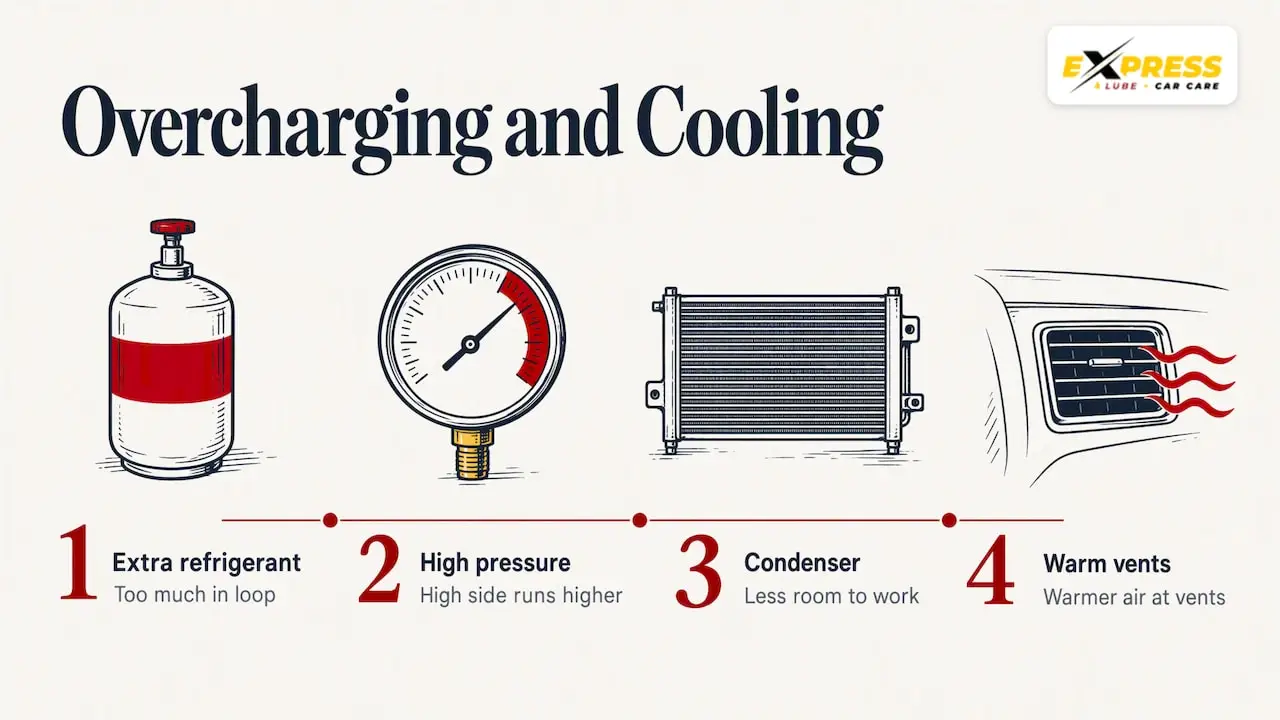
That cycle works only when the amount of refrigerant is close to the design amount. With too much in the loop, the high side runs at higher pressure, the condenser has less room to do its job, and the compressor has to work harder. We would describe it as trying to breathe through a clogged straw: you can keep pulling, but less gets through. The result is reduced heat transfer and warmer air at the vents.
The U.S. EPA says plainly that both undercharging and overcharging impair performance. Modern systems make the margin thin. UnderhoodService reports that current R-134a and R-1234yf systems use relatively small charges and are more sensitive to overcharging, and that charging until the vents feel cold can create problems. A few ounces matter more than most people expect.
How does a car A/C get overcharged?
Almost never on purpose. Here are the usual routes.
- Topping off without knowing the charge. The EPA explains that topping off a vehicle A/C without knowing the existing refrigerant amount can overcharge it. A can with a small gauge only reads pressure, not how much refrigerant is inside, and pressure changes with outside temperature.
- Adding until the air feels cold. The vents are a poor measuring stick, especially if the real problem is a blocked condenser, a weak fan or a failing compressor.
- Adding a full charge after a recovery. UnderhoodService, citing MACS testing, reports that recovery equipment may leave refrigerant behind in the vehicle. If a full charge goes in afterward, the total ends up too high. Even good recovery machines may not pull every bit out.
- Charging a system that still has air or moisture in it. Air does not condense, so it sits in the condenser and pushes pressures up and around. That mimics an overcharge on the gauges, which is one reason pros evacuate properly.
- Using the wrong amount for the vehicle. Every vehicle has a specified charge, usually printed on a label under the hood. Guessing from a different car, or from a can’s instructions, is how people end up over.
Overcharge or something else? How the symptoms compare
Here is the honest trouble: several faults produce warm air. This table shows where they overlap and what separates them. It is a guide for understanding, not a substitute for gauges and a proper inspection.
| Problem | Warm or weak air | Cuts out at idle | Typical pressure pattern | Other clue |
|---|---|---|---|---|
| Overcharge | Yes | Often | Both sides high | Recent top-off or recharge |
| Low refrigerant | Yes | Sometimes, from a low-pressure switch | Both sides low | Slow loss over weeks or months |
| Weak condenser airflow | Yes | Often | High side high | Debris on fins, fan not running |
| Worn compressor valves | Yes | Rarely | Low-side high, high-side low, needle vibrates | Noise from compressor |
| Air in the system | Yes | Possible | Erratic high-side readings | System was opened or poorly evacuated |
Notice how often the answer comes down to what the gauges say. You can’t read that off the dash.
How a technician tells overcharge from other faults
A proper A/C diagnosis is more than a pressure check. This is the order we like to follow, and it lines up with what the reference material recommends.
Check airflow and heat rejection first
Before blaming the charge, look at the condenser fins, the radiator and the cooling fans. Spectra’s cooling tech guide advises checking condenser airflow, fins and fan operation, then comparing line temperatures with normal values: the discharge line hot, the liquid line warm and the suction line cold. Bugs, road debris and a lazy fan can push pressure up with a perfectly correct charge. If you like a structured walk-through of those airflow and temperature checks, this AC system diagnosis workflow lays the steps out clearly. The cooling system matters too: a car that runs warm can hurt A/C performance, and our radiator and cooling system service covers that side.
Read both sides of the gauges at working temperature
Gauge readings only mean something against ambient temperature and with the system running under load. Both sides high is the classic overcharge signal. Low-side high with high-side low is a different story.
Verify the sensor, not just the gauge
Some vehicles have a high-side pressure sensor. In the GM bulletin, technicians compare the gauge reading with the scan tool’s sensor reading. A big difference may point to a wiring concern or a skewed sensor, not an overcharge. Without that cross-check, you can chase the wrong part.
Don’t over-read the sight glass
On vehicles that have one, bubbles can be normal at higher-than-usual ambient temperatures if cooling is sufficient, according to a Toyota service manual. Bubbles don’t automatically mean low charge, and a clear glass doesn’t prove a correct one.
Recover, weigh, and recharge
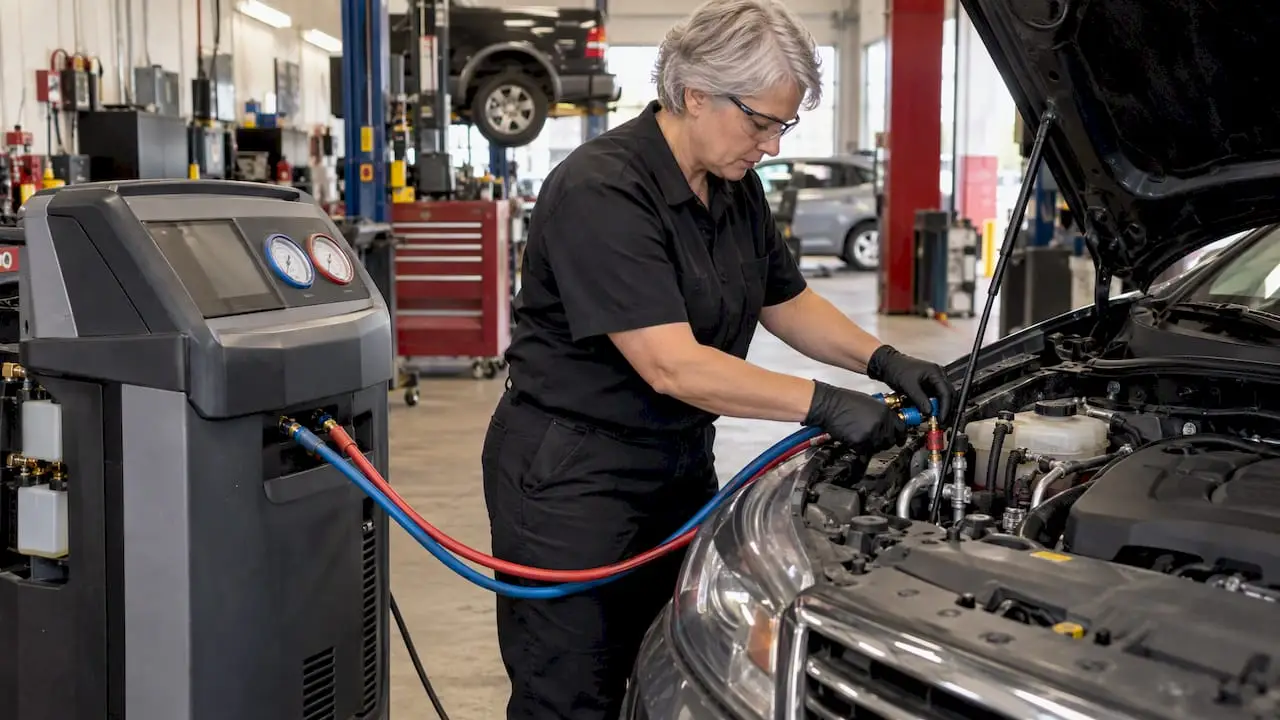
If the system is overcharged, the clean fix is to recover the refrigerant and recharge to spec. The EPA says evacuation and recharge removes the existing refrigerant and lets the technician add the precise amount the manufacturer recommends. That is the step a spray-can approach can’t match.
What damage can an overcharged A/C cause?
It depends on how long it runs and how severe the overcharge is. A/C Pro’s help page says an overcharged system can seriously damage the compressor or other components, and that a pressure cutoff switch may instead stop the compressor, which gives you warm air.
Think of the cutoff switch as a smoke alarm. It is annoying, but it is often the thing standing between you and a bigger bill. If your A/C keeps cycling off, don’t override it, and don’t keep adding refrigerant. Compressor replacement is a much larger job than a recovery and recharge. If you want to understand the stage after that, read about how compressors fail.
Other possible fallout includes stressed hoses and seals, and reduced efficiency that makes the engine work a little harder to turn the compressor. We won’t put numbers on any of that, because it varies by vehicle and by how far over the charge is.

What to do if you think your A/C is overcharged
Here is a practical sequence that keeps you safe and your wallet intact.
- Stop adding refrigerant. Whatever you did last, don’t repeat it.
- Note when the problem happens. Does the air go warm at idle and cool on the highway? Does it happen only in afternoon heat? That detail helps a technician a lot.
- Look at the obvious. Check that the condenser is not blocked by leaves or debris and that the radiator fans run when the A/C is on. Skip anything that involves opening the system.
- Don’t vent refrigerant. Releasing it is not a DIY fix. Recovery takes certified equipment, and the EPA’s MVAC program governs how service is done.
- Bring it in for diagnosis. The reference procedures say that a system that has been opened, or is excessively low from a leak, must be evacuated by recycling and a deep vacuum. Gloves and goggles are the minimum when anyone handles refrigerant, because it can cause frostbite-type injuries on skin and eyes.
If your clutch isn’t engaging at all, that is a related but different question. Our AC clutch checks article covers the basics of why that happens.
Our take: why we diagnose before we replace
We see the same story a few times each summer. A driver gets a weak A/C, grabs a can at a parts store, and adds until the cabin feels better for a day. Then the air goes warm at a red light on Highway 360, and the next stop is a repair shop that has to figure out what is in the system before touching anything.
Here is how we think about it. First, a charge is a measurement, not a feeling. Second, a pressure reading means nothing until you know the ambient temperature, the airflow across the condenser and what the compressor is doing. Third, recovering and recharging by the book costs less, in time and money, than guessing and replacing a compressor that was fine. Our ASE-certified technicians start with a look at the whole system, and our digital vehicle inspections include photos and videos, so you can see what we see before you decide.
We also don’t want to upsell you. If an A/C problem is simply a clogged condenser or a fan that isn’t turning, you should hear that, not get a recharge you don’t need.
— Express Lube & Car Care
A/C service at our Arlington shop
Our A/C and heating service handles diagnosis, recovery and recharge, and repairs from compressors to cooling components. Start at our A/C repair page or see everything we offer on the A/C and heating service page. Qualifying repairs carry our 24-month/24,000-mile warranty, and most jobs are done same day.

If a bigger repair is on the table, third-party financing through Snap Finance is available subject to provider approval and terms. You can read the details on our auto repair financing page.
Practical examples
Example 1: The stoplight cutout. A commuter on I-30 notices the air goes warm at long lights, then cools down at 60 mph. A shop finds the system took a full can on top of a partial charge. The likely path is recover, recharge to spec, and check condenser airflow.
Example 2: The recharge that didn’t last. A car leaves a quick-lube bay with cold air, then quits in the afternoon heat. Per MACS, an overcharge may not show in a low-heat-load setting, so the symptoms arrive later in the day.
Example 3: The false alarm. Both pressures read high, but the condenser fan isn’t spinning. Once the fan is fixed, readings drop. The charge was never the real issue, which is exactly why we diagnose first.
These are illustrations of how the diagnosis can go, not findings from specific customer vehicles.
Preventing an overcharge
- Look up your vehicle’s refrigerant type and capacity in the owner’s manual or on the under-hood label, rather than guessing.
- Don’t add refrigerant without knowing why it’s low. A system loses refrigerant slowly through a leak, not by using it up, so a top-off is a patch.
- Have service done on equipment that weighs the charge. The EPA’s point about precise evacuation and recharge is the reason.
- Ask what was recovered and what went back in after any A/C service. A good shop can tell you.
- Keep the front of the car clean. A condenser clogged with debris can mimic overcharge symptoms.
FAQ
Can too much refrigerant make the A/C blow warm air?
Yes. Excess refrigerant raises pressure on the high side, which reduces cooling and can trip the pressure switch that shuts off the compressor. The result is warm or weak air, often at idle or in heavy traffic. It can look the same as low refrigerant, so gauges are needed to tell them apart.
What pressure readings show an overcharged car A/C?
High readings on both the low and high side usually indicate overcharge, according to manifold gauge instructions from a tool maker. Exact numbers depend on the vehicle, refrigerant type and outside temperature, so we don’t give a universal figure. A technician compares the readings with the manufacturer’s specifications.
Can I just release some refrigerant to fix it?
No. Venting is not a safe or proper fix, and you won’t know how much you removed. The EPA explains that evacuation and recharge lets a technician add the manufacturer-specified amount precisely. Recovery needs proper equipment.
Can an overcharged A/C damage the compressor?
It can. An overcharged system can seriously damage the compressor or other parts, though a pressure cutoff switch may stop the compressor first and leave you with warm air. Running the A/C repeatedly in that condition is a bad idea.
Is a DIY recharge can safe for my car?
Cans work by pressure, which doesn’t tell you how much refrigerant is already in the system. That is how overcharges happen. If you suspect a problem, a diagnosis first is the safer path, and a professional recharge to the specified amount is the reliable one.
Get your A/C checked in Arlington
If your A/C cuts out in traffic, blows warm after a top-off, or sounds wrong, bring it to Express Lube & Car Care. We will check airflow, read the pressures, and tell you what we find before any parts are replaced. Schedule your A/C service online, call us at (682) 248-3416, or stop by 2105 Brown Blvd, Arlington, TX 76006. You can also learn more about us on our home page.
Sources
- MACS Recommended Service Procedures
- General Motors service bulletin PIT5292 (NHTSA)
- Options for Recharging Your Air Conditioner (U.S. EPA)
- Overcharging The A/C System (UnderhoodService)
- Overcharged A/C Systems (UnderhoodService)
- Manifold gauge set operating instructions (Mastercool)
- Spectra Premium Cooling Systems Tech Tip Guide
- Toyota Camry service manual, cooling
- A/C Pro FAQs
- AC System Diagnosis: A Step-by-Step Guide for Cars (Garage BRO)