
Becoming an ASE Master Automobile Technician means passing eight specific tests, A1 through A8, and documenting the required hands-on work experience for each one. There’s no separate “master exam” to sit for. Once you hold current certification in all eight areas and your experience is verified, ASE grants the designation automatically. You can bank passing scores for up to two years while you finish accumulating hours, which means the smart move is testing early and often, not waiting until everything lines up perfectly.
TL;DR:
- Passing all eight ASE A-series tests and verifying the required work experience are necessary to earn Master Automotive Technician status, but scores can be banked for up to two years.
- Most technicians take 4 to 24 months to complete all tests, starting with their strongest area to build momentum and spreading study time over several weeks per exam.
- Registration is handled online through myASE, requiring payment of fees and submission of experience documents, with tests scheduled at approved testing centers.
- Maintaining Master status requires active recertification of each certification before expiration, emphasizing the importance of tracking and staggering recert schedules.
- Effective study strategies include breaking down official task lists, using real work examples, and practicing under timed conditions to convert shop knowledge into exam performance.
Table of Contents
- What Tests Do You Need for ASE Master Technician Status?
- How Long Does It Take to Reach Master Status?
- How Do You Register and What Does Testing Cost?
- How Do You Keep Master Status Once You’ve Earned It?
- Which Study Tactics Actually Move the Needle?
- Does ASE Master Technician Status Actually Pay Off?
- How Express Lube & Car Care Supports ASE-Certified Technicians
- A Straight Take on What Certification Really Proves
- Want the Kind of Workmanship ASE Certification Is Supposed to Guarantee?
- Sources
- FAQ
What Tests Do You Need for ASE Master Technician Status?
Master status runs on eight tests. A9, the light vehicle diesel test, is not part of the requirement, even though technicians sometimes assume it is.
Here’s the full lineup you need to pass:
- A1 — Engine Repair: Cylinder heads, valve trains, engine block diagnostics, and lubrication systems.
- A2 — Automatic Transmission/Transaxle: Fluid diagnostics, torque converters, electronic controls, and in-vehicle repair.
- A3 — Manual Drivetrain and Axles: Clutches, transmissions, drive shafts, and differentials.
- A4 — Suspension and Steering: Alignment angles, steering systems, and suspension diagnosis.
- A5 — Brakes: Hydraulic systems, ABS, drum and disc components, and wheel bearings.
- A6 — Electrical/Electronic Systems: Wiring diagnostics, batteries, starting and charging systems, and body electronics.
- A7 — Heating and Air Conditioning: Refrigerant systems, compressors, and climate control diagnostics.
- A8 — Engine Performance: Fuel systems, ignition, emissions controls, and computerized engine controls.
Most of these tests demand two years of full-time, hands-on work experience, and qualifying vocational training can cover up to one year of that requirement. If you went through a formal automotive program, you’re likely closer to Master status than you think. And because ASE holds every passing score for two years, you don’t need to hit all eight requirements simultaneously. Pass what you can now, and let the experience clock catch up.
How Long Does It Take to Reach Master Status?
Realistically, most working technicians treat this as a multi-month to multi-year project, not a weekend cram session. The pace depends entirely on how much time you can carve out around a full shift schedule.
Start with the test that matches what you do every day. If you spend most of your shift on brake jobs, tackle A5 first. You already know the material cold, and an early win builds momentum for the tougher tests ahead.
A workable sequence looks like this:
- Pick your strongest area first. Bank a passing score within your first 2–4 weeks of focused study.
- Layer in adjacent systems next. If you started with brakes, move to suspension and steering, since the two subject areas overlap.
- Save the toughest conceptual tests for the middle of your plan, when you’ve built solid study habits and confidence.
- Finish with whichever test scares you most. By then, you’ll have a proven system for breaking down task lists into manageable chunks.
Plan roughly 2 to 4 weeks of study per test. Techs pushing hard can realistically finish all eight in 4 to 8 months. A more sustainable, paced approach, studying an hour or two a few nights a week, often stretches to 12 to 24 months. Both paths get you to the same certificate.
Pro Tip: Schedule your tests so certifications don’t all expire in the same year. Staggering your original test dates now saves you a brutal recertification crunch five years down the road.
How Do You Register and What Does Testing Cost?
Registration runs entirely through myASE, ASE’s online portal. Here’s what the process looks like:
- Create a myASE account and select which A-series tests you want to schedule.
- Pay the registration fee for your order, plus a per-test fee for each exam you add (specialty L-series tests typically run higher than standard A-series tests).
- Submit your work experience form once you’re ready. You can take tests before your experience is fully documented, but your certificate won’t issue until ASE approves that paperwork.
- Schedule your test date and testing center through the portal.
Each A-series test uses a set number of scored questions within a defined time limit, both spelled out in the official study guide for that specific test. Bring valid photo ID to the testing center. Spanish-language support and standard testing accommodations are available; check with your test center ahead of your appointment to confirm what’s offered at that location.
How Do You Keep Master Status Once You’ve Earned It?
Individual ASE certifications expire after a set period, and Master status requires all eight to be current simultaneously. Let one certificate lapse, even a single one, and you lose the Master designation until you recertify that area.
This is where a lot of technicians get tripped up. They passed everything years ago, never tracked expiration dates, and suddenly one certificate quietly expires while the other seven are still valid.
- Check myASE regularly to see exactly when each certification expires.
- Stagger your recert schedule rather than letting five certifications expire in the same calendar year.
- Set calendar reminders at the 90-day and 30-day marks before any expiration.
- Talk to your shop about recert windows, since many employers build testing time into slower seasons.
Which Study Tactics Actually Move the Needle?
Passing eight tests isn’t about cramming facts. It’s about converting real shop knowledge into exam-ready recall, and the technicians who do this fastest treat their study time the same way they’d treat a diagnostic job: systematically.
Start by breaking the official task lists for each test into weekly checklists. Instead of “study A6 electrical,” you might target “master starting system diagnostics” one week and “wiring diagram interpretation” the next. Track what you’ve mastered versus what still needs work.
- Run practice tests under actual time limits, not open-book review.
- After each practice run, sort missed questions by task area so you know exactly where the gaps are.
- Form a study group with two or three coworkers and quiz each other on real work orders you handled that week.
- Have someone “teach back” a diagnostic procedure out loud. If they can’t explain it clearly, that’s the topic to revisit.
On test day, triage. If a question stumps you, flag it and move on rather than burning five minutes on one line item. Check your remaining time at roughly the halfway point of the test, and leave the last stretch for flagged questions you skipped the first time through.
Pro Tip: Use real work orders from your own shop as case studies. Recalling an actual diagnostic sequence you performed last month sticks far better than memorizing a textbook scenario you’ve never touched.
Does ASE Master Technician Status Actually Pay Off?
ASE certification is recognized across the industry, and it travels with you between shops in a way that shop-specific training never does. According to Bureau of Labor Statistics and industry wage data, certified technicians generally see better pay potential and stronger job mobility than uncertified peers, though the exact difference varies by market, employer, and specialization.
Master status also opens doors beyond the diagnostic bay:
- Diagnostics lead, handling the shop’s toughest come-back and no-start cases.
- Shop foreman, overseeing job flow and quality control across a service team.
- In-house trainer or mentor, guiding newer techs through their own ASE certification path.
From there, many Master techs pursue L-series specialty certifications, ADAS calibration training, or manufacturer-specific programs, each one adding a layer of specialization that tends to translate into higher earning potential over time.
How Express Lube & Car Care Supports ASE-Certified Technicians
Our technicians hold ASE certifications, and we’re recognized as a RepairPal Certified Shop and a CarFax Top-Rated Service Center. That recognition doesn’t happen by accident; it comes from scheduling that respects study time, mentorship between senior and junior techs, and a shop culture that treats certification as a career investment, not a checkbox. If you’re a technician exploring training partnerships, or a driver curious about who’s under your hood, we’re glad to talk.
A Straight Take on What Certification Really Proves
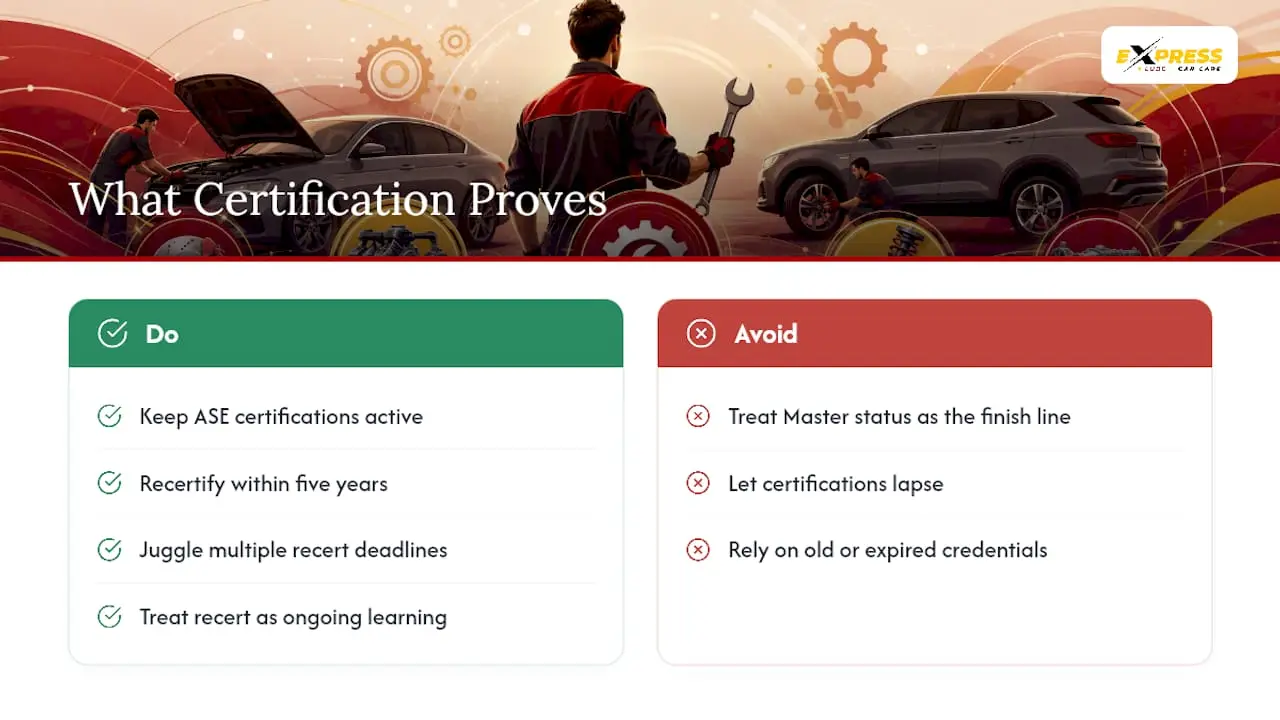
We’ve watched plenty of technicians treat ASE Master status like a finish line instead of what it actually is: a snapshot of current, verified competency across eight systems. The conventional wisdom is that once you’re a Master Tech, you’ve “made it.” That’s backwards. The credential that matters most isn’t the one framed on the wall from six years ago. It’s the one still active today.
That’s precisely why the five-year expiration rule exists, and why the technicians who take it seriously outperform the ones who don’t. Vehicles change fast. Engine performance systems, electrical architecture, and diagnostic tools look nothing like they did a decade ago, and a lapsed certification is a quiet signal that someone’s knowledge may have stalled too. We’d rather see a technician actively juggling three recert deadlines than one who passed everything once and never looked back. The juggling is the point. It’s proof the learning never stopped.
Want the Kind of Workmanship ASE Certification Is Supposed to Guarantee?
Certification tells you a technician has proven competency across specific systems. What it doesn’t tell you is whether that knowledge shows up consistently on your actual vehicle, every visit, every time. That’s the gap Express Lube & Car Care is built to close for drivers across the DFW area.
Our ASE-certified technicians handle everything from diagnostics and engine performance work to routine oil changes and preventive maintenance, backed by digital vehicle inspections so you see exactly what we see. Every repair comes with a 24-month/24,000-mile warranty, giving you a documented safety net most independent shops simply don’t offer. Whether your check-engine light just came on or you’re overdue for a maintenance check, book an appointment with Express Lube & Car Care and get the kind of thorough, transparent service that certification is supposed to represent.
FAQ
What Does ASE Master Technician Mean?
It means a technician holds current certification in all eight A-series tests (A1 through A8) and has met the documented work experience requirement for each one, verified through ASE’s work experience process.
How Long Does It Take to Become an ASE Master Mechanic?
Timelines vary widely, but working technicians typically finish somewhere between 4 months on an accelerated schedule and up to two years on a more gradual, paced study plan.
How Many ASE Tests Do You Need to Be a Master Technician?
You need eight: A1 through A8. The A9 light vehicle diesel test is not required for Master Automobile Technician status.
What Is the Hardest ASE Test to Pass?
Difficulty varies by technician and daily experience, but techs commonly cite A8 (Engine Performance) and A6 (Electrical/Electronic Systems) as challenging because both demand strong diagnostic reasoning rather than straightforward component knowledge.
Can You Take ASE Tests Before You Have Enough Work Experience?
Yes. You can take and pass tests before your experience requirement is complete, and ASE holds that passing score for up to two years, but your certificate isn’t issued until your work experience form is approved.