
If your AC blows cool on the highway but turns warm at a red light, the cause is almost always weak airflow across the condenser, a low refrigerant charge, or a compressor that struggles at low engine speed. At idle, your car has to cool the system with far less moving air. Anything marginal shows up fast. The fix depends on which of those is actually behind it, and that takes a proper diagnosis, not a guess.
If you sit in stop-and-go traffic on I-30 or Highway 360 during an Arlington summer, you know exactly how this feels. Let’s walk through what is going on under the hood and what to do about it.
TL;DR
- AC that warms up at idle but cools while driving usually points to condenser airflow (a weak cooling fan or a clogged condenser), low refrigerant, or a tiring compressor.
- Check the cabin air filter and look for obvious debris up front. Leave anything involving refrigerant to a certified technician.
- A refrigerant can is not a safe shortcut. Needing frequent recharges usually means a leak, and overcharging can damage the system.
- If the temperature gauge climbs while you idle with the AC on, pull over safely. That is an engine cooling problem, not just an AC problem.
- A diagnosis that measures pressures, checks fan operation and reads fault codes costs less than replacing parts by trial and error.
Table of Contents
- Why does AC blow warm at idle but get cold while driving?
- What causes AC to blow warm at idle?
- Quick guide: what the symptom usually points to
- What you can safely check yourself
- Why a refrigerant can is not the fix
- What a proper diagnosis looks like
- Is it normal for the car to overheat at idle with the AC on?
- When warm AC at idle needs prompt attention
- Our perspective
- Get your AC checked in Arlington
- How to keep AC performance strong in stop-and-go driving
- FAQ
- Sources
Why does AC blow warm at idle but get cold while driving?
Your AC works by moving heat out of the cabin and dumping it at the condenser, the radiator-like part at the front of the car. When you drive, air rushes through it for free. At a stoplight, that free airflow disappears. The cooling fan has to do all the work, and the compressor is also turning slowly.
An automotive expert quoted by CBS News Baltimore explains that compressor performance is not at its peak at low speeds, idle or stoplights, and that debris built up in the condenser can make low-speed performance worse. The same expert treats cooling that improves as road speed rises as a clue pointing to low-speed limits and restricted condenser airflow.
That is why the pattern matters so much. A system that is perfectly healthy can cool well at idle. A system with a small problem often cools fine at 60 mph and gives up at 0 mph. Think of it as an early warning, like sending up a flare before the AC quits entirely.
What causes AC to blow warm at idle?
Here are the usual suspects, roughly in the order a technician would look at them.
A weak or non-working condenser fan
The radiator or condenser fan pulls air through the front of the car when you are not moving. If it runs slowly, runs intermittently or does not run at all, the condenser cannot shed heat and the vent air warms up. A Toyota bulletin from 2012 documents a model-specific case where the AC stopped working and engine temperature rose while the vehicle was stopped, because the radiator cooling-fan blades or motors needed inspection and replacement.
Sometimes a fan problem is more than a comfort issue. A recall document for certain 2004 to 2006 Infiniti QX56 vehicles describes condenser-fan motor defects that could cause inadequate cooling and, in some cases, melting wiring insulation with a fire risk. That is one model, but it shows why a fan that misbehaves deserves attention rather than patience.
A dirty or blocked condenser
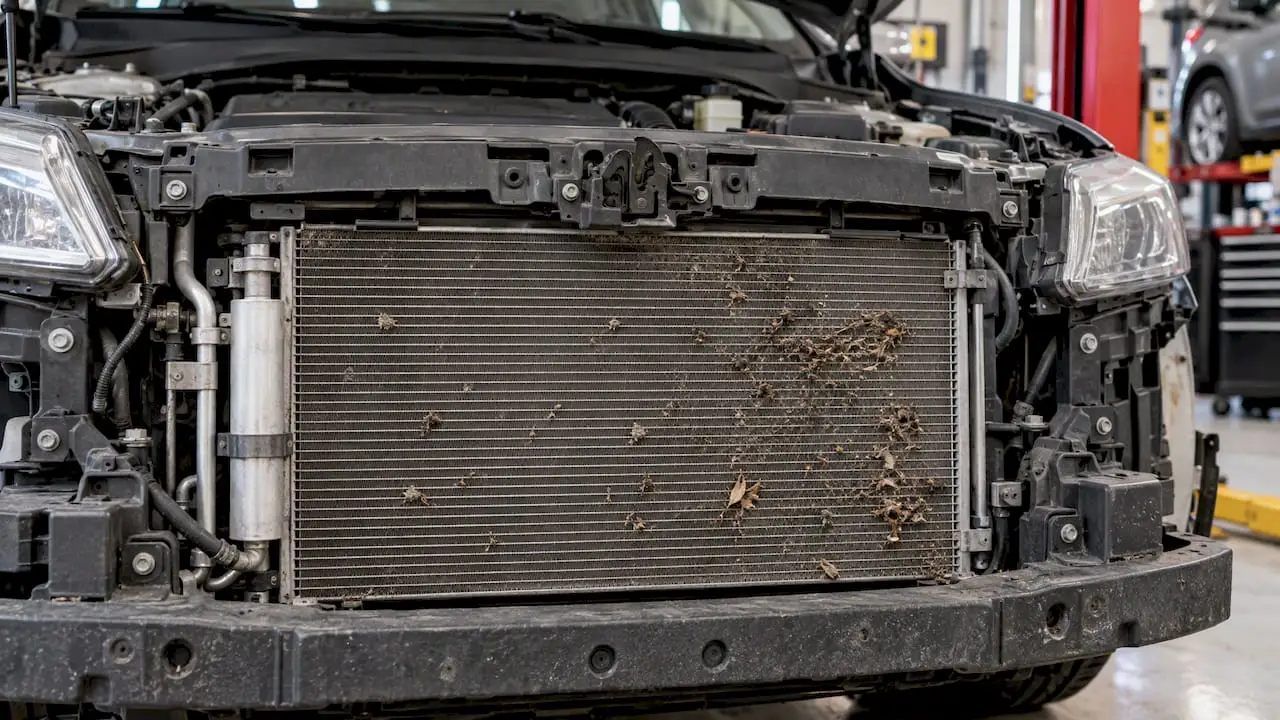
The condenser sits right behind the grille, so it collects bugs, leaves, road grit and plastic bag fragments. Bent fins do the same job as debris: they block air. When airflow is restricted, the condenser cannot release heat at idle, the pressure in the system climbs and cooling drops. Having a mechanic keep the condenser clear of bugs and debris is part of the upkeep that CBS Baltimore’s expert recommends.
Low refrigerant from a small leak
Refrigerant is not consumed like gasoline. AAA Club Alliance notes that frequent recharging is commonly a warning of leaks at hoses, seals, O-rings, condensers or service ports. Low charge also reduces compressor-oil circulation, which increases wear. A system that is a little low may cool acceptably while you drive and fall apart at idle.
Finding the leak is its own job. AAA’s article says diagnosis may require UV dye, electronic leak detection and pressure testing. We cover that process in more detail in our guide to AC leak detection.
A weakening compressor or compressor control problem
The compressor is the heart of the system. When it is worn, it may keep up at higher engine speeds and fall behind at idle. Warm air plus odd noises is a classic combination, and we explain the signs in our article on AC compressor failure symptoms.
There are also control-side causes. A 2023 BMW service bulletin filed with NHTSA describes AC cycling between cold and warm, while driving or stopped, with vent temperatures swinging by at least 25°F, caused by debris obstructing the compressor control valve. Your car may not be a BMW, but the lesson applies: intermittent cooling has more than one possible source.
Pressure-driven shutdown in heavy traffic
Another BMW bulletin explains that repeated stop-and-go or high-load driving can reduce AC output or switch the compressor off when fan control or fan hardware is inadequate, because excessive refrigerant-circuit pressure triggers compressor shutdown. This is the protective logic built into many systems. It means the compressor is shutting itself off to avoid damage, and the real fault is that heat is not leaving the condenser.
Sensors, software and electrical faults
Sometimes the mechanical parts are fine and the controls are not. A Toyota bulletin for certain 2014 to 2015 Corollas covers intermittent warm AC at idle and tells technicians to confirm specified regulator-current, pressure-sensor and evaporator-thermistor behavior before replacing the updated compressor. A Ford bulletin for certain 2016 to 2017 F-650 and F-750 trucks says the compressor was being intermittently disabled, and the specified correction was reprogramming the engine computer. These are model-specific, but they show why measuring beats replacing.
Quick guide: what the symptom usually points to
This table is a starting point for conversation with your technician, not a diagnosis.
| What you notice | Area to look at first | Who should handle it |
|---|---|---|
| Cold on the highway, warm at lights | Condenser fan, condenser debris | Checks by eye are fine; fan and repair by a technician |
| Cool, then warm, then cool again | Low charge, compressor control, sensors | Technician with gauges and scan tool |
| Weak airflow from vents at all speeds | Cabin air filter, blower | You can start with the filter |
| Grinding or squealing when AC is on | Compressor, clutch, belt | Technician, soon |
| Gauge climbs while idling with AC on | Engine cooling system | Technician; stop driving if it reaches the red |
| AC needs a recharge every few weeks | Leak | Technician with leak detection |
What you can safely check yourself
You do not need to be a mechanic to gather useful clues. Kelley Blue Book’s AC diagnostics guide suggests starting with the cabin air filter and the related fuses and relays, and it warns that AC systems hold highly compressed refrigerant, so take the car to a mechanic if diagnosis or repair feels unsafe.
Here is a sensible short list:
- Swap or inspect the cabin air filter. A clogged one can cut airflow noticeably. CBS Baltimore reports that replacing it at least annually can prevent a significant airflow reduction.
- Look through the grille with a flashlight. With the engine off, see whether the condenser is packed with leaves, bugs or road debris. Do not poke at fins with sharp tools, since they bend easily.
- Watch the fan with the engine running and AC on. In a safe, parked position, with hands and loose clothing well clear, see whether a fan is turning at the front of the engine bay. Never reach near moving fan blades or belts.
- Note exactly when it happens. This one is gold. Does it warm up after ten minutes in traffic? Only on 100-degree afternoons? Only when stopped, not when rolling slowly? Vehicle Service Pros makes the point in a case on intermittent AC problems: AC may work under some conditions and fail after small changes in ambient temperature or driving conditions, so the details you provide matter.
- Watch the temperature gauge. More on that below.
If the compressor clutch is not engaging at all, our AC clutch checks guide walks through simple first steps. Then stop and call a shop when the list runs out.
Why a refrigerant can is not the fix
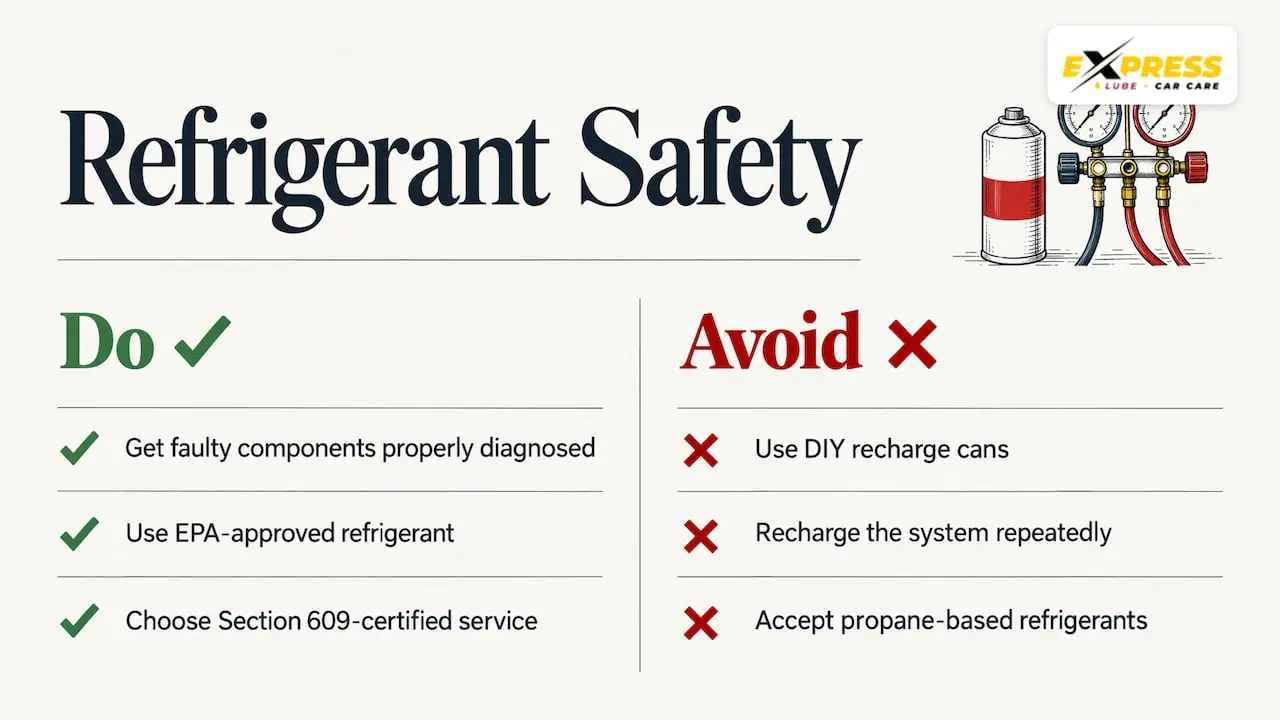
It is tempting to grab a recharge can at the parts store. Resist that. A recharge is not a universal fix: AAA Club Alliance’s Dax Haak says faulty components and electrical problems require proper diagnosis, and frequent recharging is a red flag for a leak. CBS Baltimore also warns that DIY refrigerant cans can overcharge or damage the system. Overcharging is especially relevant to idle problems, since too much refrigerant raises pressure and makes the condenser’s job even harder. HELLA’s technical guide lists a defective condenser fan, a contaminated condenser, engine overheating and system overcharge among the causes of high pressure and warm vent air.
There are legal and safety angles too. The EPA says refrigerant must be EPA-approved and may not be intentionally vented, and that paid servicing of vehicle AC systems requires Section 609 certification and approved refrigerant-handling equipment. The EPA also says hydrocarbon refrigerants such as propane are highly flammable, unacceptable for vehicle AC systems and may create fire or explosion risks. If someone offers a cheap “special” refrigerant, say no thanks.
Our article on what to say to avoid a refill rip-off gives you the right questions to ask at any shop.
What a proper diagnosis looks like
Good AC diagnosis is detective work, not part swapping. According to Vehicle Service Pros, it uses scan-tool codes and data, plus pressure and temperature testing, and a large fan can supply condenser airflow during testing. The BMW procedure mentioned earlier is a good model of the thinking: it has technicians check the compressor belt and pulley, pull climate-control fault codes, evaluate evaporator-temperature data, check refrigerant quantity and leaks, and rinse contaminated components where needed. That is a structured process, not an automatic recharge.
Gauge readings tell a story, too. HELLA associates low pressure on both sides with insufficient refrigerant, and equalized low-side and high-side pressures with low refrigerant, compressor failure or an electrical fault. High pressure points toward the airflow and heat-rejection problems described above.
A typical visit for this complaint might include:
- A conversation about when and how the problem shows up
- A visual check of the condenser, fans, belt and hoses
- Pressure readings with the engine at idle and at raised rpm
- A scan for climate-control and engine codes
- Leak detection if the charge is low
- A written estimate before any repair, so you decide what happens next
At Express Lube & Car Care, our ASE-certified technicians use digital vehicle inspections with photos and videos, so you can see what we see.

Is it normal for the car to overheat at idle with the AC on?
A small bump in engine temperature is expected, because the compressor adds load to the engine. AutoZone explains that a slight rise can be normal, but real overheating can indicate a cooling-system deficiency such as low coolant, a bad water pump, a blocked radiator or a slipping belt.
So what counts as real overheating? If the gauge heads to the red, treat it seriously. A Honda owner’s manual says a gauge at the red mark can seriously damage the engine, and instructs drivers to pull over, turn off accessories and stop the engine if the gauge stays at red or steam is present. Follow your own owner’s manual for your vehicle.
If your AC warms up and the gauge rises together, the engine cooling system is likely part of the story. Our radiator and cooling system service page explains what we inspect.
When warm AC at idle needs prompt attention
Do not wait it out if you notice any of these:
- Grinding, squealing or rattling when the AC turns on
- The temperature gauge climbing at idle
- A burning or electrical smell, or smoke
- Cooling that gets worse week by week
- Refrigerant top-offs needed again and again
Bosch Mobility Aftermarket expert Steve Haney, quoted by AAA Club Alliance, advises against letting poor AC performance persist, because unattended faults can become more expensive. A fan problem caught early is a simple repair. A compressor that ran low on oil for a whole summer is a different story.
Our perspective
We see this complaint most often when Arlington traffic slows to a crawl and the afternoon heat settles in. Customers usually tell us the same thing: it was fine on the freeway and then quit at the light.
Our view is simple. Warm air at idle is a clue, not a verdict. Before we recommend any part, we want to know what the system is actually doing: pressures, fan operation, codes and leaks. That is why we perform digital vehicle inspections with photos and videos, so you can see the findings and decide with confidence.
We would rather fix the real cause once than recharge a system three times. Our ASE-certified technicians handle everything from AC service to cooling system, electrical and engine work, so when the AC problem turns out to be a fan, a belt or a coolant issue, it is handled under one roof. Qualifying repairs are backed by our 24-month/24,000-mile warranty.
Express Lube & Car Care
Get your AC checked in Arlington
If your AC warms up in traffic, our A/C and heating repair service starts with a proper diagnosis, so you know the cause before you approve a repair. We also take fleet vehicles and daily commuters, and most jobs can be done the same day.

You can see everything we do on our services page or learn more about us on our home page. Call us at (682) 248-3416 with questions.
How to keep AC performance strong in stop-and-go driving
A little prevention goes a long way in North Texas heat.
- Replace the cabin air filter on schedule. Use the interval in your owner’s manual, and replace it sooner if you drive on dusty roads.
- Keep the condenser clean. Ask for a visual check of the front of the condenser whenever your car is in for service.
- Check coolant and the cooling system before summer. The National Highway Traffic Safety Administration recommends checking AC performance and the cabin air filter before travel, and checking the cooling system for adequate manufacturer-specified coolant and leaks.
- Run the AC regularly. Do not wait for the first 100-degree day to find out something is wrong. Test it in spring.
- Act on small changes. A slightly warmer vent today is cheaper to fix than a failed compressor in August.
- Follow the manufacturer’s maintenance schedule. Service intervals vary by vehicle, so your owner’s manual is the authority, not a rule of thumb.
FAQ
Why is my car AC not cold when I idle?
At idle there is little airflow over the condenser, and the compressor spins slowly. If a fan is weak, the condenser is dirty, the refrigerant charge is low or the compressor is worn, cooling suffers most when you are stopped. A technician can tell which one by measuring pressures and checking fan operation.
Why does my car AC warm up when I stop but cool when I move?
Moving air does some of the condenser’s work for it. When you stop, the fan has to take over completely, so a weak fan or restricted condenser shows up right away. Low refrigerant can show the same pattern, which is why measurement matters more than guessing.
Is it normal for a car to overheat while idling with the AC on?
The AC adds some load, so a slight temperature rise can be normal. A gauge that climbs toward the red is not. Pull over safely, shut the engine off and follow your owner’s manual, then have the cooling system inspected.
Can I fix warm AC with a store-bought refrigerant can?
It is not a good idea. A can cannot find a leak, fix a fan or repair a compressor, and overcharging can raise pressures and damage the system. If the AC keeps needing refills, that points to a leak that needs proper detection and repair.
Should I be worried if the AC is cold, then warm, then cold again?
It deserves a check. Intermittent cooling can come from low charge, debris, a compressor control problem or a sensor or electrical fault. Write down when it happens and share that with your technician, since those details speed up diagnosis.
If your AC is losing its cool at idle, schedule service with us at Express Lube & Car Care at 2105 Brown Blvd, Arlington, TX 76006. You can request an appointment online or call (682) 248-3416, and we will find out what is really going on before you spend a dime on parts.
Sources
- CBS News Baltimore: How to maintain your car’s AC
- BMW service bulletin, 2023 (NHTSA)
- BMW service bulletin, 2014 (NHTSA)
- Toyota bulletin SB-10061714 (NHTSA)
- Toyota bulletin SB-10061660 (NHTSA)
- Ford technical service bulletin, 2016 (NHTSA)
- Infiniti QX56 recall document (NHTSA)
- Vehicle Service Pros: Addressing an intermittent A/C issue
- AAA Club Alliance: Is your car’s air conditioner trying to tell you something?
- HELLA: Air-conditioning service
- Kelley Blue Book: DIY automotive air conditioning repair and diagnostics
- EPA: Regulatory requirements for MVAC system servicing
- EPA: Safety risks of using hydrocarbons in motor vehicle air conditioners
- AutoZone: Why does your car overheat when the AC is on?
- Honda owner’s manual: If your engine overheats
- NHTSA: Summer driving tips