
If your car starts fine one morning and refuses the next, the cause is usually in the starting circuit: a weak battery, a loose or corroded connection, a failing starter or relay, or a charging problem. Fuel and ignition faults can also do it. The pattern matters more than the symptom itself. How the car sounds when it fails tells you which part of the system to test first.
That’s good news, because an on-again, off-again problem feels random, and it rarely is. Something is marginal, and it only fails when heat, vibration, moisture or a low charge push it over the edge. Let’s break down what to watch for, what you can safely check in a parking lot, and why a proper diagnosis beats swapping parts.
TL;DR
- Intermittent no-starts almost always trace back to the battery, its connections, the starter or relay, or the charging system. Fuel and ignition faults are the other main suspects.
- Listen first. Rapid clicking, a single click, a slow groan, and total silence each point to a different component.
- A battery that starts the car 9 times out of 10 can still be failing. Batteries generally last 3 to 5 years, and Texas summers are hard on them.
- Don’t replace parts by guesswork. Testing the battery, starter circuit and alternator is how a shop finds the actual fault.
- If you’re in Arlington, call us at (682) 248-3416 or book an appointment online.
Table of Contents
- Why Does a Car Start Sometimes and Not Others?
- Read the Symptom: What the Sound Tells You
- The Battery: The Usual Suspect, and Often the Sneaky One
- Starter, Solenoid and Relay Problems
- Connections, Grounds and Wiring
- When the Engine Cranks but Won’t Fire
- Safe Checks You Can Do Before Calling a Shop
- Why Diagnosis Beats Guessing
- Our Perspective: What We See When Cars Come In Hesitating
- Getting It Checked in Arlington
- FAQ
- Book a Starting and Charging Diagnosis
- Sources
Why Does a Car Start Sometimes and Not Others?
A starting system needs four things to line up: enough electrical power, clean connections to deliver it, a starter that engages, and the signals that tell the engine to fire. If any one of them is borderline, the car works until conditions shift.
Common triggers for the “sometimes” part:
- Temperature. A hot starter or a weak battery can behave differently after a long drive than on a cold start.
- Vibration. A loose terminal or ground strap can make contact on a smooth road and lose it after a bump.
- Moisture. Corrosion on a terminal can bridge or break a connection depending on humidity.
- State of charge. A battery that is just barely able to start the engine will fail the day after a few short trips or a night with the dome light left on.
The tricky part is that the car often passes every simple check when it’s working. That’s why the clue you collect during a failure is so valuable.
Read the Symptom: What the Sound Tells You
The next time it fails, don’t just keep turning the key. Take 30 seconds to notice what happens. Then compare with this chart.
| What you notice | What it often points to | What a shop checks |
|---|---|---|
| Rapid clicking, dash lights dim or flicker | Low battery charge or a poor battery connection | Battery load test, terminal and cable condition, voltage during cranking |
| One loud click, then nothing | Starter motor or solenoid fault, or a weak connection in the starter circuit | Voltage at the starter during a failed attempt, starter wiring and mounting |
| Slow, labored crank | Aging battery, corroded cables, or a tired starter | Battery test, voltage drop across cables, starter draw |
| No click, no crank, dash lights normal | Starter relay, ignition switch, neutral safety or clutch switch, or an anti-theft issue | Relay and switch testing, security system check |
| Engine cranks normally but won’t fire | Fuel delivery, ignition, crankshaft sensor or immobilizer problem | Scan for codes, fuel pressure, spark and sensor signals |
| Dash and interior lights dead, nothing happens | Fully discharged battery or a loose main connection | Battery state, terminals, grounds, charging system |
Treat this as a starting point, not a verdict. Several of these overlap, and a shop will confirm with test equipment before recommending anything.
The Battery: The Usual Suspect, and Often the Sneaky One
AAA calls dead batteries by far the most common cause of a car that won’t start. It also points out that the harder question is why the battery is dead. Sometimes the battery is simply old. Sometimes something else isn’t charging it.
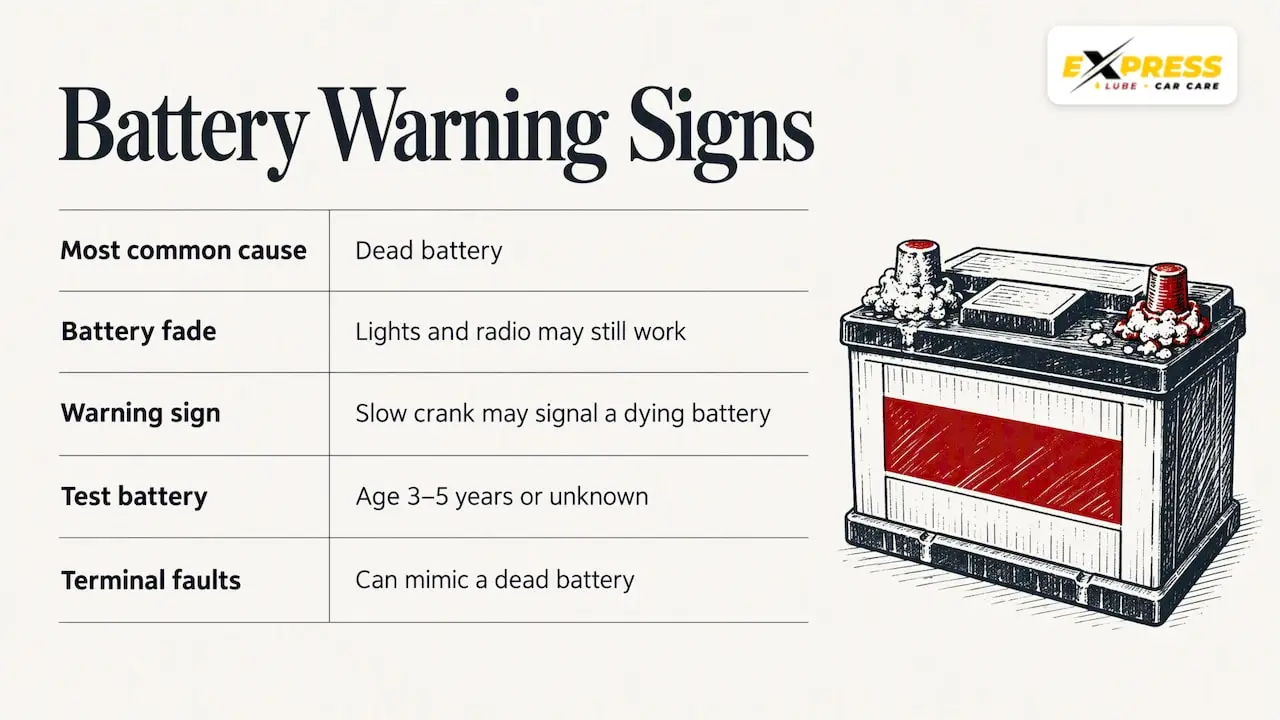
What makes batteries tricky for intermittent problems is that they fade gradually. A weakened battery can run your lights and radio perfectly well while lacking the muscle to turn a cold engine. AAA notes that a struggling, slow crank can be a sign of a dying battery and says to get it checked as soon as possible.
Arlington drivers have one more thing to think about. Long stretches of summer heat are tough on batteries, and a battery can limp along until the first cool snap or a few days of short trips finally exposes how weak it has become. If yours is in the 3 to 5 year range, or you can’t remember when it was replaced, testing it is cheap insurance. If you want a second look at the warning signs, this rundown of the signs your battery needs replacing is a good companion to the chart above.
Batteries also fail because of what’s attached to them. Loose, dirty or corroded terminals can mimic a dead battery completely. We cover simple habits that help in our guide to battery maintenance that prevents breakdowns.
Battery or Alternator?
The two get confused constantly. The battery starts the car. The alternator recharges the battery while the engine runs and supplies power to the lights and stereo. If the alternator weakens, the battery slowly drains, and you get a car that starts fine for a week and then doesn’t.
AAA lists these hints that the alternator may be the problem:
- Dim or flickering headlights
- A stereo that sounds weak or cuts out
- A battery warning light on the dashboard
If you’ve seen the battery light, read what the battery light means and what to do before your next long drive. A new battery installed on a failing alternator will just die again, which is why testing both together matters.
Starter, Solenoid and Relay Problems
When the battery is healthy and the car still hesitates, the starter system is next. The starter motor spins the engine, a solenoid pushes its gear into place and closes the high-current circuit, and a relay or ignition switch tells it all to begin.
Typical intermittent behavior:
- A single click and silence. The solenoid is trying, but either the motor is worn or not enough current is arriving. Tapping the starter with a tool is an old trick that sometimes works once. It is a sign the starter is on its way out, not a repair.
- Starts after several tries. Worn internal contacts can leave dead spots, so the starter works only when it stops in the right position.
- Nothing at all, with lights working. This can be a relay, switch or wiring issue rather than the starter itself.
One ranked forum thread on the topic mentions loose starter mounting bolts as a possible cause, and that’s the kind of thing a visual inspection catches. For more on what’s involved in replacing one, see our overview of starter repair.
Two cautions. Repeated cranking attempts can overheat the starter and drain the battery further. And a bad starter can itself pull a battery down, so don’t assume one fault at a time.
Connections, Grounds and Wiring
A surprising share of intermittent no-starts aren’t failed parts at all. They’re resistance in the path. Starting an engine pulls a big surge of current, and a corroded terminal, a frayed ground strap or a loose connector at the starter can choke it off.
Signs to look for:
- White, green or crusty buildup around the battery posts
- Cable ends you can wiggle by hand
- Cables that look swollen, cracked or discolored
- Problems that show up after hitting bumps or after rain
This is where professional tools earn their keep. A voltage-drop test measures how much power is lost across a cable or connection while the engine is cranking, and it finds faults a quick visual check will miss. ASE’s starting system webinar lists the same chain of components a technician reviews: battery, starter motor, solenoid, relays, ignition switch and the related wiring.
When the Engine Cranks but Won’t Fire
If the engine turns over normally and just doesn’t catch, the problem has shifted away from the electrical supply. Now we look at the ingredients of combustion: fuel, spark and the signals that time them.
Possible causes include:
- A fuel pump or relay that fails intermittently
- A crankshaft or camshaft position sensor that drops its signal when hot
- Ignition components such as coils or the ignition switch
- An anti-theft or immobilizer fault, often with a security light that stays on or flashes
A check engine light, even one that comes and goes, is a valuable clue here. Stored trouble codes can point a technician at the right circuit. Don’t ignore a light just because the car eventually started.
Safe Checks You Can Do Before Calling a Shop
You don’t need tools for most of these. Do them with the engine off and the parking brake set.
- Note the symptom. Click, crank, silence, or crank without start. Write it down, along with whether the engine was hot or cold.
- Check the dash lights. If they dim hard or go out when you turn the key, suspect battery or connection.
- Look at the battery posts. Corrosion or loose clamps are visible without touching anything.
- Try the car in neutral (automatic). A neutral safety switch fault can block starting in park.
- Watch for the security light. A flashing key or lock icon points toward an immobilizer issue.
- Consider a jump start. If the car starts right away on a jump and then dies later, the battery or charging system is a prime suspect. AAA’s guide explains how to jump a battery safely.
Safety first: don’t work around the engine bay with the engine running if you’re unsure, keep hands and loose clothing clear of belts and fans, and never keep cranking a car that smells of burning or smokes. If you smell fuel, see smoke, or the symptoms are paired with a stalling engine on the road, stop and call for help.
Why Diagnosis Beats Guessing
Parts swapping is expensive and frustrating with intermittent problems. Replace a battery when the real problem is a corroded ground, and you’ll be stranded again in a month. Replace a starter when the relay is the culprit, and you’ve paid for a part you didn’t need.
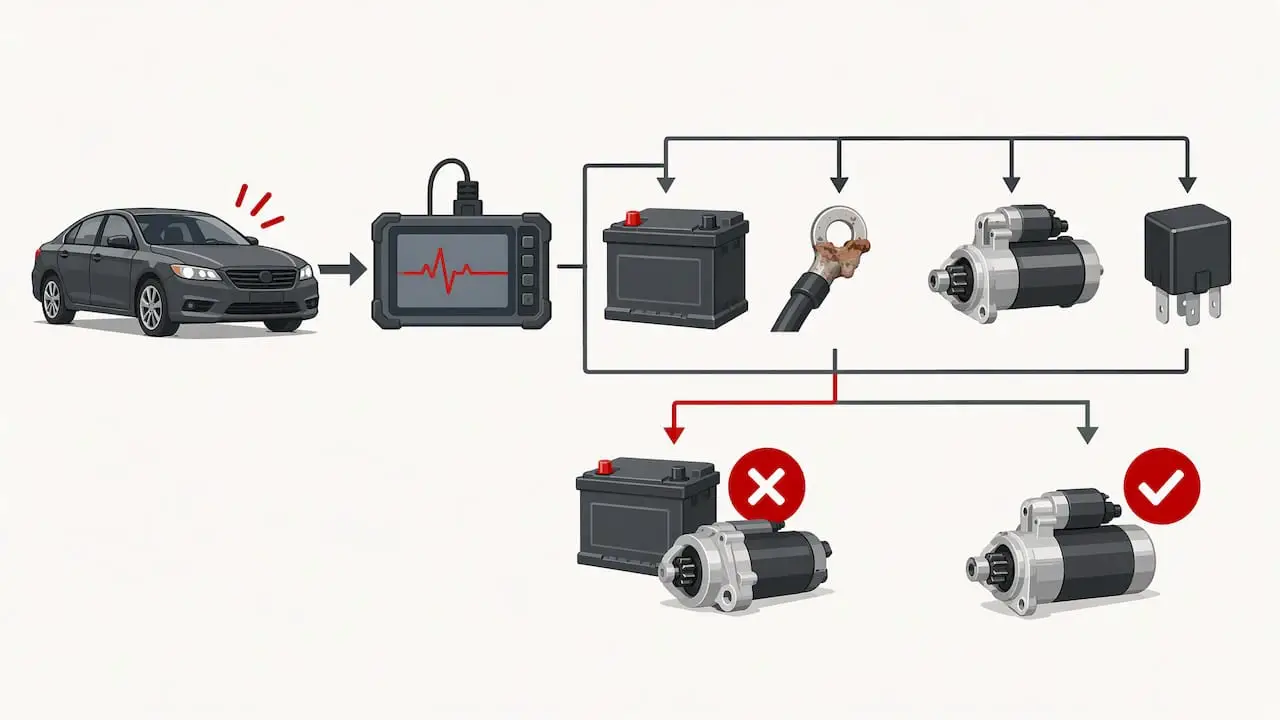
ASE’s study guides describe the sensible workflow: verify the customer’s concern, research the vehicle’s service information, then test before deciding on the repair. For tricky ones, ASE’s L1 guide emphasizes using diagnostic procedures based on available vehicle data and service information.
In practice, a good intermittent-start diagnosis includes:
- A battery load test and a check of charge state
- Inspection and testing of terminals, cables and grounds
- A charging system test on the alternator
- Starter circuit testing during a start attempt
- A scan for stored codes and, if needed, fuel and ignition checks
Because the fault comes and goes, it helps to tell the technician everything you’ve noticed. “It fails after I fill up the tank on hot afternoons” is a gold-plated clue.
Our Perspective: What We See When Cars Come In Hesitating
We’re a full-service repair shop, not only an oil change stop, and starting complaints are a good example of why that matters. A customer comes in saying the car “sometimes won’t start,” and the answer could be a battery, a cable, a starter or something deeper in the electrical system. Our ASE-certified technicians work through the starting and charging system in order rather than reaching for the most expensive part first.
We also use digital vehicle inspections with photos and videos, so if we find a corroded terminal or a leaking component, you can see exactly what we saw. That matters when the repair is not obvious from the driver’s seat.
Our advice is simple. If the car has failed to start even once, don’t wait for the day it fails on I-30 or Highway 360 in rush hour. Intermittent faults rarely heal themselves, and they tend to get more frequent.
— Express Lube & Car Care
Getting It Checked in Arlington
Whether you commute along Brown Boulevard, work in North Arlington, or run a fleet of vans, a car that doesn’t start reliably is a problem that costs time. We handle battery, alternator, starter and wiring diagnosis, plus the repair when one is needed. You can see the range on our services page, or visit our home page for more.
If you need a repair, qualifying work is backed by our 24-month/24,000-mile warranty. Most jobs are done the same day, though we’ll tell you up front if your car needs more time.
FAQ
Why does my car not start sometimes?
Usually because a part in the starting system is marginal. The most common culprits are an aging battery, corroded or loose terminals, a worn starter or solenoid, a failing relay, or a weak alternator that isn’t keeping the battery charged. Because the problem comes and goes, testing the whole system is the fastest way to find it.
My car won’t start but the dashboard lights work. What’s wrong?
Full dash lights only tell you the battery has enough power for small loads. Starting needs far more current, so a weak battery, a bad connection, a starter fault or a relay or switch problem can still prevent cranking. Note whether you hear a click, and try the car in neutral if it’s an automatic.
Why does my starter click but not crank?
Rapid clicking often means the battery is too weak or a connection is poor. A single click can mean the starter motor or solenoid is failing or isn’t receiving enough current. A technician should test voltage at the starter during a failed attempt before replacing anything.
Can a bad starter drain the battery?
Yes, it can. A failing starter may draw more current than it should, and repeated cranking attempts will run a battery down quickly. That’s why we test both the battery and the starter circuit instead of assuming only one is at fault.
Is it safe to keep driving if the car only fails to start occasionally?
It’s a gamble. If the problem is the battery or charging system, the car could stall or strand you at an inconvenient moment. If the car stalls while driving, or you see a battery warning light, get it inspected promptly.
Book a Starting and Charging Diagnosis
If your car has been turning into a guessing game each morning, let’s find out why. Call Express Lube & Car Care at (682) 248-3416, stop by 2105 Brown Blvd, Arlington, TX 76006, or schedule your visit online. Tell us what you’ve noticed, and we’ll start from there.
Sources
- 14 Reasons Why Your Car Won’t Start, AAA Automotive
- Top Reasons My Car Won’t Start, AAA Club Alliance
- Dead Battery Vs. Bad Alternator, AAA
- How to Jump a Battery, AAA Automotive
- Automotive Starting System Troubleshooting Essentials webinar, ASE
- ASE Automobile Tests study guide
- ASE Advanced Engine Performance Specialist (L1) study guide